A friend came by the other day and said "Let's go to the Mall!"
To me, this is akin to saying "Let's have our wisdom teeth removed without anesthesia!"
But I went anyway. What are friends for?
As I noted in my earlier article, "Shop 'till You Drop!", one sure way to squander money is to "shop" for things you don't really need or want. And clothes is probably the #1 area you can squander dough. As I noted, one friend literally went bankrupt shopping for clothes.
The Mall is an interesting place - designed like a Casino - to separate you from your cash. Malls and mall stores are not accidentally put together. The ambiance and environment is designed to promote consumerism and induce you to buy. So just by going there, you are immediately at a disadvantage. So the best thing to do is not go, period.
If your truly NEED to buy something. make a list and then go get what you need. But going to see "what's available" will inevitably end up with you buying things that you do not need or want - and ratcheting up your credit card debt another notch.
Most of the clothing stores are alarmingly aimed at the young - and by that I mean the very, very young - teenagers and below. Older people are less fashion-conscious, so there is little point in marketing to them with flashy gear. But the malls are chock full of stuff aimed at the 20-and-below set.
Much of the clothes for sale were pretty laughable, too - at least to anyone over 30. Once again, the fashion designers have decided that "distressed jeans" are "in" this year. We went through this 20-30 years ago with stone washing, acid washing, and distressing, remember? As teens, we would wash our brand new jeans a dozen times or more, or sandpaper the knees to give it that "distressed" look. Only a dork would wear NEW jeans to school, right?
The problem with the new "distressed" look it that it is so obviously fake. In fact, the more fake the look is, the more popular it is. Really distressed jeans are not "in", so my well-worn and holey car-repair pants (battery acid will distress the best jeans, pronto!) are not hip. Instead, you need a pair that look like some Chinese sweatshop worker haphazardly applied some "distressing" to them when they were flat. The wear points are in all the wrong places, and the "fake wear" is little more than a dye. Like fake "distressed" leather, this stuff will surely look horrible once it really wears.
Going back to the future further, the trend of putting the name of the store in huge letters on every item of clothing seems to be back. I can still remember the first time in school when someone wore a Benneton sweater to school with the name BENNETON plastered across the front of the sweater. Or the first time we saw clothing with the labels sewn on the outside. "Hey, your shirt is on inside-out" we all said. Little did we know then, that this trend would presage the whole idea of status clothing - where brand and label meant more than quality and style - and consumers could be induced to advertised brand names all over their bodies as though they were like NASCAR drivers.
Fast-forward 30 years, and not much has changed in fashion. There is still a lot of money to be made selling poorly made clothing to insecure adolescents, if they think it will make them "look cool," right? Remember Chess King? Geez, what were we thinking?
Anyway, we got out of the mall for about a hundred bucks. I even succumbed to buying a pair of flannel pajama bottoms at Aeropostal or something or other. It said $16, which was 70% off list price. So it was a bargain, right? Not exactly. These things are made in Taiwan or Indonesia for about $2 apiece, so they still made out all right at "70% off!!" And do you really think anyone pays the full rate on any of this junk? Of course not.
One of us bought a dress shirt, which I suppose might get used someday (add it to the other shirts in the closet) and another bought a down vest, which here in Georgia is sure to be practical. And yes, everything was on sale, 70% off, blah, blah, blah.
It was a classic example of "if you go, you'll buy". It's like if you go to the pound to "look at" a dog, you'll probably come home with a dog. This is not necessarily a bad thing - if you want a dog. But I am not sure I was desperately in need of new pajama bottoms, but here I am with them, right? No one is immune from the pressure of the marketplace. So just don't go, unless you are really in need.
For me, this is not a major problem. It's like smoking. Someone can offer me a cigarette and since I don't smoke, it is no big deal. I'm not a smoker. But some folks are addicted to cigarettes. And some are addicted to shopping.
If you go, you'll spend. It is as simple as that. If you don't go, you won't spend. Find another hobby or another outlet. And by outlet, I don't mean a discount outlet.
Now, if I can just find the receipt for those pajama bottoms......maybe I can take them back.
FWIW....
Monday, December 29, 2008
Saturday, December 13, 2008
The Unwritten Social Contract
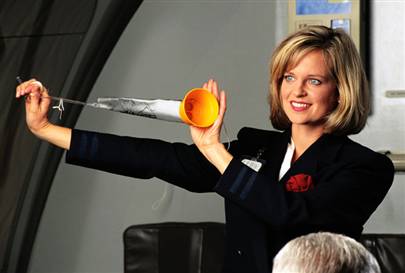 The Oxygen Mask speech is an example of the Unwritten Social Contract. Make sure your mask is secured before attempting to help others.
The Unwritten Social Contract
(or, Charity Begins at Home)
(or, Charity Begins at Home)
I often refer to a concept I call the "Unwritten Social Contract" in describing one's obligations to society. I cannot point to a specific recitation of this idea (it is, after all unwritten) but the concept underlies many religions, governments, and social theories. Perhaps the idea is better expressed somewhere in text. If you have a citation to it, please let me know.
The basic idea, which is often lost on many people today, is this:
"Each individual in a society has an underlying obligation, to the best of his ability, and before all else, to take care of his own basic needs, both immediate and for the foreseeable future, before attending to the needs of others."
Now some folks might say this is "selfish" and not altruistic. However, as we shall see, altruism can sometimes lead to all sorts of problems when people fail to take care of themselves first. But the basic concept is sound. You may have heard an example of this concept expressed whenever you fly on an airplane:
"In the event of cabin depressurization, an oxygen mask will drop down from the compartment above you. Secure the mask to your face using the straps provided. Air will flow into the mask even if the bag does not inflate. Do not attempt to assist other passengers or children until you have secured your own mask."
The concept is simple, isn't it? If you go around trying to "help others" before you put on your own oxygen mask, not only will you not get around to helping those others, you yourself will end up in need of help (adding to the problem) and probably end up blocking the exit with your corpse. In an emergency situation, the best thing to do is make sure that you are OK before you run off trying to help someone else. It is not selfish, it is the best thing you can do to help others. You cannot help someone by bleeding all over them.
But aside from plane crashes, the basic concept applies to everyday living. Each citizen in our society should make sure their oxygen mask is secure before they run off trying to help others. Unfortunately, in many circumstances, this is not the case, and we end up with more people falling in the aisles, adding to the problem, not reducing it.
Simply stated, each person should insure that their own needs are met - that is to say, food, clothing and shelter, not just for today, but for the foreseeable future. By doing so, a person insures that they are not a burden to society, either in the short haul or the long haul.
However, many folks barely scrape by these days, living "paycheck to paycheck" and failing to save for retirement. By doing so, they place an additional burden on our society now, and in the future. And yet oftentimes, these are the sort of folks who expend considerable energy on activities not related to their basic survival.
A classic example is the political junkie. I have known of number of such folks, from both ends of the spectrum, who will spend hours arguing politics and listening to talk radio, convinced that their opinions on every single issue are making a difference in society. In their personal lives, however, they lag behind. Some are living with parents or other relatives, or failing to properly support themselves or fund their retirement. If asked, they would say "How can I worry about my own affairs while Bush is in the White House?" If they are right-wing, they use the same cry, but with a different slant.
People like this arguably have some mental health issues, and that is tragic. But they are failing, on a basic level, to fulfill their social obligation to take care of themselves before seeing to the needs of others. Working for a living and saving enough for retirement takes a lot of effort. So it is not surprising that many folks don't have time to be political junkies and obsess about politics. They are taking care of their own needs first, which is more important that their "views on the issues" which are really irrelevant anyway. The only opinions you have that count are your vote and your dollars. Ironically, many political junkies do not vote or contribute to political campaigns. But they do waste an enormous amount of energy.
Another example is the church enthusiast. Some churches want you to tithe 10% of your income to the church. This is a staggering amount of money, considering that the government is lucky to get 15% from most citizens, and they have a lot more overhead than a church. While it is a fine and wonderful thing to give to a church, be sure you are taking care of yourself first. Oftentimes, it is the poorest segments of our society that give such large percentages of their income (tithing often viewed as the baseline donation, with additional funds donated above and beyond that for special needs) while failing to provide for themselves. In one instance, I've seen where a parishioner gave not only the 10% tithing to a "Mega-Church," but donated tens of thousands of dollars for church windows and construction - only to later end up destitute and broke. Needless to say, once they ran out of money, the "Mega-Church" stopped answering their phone calls.
I've met others who are volunteer junkies. While they themselves are poor and barely getting by, they spend an enormous amount of their time volunteering for "good works" - feeding the homeless and such, or donating large amounts of money to charities. We tend to laud such folks, as helping others in need is the penultimate Christian good. But if in doing so, you place yourself in jeopardy, are you really helping? And if by "helping" another, you are enabling an addict, is it really help? As we say in the 12-step programs, sometimes you have to let people hit rock bottom before they will help themselves.
Note that the largest health problem among the poor in America is not malnourishment, but obesity. And yet television charities (often bloated with their own overhead) implore us to donate to help the hungry in America. We live in a staggeringly wealthy country, by world standards. The average American, living below the poverty line in the US has a home, a television, air conditioning, a car, and a kitchen with refrigerator and a stove, and usually a microwave - and a life expectancy of 60 years. While this is 10 years shorter than average, the average "poor" person in America is also more likely to be a smoker or have other bad health habits. Do these folks really need your help, or do they need to spend more time fulfilling their end of the unwritten social contract?
The average African living below the poverty line hasn't eaten in 2 days, lives on less than a dollar a day, and has a life expectancy of less than 40 years. Arguably the African needs your help much more than "poor Americans". But some African activists are even questioning the effectiveness of altruistic American aid to their countries. Providing emergency food relief allows us to feel better about ourselves and allows Bill and Melinda Gates to claim the moral high ground (after holding the world hostage to a second-rate operating system). But in the long run, such aid does little to address the underlying problems in Africa - corruption, greed, tribalism, overpopulation, and the like. Meddling by industrialized nations has not helped, but hurt, most African countries.
Another example is what I call the "helpful Grandma", although this can happen to grandparents or other relatives) of either gender. Grandma is retired and has a little money set aside. Her Grandchildren are "in trouble" in her estimation, and at every opportunity, she intervenes in their child rearing, usually providing money for gifts, school, cars, rent, utilities, or other "needs". The children (parents of the Grandchildren) are often also the recipients of such largess, and have mixed feelings about it. While they resent the meddling and control Grandma has in their life, they get all too used to the "free money" being doled out. Unfortunately, Grandma often ends up running out of money in her old age, and then tries to put the squeeze on other children for support. Of course, the children and grandchildren she has passed money out to don't have any - they have learned only to be dependent, not how to take care of themselves. So when Grandma needs $100,000 for assisted living, she doesn't have it - nor do the kids she spoiled by giving that money to. Grandma would have been better off keeping her cash for her own retirement and leaving an inheritance later on, rather than trying to spoil, manipulate and control her children and Grandchildren.
This last example illustrates the sometimes evil nature of altruism. We like to think by "doing good deeds" that we are being unselfish and good. But often the real psychological motivations for "doing good" can be based in a deep sickness. "Volunteer Junkies" will never fail to mention to you how much they volunteer and what good they are doing (and then bitch, bitch, bitch about how they are unappreciated). A part of what drives them to volunteer is no different than what drives someone to buy a Cadillac. They want the ability to say "I'm Better Than You." It is a common need among human beings - to have status, perceived status, to impress people you know, or don't even know. We all do it. The volunteer junkie does it in part to achieve moral superiority. That, and it is cheaper than a Cadillac.
Don't get me wrong, volunteering is a fine and wonderful thing. But examine your motives sometime, perhaps one night at 3:00 in the morning, if you can't get to sleep. What you find might surprise and even repulse you. Do you feel superior to, or talk down to, the people you are volunteering to help? Do you look down at, or criticize those who do not volunteer? Do you really, in your heart of hearts, think that volunteering makes a you a better person? If you can answer "yes" to any of these questions, you are missing the point.
Note that I have discussed this issue in the past, and the response I get from some quarters is quite indignant and self-righteous. "Well, I'm glad that I don't have such a shallow view of the world as you!" they cry, neatly proving my point. They view their own perceived altruism as a form of moral superiority to others in the world. It is, in a way, a loser's game. Folks who play that card are often those who are less successful in the world, and they argue, bitterly, that those who do succeed are those who "sold out" or otherwise compromised their morality. They may be less well off, but at least they have superior morals! Ironically, Christianity would seem to argue otherwise - that one who lauds their own moral superiority is in fact, less moral.
For example, a friend of mine runs a small theater that is not very successful. It never turns a profit, but instead has to rely upon government grants and other handouts to survive. He also lives, in part, off money from rich relatives. He argues that he is "doing good" in the world by "raising awareness" for political causes with his theater. One of his compatriots, on the other hand, who managed to get a part in a television series, is viewed as a "sellout" who compromised his moral authority. My friend believes that everyone should live in poverty and fight for social justice. Unfortunately, the world is filled with such folks, who often think they should be in charge of things, who claim the moral high ground, while at the same time, are unable to provide for even their own basic needs. It is possible, I suggest, to support yourself and still do good deeds - and in fact supporting yourself is the the most basic good deed you can do for society.
Again, the "helpful Grandma" scenario also illustrates how altruism can be the truly evil. Grandma will argue that she is "helping" her kids and grand kids, by selectively doling out money to those in "need". However, by making a selective judgement of who is in "need" and who is not, Grandma is training some kids to become dependent. I have seen this scenario repeated time and time again in family after family. One child or grandchild is identified as being "in need". That child quickly realizes that presents and attention (and later cash, cars, and even houses) are garnered by being "troubled." So they assume the identity of the "troubled child" and fulfill the Grandma's prophesy that the child "will never amount to anything". Oftentimes, such children never get a job, finish school, or move on with their lives. Grandma did not "identify" the problem child, she created it.
And what does Grandma get out of it? Control, for starters. Once children and Grandchildren are conditioned to live off the regular checks from Grandma (or go to Grandma every time they need to make a major purchase, pay off a credit card debt, etc.) they will keep going back to the well, again and again. Grandma makes them jump through hoops, to be sure, and both sides of this sick dance are never happy. The dependent children never develop their own lives, for starters. And safely outside of Grandma's earshot, they will bitch for hours about how they hate her. People resent those that give them welfare, if only because they know it symbolizes their own helplessness and lack of power. Biting the hand that feeds you is the norm, not the exception.
And Grandma? In addition to spending herself broke, she will do nothing but bitch about her "problem grandchild" at the slightest provocation. They will regale you with tales about how little Johnny needs help, and how they (as the hero in this story) paid for Johnny's new car to encourage him to finish High School. Or whatever. The main point is that they get to star in this little movie-of-the-week drama. Listening to this sort of thing gets old, really fast.
You see, being dependent is never fun for anyone, even those forced to do it because of circumstance. And you'd be surprised how many people will take extreme measure to live independently, even with severe handicaps and difficulties. Being dependent on the government or family for money breeds a deep, brooding, depression that is nearly impossible to shake. Everyone wants to be in control of their own destiny. And yet all of us will take easy money, if it is offered to us. Dependent people hate and revile the persons they are dependent from. If you try to "help" someone out, don't expect their eternal gratitude. It just ain't gonna happen.
Note also that there is the "reverse Grandma" scenario I have seen many times. This involves the parent or Grandparent who is old, infirm, and impoverished. Oftentimes they are impoverished because they played "helpful Grandma" earlier in life. One child or children assume responsibility for taking care of Grandma, or sending her money, often at the expense of their own financial well-being. Nailing themselves to the cross, they will regale anyone (and everyone) with their tale of injustice - how they helped pay for Grandma's upkeep, while the rest of the children (selfish bastards!) refused to contribute.
I know one person who played this game for a while, until they realized that Grandma was using them as a patsy. After paying off Grandma's credit card debt, moving her into assisted living, paying for the upkeep on her car, and sending her $500 month in cash, they were chagrined to see her roar into the driveway one day in a shiny new sports car. "Do you like it?" Grandma says. "I should" replied the son, "I'm paying for it." Before you fork over cash to someone who claims to be "in need" make sure they truly are.
I have had more than one friend approach me, asking for a handout. "You're lucky" they say, "You have money". I suppose luck has something to do with it. Perhaps working three jobs while attending night school might have had something to do with it. Or maybe driving older cars, living on less and saving more had something to do with it. Or perhaps it was valuing an education and not squandering it studying advanced navel-gazing. Perhaps. No, they're right, it was just luck - like winning the lottery. Not.
Anyway, in each scenario, they approach me to "borrow" money. And in each case, they are so far in debt that such a "loan" amounts to a "gift". When I review their finances, however, I discover that far from being destitute, they have a steady income, a place to live, and even a car. The reason they are destitute is that they are spending more than they are making. What they need is not a "loan" from me, but to cut out cable television, credit card spending, and eating out at restaurants 4 nights a week. They are asking me to loan them money to maintain a lifestyle that I myself cannot afford!
Creating dependency in others prevents them from fulfilling their part of the unwritten social contract. Once the "troubled child" realizes they can get a free ride by causing trouble, they will continue to do so. A junkie who is able to panhandle a hundred dollars a day and get free meals and a warm place to sleep has little incentive to give up drugs. The person who you "loan money" to will inevitably keep coming back to you for more, until you finally say "no."
And if by attempting to "help" such individuals or institutions or whatever, you end up not taking care of your own needs, then there are two victims to the story - as eventually, you will be the one broke and destitute, having squandered your savings trying to "help" others.
Fulfilling your basic obligation to society, by taking care of your own needs and insuring that your needs will be taken care of in the future, is the first and foremost basic "gift" you can give to society. Before you run off trying to "do good", make sure you have taken care of yourself, first.
Thursday, December 11, 2008
FIGHT BACK!

Don't let banks and other financial institutions push you around!
In America, many people are afraid of banks and other financial institutions. The reason for this irrational fear is the misconception many folks have about banks - misconceptions that banks would prefer that you have.
Movies, television, and literature all perpetuate these myths. Chief among them is the idea that banks are all-powerful and that they control all the money. Individual citizens, it seems are reduced to begging for a pittance of this largess.
For example, in the movie, "Catch Me if You Can", Christopher Walken plays the part of the Father, whose irregular bookkeeping has resulted in an IRS audit. He is forced to close his business and beg for money from the banks. "They have all the money" he says, ruefully, and they won't lend him any.
I would suggest that once you take this attitude that the bankers have all the power, money, and control in any situation, then you have already mentally and monetarily surrendered to them.
The reality of the situation is that no bank, no matter how large or how powerful, can survive without customers. This simple truth often eludes many people. Banks can, on the other hand survive without bad customers, and they certainly don' t need or want customers who cannot pay back a loan or constantly default on payments or overdraw their accounts. If you fall into this second category, well, then yes, the banks hold all the cards, but only because you've given the cards to them.
If you find yourself in dire financial straits, when it is too late to turn things around, as happened to the character played by Christopher Walken, then yes, the banks have all the "power" and you are screwed. But even then, sometimes someone completely in debt might find they still have a "hole card" to play. But more about that later.
The first thing to maintain in a banking relationship is the upper hand. By this, I mean you have to be a customer in good standing - with a balance on your accounts, regular payments on your loans, and no history of overdrafts, late payments, etc. For some folks, this sounds incredibly hard to do. And, they might argue, that circumstances "forced" them into a situation where they were in financial trouble. However, if you look at how events progressed, you can see oftentimes there were early warning signs that trouble was coming, and that they failed to take action early enough to avoid trouble.
In one of my earlier posts, Life in the Rowboat, I illustrated the model for personal finances using the rowboat analogy. Water comes into our leaky rowboats in terms of spending and expenses. We remove the water though bailing (income through work, usually) and if our work income exceeds our expenses, our rowboat is nice and dry. If the amount of water coming in (expenses) is more than the bailing (income), well, eventually you will be sunk.
Power-shifting occurs when folks don't notice that the rowboat is slowly taking on water and then fail to take action to stop the flood. They start to get used to having a little water in the bilge (outstanding debt), and think, "Well, all boats leak, so this is normal." As the water starts to rise, they don't get too worried, as they think they can always bail it out later with a more powerful pump (pay raise). However, once the boat is nearly under, it is often too late to take action.
When that occurs, then yes, you'll find the banks are in the position of power, and you are basically screwed. So one key to maintaining that position of power is to keep your own financial house in order. It makes no matter how large or small your rowboat is, if it is a tight ship and fully afloat, you are the captain and in charge.
Once I started getting my finances in order, I noticed a funny thing. When I went to the bank, they started treating me better. It is an old adage that in order to get a loan, you have to prove you don't need the money - and it is true. Once you have money, it is far easier to make more money. Loan interest rates are lower for folks with money. And interest rates for savings are highest. If you have money, you can easily make money. As Warren Buffet says, "The first Billion is the hardest".
The contrary is also true. Once you "fall off" the financial cliff, you 'll find you are charged the highest rates for loans and earn the smallest rates of return on your savings. It is often a death spiral. As I noted in my Understanding Credit Cards article, once you have a high balance and a late payment history, the banks will zing you with interest rates so high that you might never pay back the balance. And if your credit is bad enough, other banks won't loan you the money (at a lower interest rate) to pay off the balance. You truly are screwed.
If you have good credit, and a bank tries to jam up your interest rate, you can simply close that account and take your business elsewhere. Even if you have a balance, you can transfer it - provided you have good credit. However, if you have a history of bad credit, then you have no power, and are "stuck" with whatever terms the bank dictates.
For commercial borrowers, the scenario is even worse. If you have a commercial loan, say, on an office building, it is on what is called a "callable" note. That means the banker can "call" the loan at any time, for any reason, if they do not feel secure on the loan. And you have to either pay off the balance due, or be in default. And since it is a commercial property, you could be out in the cold in as little as 30 days.
For businesses, bad news often accelerates into worse rather quickly this way. A company misses a loan payment or bounces a check and suddenly, a note is called, and a business that was on sound footing one day is bankrupt the next. So it is vitally important to stay on the sunny side of the money street. Once you fall off the financial cliff, you lose what little power you have in the relationship.
If you pay your bills on time and have good credit, no bank can push you around. It is as simple as that. If one bank decides to raise the rate on your credit card, well, screw them, you can transfer the balance elsewhere and close the old account. They need your business to survive. If you stop charging with your credit card, they don't collect those credit card fees and they don't collect that nice credit card interest.
If you start to see the water rising in your personal financial rowboat, the time for action is NOW. If you let the water lap over the sides, you've surrendered all control to others. Taking action may mean minor steps - cutting expenses or selling assets, which often means swallowing your pride and taking a loss. Or it could mean refinancing debt at a better rate (slowing the rate of leakage) and putting a plan in place to bail out that accumulated water. At the early stages, you still have the power to do this, and banks will cater to your needs - and you can stay afloat.
But once you are "swamped", it is too late, and you have no power or leverage to negotiate - except for the cram-down.
Cram-downs are a pure expression of power, and not everyone can do them. The most famous occurred in the 1980's with Donald Trump. Most people (mistakenly) believe that Trump is a wildly wealthy successful businessman. While he has some money and has had some success, he is not as successful as the Warren Buffets of the world. He doesn't do TV shows out of sheer boredom. The Donald probably needs the money.
In the 1980's his casino empire was melting down - he owed more money than the properties were worth, and the cash flow was not servicing the loan debt. Some poorly advised purchases, such as the Trump Shuttle (remember that?) were losing money. The sharks started to circle, sensing blood in the water.
Then Trump did a truly ballsy thing. He crammed down his lenders. He told them, basically, that if they didn't re-negotiate the terms of his loans, lower the interest rates and balances owed, that he would declare bankruptcy, and they would be stuck with pennies on the dollar. The banks balked at first, but with such a large gun to their head, they had to negotiate. Trump lost a lot of control of his projects, and some equity as well, but he survived to fight another day, and he forced his banks to take on a share of his losses.
Today, with the mortgage meltdown, some borrowers are doing the same thing. They are trying to negotiate with lenders to reduce rates and terms so they can stay in their home. In this market, the last thing a bank needs is another foreclosed property on its books. Banks typically lose as much as 50% on foreclosures, with legal fees, realtor's fees, as well as the empty properties sitting for months on end. If they can keep a loan on the books and avoid all that hassle, it is a better option for them to write-down some balances. And some banks are willingly renegotiating loan terms at lower rates, rather than go through foreclosure.
For some homeowners, a deed in lieu of foreclosure can be an option. If you can't afford to stay in your home and owe more on it than it is worth, some banks will accept your deed and forgive the debt, if you agree to move out right away. In many states, eviction can take months and months, and if a debtor declares bankruptcy, it may stay eviction indefinitely. With a deed in lieu of foreclosure, the bank gets the home without months of legal wrangling, and you walk away with your credit record intact.
However, if you have declared bankruptcy in the past seven years, these options may not be available to you, as is what happened to one friend of mine. Since you cannot declare bankruptcy more than every seven years, a threat to declare bankruptcy and screw the bank is an empty threat. In other words, you've surrendered that power again, and you are at their mercy.
Insurance is another field where people, particularly young people, tend to let themselves get pushed around. But again, it is all a matter of power, and you can surrender that power quite easily. When I was in my 20's, I drove as fast as I could everywhere, like most young men do. Pretty soon, I amassed quite a few speeding tickets and even an accident. I had bought a brand new car and borrowed the money to pay for it, so I needed collision as well as liability insurance. I voluntarily surrendered what little power I had in the relationship.
Getting insurance when you are young is hard. If you have a bad driving record, it is even harder. And if you have a car loan and need collision insurance, it is very, very expensive. The best thing a young person can do is to learn to live without and buy a car for cash, and do without collision insurance. If you can keep your foot off the gas pedal and keep your driving record clean, your insurance rates will stay lower and get lower faster. Until you are about 26 years old, your insurance rates will be rather high.
Yet most young people do the opposite, particularly young men. They buy the flashiest, fastest car they can find, usually one with the highest insurance rates. And since they drive it as fast as possible (and inevitably wreck it) they end up in the "assigned risk pool" - often paying thousands of dollars a year in premiums, sometimes more than the car payments themselves.
Again, insurance companies need customers in order to stay in business. But they don't need reckless drivers who are going to pay little and expose them to a lot of liability. Once you round the corner on 30, the attitude of insurance companies changes. Not that this means they still won't try to push you around, of course, if you let them.
As I noted in my Understanding Credit Cards article, you should know your interest rate, terms, and statement and payment due dates for your Credit card - the vital "stats" of this valuable asset. Similarly, for insurance policies, you should have your policy information handy and cross-shop your policies every year or two to make sure you are getting a good rate. Rates vary considerably among companies. Many insurance companies make it hard to keep track of your insurance by sending multiple and confusing documents, garbage documents, and so much data that you have little or no idea what you are paying for coverage on.
Coverage that you may think is mandatory may in fact be optional. Some agents automatically write in rental car coverage, roadside assistance (towing) coverage, and medical coverage, even if it is not required by State law. Roadside assistance is nice and all, but if you are a member of AAA (recommended) you'll find that it is redundant. Rental car coverage is also nice, if you plan on wrecking your car a lot. On the other hand, if you have multiple cars or other means of transportation (car pool, bus) then it may be an unnecessary expense. Don't fall into the trap of the "well, it only costs a few dollars a year" mentality - that sort of thing ends up costing a lot when added up across your entire budget.
Motorist medical coverage may be optional in your State. Oftentimes, the coverage provided is limited - $10,000 or less. If you already have health insurance, you are already covered for your medical bills. Paying a relatively large amount of money for a small amount of what amounts to be accident insurance is not a very effective use of funds. Figure out what you actually need, and you can save a lot of money.
(Car Insurance will probably be the subject of an entire future article).
Again, people who are not assertive will simply take what the agent recommends and not ask questions. If you take charge of the situation, you can save a considerable amount, and prevent junk add-ons from cluttering up your policy and driving up your premiums.
Taking charge of your financial situation requires that you be assertive and also work to manage your finances. It is not easy. But once you get on the positive side of the financial picture, it gets easier and easier, as you are in a position of power to negotiate with your bankers and other financial institutions.
Monday, December 8, 2008
Do We Really Control Any of Our Destiny?

Are compulsive gamblers just people with weak constitutions, or are their brains wired differently?
One aspect of financial planning that is very disturbing, is the possibility that we, as human beings, are little more than pawns at the mercy of our own brain chemicals. Trying to plan for retirement or save money may be short-circuited by overwhelming impulses over which we have no control.
In other words, all the best advice, seminars, etc. can't overcome a brain pre-wired to squander money. It is possible?
Recently, it was discovered that a drug prescribed for Parkinson's disease patients was causing them to go berserk and gamble their life's savings away.
It was a tragic scenario, as businessmen who had amassed over a million dollars in life's savings, suddenly became compulsive gamblers and gambled every last dime away. Once they were taken off this drug, they realized what they had done, to their horror.
This incident raises several interesting questions.
1. As a casino owner, wouldn't it be a good idea to put this chemical in the food and drinks?To answer all these questions, of course, I can only speculate. What is troubling to me is that few people see the true implications of this incident with the gambling addiction. It is clear that the human brain is pre-wired to respond to certain chemicals and hormones, and that behavior, once thought to be a matter of mere will or "character" might be selectively programmed with a pill.
2. How much control do we really have over our spending and savings?
3. Are our brains pre-programmed to release certain amounts of these chemicals, making any behavioral modifications even possible?
4. Or do our brains release these chemicals in response to environmental stimuli?
5. Are plans to privatize social security or rely on self-funded retirement programs (e.g., 401(k)) hopelessly flawed, as a certain portion of the population will inevitably squander their savings as directed by their brain chemicals?
In other words, if there is a chemical that causes compulsive gambling, perhaps there is also a chemical that does the opposite - blocks the receptors of the risk-taking portions of the brain. Which in turn raises the possibility all sorts of behavioral problems might be caused and cured by altering brain chemistry.
Of course medicine has been working on this theory for years, but most of their work has been in trying to help the severely disturbed (psychotics, bi-polar disorder, severe depression, etc.) and the drugs used in such treatments are akin to using sledgehammer to kill a fly. I am not aware of use of drugs to control behavior in "healthy" people. It is a tantalizing idea, although one fraught with peril.
If we could take a "risk-taking" or "risk-averse" pill (in an Alice in Wonderland scenario) which would you take? What we might think is the "right" modification of our behavior might end up being the exact opposite thing we need to do. As many people are financially harmed by being overly risk-averse as are those who bankrupt themselves by taking too many risks. Your instincts to control your own behavior might backfire in a big way.
Since such pills do not (yet) exist, the question is moot. However, what does cause some of us to be more risk-takers than others? And does this change in response to environment? I think the answer to the latter is "YES." When placed in an environment where risk-taking is the norm, people probably tend to take more risks. Perhaps this is why con-artists like to hold "seminars" where you can get a group of people together in a church-like setting and make buying a time-share seem like a sound proposition. Perhaps the risk-taking pheromones released throughout the room become contagious and suddenly, normal rational people start to sign the papers. (And just as deadly to such a scenario is the doubter whose pheromones are a total buzz-kill to the rest of the congregation. No wonder such folks are usually quickly shown the door, whether it is a time-share weekend seminar or a religious cult).
At the other end of the spectrum, there are probably pheromones of risk-aversion released in groups, such as 12-step programs and savings clubs. It is just a guess, but group behavior is an interesting thing.
Similarly, in conditions of economic boom, the feeling of prosperity in a person's brain probably releases chemicals that say "go for it!" while in depressed economic times (like today) the constant barrage of bad news causes people to hoard their money and carefully consider their purchases, even if they personally have not been affected by the downturn.
A hundred years from now, we probably will have better answers to these questions. Perhaps by then, gambler's anonymous will be replaced by a simple over-the-counter medication (if the casino operators don't suppress the research first).
But, how that this information be useful to you as an investor or person trying to live on a budget?
First, I think it tells us that a lot of our behavior is not always within our control. This is not to say we have NO control, only that on occasion, we end up doing stupid things, like buying something we have absolutely no use for. Rather than recriminate ourselves and feel bad about it, chalk this up to human behavior.
I like to point out that as human beings, we are remarkably inefficient animals. Much of our working time is squandered with unproductive work, and often we work at cross-purposes. Given that nearly half our lives are spent sleeping and eating, and the remaining half spent goofing off, I suspect that the overall efficiency of a human being might be 1 to 2 percent, at best. So, rather than feel bad that you've wasted money or time, or not lived up to some high standard, you should feel good that you've accomplished anything at all. After all, the deck is stacked against you.
I think the cycle of addiction occurs when people try to feel bad about their pleasure-seeking behavior, and then engage in more pleasure-seeking behavior to overcome their bad feelings.
Thus, the alcoholic depressed about his alcoholism, cheers himself up with a drink. The shopaholic, depressed about credit card bills, does the one thing that surely cheers them up - more shopping! (an article about this is forthcoming, again based on a real-life experience of a friend of mine).
One thing is certain, though, such behaviors are usually impulsive. The more we can consider and contemplate our behaviors (by planning) the better we can control them. Thus, making a shopping list and setting up a budget can allow one to shop without over-spending.
The 12-step programs, of course, take an opposite approach, and perhaps for hard-core addicts, such a technique is necessary. An alcoholic cannot "manage" his drinking by limiting himself to one drink. The shopaholic cannot limit themselves to buying one dress. The over-eater cannot limit themselves to one slice of pizza. They all must quit "cold turkey" and never engage in these behaviors again.
However, the majority of people are able to drink occasionally without getting falling-down drunk and ruining their lives. Many people can shop responsibly without going bankrupt. And despite the obesity epidemic in the US, there are folks who can eat responsibly and exercise and stay in shape.
I would like to think we still have some control over our destiny, otherwise all hope is lost.
Sunday, December 7, 2008
Buying a Car, a Classic Example of "How NOT to!"

Ooooh! A Jaguar! I've always wanted one of these! And look at the price! So cheap!
My previous post illustrated how you can purchase an automobile as a rational decision and end up with a decent looking car that provides you with reliable service at a minimal cost.
At the other end of the spectrum, well, you can throw thousands of dollars down the hole with cars. Consider this (bad) example:
Frank saw a Jaguar parked on the side of the road on his way to work every day. It was a green sedan, and Frank remembered how when he grew up, that Jaguars were considered "cool" cars. He idly thought about how nice it would be to have one, and fantasized about owning that Jag. Every day he drove by it, he'd think about that car.
He didn't need a new car, or another used one. Frankly, he need a Jaguar like he needed a hole in his head. Cash was tight and he was barely making his monthly bills. But he had just got a tax refund check, so he had a few grand in the bank this month.
So one day, after work, Frank stops to look at the Jaguar. It had been sitting for a month, and the lawn had grown up around it. Grass clippings were stuck to the tires and wheels. The owner came out and showed him the car. The driver's door opened with a creak and they tried to start it. No luck. The battery was dead.
The owner got out a battery charger and an extension cord, and while it charged up, the owner showed him the rest of the car. The once proud Jag had fallen on hard times. One panel had a dent in it ("you can take that out, easy" the owner said) and small amounts of rust were creeping around the wheel wells. The driver's seat was slashed to ribbons - so much for Connolly leather. Some of the electrical "toys" like the power windows and locks no longer worked. The A/C was busted, too, but Frank figured that in rural New Hampshire, where he lived, it was not all that necessary.
They finally got the car started and it roared to life as the owner held down the throttle. Wow! What a motor! Only later would Frank discover that the loudness of the engine was due in part to the rusted exhaust. They got in the car and drove it around. It seemed to handle a bit quirky, but wow! Driving a Jaguar! This was what he had dreamed of since he was a kid.
Frank had no idea what he was buying. He never researched the car or figured out what a good "book" value for the car would be. Since he lived out in the country, there were not a lot of places where you could get a Jaguar fixed - and not a lot were for sale locally.
The owner said he wanted $5600 for it, which seemed like a steal for this "luxury" car. Frank tried to talk him down a bit, but the owner held firm. Frank easily paid $2000 too much for this nightmare.
Frank brought the car home, thinking his wife would be pleased by this luxury car. She wasn't, and a fight ensued. "What the heck do we need with a hoary old Jaguar?" she said. And she had a point.
Frank put tags on the car and drove it to work the next day. Of course, the battery was dead by the end of the day, and he had to jump-start the car. "Oh well, a new battery isn't too bad".
But when Frank went to the local gas station to get the car inspected, he discovered, to his horror, that he had bought what is known in the used car world as a "fright pig." Nearly everything on this car was broken, rusted, or just plain worn out. What little was left working was well on its way to breaking soon.
The car needed a total brake overhaul, including pads, discs, parking brake cable, new hoses and lines, and even a master cylinder, which was leaking. The total bill would be easily over $2500, and it would take a week to get the parts.
What's more, the tires were nearly shot, having little tread left and being dry-rotted. The suspension was also shot. In addition to new shocks, the front end was worn out, needing new ball joints and tie rods. This would run an additional $1500, if he skimped and used cheap tires.
The car needed a new muffler - and resonator for another $800. And it was burning oil, which could not be fixed unless he had the engine rebuilt.
The worst news was the rust. The rule of thumb with rust is this: If you see a "little" rust as Frank did, multiply it by 10 or even 100 to get an idea of the total rust involved. The rear shock towers were rusted out and the shocks were ready to poke through into the trunk. The mechanic didn't even want to touch this last part, as welding so near the gas tank was suicidal. Removing and re-installing the gas tank would add $500 to the repairs.
The mechanic "knew a guy" who could weld the shock towers for cheap. Hank had that done and had the brakes overhauled and new tires put on, and charged it all to his credit card. On the way home, he stopped at Wal Mart and bought a seat cover for the torn front seat. It had a picture of "tweety bird" on it.
Frank didn't mention the cost of repairs to his wife. When he got the car home, he put it in the garage and started looking at the rust on the wheel wells and the dent in the rear quarter. Poking with a screwdriver, he knocked off some of the rust. He kept poking and poking and pretty soon, he had gouged out nearly the entire wheel arch. It turns out the paint was barely hanging onto all that rust. Ouch.
On the way home from work the next day, he stopped at the NAPA store and bought a gallon of BONDO and some sand paper. That night, after supper, he gouged out more rust and sanded it back almost to bare metal and applied layer upon layer of bondo into the holes. He found an old door screen in the garage and cut that to wedge in the holes, so the bondo would have something to stick to. Even with that technique, one wheel well swallowed up a whole gallon can of the stuff.
The car looked pretty sickly now, with the garish red bondo, grey primer, and faded "British Racing Green" paint, along with the ill-fitting "tweety bird" seat cover. But Frank was not about to give up! Every evening, he'd bondo and sand and bondo and sand. His wife was glad to have him out of the house, but worried about how much money he was spending on the car.
Eventually, the rear fenders started to fill in and look sort of Jaguar-ish, or more like a Jaguar that someone made of plasticine clay. The bondo lumped and bumped and no matter how much he sanded, never went flat and smooth. Grey primer started to cover larger and larger sections of the car, and overspray dotted the windows and tires.
Frank stopped by a body shop one day on the way home from work to get a quote on repainting the car, now that the body work was "done". The body shop owner shook his head, but politely wrote up a price quote for $3000, knowing full well that Frank would never have the money to pay for such a job (and the body shop owner didn't want Frank's rusty hulk dirtying up his bays anyway). Frank thought about the local "speedy paint king" place, that offered to paint "any car for $299!" but even that seemed excessive. The cars in the lot there all had paint on the trim, windows, and masking marks around the door handles and side moldings. On the way home, Frank bought several "foo-foo" cans of "matching" Jaguar green paint.
Frank had, by this point, over $10,000 invested in this car, and it was still a fright pig. A fright pig with a new battery and some very cheap tires, but nevertheless a fright pig. It would never be a collectible with all the rust on it (the floor pans were ready to poke through at any minute) and the engine was burning a quart with nearly every tankful. Frankly, even pristine examples of old Jag sedans like this were never likely to become very collectable. The car looked funny with its bondo'ed panels and orange peel paint job. Within a month, Frank noticed that his bondo job was starting to bubble up again.
On the way to work a month later, the car died in the middle of the road and refused to budge. Towed to the garage, Frank got the bad news. The broken kitty needed a new transmission. His mechanic could find a rebuilt one for $3500, but it would cost another $1500 to install it.
By this time, Frank's wife saw the credit card bills and caught wind of what Frank was up to, and put her foot down. Frank argued that they had $10,000 "invested" in the car already, so putting $5000 into a "new" transmission made sense. His wife argued that the car was a bottomless pit of money and that they should cut their losses now and get rid of the car.
Frank sighed and agreed and put the car out at the end of their driveway with a sign saying "For Sale, $5000." Needless to say, the car still sits there today. An old, broken-down rusted-out Jaguar that won't even run under its own power is worth about what the scrap man will give you for it.
So what did Frank do Wrong? About everything. Here's a list of what I can spot:
1. NEVER buy a car because you drive by it every day. If you decide you need a car, research the makes and models and make a rational buying decision. Deciding you want to buy a car, boat, or RV merely because it is a familiar sight almost always ends up being a bad decision.
2. RESEARCH a car before buying. What is a reasonable asking price? What defects or wear points should you be looking for? Never close a deal without knowing what the book value of the car is. If Frank did even modest research (checked the Kelly Blue Book at his local credit union) he would have realized that the car was radically overpriced.
3. WALK AWAY from UNREASONABLE SELLERS: Frank got taken by a seller who was "firm" on his price, even though it was far above market value. Such dreamers are plentiful and they do waste your time. You cannot "negotiate" with such folks, as they believe they have a rare collectible and not a junk heap. Just walk away and don't waste your time.
4. Buy the BEST EXAMPLE you can find: Repairs are expensive, so there is no point in buying a "junker" and trying to "fix it up.. Even if you can do the labor yourself, as I can, you'll end up spending thousands and thousands of dollars on parts and hours of your time. You can buy a better car with all that work done already for less time, money, and hassle.
5. INSPECT before you BUY: Most mechanics, for a small fee, will put your prospective purchase up on the rack and give you a list of what needs to be fixed and an estimate of repairs. If Frank had done that, his mechanic would have given him the bad news ahead of time - and told him to walk away from the deal.
6. WALK AWAY from even a LITTLE RUST: Rust is nearly always impossible to repair. It creeps like a cancer and is nearly impossible to remove. The only proper repair for rust is to cut away ALL of the affected areas, back to solid metal in every direction, and WELD IN new factory panels. It is an expensive and time-consuming process. Again, you can find a rust-free car for less money, even if it means driving or flying to Arizona or California.
7. KNOW WHEN TO QUIT: Throwing good money after bad is never a good idea. When Frank discovered that he paid more than book value for the car and it still needed thousands of dollars in repairs, he should have sold the car or donated it to a charity and cut his losses right then. As it was, he spent nearly ten grand for only a few months worth of transportation. For that much money, he could have bought a rust-free Jaguar in fairly decent shape.
Cars like Frank's Jaguar are everywhere, it seems. And people buy them, too. I see them all the time and wonder what possesses people to even bother to refuel such heaps. With the price of scrap metal being what it is, the economic model for driving a "junker" makes little or no sense anymore. Once a car is worth less than a grand or two, it is no longer worth repairing, unless repairs can be done for free or at low cost.
And yes, over the years, I've talked myself into buying a "fright pig" or two, only to later regret such a decision (and later on dumping the car for pennies on the dollar). I've learned the hard way that it pays for "fish a little further upstream" and find newer examples of a vehicle, or one in much better shape.
Fishing that far down the food chain makes little or no sense. And yet folks do it every day, just as they run up credit card debt and buy lottery tickets. Just because folks do it, doesn't mean it makes sense.
NOTE: I used the example of an old Jaguar here, but many other makes of cars fall into this same scenario. Expensive foreign luxury cars are just the worst, as parts costs make the whole thing a more extreme nightmare. Old BMW 7-series, for example, can be had for cheap. Ditto for old Mercedes S-class sedans. Some even look nice on the outside. But they are a money pit of repairs. See my posting on BMW Fright Pig, and BMW Fright Pig, Part Deux.
Subscribe to:
Posts (Atom)
-
 AI trains on data from the past - how can it be the wave of the future? The scenario shown in the comic above sounds too dumb to be true, bu...
-
 More and more companies are trying to push us into the "Cloud" - is this a good deal for ordinary consumers? Probably not, ...
-
You can boost your share price by putting trendy buzzwords in press releases . Meme stocks are stocks that are hyped heavily on the Internet...
