Sunday, March 4, 2012

How Banks Turn Small Problems Into Big Ones

If you get into a little financial trouble, your bank may turn it into big financial trouble.  Your finances may not be as rock-steady as you think.

During the last financial crises - 1989, not 2009, the banking industry was facing difficulties.  The Savings and Loan crises took down a number of S&Ls - leaving Uncle Sam to clean up the mess.  Nervous regulators started demanding that banks have more capital to balance their loan portfolios.

So, for companies that survived the downturn and had profitable businesses, it seemed that things were going well.  That is, until the bank called.  "I'm sorry, but we're going to have to call in your notes and cancel your line of credit," the banker says.

"Why?" asks the mystified businessman, "I am current on all my payments, my business is profitable, I have a healthy balance sheet, my credit rating is good, and my Dun & Bradstreet report is clean!  Why me?"

And the banker replies, "It is nothing personal, but the regulators say we need more cash on hand, so we have to start calling in loans."

And since business loans are "callable notes" they can do this.  And suddenly, a businessman who thought he was solvent one day, finds himself bankrupt the next.   He scrambles to find alternative financing, but other banks are facing the same problem, and no one wants to lend.  And in some cases, this ends up "taking down" a business that otherwise seemed healthy and profitable, but perhaps was a little too hollowed out.

And of course, it goes without saying, if you bounce a check or are late on a loan payment, similar things can occur.  For example, for a businessman, if they are late on a loan, the payment may be "accelerated" and the entire balance is now due - it becomes a balloon payment, with the entire thing due NOW, at a time when the business is faltering slightly.

It seems remarkably unfair.  A businessman hits a rough patch and can't make a loan payment.  The next month, he can, but in the interim, the bank has pulled the trigger on a handgun aimed at the businessman's head, and he is now insolvent and bankrupt - overnight.

And it seems like a stupid deal for everyone involved.  The bank rarely comes out ahead in these deals - getting only pennies on the dollar in bankruptcy court.  And the businessman of course, loses his business.

In your personal life, similar things can happen.   You are late with a credit card payment, and at a time when you need help the most, they jack your rate to 25% or 30%, which insures you never can pay it off and makes bankruptcy inevitable.  And late fees and the like are folded in and add to the amount due.  A little problem snowballs into a large problem, very quickly.

Similarly, our mortgage crises is based on the same scenario.   You over-pay for a house, sign a bad loan agreement, and then lose your job.  The bank jacks the rate and then throws you out of the house, and then sells it at foreclosure for less than the balance on the loan.   You lose, the bank loses.  And your credit rating is destroyed.

Wouldn't it make more sense to work out a deal with the bank?  If you have a job and can pay something close to a reasonable mortgage payment, wouldn't it be a win-win situation for everyone?

You would think that, and many are calling for that, and as part of some laws and court settlements, banks are trying that - in a small minority of cases.

But historically, it has been shown that whenever a bank offers a "workout" to a home owner, in 3/4 of all cases, the homeowner ends up losing the house anyway.  Usually, there is more at stake than merely being upside down - the homeowner cannot afford to pay, period.  And the sooner the bank can sell the home, the more they collect, of the amount owed.  The longer the process drags on - in most cases - the harder it is for the bank to recover.

That is the thinking, anyway, behind these acceleration devices in loans, credit cards, and mortgages.  A businessman, facing difficulty, will try to "hang on" for months or years, accumulating more debt and hollowing out his business further.  Better to wipe him out now, while there is still something to liquidate.

If you are late on a loan, you have a bad credit rating, making it harder to refinance the loan and raising your available interest rates.  At a time when you need help the most, you get hammered.  Meanwhile, the fellow with money in the bank who doesn't need the loan is offered the lowest rates and the best terms.

It is unfair?  Probably.  Well, that was the way I felt, having four callable notes and a line of credit on my business - and being "slammed" to a higher interest rate, once, on a credit card.  Is it going to change anytime soon?  No, alas not.  The OWS protesters can rob and rape all they want, it ain't gonna change much.

But - and this is the big but - you do have control over your own behavior and that is one reason I gave up on leveraging myself this way.   It can all go horribly wrong, in an instant, even if you are solvent, even if you are paying your loans as agreed, even if you have a healthy balance sheet.  There is a reason they call it leveraging - you are at the end of a lever, and things can swing wildly out of control in response to small inputs on the other end.

Having debt makes you vulnerable.  It leverages you, it hollows you out.  And while such scenarios may remain stable for months, years, or even a lifetime, they are susceptible to the slightest wind of change.  And it goes without saying, such leveraged scenarios require your constant attention and a steady income stream.  One slip up and it all goes south in a hurry.

It is like loading up your rowboat with 10 people - far in excess of its capacity.  You figure this way, you can make more money rowing people across the river.   But since you only have a half-inch of free-board, the slightest gust, the slightest wave, the slightest movement by one of your passengers will swamp the boat in short order.  And all of these things are beyond your control.  Perhaps 5 people in the boat isn't as profitable, but you have 6 inches of free board and can survive a category 1 whitewater rapid.

Life ain't fair, yea.  And these banking mechanisms seem unduly harsh.  But you don't have to play.  The ultimate decision - the ultimate control over the situation - lies with you.
Orchard Bank Credit Cards

Getting or having a credit card is no big deal - nor is it desirable.  Some people are so desperate for a credit card, they will do anything.  This is a very bad idea.

In the SPAM folder today, a note from "Orchard Bank" that I have been pre-approved for a Platinum card.  You have to wonder about a bank that pre-approves people they don't even know.

What is this, a scam?  A rip-off?  A con?   Well, today, anything short of sticking a gun in someone's face and demanding money is basically legal (disclaimer: sticking a gun in someone's face is legal in Texas).  So yea, they are above-board in terms of today's laws.

But 50 years ago, they would be accused of usury or loan-sharking.

The credit card is run by HSBC, and offers people with horribly bad credit a chance to get a credit card, with the promise of "rebuilding" their credit.  Of course, if you've destroyed your own credit rating, borrowing more money is not likely to help.  Time is the great healer of all wounds, and getting a toxic-rate credit card is probably a bad idea.

To begin with, there are a lot of fees tacked onto the card - a fee to get the card and an annual fee to have the card.  And the credit limits are pathetically small.  Paying a $79 annual fee for a $300 limit card is kind of ridiculous.  And the interest rates are pretty astronomical - 14-30% or more.

Still, this is better than some of these rip-off rate credit cards which have interest rates higher than 50%.   You read that right, 50%.

What would cause someone to be so desperate to have a credit card?  It makes no sense.

One writer opines that immigrants, students, and people with bad credit histories could use such cards to "build up" their credit - as if having a good credit rating was like going to the gym and working out with weights.  The more "reps" you do, the bigger your financial muscles will be!  Spend, Pay, Repeat!

Actually, not.

You see, your ability to get credit depends on two major things:  Your wealth and your income.  If you have a low-paying job, no one is going to approve you for a $50,000 car loan, at least not on very good terms.  And likely, you will default on such a loan and end up with "bad credit."  Simply stated, your income determines, more than any other single factor, how much you can borrow.

A better approach is to stop borrowing so much and worrying about your credit rating - and stop thinking of credit as the only way to live and to own things.  The more you buy into this concept, the worse off you will be, financially, emotionally, and even physically.  Financial stress leads to mental stress, which leads to physical stress.  A new car ain't worth a heart attack or ulcers.

Stop playing their game and play your own.  Obsessing about credit score is another example of faux financial acumen.   And it is funny to me that the people who obsess about credit score the most are the ones that fuck it up so badly all the time.  If this is so damn important to you, then pay attention to it, eh?

But if your income sucks, you can "go to the gym" all you want with these stupid credit cards and you still won't qualify to borrow much money, PERIOD.

Second of all, having wealth is far more important than having good credit.  Having money in the bank is better than an 800 score, any day.   And if you have money in the bank, you don't need a credit score.  So, rather than obsess about "building up credit" so you can buy a brandy-new spanking car, just drive an older car, pay cash, have money in the bank and be happy.  Only poor people and idiots chase after new cars.

Over time, your credit score will improve, if you have a bad credit history, as bad credit items fall off your report.  But it can take a long time, and you really can't jump start the process by borrowing more.  And in the interim, you can open a bank account and get a debit card and use that, in place of a credit card.  They take debit cards at all the same places, and there are no annual fees, interest charged, and most importantly, you can't spend more money than you have.

If you have no credit history, people will offer you credit - don't worry about that.  This is America - we offer people's PETS credit cards.   The problem is, the more and more debt you take on, the worse off you will be.  So it pays to be selective about who you accept credit offers from.   You are not "lucky" to take out a loan - they have to be paid back.  You are not "lucky" to be approved for a credit card.  They are lucky to have you.  Be picky.  Don't sleep with the first person who agrees to have sex with you - Rush Limbaugh will call you a slut!

Now, some folks argue that you should get a department store credit card and buy something small, like a dress or tires for your car, and then pay off the balance and be done with it and that this will "establish credit."  That may be fine and all, but what usually ends up happening is that you buy more than you can pay off in one month, and these types of cards (such as at Sears) have fairly hefty interest rates.

But there is no reason to pay a fee to a bank to get a card and keep it, if "building credit" is your goal.  Shop around and get the lowest interest rate you can, with no fees and then treat the damn thing like the loaded handgun it is - ready to go off and blow your financial brains out.  And keep the credit limit LOW - like $5000 or less - far less.  There is no reason whatsoever to have a 15% credit card with a $20,000 limit.  You will rack it up, over time.

And if you have destroyed your credit, through bankruptcy, judgments, unpaid bills and the like, getting some expensive credit card is not going to "fix" things for some time.  Why?  Because all that bad shit appears on your credit history for years and years.  Decades even.

For example, on my credit report is a "FIRST USA BANK" credit card that I apparently obtained in 1989.  According to Transfirst, this item will remain on my credit report until February 2014 - a decade after the last status change on the account.  It is a good thing it is listed as "Paid.Closed/Never Late" - isn't it?

Similarly, we have  Citibank Card, opened in 1985 that will appear on a credit report until 2016.   That's over 20 years!

So, getting a crappy high-interest, high-fee credit card, and trying to pay it on time to show you have become a reformed man is sort of a flawed idea, on two grounds.  First, you are a deadbeat.  Your credit history says so.  Just own that and move on with life and switch to an all-cash basis.  It will be cheaper in the long run.  Odds are, if you try this 30% credit card deal, you'll screw that up, too, and then be royally fucked.  Just own up to your own weaknesses.  It is like an alcoholic trying to "drink responsibly" - we all know how that works out.

Second, all that bad shit on your credit history isn't going to evaporate overnight, just because you signed up for a Desperate Chump Bank Credit Card.  It will still be there and it will far outweigh any "good" credit value you get from paying off the new crappy card regularly.   In order to qualify for "good credit" deals like these 2.9% car loans, you need a near-perfect credit score - like 770 or higher (and it don't go much higher!).

It is not like grade school, where you can scrape by with a C-.  There are honor students and then there is bad credit.   There are few shades of grey here.  And if you have bad credit, then the best thing you can do is stop borrowing because the credit deals you will be offered will be the worst in the world.

I wish I could say it wasn't so.  Our system seems harsh and unfair.  The rich are offered the best deals and get richer.   The poor are offered the crappiest deals and get poorer.  And whether you are a small business or an individual, if you get into a small amount of financial trouble, the system is designed to turn that into a large amount of financial trouble.  Loans get called, penalties are applied, default interest rates and late fees kick in, to the point where one bounced check and one missed payment starts a financial avalanche that ends up in bankruptcy court.

Most people don't see this, of course.  They are paying all their bills and think they are doing fine.  But their carefully balanced financial planning is just one mis-step away from disaster.   But more about that in another posting.

You can't eat your way to slimness.   You cannot spend your way to wealth.   You cannot borrow your way to a high credit score.    It seems pretty obvious, but most people believe just the opposite.

My credit score?  It is high - over 800.  Why?  Because I have no debts and paid off all my loans.  That really is the only way to have a super-high credit score.   You aren't getting there from bad credit and crappy credit card.

But if you asked me two years ago what my score was, well, that would have been a different story.  I was heavily in debt, and while "current" on all my obligations, the amount of debt I had was dragging down my score.  It was still "good" - although I might not have qualified for one of those come-on loan deals from the car dealer (good thing I didn't want one!).

The old axiom is true - to borrow money, you first have to prove you don't need it.  People who desperately want to borrow money are setting themselves up for a big fall.  And rarely do they really need the money - they usually just want it to buy things they really don't need.

The Chopper

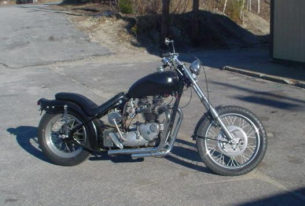
A friend of mine built a chopper from a bunch of parts that came in cardboard boxes.  The end result, well, was less than spectacular.


When I lived in Connecticut as a youth, I shared an apartment with a lot of 20-somethings.  We were in college at the time, and in the basement lived a fellow who was at the ripe old age of 26, and we were in awe of his age and expertise.   We were that dumb.

He bought a motorcycle from a friend for $50.  It came in a series of cardboard boxes.  It was an old Triumph Bonneville that someone, somewhere along the line, decided to make into a wicked chopper, complete with extended "springer" forks, a fender seat, ape-hanger bars, and an iron cross tail light and matching rear-view mirror.   In one of the boxes was a chrome Nazi helmet with a spike the middle.  A complete white-trash starter kit.

My friend started working on it, with the idea that he would assemble it and ride it like in the movie "Easy Rider".  But it was anything but an easy ride.  He spent months just sanding and bondo-ing all the dents out of the gas tank, and I would spend hours with him in the basement, smoking pot, while he sanded that gas tank and talked about how cool the bike would be, once it was done.

As a chopper, it was an exercise in minimalism.  If someone had left this bike unmolested, it would be worth a tidy sum today, and be a head-turner as well.  But back then, in the 1970's, it was just an old British bike, to be sacrificed on the altar of teenaged and 20-something dreams of "mods" and customization.  Today, the same thing occurs, with innocent young Hondas being taken to the torture chamber of teenage mods, with predictable results.  The U.N. Commission on Human rights should do something.  Oh, the horror of it all.

The chopper had no front brake.  That was sacrificed on the altar of minimalism.  So it relied on the rear drum brake for its sum total stopping power.  If you know anything about motorcycles or cars, you know this is a horribly bad idea - 90% of your braking power is in the front wheels, not the rear.  And locking up the rear is a sure recipe for a skid and accident.  But no worries, right?

The front tire and wheel was a thin, almost bicycle-like tire with a bicycle-wheel spoke lacing.  It hardly had anything to it.  And of course, no front fender would mar the minimalist approach to the design.

In the rear was a wide wheel with what appeared to be a dry-rotted studded snow tire, (whitewall, of course) off an old Dodge Dart.  And I am not kidding when I say this.  It was not a motorcycle tire, but a car tire, and would cause problems, down the road.

After about a year of sanding the tank, he finally got the courage to assemble the thing.  He talked long and loud about having the tank done in a metalflake finish with an airbrushed mural of a naked woman on it - he had a friend who did such things.  But of course, every time he had $20 in his pocket, he bought pot, so the tank mural was not to be.

He painted the frame with Rustoleum black, from foo-foo cans.  The gas tank remained primer brown with streaks of red bondo. It was a package.  The sole instrument was a speedometer, clamped to the ape-hanger handlebars, and apparently from a Schwinn.  A tiny headlight between the chrome arms of the "Chopper" forks was the only concession to laws and reality.

While the extended chopper forks had been added, the frame had never been chopped to correct the steering angle.  As a result, the front of the frame rose way up in the air - pointing skyward, while the long chopper forks (and I want to say they were six feet) made a perfect triangle pointing toward the ground.  The whole thing looked ridiculous.  The tiny tank hung off the frame like a pair of retracted testicles.

Sitting on the rear fender seat, one could barely reach the ape-hanger bars, even if you had long arms.  The iron cross taillight was attached to one rear stay.  It was a machine!

He managed to get the engine running.  With two straight pipes, it was loud as hell, even for a 750cc engine.  Clouds of blue smoke came out, with every twist of the throttle.  My friend gunned the engine, a grin appearing on his face, beneath the chrome Nazi helmet and the Rommel goggles.

He let out the clutch and took off.  He wobbled around the first curve, with the rear of the bike doing alarming things - swaying first left, then right.  He zoomed out of sight and we heard the straight pipes echoing from the apartment buildings down the street.  Then silence.  We presumed he went off for a ride and to show off his chopper.

An hour later, he returned, puffing heavily as he pushed the chopper up the hill toward our apartment complex.  "Fucking piece of shit!" he said, "It's fucking un-rideable!"

He had set down the bike about two turns past our complex.  With the extended forks and the oddball steering geometry, not to mention the combination of bicycle tire up front and car snow-tire in the rear, it basically could not be ridden - in anything other than a very straight line.

The bike was a mess - again.  There were dents in the tank and one carburetor was broken off - as was the spike on his Nazi helmet. He skinned his knee and elbow and walked with a limp for a few weeks, but otherwise seemed no worse for the wear.  No doubt, today, those injuries are causing him more than a little soreness in his old age.

He spent the next month disassembling the bike in the basement, promising to "fix" the bike to make it ride-able.  He was going to have the frame chopped and the steering angle changed to match the extended forks.  Or perhaps he would get new forks for it - perhaps not so radically long.

Before long, the chopper returned to the cardboard boxes from whence it came.  And my friend lost interest in it.  He finally traded it for a bag of weed, and that was the end of that.

* * *

A vintage 1968 Triumph Bonneville in original condition would be worth a tidy sum today - and be a piece of history.  But somewhere along the line, some kid decided he had to have a chopper, and used a very unlikely bike to make one.

I suppose today, it might still be around somewhere, revived as a "rat bike" with red painted wheel rims, white wall tires and a bowling-ball-black tank finish.  Probably still un-rideable, though.

It is possible to over-customize and over-mod a vehicle - the point where it basically is no longer functional as a vehicle.  Kids do this all the time, with these "rice racer" mods, that cripple a car to the point where it can barely do 50 mph without losing control.  Slammed suspensions and huge rims may look cool, but often they ride and handle far worse that stock.

And it terms of throwing money away, well, it is just utter waste.

My friend got off cheap.  He paid $50 for he bike, spent only another $50 on primer, black paint, and bondo, and then sold the whole mess for a bag of weed.  Others are not so lucky.  For example, the guy he bought the bike from actually spent a lot of money on extended forks, a Nazi helmet, and an iron cross tail light and mirror.

All I can say is, before you decide to build a chopper out of an old bike, or mod your Mom's old Honda into a race car, think carefully of where you are going.  Chances are, you are going to just destroy what you had started with, but only after blowing through a lot of cash.

And if someone ever offers to sell you a chopper that is in a lot of cardboard boxes, well, walk away.

DO NOT HANG UP!

Telemarketers are back, and blowing through the 'Do Not Call' registry the same way an abusive husband tears through a restraining order.

True Story:  The other day, I get yet another one of those robo-calls that says, "DO NOT HANG UP!  This is not a telemarketer call!  You have selected to receive a FREE GE Alarm System!"

Now, chances are, you've been getting this call, too.  I have had it at least 10 times.  And yea, it is fraudulent, and if you do business with these people, you should not act surprised when you get ripped off.  After all, they have telegraphed, up front, what low-life lying scumbags they are.  They are violating Federal Law by violating the "Do Not Call" act.  And if you do business with them, don't expect it to go uphill from there.

And of course, it goes without saying, if you do business with them, you encourage this sort of thing.

But I like to have fun with telemarketers, so this time, I hit "1" and the following conversation took place.

STEVE (telemarketer):  "Congratulations!  You've won a new alarm system!  My name is Steve and let me tell you about this fantastic opportunity!"

ME (using same over-animated voice):  "Gee! Thanks Steve!  But before you do that, let me ask you a question, OK?"

STEVE: "Uh, sure..."

ME: "Tell, me Steve, have they PAID you yet?"

STEVE: "Actually, uh, no..."

ME:  "That's right, Steve!  And they aren't going to!  You see, Steve, you work for a telemarketing company that has no compunction about violating Federal Law, ripping off their customers, and of course screwing their employees, sometimes literally.  And these folks hire young energetic guys like you, promise you all sorts of riches, and then don't pay you, hoping you keep showing up for work for at least a month, before you finally get wise to their excuses, and quit.  Have you thought about QUITTING, Steve?"

STEVE (whispering): "Well, actually..."


ME:  "Well, this is your LUCKY DAY, STEVE!  I'll tell you what.  Just take off the headset, put it down on the table, get up from your cubicle, and just WALK OUT THE DOOR.  Because you know, Steve, this isn't even a REAL JOB, is it?  In a REAL JOB you get PAID.  And you are just WASTING YOUR TIME at this telemarketing gig - you really can't even put this job on your resume, or let me say, if I was you, I wouldn't!"

STEVE: "Well, I..."

ME:  "BUT WAIT, Steve, THERE'S MORE!  If you ACT NOW, you can actually get your life and career back on track!  You could take this precious time you are spending working for a CRIMINAL ORGANIZATION that WON'T PAY YOU and put it to good use!  You know, a real job, or going back to school.  Even just being unemployed would be better than working for NO PAY!  So, whaddya say, STEVE?"

STEVE:  "Fuck it, I'm out of here!"

ME:  CONGRATULATIONS STEVE!  YOU'VE WON!!!

* * * 

We all have to do what we can.  Who knows?  Maybe I turned his life around.

Saturday, March 3, 2012

Dumbing it Down


Videos of handling equipment at work are hardly instructive as to how things are made.  But this is what the television thinks we are capable of handling.  They want to keep us passive and uncreative.

I was recently watching this show on Netflix, called "How its Made" and I was bitterly disappointed in it.  Why?  Well, the producers seem to enjoy showing mesmerizing video of automated equipment used in high-volume, high production factories, which, while interesting, doesn't really tell you "how its made" at all.

It reminds me, in a way of this Monty Python bit, where they describe how to cure all the diseases in the world, as well as how to play the flute:
Alan: Well, last week we showed you how to become a gynecologist. And this week on 'How to do it' we're going to show you how to play the flute, how to split an atom, how to construct a box girder bridge, how to irrigate the Sahara Desert and make vast new areas of land cultivatable, but first, here's Jackie to tell you all how to rid the world of all known diseases.
Jackie: Hello, Alan.
Alan: Hello, Jackie.
Jackie: Well, first of all become a doctor and discover a marvelous cure for something, and then, when the medical profession really starts to take notice of you, you can jolly well tell them what to do and make sure they get everything right so they'll never be any diseases ever again.
Alan: Thanks, Jackie. Great idea. How to play the flute. (picking up a flute) Well here we are. You blow there and you move your fingers up and down here.
Noel: Great, great, Alan. Well, next week we'll be showing you how black and white people can live together in peace and harmony, and Alan will be over in Moscow showing us how to reconcile the Russians and the Chinese. So, until next week, cheerio.
That pretty much sums up the show, How It's Made.

For example, a segment on cheese-making shows milk going in one end of a factory, and cheese coming out the other.  In the middle are lots of machines moving around blocks of cheese.  You see the cutting and packaging, but the actual process, with the enzymes, is glossed over.  How they clean the trucks is more clearly illustrated.

The show is non-empowering. Nowhere do people appear - running things or doing things.  The message is clear:  You are a consumer.  Our robot overlords make products for you.  Do not try this at home.

And it is a dumb message for a dumb culture.  People can make cheese.  My hateful town clerk runs a cheese factory in her back yard.  I have been to a goat cheese factory in France - and saw people making cheese.  I visited a cheese factory on the Gaspesie peninsula in Canada, and saw people making cheese.  The process is not hard to explain.

And an explanation of cheese-making really isn't complete without the history of it - and our relationship to the cows and the domestication of them.  And perhaps an explanation of different cheese types?  But no, all we get is video of blocks of cheese darting about through stainless steel conveyor belts, finally coming to rest in plastic pouch packages.  Cheese is handed down from the mechanical Gods.  You are little more than a consumer.  Eat your nachos and shut up.

Or take the segment on making CDs.  It goes through the process, spending more time explaining the washing steps than how CDs work or are formatted or how the data is stored (in pits and lands).  All you get from the segment is more mechanical ballet of automation.

CDs are hard.  Machines make them.  You can't.  You are a dummy. 

Why is this a bad thing?  Because it dumbs down our culture - and turns us into passive consumers.  Creating things is "hard" and technology is "difficult" so you might as well not bother, and just get a job in Human Resources or sales.

But it is people, not machines, who make things, and people who makes the machines.  And we needn't dumb down our discourse just to appease the lowest common denominator.  And that is exactly what is going on, too.  Journalism majors and TeeVee producers - themselves having an 8th grade educational level - are scared of technology and believe that "content" will scare off viewers.  "You don't want to confuse people with facts," I've heard them say, "Punch up the story with good visuals and quotes!"

So they think a "Reality TeeVee" show about motorcycles, where people scream and throw wrenches at each other is more interesting than one where they actually explain how they build motorcycles. They tell us that the emotional drama is so much more interesting than real facts, real technology, and real creativity.  And this drags our entire culture down to the level of soap opera.

People can create things - even complex things.  Apple computer was created in a garage by two guys who built a computer.  Geniuses? Hardly.  A lot of people were building "hobby computers" at the time.  Turns out, anyone can do it - people still do, today.

People build their own cars - either through kits, or through their own designs, or by rebuilding old cars from scratch. And often they engineer their own solutions to problems. And yea, they build motorcycles, too, although they don't generally throw wrenches and hissy fits.

And yes, people even build their own airplanes.  The Experimental Aircraft Association is dedicated to the principle that anyone can build their own airplane and should be allowed to do so.  And people do - a lot of people.  And it never ceases to amaze me that folks can spend a few winters in their basement with some spruce and glue and fabric and end up flying through the air later on.

Empowerment.  It is a very wonderful thing, to be able to actually do things, rather than just watch them on TeeVee.  But the powers that be want you to be powerless and clueless, for a number of reasons.  Powerless people are easy to manipulate.  You can sell the clueless idiots who watch Fox News just about any proposition you want to, because they likely are powerless people who are mere consumers, not creators.

So, everyone has an opinion, for example, about the economy.  How many of those opinions are very well informed?  Not many, it seems.  Most folks will vote for the candidate who promises bread and circuses - or $2.50 gas.  They have little or no clue about geopolitics, the laws of supply and demand, or even how the oil business works.  They really think the President gets up in the morning and decides how much gas will cost that week.  And we let these people vote.  Scary.

People ask me, "How do you know how to fix cars?" and I have to say, "Well, how do you not know?" and while that sounds smart-ass, it is essentially a truism.  How can you live on a planet for 3/4 of a Century and not understand even the basics of maintenance of the hundreds of thousands of dollars of machinery that will pass through your hands in your lifetime?

And the answer is - willful ignorance coupled with our "dumbing down" society.  Many folks act like ignorance is something to be proud of - as if soiling your hands with labor or your mind with knowledge is only something the "little people" do.

We built a studio in the back yard last year, and it is really a small factory that churns out ceramics.  People act amazed we built the building.  But it turns out, anyone can built a house.  All you need is a hammer.  for millions of years, we built our own shelter, made our own clothes, grew our own food.  Today, these skills are lost - and we are told that only "experts" with machines are even capable of it.

People act amazed when Mark makes a pot.  "How do you do that?" and the answer is, the same way our ancestors going back thousands of years made ceramics - which were essential for daily living.  It ain't real rocket science - you take clay out of the ground, shape it, fuse it in a kiln, then glaze it and then fuse it again.  voila.  Doing it well takes talent and experience, of course.  But the basics are not beyond the capability of anyone.

No doubt, if the producers of "How It's Made" did a segment on this, it would show lots of automated handling machinery and huge railroad-car-sized kilns, with the subliminal message of, "You can't do this, only big companies can" - and show stacks of bland and uncreative ceramics filling tractor-trailers.   Yea, we need this mass-produced stuff, but seeing how it is made is not very instructional - or empowering.

As a Patent Attorney, I see all the time, how great inventions are created - by people, often like you and me.  And the difference between and inventor and a consumer is often only that no one told the inventor he couldn't do something, or not to try, because it is too hard.

Unfortunately, more and more of our society is dumbing down.  Real information is hard to come by, and the major media outlets program more and more superficial information and intentionally edit out anything that seems difficult to understand, lest they "lose the audience" with "boring details."

And this yet another reason why I say not to watch television.  People ask me, "How can you stay informed, if you don't watch the news on TeeVee?" and I ask them the opposite, "How can you stay informed by watching this drivel?"

Seek out the hard information, the detailed facts, real information,  It is hard to do, but it is where the money lies - in learning things.  Don't waste your time with superficial crap, celebrity gossip, or these "Reality" TeeVee shows.  Fill your brain with garbage, and you will remain poor and powerless your whole life.

It never ceases to amaze me, how I meet people who know every detail on the background and status of every character on a Reality TeeVee show, like America's Idolatry or whatever, but have no clue what the balance is in their checkbook, or how to change the oil on their car.

It is a matter of priorities.  If you dumb down your own life, you have no one to blame but yourself, when you become a passive consumer and are powerless to control your own life.

Do the hard thing.  It pays off handsomely over time!