Saturday, October 25, 2014

Viewer Mail: Is A Mortgage A Hedge Against Inflation? Huh?

Note:  This is an older draft post that I just got around to editing.


People use a lot of odd self-justifications to justify going into debt.


A reader writes:
"What are your thoughts on this article?   Particularly, what are your thoughts on comment #125 by csdx?  I quote, "By having debt, you’re in effect getting something at today’s price while paying for it with your future dollars which are devalued due to inflation. Thus a mortgage can act as a hedge against high inflation."
Is paying cash for your house always the smartest way to go about it?"
I think I addressed this in my opportunity cost article.  

The opportunity cost argument goes like this:  If you get a mortgage at 5% interest, you could take that money you would have used to buy the home and put it into stocks and earn 10%!!! By paying cash, youa are foregoing the opportunity cost of investing all that money!

There are two flaws in that argument about opportunity cost and hedge against inflation.   Actually three.  Well, really four.

1. Opportunity cost is a great argument for businesses to make, but a lousy one for individuals to use in their personal finances.  Usually people trying to lend you money make this argument.  Don't listen to them.  Why?

2.  Because comparing stock returns, which are very risky, with the guaranteed rate of return of not paying interest, is comparing apples to oranges.  Not paying 4.5% interest on your mortgage is like getting 4.5% interest on a Certificate of Deposit - zero risk involved (ask your bank for a 4.5% CD and when they stop laughing, they will ask you politely to leave).  Stocks CAN have a greater rate or return, or, like my GM stock, they can go down to NOTHING.

3. Let's face it, that mythical money you are going to "invest" doesn't exist anyway.   What you are doing is borrowing - and borrowing more than you need to - and then trying to make yourself feel like a financial genius by tossing around terms like "opportunity cost" and "inflation hedge".  A better idea is to minimize the amount of money you borrow.  Borrow what you need, not what you want.
4.  Because you can end up losing all your money - or a lot of it - in stocks, and at the same time, see your house decrease in value by half, while the mortgage debt remains the same.  Suddenly, you are upside-down on a mortgage, and broke as well.  Whereas you could have had a paid-for house that would be worth something - or at least not be upside-down.  This is why, in the olden days, you had to put down 20% as a down payment.

Is this last flaw a far-fetched scenario?  Not really, it happened to a lot of people in February of 2009. They lost their shirt in the stock market and foolishly sold out, locking in their losses.  They owed more on their houses than they were worth.  So much for a "hedge" against anything.

I could see someone making that argument in 2005.  But today?  We know better.   People use arguments like this to self-justify serially refinancing their home or taking out equity to pay off credit card debt.  Or, more than likely, they are just parroting what some mortgage broker told them.   People selling you debt are the last people you should take advice from!

The "hedge against inflation" argument falls along the same lines as "opportunity cost" arguments.   Yes, for big businesses, such arguments make sense as they are making investments with their cash-flow which in turn generates profits.  For the individual, they make less sense.  When you borrow money to spend you are just spending, not making money.  And no, you don't "make money" on your personal residence - at most you just get your money back.   The average homeowner moves every five years, not every thirty.   As a result, the effects of inflation are not felt by most of us, unless we stay in the same house for at least a decade or more.

And in case you haven't noticed, inflation has been at all-time lows recently - which is one reason interest rates are at all-time lows.   When we had 10% inflation back in 1980, mortgage rates were 14%.   You see, interest rates already factor in inflation.  If banks didn't do this, they'd go broke in a heartbeat.  So I am not sure that a mortgage is a "hedge" against anything.  If anything it is just a risk you take, and risks are not hedging.

Usually, for people who make these "opportunity cost" arguments, the point is moot.  They are in debt up to their eyeballs and have no cash to buy a home.   So they use these types of arguments to make themselves feel better about their situation.

They aren't flat broke - they are hedging for inflation!  Right?  Riiiiiight! 

As people found out in 2009, if you do this, and the stock market tumbles and your home value tumbles, you end up losing all your money AND are now heavily in debt.

Or, you end up with $300,000 in your 401(k) and a $300,000 mortgage.   In theory, you are even-steven, but you can't cash in the 401(k) to pay off the mortgage, without incurring huge penalties.

There are a number of factors involved.  Generally, my thoughts are this:
1.  For self-employed people like me, who never know where the next paycheck is coming from - or indeed if there will be one, signing on to a large debt-train is a bad idea.  That debt has to be serviced, regularly.

2.  For young people starting out, the point is moot - they don't have the money.  They get a  mortgage because they have to, not because of some opportunity cost theory.

3.  If you are approaching retirement, a paid-for house is a safe investment.

4.  Comparing 10% in the stock market (risky investment) with the 5% you save on mortgage interest is comparing apples to oranges.  Stocks fluctuate - they can go down to zero.  Not paying 5% interest is a 100% guaranteed rate of return, like a government bond.

5.  If you pay cash for a house, the $1500 a month you save on interest (for example) can be invested.   So it is not like you will have no savings.  And a paid-for house is one heck of a safe asset.
All I can say is, not having a $3000-a-month albatross around my neck is a great thing.  I can work less now, and not worry if there is no work (a lot of that going around these days).  And as I lurch toward retirement, I am more confident that I will survive.  I can live on a little more than $20,000 a year at this point - if need be.

Granted, few people can afford to pay cash for a house.   That is not my point.  My point is, borrow as little as you can - what you need, not what you want.  Avoid the temptation to serially refinance, but instead, work toward paying down the mortgage over time - with the goal being eventually being debt-free.   Perpetual debt is not a hedge or an advantage.  It grinds on you and limits your options.  It is mortgaging your future, quite literally.

All that being said, mortgage rates are very low right now, and if you qualify for a low, fixed-rate mortgage, it is a good time to do so - if you need to borrow the money.

But the mortgage being a hedge against inflation?  Even at 4-5% interest rates, you will pay twice the purchase price of the house, over time, once for the principal, and once again for the interest.

It is a personal decision, based on your personal circumstances.  My suggestion is to borrow what you need, and avoid the temptation to go heavily into debt for granite countertops and a "look-at-me!" house (or car, or whatever).

I think the fellow who made this argument is really saying that he doesn't have a lot of cash, and "opportunity cost" and "hedge against inflation" arguments are reassuring to him that he is being smart about money.  But he is only deluding himself.

Having money is better than borrowing it - bottom line.

Home Improvements versus Shittly Little Projects

You can bankrupt yourself, $199 at a time, at a place like this.


We are in the process of replacing the windows on our house.   We are doing the labor ourselves, which saves a lot of money.   Replacement vinyl windows are cheap - about $100 to $200 apiece.   Many companies want $500 to $1000 per window, if they install them.  It is not hard to install these.  Cut off a piece of exterior molding and the old "cartridge" windows pop right out.  The new ones slide right in, are secured in place, and then the molding trim is replaced.   After you've done a few, it goes quicker and quicker, as you start to get a system in place.

Why replace the windows?   Well, the old ones are made of wood - and are 40 years old.  Wood needs to be painted periodically.  Wood windows stick and bind and are hard to open (which encourages homeowners to turn on the A/C when they should be opening a window).   And the single-pane glass lets in a lot of heat in the summer (and lets it out in the winter) and also transmits a lot of noise as well.   When you replace old single-pane glass windows with thermopane vinyl windows, the first thing you will notice is how quiet your house is.

How much will the project cost?   In reality, nothing.   You see, the energy savings of replacing the old, inefficient windows will pay for the cost of their installation in just a few years.   I only wished I had done this sooner!  This is a home improvement which is actually an improvement.

Project like this -  major home improvements - help maintain the value of your house and also can reduce energy costs.   Yes, they may even increase the value of the home - although usually not by more than half the cost of the project.

And the prevalence of "big box" home improvement stores has made it easier and cheaper to do such projects, which can be a big savings for the average homeowner.

But many folks go to home improvement stores to do what I call shitty little projects.   These are the kind of deals that are hyped on the end-caps of the aisles.   Little weekend jobs that always seem to cost $199 on your credit card, which provide the appearance of home improvement, without actually improving anything.

Yard projects are a case in point.   I have a friend who obsesses about their lawn and yard.   And every weekend (and most weekdays) they are in their yard, raking and weeding and mowing and trimming.   They even hire a guy to help them with these projects.

What sort of projects?   Well, you know, birdhouses, fountains, and other tchotchke that clutters up the yard (and makes mowing and maintenance more of a hassle).  Little half-assed patios scattered around with seats that look inviting but that no one sits in, ever.   Attempting to turn the yard into a garden spot - and then going inside and watching television for 5 hours a day.   What's the point?

When the house is sold, its value will be in the age of the roof, the hot water heater, the furnace and air conditioner, the type and condition of the floors, the windows, and the kitchen appliances.  Oh, and of course, the location as I found out when they bulldozed my house into the ground. 

You see, I know all this because at one time, I made the mistake of doing shitty little projects myself.  We had lawn lights everywhere, along with a drip irrigation system.  We had tiny gardens spread here and there and patios with seating areas that no one sat in.  We had a Koi pond that no one looked at.   It was kind of neat and fun but it all cost a staggering amount of money to build and a staggering amount of labor to maintain.   And it all was done, one $199 credit card charge at a time.

Yes, I refinanced my house to pay off a credit card bill that was rung up for lawn lights - at least in part. I learned my lesson - no more weekend warrior projects.  No more shitty little projects that just waste time and money and add no real value to a home - nor maintain it.

You see, no one wants to buy a house that is cluttered with junk like this.   To most folks, a spectacular garden says one thing - weeding nightmare.    And most folks are right.   We had a spectacular garden in Virginia and it was a maintenance nightmare.  We went away on vacation more than once, only to return to three-foot-high weeds.    And stupidly, we replicated this (on a smaller scale) in our vacation home in New York.   Do the math on this: garden + vacation home + vacant for six months = yard-high weeds when you get back.

It is just cheaper and easier to have simple plantings that do not require a lot of constant maintenance and intervention.   The "showplace" home with spectacular rose bushes (or whatever) is not worth a penny more than the house with ordinary shrubs (that need trimming once every other year, at most).

My friend who does the shitty little projects complains all the time that he is broke and can't afford things.  "I can't afford to replace my old car" he sighs, while forking over money to his hired hand and writing out a check to VISA for the latest load of mulch he bought last week at the big-box store.   Maybe if he got that plastic edging to go around the new plants?   Hmmmm.... that might look nice!

It is very easy to get caught up in these sorts of projects.   A house can be a real money pit if you let it become one.   In a way, it is like teens and 20-somethings who squander money trying to "mod" a car  while ignoring basic and essential maintenance.  The secret, I think, is to think of your home in terms of a landlord - and perhaps after being a landlord, this is easier to do.   When you own a number of properties, the idea of high-maintenance "improvements" loses its allure rather quickly.   What does appeal to you is reliable appliances and infrastructure that do not require your constant intervention.

I want to do things not own things at this point in my life.   And I certainly don't want to bankrupt myself by spending every weekend dragging home crap from some big-box store and laboring in my yard.

What is it with Men and their Dicks?

This morning, someone sent 56 messages to my inbox, only minutes apart, advertising Viagra and Cialis.  Of course, I long ago created an e-mail filter that sends any e-mail with the words "Viagra" or "Cialis" to my TRASH box.   What is it about men and their dicks that gets them so worked up?  Click to enlarge (pardon the pun).


Viagra is one of the most popular prescription drugs on the market.  It has made its makers millions, if not billions of dollars.   And for some reason, it is the number one drug advertised on the Internet, even though it is a prescription drug and you can't buy it without a prescription.  I suspect that they are not actually selling Viagra, but are instead trolling for data - hoping some chump clicks on the e-mail and then forks over his credit card information on the hope he can get a boner pill.

Why do internet con-artists use "Viagra" as a come-on?   Probably because a lot of men are too embarrassed to go see a doctor and get a prescription for the drug.  Probably also that a lot of people use the drug recreationally - that is, without a prescription.  Viagra pills are handed about or sold with impunity - the Police have better things to do with their time than go after illegal Viagra sellers.

And of course, pharmaceutical companies like this just fine.   The big pharmaceutical companies know that they sell more Viagra (and its equivalents) than there is a legitimate market for - just as they know they sell an awful lot of Oxycontin and other opiates and derivatives than there are legitimate patients for.  The illegal drug market in the United States is more and more marked by the illegal sale of legal drugs.   The companies know this - and turn a blind eye.

But it beggars the question - who buys this stuff and why?   I know some folks who passed around "the little blue pill" which they "got from a friend" and decided to try.   Did they have erectile dysfunction?   Of course not.   But they felt that somehow this pill would enhance their sexual experience or make them more virile.

And that is men in a nutshell (pardon the pun).   They are obsessed with their penis.  From the time a prepubescent boy discovers that it "feels good if I touch it there" (and his horrified Mother tells him to stop!) they cannot leave it alone.   They worry that it is too small, too big (not very often), curves to the left, or right, or that one testicle is larger or hangs lower than the other (all are very normal, relax).   And then they worry about their performance in bed (or don't worry, much to the chagrin of women everywhere).  They are obsessed with their dick.   And as many women note, they seem to think with it.

Marketers know this.   And that is why you can sell monster trucks (what we call "penis enlargers" - they don't work, though) to idiots who feel the need to bolster their manhood.   We saw one the other day - a crew-cab Ford dually with a lift kit that was easily a foot.   It looked ridiculous.   He clearly wasn't towing anything with it (now with the lame "adjustable hitch" he had on it) and the back of it was full of trash.   He was commuting to work in it.   This is a truck whose only real use is in towing a 10,000 lb. trailer, and even then, a 12" lift kit kind of defeats that purpose.  It was a clown truck, really.

Men's anxiety about their dicks sells a lot of products.  So-called "Penis boats" are a case in point.  Without this anxiety, the motorcycle industry would disappear entirely (while many women enjoy motorcycling, it is predominately a male sport - and a rather misogynist one at that.  Women are viewed as mere passengers only, by most men).  Penis anxiety is what gets men to buy the biggest and baddest motorhome on the lot.  And it sells a lot of muscle cars, as well - and let's not forget off-road buggies!

Note that all of these are "big ticket" items than can bankrupt a middle-class person - or at the very least put a huge dent in their net worth (and retirement plan).  That is how powerful the pull is (again, sorry for the pun).   Men just can't help themselves, it seems.   Even for the younger crowd - who might not have as much money to spend, penis anxiety sells a lot of bolt-on automotive accessories, which are usually designed to make a pedestrian car louder and more ugly (but rarely faster).

But on a daily basis, men are marketed to on the basis of their penis anxiety.   Things like beer, liquor, aftershave, and the like, are sold on the basis of how manly they will make you feel or how sexually attractive.   Old Spice is running a spot now where a very poorly designed robot is fawned over by women, after he applies Old Spice.   The message is clear:  Even the most unattractive man with the tiniest penis, will be sexually attractive if he applies this aftershave.   The folks at Axe Body Spray have been playing on this post-adolescent fear for a long time.

The marketing business knows it can sell just about anything to Men, if you approach them the right way.  The old saw that "the way to a man's heart is through his stomach" may be true.   But the direct line to his cerebral cortex is through his penis.   Once you yank his wanker, you have him hooked on whatever product you want to sell him.

And that is why marketers love young men, age 16-35, as you can sell them just about anything - even the idea of charging a machine-gun nest.  Men are brave.  Men are strong.  Men are idiots.   Nothing works better - for other people - than a strong back and a weak mind.

So, what is the point of all this?   Well, as a man, you can save yourself an awful amount of grief in life by simply owning up to this fact - that you are caught up in your genitalia, and that it dominates your life.  Be aware of this and be aware when the marketing types play to your weakness.   They will try to sell you things (boy howdy will they try to sell you things!) based on your need to assert your masculinity.

Once you are safely past the age of 35, or even 40, the siren song of marketing starts to fade.   Perhaps because you have family responsibilities now, or perhaps you are thinking more and more of retirement.  Whatever the reason, it is a lot harder (but not impossible) to sell monster trucks and other "penis enlargers" to older men.   Thus, if you can resist the temptation to be wanked by the marketing department during those vulnerable years, it will pay off for you in the end.   And trust me, you are missing nothing by not buying a penis boat or a monster truck.

But what about women?   Well, if you marry a man (or even date one) keep this in mind.   Men have this need to be validated for what is between their legs.   While they appear to be brave and strong and stoic (or so goes the mythology) in reality they are incredibly vulnerable beings.   They usually express their fears and frustrations in violence, not tears, however.   If you decide to take up with a man, expect him to come home at least once with some bonehead idea like buying a Jeep or a motorcycle.  While these may be fun toys, the cost of them probably directly conflicts with your plans of having a family, buying a home, and saving money for retirement.

And handling this is tricky.   You don't want to be seen as the harridan who spoils all the fun - the Marge Simpson to his Homer.   But there are other options, besides signing loan papers on a rapidly depreciating powered toy.   Get him to buy an older bike, for example, and he can spend the winter months restoring it in the basement.  Far cheaper and safer than him actually riding it.   You can be creative and have hobbies and toys at a much reduced expense.  Be supportive without being a doormat.   Set a budget for such things and stick to it.

And when he turns 35 and loses interest in the "must have" toy of a 28-year-old, well, for God's sake, sell it.

Friday, October 24, 2014

The Threat of Deflation - You're Kidding Me, Right?


Is deflation really a threat?  Get Real!


There have been a lot of articles as of late (and over the last five years) about the "threat of deflation".   Deflation is a threat?  Get real!

Please, I am looking forward to retirement and living on my savings.  Deflation would be a blessing!

Deflation is not a threat.  Why?  Because first, the vaunted "threats" from deflation are nonsense.  Second, deflation ain't gonna happen to any great extent, period.

Let's look at the first issue.  The geniuses who write these articles about deflation barf up, intact, the same party line.  "If prices drop, people will stop buying, as they will see that prices will be lower in the future and thus delay purchases."

Really?  You think people really think that way?  In the supermarket, they are holding a loaf of bread in their hands and saying, "Gee, I think I will wait until tomorrow to buy this loaf of bread, as it will be cheaper then!"

This is a classic example of economic theorists who don't understand human nature.  If you are hungry, you buy a loaf of bread.  You are less concerned about the Future Value (FV) of bread than the fact you are hungry.

And this applies to larger purchases as well.   People buy cars, washing machines, air conditioners, refrigerators, computers, or a pair of blue jeans because their existing product has worn out.  They don't sit around like economists and make predictions about the prices of products in the future for the simple reason that most people have no clue how prices are trending.   If your car needs an engine overhaul, chances are, you are in the market for a new (or newer) car.   You don't buy a car on the premise that you'd "better buy now because they'll be more expensive tomorrow!" and you don't throw a rebuilt engine into a junker because "you might as well wait, as prices will be lower tomorrow!"

In fact, it works just the opposite.  During the last recession, when prices of cars were flat, and the prospect of higher prices seemed dim, people threw money at their older cars to fix them because they could not afford a new or newer car.   When the economy recovered, people bought new cars (and boy-howdy did they buy new cars!) because their old clunkers were really past their prime.  That is what drove sales, not some theoretical philosophy about price trending.

The idea that the average consumer can perceive price trends and then act in accordance with them is just nonsense.  People buy goods because they need them, for the most part, or they want them and believe they can afford them.   Future Values just don't register in their brains.

The second half of the equation is that deflation just isn't going to happen.   Yes, the cost of producing a lot of goods has decreased over the last few decades, thanks to China.   But the cost of energy has kept up with this pace, and as a result, prices keep going up every year.   And those folks in China, India, and other 3rd world (or 2nd or 1st?) countries who are working for low wages, are starting to demand increases and thus the cost of such goods cannot remain low indefinitely.

Yes, the growth in the population has slowed.   But it is still growing.   And that means that demand for every product, from corn to iPhones, is on the rise, which means that prices will continue to rise, albeit more slowly.   Deflation?  Maybe if a plague cuts the world population in half.  Maybe.

So what is behind this deflation gloom-and-doom?   Well, alarmist articles sell newspapers (or capture eyeballs or click-through revenue).   So if you give unconventional wisdom, people will bite on it.  It also sells newspapers if you can make alarmist claims - people bite on bad news more than good.  So if inflation goes up, you tell people how rotten it is than inflation has gone up.   If inflation is flat, you tell them how rotten it is than inflation is flat.  And if there is a possibility of deflation, well, you tell them how horrific that would be as well.

(And these articles about deflation pop up about every year or so, like clockwork, when there is a slow newsday.  If you google "deflation threat" you see articles arguing that deflation will wipe us all out - dating back every year for the last five years.)

Hmmmm... So when exactly are things going OK then?   I mean if inflation is bad, deflation is bad, and no inflation is bad, that means everything is bad all of the time, right?

Oh, right, that's the definition of reality, as viewed by the news media.   Bad news sells, they know it, and you bite on it.

Stop biting.

Obama's Dirty Little Secret!

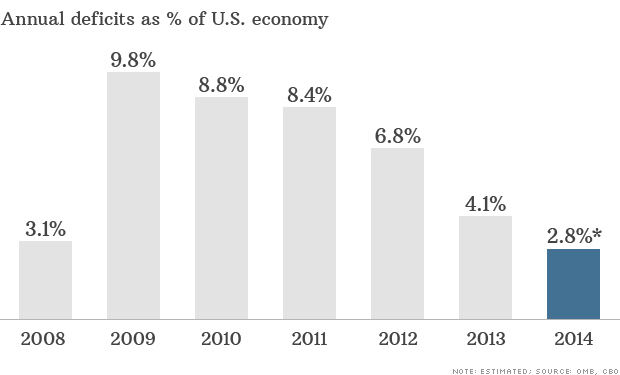
An Improving Economy and Decreasing Deficits.  Brought to you by, the President with the lowest approval ratings since George Bush!

People like to bash Presidents like Pinatas.  Why not?  They are easy targets.  Blame them for everything that goes wrong in your life!   But give all those S.O.B.'s in Congress who actually make the laws a free pass, OK?  Particularly the odious bastard from your district that you voted for.

The untold story of the last five years is that since the market crash of 2009, things have been getting better and better.   If we had a Republican in the White House over the last eight years, we would really be in the shitter.   See, e.g., Herbert Hoover.   You see, when the economy tanks, it is no time to cut back on spending and lower taxes.  But that is what Republicans have been clamoring for since Obama took office.

Good thing they didn't get their way.

Because in the last five years, the stock market has been on a tear - a bull market, as they say.  Not spectacular rates of return, but more than adequate.

And unemployment has dropped considerably, to the point where it is at levels that are considered "normal" in most economies.   But no one seems to notice this.

And government spending?  Well, our deficit, in terms of percentage of GDP, has dropped every year for the last five years.

Funny thing, the news channels never talk about that.   All they talk about is the three people with Ebola or some idiot with a gun who shot somebody in the name of Islam.   Yea, that's a real threat to our society - issues that affect less than a dozen people in our country.

We fail to see the larger picture.   We like to think of ourselves as "put upon" and under stress.   After all, we are just living "paycheck to paycheck" - hardly able to pay the credit card bills for our take-out meals and cruise-ship vacations, right?

Right.

The reality is, the vast majority of Americans have it pretty swell, but they don't want to admit to it.   Because admitting that things are good is somehow bad.   Everything has to be rotten, all the time.

Maybe America is smoking pot?   I dunno.  I just don't get it.   If current economic conditions are not to your satisfaction, I submit that absolutely nothing in this world will ever, ever make you happy.

You have the highest standard of living on the planet and are still unhappy.

Maybe the problem isn't Obama or the Republicans or the government or Islamo-fascists or Ebola.

Maybe the problem is YOU.

Think about it.