Thursday, March 30, 2017

Slow News Day - More Press Release News


Never confuse a press release with news!


"Fake News" has taken on multiple meanings since the election.   Before the election, it was the blatantly fake news sites run by people out of their spare bedrooms in silicon valley or teenagers in Macedonia or wherever, who put up outrageous stories and then profited from the ad revenue from Google.   Ahhh... the good old days!  Only months ago.

The Trump administration turned this on its head by calling all news fake news, or at least news they didn't like.   As I noted in an earlier posting, the news media makes decisions about what does and does not get reported, so like all of Trumps lies, there is always some nugget of truth they can point to that exists at the core of his lies, covered with layer upon layer of Trump liar frosting.

Today in the press, another press-release news item.   These pop up regularly, about once a month or so.  Someone puts out a press-release with a compelling image or even an animation.  I may be "floating island cities" or "rotating skyscrapers" or "air powered cars".   Today it is the "U-shaped skyscraper" that is being built in New York City and will change the skyline of Manhattan forever!

Well, it would, if it were being built.   If you google the firm name, "Oiio" you get the same damn press release for pages on Google - all in different journals, barfed up verbatim.    If you go to the company site, you get "awards and exhibitions" but it is not clear they have actually built anything other that art installations.

Usually, skyscrapers are built by developers, who hire architects as the second stage in the development.   This idea, like the rotating skyscraper press-release news item is a design from a studio with no clear experience in skyscraper design or construction, with no client in mind for the project.

But, it has a compelling graphic, and today, with photoshop and other tools, you can make graphics that appear to be actual photographs.   Some of the "ideas" on their site appear to be finished projects, until you read the fine print and realize the photo is not real, but photo-shopped.

What's the harm in this?  Perhaps none.  But like clockwork, today some yahoo I meet on the street will say, "Didja here the latest? They are building a U-shaped skyscraper in Manhattan!"   And maybe that is the harm right there.   The press-release uses vague language (hallmark of the passive-aggressive) to imply this skyscraper actually will be built.  The media glosses over it even more, because it sells the story (Much as "passenger thrown off United plane!" sells more eyeballs than "employees traveling on free pass violate dress code rules for employees!"  Accuracy is sacrificed for ratings).

And we see this all the time with the "legitimate" media.   The New York Times is not a "fake news" newspaper.   But to argue they don't slant stories a certain way and make careful choices as to what to hype and what to suppress is to be foolish.

The problem is, people either start to believe foolishness like this skyscraper, or they stop believing in the media altogether.  Suddenly, real fake news like Breitbart seems plausible.

Will this skyscraper be built?  I doubt it.  A design that predates a customer is a hard sell.  Also the aspect ratio of this design is troubling.   Very thin and tall, how would it withstand high wind events and even mild earthquakes?   If you want to go tall, you have to have a solid core structure, not a thin, cane-like one.   But hey, that's just me being a pesky Engineer again.   When you take courses in statics and dynamics, as opposed to art and design, your have all this annoying "facts" rattling around in your head.

Press-release news annoys me.   But it is not the fault of the companies putting out the press releases, but rather the news media who reprints them almost verbatim without doing any sort of vetting, investigation, or even a phone call or two.   At least a couple of media outlets asked a few questions about the "rotating skyscraper" guy and did report than he never designed a skyscraper before and did not have a client for the project.   Even that mild level of curiosity seems to have eluded the media this time around.

Not Enough Indians....


Journalists are still using backward-looking statistics to prop up the idea that college is a panacea for all our nation's problems.  Click to enlarge.


In a recent article online, I read some snotty comment from a journalist that while some people are questioning the value of a college education, these claims have clearly been dis-proven by statistics that show college graduates make 50% more than non-college graduates over their lifetime.

The actual quote is this:
More than 25 percent of people in their 30s who have attended college at some point have no degree — neither a community-college degree nor a bachelor’s degree. They fare vastly worse in the job market than their counterparts who do graduate (despite all the overwrought commentary claiming that education is overrated).
Overwrought commentaryIs she talking about ME?

What irks me about these sorts of statements is multi-fold.   First, you are not a statistic, and the Left loves to use statistics about people to pigeon-hole people for life.   Second, this statistic is old and based on old data.   To figure out someone's lifetime income, you have to wait, well, a lifetime.   That someone who graduated in 1960, 1970, 1980, or even 1990 made more money that a peer who did not is not really helpful in evaluating the value of a college education today.   And college is radically different today than in the past, as we shall see.

The other problem with statistics is that they assume all college educations are equal and that a college degree is a fungible commodity - that a 4.0 from Harvard is the same as a 2.5 from Community College, or a "phone it in" from a "for-profit" University (the latter an illustration of how college has changed since the authors of these condescending articles graduated).

As I noted in an earlier posting, as a college dropout from General Motors Institute, I was able to find better-paying career positions than my brother who had a B.A. in "Communications" from Syracuse University.   He bummed around trying various "jobs" that were not really jobs at all - working at call centers (telemarketing) for a freezer-scam company, and even selling vacuum-cleaners door-to-door in a short-lived venture.  He struggled with a college degree.

Meanwhile, I landed a salaried position with United Technologies Carrier, working in the lab, with full medical benefits, a retirement plan, and even a tuition-reimbursement plan to send me back to college.   A dropout from an Engineering program has more job prospects that a graduate in "communications", liberal arts, philosophy, or whatever.   All college degrees are not alike.

The theory the Left is selling - and it is past its sell-by date - is that we can lift everyone out of poverty by getting everyone a college education.   And clearly, liberal arts majors are falling down in math, statistics, and probability when they make statements like, "College graduates make 50% more than non-college graduates, so if everyone became a college graduate, everyone would make 50% more!"

But 50% more than what?   If everyone goes to college then they can't make "more than" the non-college grads, as non-college grads would cease to exist.   Simple logic, but it eludes the Left.

As a result, college degrees are worth less today.   A college degree isn't worth as much as it used to be, as so many people are going to college.  You can't simply elevate everyone from the factory floor to the executive suite.   Someone has to do the bottom-level jobs.

We are seeing this today.  Trump wants to kick out all the Mexicans, but meanwhile, the construction industry is lagging as no one wants to work construction anymore - at least not native-born Americans.

Meanwhile, in some flophouse somewhere, a young millennial sits and smokes pot and laments the fact there are no "good paying jobs" with a future left - for someone with his credentials from Useless Party University.   How can he pay back his student loans without some six-figure salary job that he is entitled to?   His experience negates the philosophies of leftist newspaper journalists.   And likely that unemployed millennial has a degree in journalism, ironically enough.

The problem we have today is not the lack of blue-collar jobs (as Trump posits), but the lack of blue-collar workers.   One of the myths about immigrants is that they take jobs "no one else wants to do" like dishwasher, lawn service, home cleaning, or picking crops.   Migrants, we are told, are taking only sub-minimum wage jobs and working under the table. 

The reality is, the number one job (outside of the service sector) that migrants are taking is in construction.

And the reasons are not hard to fathom.   It is seasonal work, it is easy to "hide" on a construction site, as you may be working for only a day or two for a subcontractor.   Subcontractors can easily bring in day-laborers and skilled illegal workers without the knowledge of the general contractor.   And many migrants from Latin America have solid construction skills.

Hiring "American" workers is harder to do.   As I noted in an earlier posting, all you need is an old dented pickup truck and a circular saw, and you are a "carpenter" of sorts.   And it is not hard to get jobs framing up a house.   But Contractors know that the first week of deer season and the first week of fishing season are unofficial holidays in the US for construction workers - half your work force disappears during that time period - leaving only undocumented Mexicans at the job site.

But it is a job that can turn into a career if you apply yourself.   I have friends who started out putting up sheetrock or framing houses and went on to starting their own businesses, doing remodeling jobs and eventually becoming home builders themselves.   The sky is the limit, limited only by your own abilities and ambition - something lacking in most people.

And that's OK, too.   What the "everyone should go to college" crowd fails to realize, is that you can't run a company or a country or an economy where everyone is an executive with a corner office and no one actually does the work.   Well, at least not until the robots take over.   The problem in the labor market today is that we are graduating people with useless and expensive college degrees, with the promise that all that hard work and student loan money will pay off in the end.

And it will, for some.   Doctors, Lawyers, Engineers might recoup some of these expenses - although the Lawyering field was a bit overstaffed in recent years and not every lawyer makes a lot of money these days - some in fact are starving, not literally of course.   But others with degrees that are academic in nature are less inclined to see the payback moving forward into the future and not looking back into the past.   Yea, sure, my elders made out OK with their liberal arts diplomas from 1968 or even 1978.  Today is a different world and colleges are graduating people who can barely read and write.    College is the new High School and often is failing at even that.

It will be interesting to see, 30 years from now, whether this statistic "college graduates earn 50% more than non-college graduates" holds up.   In other words, statistics about old people are really not helpful to young people.

But people are not statistics and there are plenty of folks out there who do not get college degrees but still succeed in life.  You may be one of them.  Success depends less on some diploma, but rather on your own talents and ambition.  The most useless person in the world with a college degree is not going to land a job just because they went to college.  The smartest guy in the room will succeed, college degree or not.

It is funny, but almost every big name in the tech sector today - the people who the liberal press salivates about, is in fact a college dropout, as the infographic above illustrates.  It literally is a Who's Who of the leaders in the tech sector today.

The media hangs on every word that Bill Gates or Mark Zuckerberg say about the future of technology.   Then they go back to the newsroom and pound out another piece about how college-is-everything and the key to life and the key to eliminating income inequality or whatever.   They fail to appreciate the irony that the richest people in the world are often not college graduates

A college degree qualifies you to work as a clerk in the office of the really rich guy who dropped out of college, if it qualified you to do even that.   College doesn't teach success, it rarely teaches even skills.  Today, it barely teaches math and reading, but instead stuffs people's heads with ideas about entitlement and "gender studies" or whatever trendy topic-du-jour that academia is keen on but the rest of the world is scratching their head about.

The article accompanying the infographic above includes this startling quote:
Today a college degree is worth $365,000 for the average American man after subtracting all its direct and indirect costs over a lifetime. For women — who still tend to earn less than men — it’s worth $185,000. If the decision to drop out or not boils down to economics, all you need is compare those numbers with what you could do with the money you are spending on tuition now.
Ouch.  Is $365,000 worth borrowing $100,000 to get?  Considering the future cost of money?  Considering compound interest?  And yes, this is an example where opportunity cost kicks in.  Could the money spent on tuition be better spend founding a business or buying your first home?

"But Bob!" you say, "You went back to college, got a law degree and ended up successful!  You made over a million dollars as a Patent Attorney!"   All very true, of course.   But I made far more as a landlord and as a Real Estate investor.    And if you throw in what I made by investing in stocks and bonds, I easily made more than twice what I made as a professional or could have made had I kept practicing, in these other activities.

College was a good deal for me, but I could have made as much if not more in other endeavors - and in fact did.   College is great, but not necessary for success.  And just any old college or any old degree is not a guarantee of success as the Left postulates.  (Why does the Left hype college so much?  Because if you go to college you are more likely to vote Democratic whereas if you don't you are more likely to vote Republican.   Maybe indoctrination is one reason why the Left loves to push college as a panacea for the nation's ills).

Borrowing huge sums of money at age 18 to get a useless degree is not a good idea, in my opinion.   Having the government (taxpayers) fund four-year party schools for everyone is an even worse one.  The problem with college can't be fixed by throwing more money at it or getting more people to go or to graduate.   That is the problem with college.   We've decided to allow "funny money" into the process, encourage everyone to get a college degree, needed or not, and then chained them to a lifetime of debt payments.

The price of college has spiked because of this funny money.   Cut off the flow and you kill the beast.   Colleges, if they had to compete on price, would have to cut costs.   And when Deans and Chancellors are bringing home seven and eight-figure salaries, it isn't hard to figure out where to cut the fat first.

Wednesday, March 29, 2017

The Trump Recession

Living Stingy: Is Donald Trump Diabetic?
Donald Trump may find himself presiding over a recession.  And if his trade policies are enacted, a depression.

A recession is coming.   I can say that with confidence as a recession is always coming, the trick of course is saying exactly when it will come.    No one ever knows for sure, but sometimes the signs are all there.

After the election, the stock market went nuts, increasing in value by a phantom 10% within two months.   People were ecstatic that Republicans would be in charge, slashing regulations and taxes and letting businesses run "unfettered" by government regulation.   Of course, no one remembered that lack of regulation and oversight is what caused the collapse of 2009.   Economic memory in humans spans 18 months, by my estimation.

Banks making bad loans and brokers making risky investments.   Consumers over-extending themselves with credit and sketchy mortgages.  Builders overbuilding houses and condos in saturated markets.   We all just had a jolly good time and just hoped the hangover wouldn't be so bad.

Well, it took eight years of strong coffee, but Obama slowly resuscitated the economy - one of the longest bull markets in history.  People complained that growth wasn't fast enough and that wages were stagnant and "income inequality" was on the rise.  But compared to the day he took office, things improved dramatically over his term.   When he left Office, the Dow was at all-time highs, unemployment at record lows, inflation nearly non-existent, and interest rates so low the banks were complaining they weren't making any money.

What direction could Trump go, but down?   As it turns out, his slashing of regulations hasn't really changed anything too much.   The loosening of CAFE and emissions requirements may be moot, as States like California might keep its own rules, which other States also follow.   So the idea of 8-liter cars being commonplace might be a little overblown.   Carmakers are using smaller engines with turbocharging to get more power - and consumers are liking it.   My neighbors traded in their old Expedition (a monster of an SUV) that had a 4.9 liter V-8 for a new Expedition (the same truck!) with a turbocharged V-6 that has more horsepower and gets better mileage - from 15 in the old truck to over 20 in the new one.    Ford could go back to the older, cheaper engine design, but it is not clear consumers will buy it, if gas remains pricey.

The "Coal Renaissance" isn't likely to happen either, at least so long as we are awash in a sea of cheap natural gas.   You can go dig all the "clean coal" you want, the utilities aren't going to switch their power plants back to coal and pay more money for the privilege.

Speaking of power, four nuclear plants under construction in the USA are in trouble, as Westinghouse, the prime contractor for the AP1000 reactors is declaring bankruptcy.   How this will play out with power bills for consumers as well as profits for the utility companies remains to be seen.

Speaking of bankruptcies, expect a few major ones this year.   No, it isn't just the Elio wet dream, but storied companies with lots of exposure in the market, including Sears, J.C. Penny and maybe even Macy's - as "brick and mortar" continues its decline.   A disruption in the marketplace could also mean the premature bankruptcies of many money-losing "dot.com" and tech companies that have never turned a profit and likely never will.    Investors in a skittish market will be less likely to plow more money into things like Twitter if they don't look like they will be profitable, ever.   A series of "dot com" collapses could start to topple these companies like dominoes.

And let's not talk about Tesla and other Musk endeavors which have not made a profit yet - a recession could cause them to sell out to larger competitors, or just collapse.  Or Uber, which everyone thinks is "too big to fail" but is systematically being shut out of one market after another.  It is one thing to be shut out of Demnark, but Austin Texas?  If you can't make it in the capital of hip, forgetaboutit!  And how long before taxi companies push through regulations in other cities?   And let's not forget, Uber has never made a profit, and in fact is hemorrhaging cash.  The pundits wonder what we will do without Uber?  How will we live?  Probably the same way we did before.   Although before Uber goes bankrupt, they probably will be bought out by someone with deeper pockets and more influence.

Speaking of cars, again, have you really read what Ford is saying about the car business?   Cheap leases has meant that a flood of lightly used cars is hitting the market - and car companies are losing money.  Long-term car loans mean many buyers are "upside-down" on their cars, and cannot afford to trade-in.  With interest rates rising, car costs will rise.  If Trump imposes an "import tax" on car parts, car prices could skyrocket.   Ford is projecting a 14% decrease in profits this year.  Read that again.   How far do you think their share price will drop as a result?  I'm guessing 14%.   Good time to buy an off-lease used car as the dealers cannot give them away (as opposed to SUVs).   GM is faring no better.   Trump's "de-regulation" of these industries will not offset the build-up of used car inventories, the losses in leases that over-valued residuals, and the saturation of the market over the last seven years.

The Fed has raised interest rates, which means the 0% financing and low mortgage rates are going to go away for good.  Already we are seeing higher interest rates in mortgages and higher housing prices - even shortages and bubbles in some markets.   People are already over-paying for crappy houses in shitty neighborhoods just so they can say they "bought before they were priced out of the market!" which as a very, very familiar ring to it.   In other words, the next few years could bring yet another housing bubble, because people deny the 1989 bubble even happened and blame the 2008 bubble on something called the "CRE" and Bill Clinton, instead of their own stupidity (where blame rightly belongs).

And of course, the Fed raising rates was designed to increase inflation to slow down the economy.   So here we have Trump trying to step on the gas, while the Fed applies the brakes.  But like a lady driving an Audi 5000 in high heels, Trump is subject to "pedal confusion" and is actually stepping on the brakes as well.

And a trade war could be the nail in the coffin.   Not only would it accelerate inflation dramatically by raising prices on imported goods a whopping 20% (and let's face, it, a lot of our goods are imported!) it would mean exports would face similar retaliatory tariffs which would cut sales and result in layoffs.  Much has been made of Trump's meddling with Carrier, but in addition to household HVAC systems, Carrier makes industrial and commercial systems which are exported all over the world.   How do you sell an industrial chiller in Europe when it has a 20% import duty?   Or an Otis elevator made in South Carolina?   Or a Pratt & Whitney jet engine made in Connecticut?   All are divisions of United Technologies, all export a substantial portion of their products.  (Disclaimer, I am a shareholder and former employee!).

Inflation would skyrocket.   Go to the grocery store and see many products with 20% higher price tags.  Your car costs 20% more.  Even things like lumber from Canada - now 20% more.   Once you start a trade war, it never ends, and tariffs, once on the books, are nearly impossible to get rid of.  The 20% "chicken tax" on light trucks from 1963 is still in effect, and as a result, car makers do odd things like ship trucks in pieces or install passenger seats in them and then remove and shred them once they reach the States.  This is not an example of more efficient government or more efficient manufacturing or business.

It also illustrates the lengths people to go, to avoid taxes.

But what about the rest of the Trump agenda?   Surly profits will rise once "Tax Reform" (read: tax cuts for higher brackets) are implemented.   A corporate tax cut may help by repatriating foreign profits that many US companies are holding overseas.   But it is unclear that cutting taxes on the very rich will stimulate the economy much, at least that is what we learned from the Bush era.

The other problem with tax cuts is who pays for them?  Since we are not seeing spending cuts, but rather spending increases, we will fall into the same trap as Bush did - cutting revenue and increasing spending, thus raising the deficit.   The biggest complaint about the Obama administration was the deficit spending and increasing government debt.   Trump appears poised to make Obama's deficit spending look like child's play.

And as with Bush, maybe this can go on for a year, two years, four years, or even eight.   But eventually the piper has to be paid, and these "house of cards" economies eventually come crashing down, profiting a very few people very handsomely, but impoverishing a whole lot of people at the same time.

The question is when.    The stock market peaked on March 1, 2017 and has been in decline every since.   Will it ever exceed March 1st levels, or was that the height of the bubble?   It is hard to say for sure.   One thing is clear, though, a lot of people are starting to wonder whether a recession is due.

What is disturbing to me is how quickly the market reacted to the failure of "health care reform-reform" by dropping nearly 10%.   Suddenly, the Libertarian Shangri-La promised by Trump turned out to be an actual Shangri-La - a mythical place that doesn't actually exist.   The myth of Republican solidarity was exposed, and no Republican worth his salt allows a President to cut spending on any government agency whose offices are located in his jurisdiction.   Too late, the "great dealmaker" fails to realize that what he needed was perhaps incremental changes that involved reaching across the aisle for a consensus of those "middle-of-the-road" Republicans and Democrats that represent a majority of Americans.   Too late.

And as I noted before, this is right out of the Carter, Reagan, Bush, Clinton, and Obama playbooks.  Whenever a President has control of both houses of Congress, they often are less effective in getting legislation through, as attempts to pass things using only one party only serves to highlight the differences among party members.   It also emboldens some party members to be holdouts for political pork, or for coalitions to hold out for their radical agendas.   We see this time and time again, sadly.

A reader writes asking how to time the market - to know when the bulls are running or the bears are coming.   When you do buy and when do you sell?   If I knew that, would I be writing this blog?  I'd be on my jet headed to some sunny tropical island.    And if I knew that, I certainly wouldn't tell you!

There isn't much you can do to position yourself for recession, as timing the market is nearly impossible to do.   The best thing to do is to diversify your portfolio and not panic.   Our paranoid-in-chief, Steve "Homeless Rasputin" Bannon, is a case in point, or at least his Father is.   According to Bannon, he became a political activist after his Father lost his life savings in the 2008 recession.   A lifelong employee of AT&T, he put all his money into AT&T stock and then sold it all in a panic in 2008, thus locking in his losses.   This is not a reason to be a political activist, so much as it is a reason for elder abuse.   Steve Bannon was an investment banker at Goldman Sachs (Hillary's favorite place to give a speech!).  Why he let his Dad do this, or why he thinks it is not his Dad's fault is an excellent question - a classic case of externalizing if I ever saw it.   And these are the idiots running the White House!

So, to survive the recession, don't do what Steve Bannon's Dad did.   Invest in a number of different things, and as you get older, take less risks and put more money into stupid safe things with lower rates of return, like government bonds.   Sure, we all love to see our portfolios go up, up, up with the rising stock market, but when you are 65 or 75, you can't afford to ride the market all the way down and wait for it to come back.

So my personal strategy is to do almost nothing, as I already am diversified into a number of stocks, bonds (corporate and government), mutual funds, bond funds, index funds, insurance, and real estate.   The key is, like with 2009, to be able to lose money - a lot of money - and just shrug your shoulders and say, with confidence, "It will come back".   Because if you invested in things that are not con-jobs, they will come back over time.

What are con-jobs?  Money-losing companies whose valuation is based on fantasy.   IPO stocks in high-tech firms with no profits and no plans to make profits.    Commodities that are hyped as going up in price because they are inherently valuable and everyone can see that, duh!   Yes, I am talking about gold.  Or bitcoin.   These are just placeholders for money that earn no profits and rarely do not go up in value, over time, more than the market - often not even beating inflation.   You need to understand the history of gold from 1980 to 2005 to see that.

The worst thing to try to do?   Try to time the market.   Because unless you are lucky, your timing will likely be off.   Unless the market really goes insane, like the housing market did in the 2000's, it is hard to see when you want to get off.    Housing was easy to spot - who could afford these overpriced houses?   Why buy a house for $3000 a month cost when you could rent it for $1500?   It made no sense at all.

On the other hand, an old-line company with a good product that doesn't appear to be going obsolete, that is also investing in new technologies, that makes a regular, if not fantastic, profit, and pays a regular dividend - and has a healthy balance sheet - that likely won't stay down for long, even as it is dragged down by the rest of the market.   Yes, good investments can be dragged down by a declining market as markets are driven by emotions, not by logic.   

The best place to be, in retrospect, was the guy with the cash in March of 2009.   I bought 1,000 shares of Avis stock with my last $750 cash back then, and it went up over 7000% in price.   I was lucky not brilliant.   And even if I had more cash to invest back then, I likely wouldn't have.   Because that was gambling and not investing.

And those are the folks who lose big, both at the casino and in the stock market - the gamblers.   Gamblers want the "big score" and the huge payback.   But it rarely happens.   And for every "superstar" investor out there who gets lucky, there are dozens, if not hundreds, if not thousands, who lose it all and go broke.   Sometimes they are the same person.   Never confuse getting lucky with being brilliant!   Today's golden boy is tomorrows has-been, if he thinks a few lucky trades give him special insight into the market.

So there you have it.   We are heading for a recession, but when and how severe is hard to tell at this time.   My guess is that we will see a recession in the next 18 months and it will turn the mid-term elections against the Republicans.   How deep the recession will be - and how long, and whether it turns into a depression - will depend on whether some of Trump's wackier policies are enacted.   Throughout history tariff wars have resulted in prolonged depressed economies.   I see no reason why Trump has any special magic to prevent this from happening again.

And, quite frankly, after two months in office, I think the market is realizing that Trump has no magic at all, and in fact, is quite incompetent to lead the country, or the economy.

Tuesday, March 28, 2017

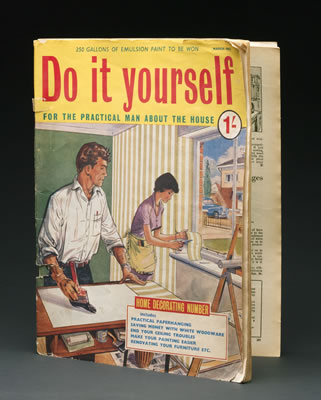
The Do-It-Yourself Movement of the 1970's - How It Failed

Should you do it yourself?  Of course, but maybe not the big projects in your life!

I wrote before about the Do-It-Yourself movement and why it often isn't a good idea to do things yourself.  Most of us have half-assed carpentry and plumbing skills, so if we fix things on our own, they tend to look half-assed and may create more problems than they solve.

I find as I get older, I am less and less willing to "do it myself" mostly because new stuff is so cheap and my skills are aging.  For example, I installed a new split-system air conditioning system in our garage, which is also our laundry room.  It came out OK, but it could have been a disaster.  I bought a vacuum pump and manifold gauges and pumped down the system and charged it and voila - it actually worked.

But I was nervous doing this as the last time I used a set of manifold gauges was at Carrier in 1985, over thirty years ago.   Today, we have technologies and even refrigerants that didn't exist back then and what I didn't know about new refrigerants was basically everything.

But at least I had some professional experience at this, albeit out-of-date.

What is do-it-yourself movement and how did it get started and why, for the most part it is a bad idea.   And why are people not doing for themselves the basic things in life we used to do?  These are all good questions!

The "Arts and Crafts" movement of the late 1800's and early 1900's could be considered the founding of this movement.   People were turning away from machine-made and factory-made things and wanting to "go back" to the times when "America was Great" (sound familiar?) and people did things for themselves.

Oddly enough, they celebrated this concept by buying things from factories that were "Arts and Crafts" style, and then furnishing their homes in this style of self-made goods.   Few people hewed furniture out of wood from scratch.

But the idea took off, and of course, for many folks, it never left - making things yourself was always the way things were done in rural America, as the cost of factory-made goods was considered too high.

In postwar America, however, factories were running full-tilt, and people were working hard in the 1950's boom.   And buying brand-new shiny factory-made stuff was the name of the game.   Few people wanted home-spun things in their homes, even if Dad had a hobby woodshop in his garage.   But Mom did make things at home.  She cleaned and cooked and baked pies and sewed dresses.   Dad mowed the lawn on weekends and "did chores around the house".   Simple things were done at home, complex things were often left to professionals, who were reasonably priced.

In the 1970's this started to change.  Stag-flation meant that wages were skyrocketing and labor was expensive.   Suddenly, trying to repair your own dishwasher made sense, as the local plumber wanted a pile of money just to drive out to your house.   Self-help books became a craze, and people started attempting projects that in the past, would have been left to experts.  And even manufacturers got in on the craze, offering products that the consumer could "service themselves".

For example, in my Mother's 1973 Vega Owners Manual, they posited that the new Vega was designed with "easy consumer service" in mind.  It wasn't actually true - the car was no easier or harder to service than other cars.  However, the "do it yourself" movement was in full-swing by then, and possibly this was a response to Volkswagen "Bug" owners who lauded their cars as being "easy to service" which was a good thing, as they often needed it.

Of course, one of the few things you could "do yourself" was change your own oil, a messy and time-consuming job that the local mechanic would charge you for.   Today, we have legions of low-cost oil-change places that charge often less what a "shadetree mechanic" would pay just for materials.   It often makes no sense to "do it yourself" anymore with regard to oil changes, yet many do just that.

This Old House went on the air in the late 1970's and touted the idea of self-home-improvement, at least initially.  Norm and Steve backed away from this "sweat equity" concept, perhaps after a few-too-many half-assed tile countertops (remember those?) were installed by homeowners without proper grouting or sealing.  But the show promoted the idea that you could install your own roof, your own bathroom, or remodel your own kitchen.   And while it is possible for some folks to do these jobs, not everyone should.

The Craft Beer Movement actually started in the 1970's as part of this craze.  As I noted before, many pioneer home-brewers got started back then, even if today's hipsters think they discovered the craze.   Again, the idea of having a lot of exploding bottles in your closet or cellar seemed like a good idea at the time.   And yes, some folks went on to found micro-breweries and ended up selling out to the big breweries and made a lot of money.   A lot more bought half-assed "home brewing kits" that ended up being sold at a garage sale a year later.

This also coincided with the Back to the Earth Movement of the 1960's and early 1970's.  We would all go back to living on the land, fending for ourselves, in a quasi-feral fashion.  Again, like the Arts and Crafts movement, it was a way of getting in touch with basic things in life, after feeling detached in a society where most people consumer machine-made products, including machine-made food. Of course, living in an unheated barn got old real fast, and many folks dropped out of this movement - as most people do, when it comes to movements - but kept vague notions of being organic or holistic or "natural" in their minds - only to be later exploited by marketers, who slapped labels like "natural" on unnatural things.

To some extent, this Do-It-Yourself movement was a good thing.  So why do I say it failed?   Well, simply because today, people are less capable of doing for themselves than ever before.  Most folks have no idea how to fix their own computers, much less smart phones.  Their cars are a mystery to them, even as they neglect and abuse them.   So much of our world today is sealed "black boxes" that you either have to throw away, or take it to the "genius bar" to try to recover your data.

But it is worse than even that.  Today we are willing to take on projects that require the skills of craftsmen, but are unwilling to do low-skill jobs like cleaning the house, mowing the lawn, or even preparing our own meals.

Mom and Dad decide to re-tile the bathroom - a daunting job even for a skilled tile man.   They attempt this, but at the same time Consuela their maid, is doing their laundry for them, washing their dishes, and vacuum their floors - all jobs Mom and Dad can do but would rather not do because they are "boring" and tedious low-skill labor.  And I know this as I remodeled my kitchen and bath while my maid did my laundry.

At the same time, of course, the yard man is mowing the lawn.   And when we're hungry, why bother cooking?  Just go out for some fast food, or have "takeaway" to bring home, or better yet, just have them deliver the food, taking away even that pesky "driving" stuff you have to do.  Then you can sit down and watch a home improvement show while eating fast-food.

We are all capable of performing these menial tasks, but choose not to because we deem them to be tedious, boring, repetitive, and dull.  So we farm out tasks we are clearly capable of doing in favor of taking on technically difficult jobs that require specialized skills because a TeeVee show said we could do this.

It you want to "save money" by "doing it yourself" think about the jobs you are currently farming out to others, that you are already clearly capable of doing.   If you are sending out clothes to the cleaners that could be washed and ironed yourself, ask yourself why you are paying someone else to do this.   If you are hiring a maid and a lawn guy and you can do these jobs yourself, ask yourself why.  If you are using restaurants as your kitchen, ask yourself - if you really want to save money by "doing it yourself" - why you aren't even taking on this simple task.

Because that is irony right there - the upscale couple remodels their own kitchen and then uses it for nothing more than re-heating restaurant meals.   What's the point of that?  Oh, right, status - the real reason people put in "look at me!" kitchens.

Now, let me anticipate the snotty response I will get from some yahoo out there.  "Well," they will say, "I can afford to hire a gardener and a maid!"   And if that is really true, then what the heck are you doing reading this blog?  The point is, it is idiotic, in my mind, to take on "do it yourself" projects if you are already hiring out half of the basic labor in your life.   The money saved by mowing your own lawn, doing your own dishes, washing your own clothes, vacuuming your own house, and so on and so forth, could pay for a professional tile person to do your bathroom or whatever.

Yet, we do the opposite, and like I said, in retrospect, I found myself doing just that when I was younger.  

Odd.  Very odd.

How Moving Has Changed

How we move today is one reason why the labor market has changed.  The do-it-yourself movement put a lot of people out of work!

When I was a kid, moving was an everyday occurrence. In the new suburbs Across America, moving vans shuttled people's possessions back and forth. Shiny new moving trucks with names like Atlas, Mayflower, and North American Van Lines showed up at your door packed all your belongings and moved them to another city or state.  Every week, a new family moved in or moved out, in postwar mobile America.

Of course, back then when America was great, (sarcasm light is LIT) companies would pay for workers to move to new locations. Or at least they would pay for salaried employees to move, or at least valued salary employees.  As my father once put it, "we even pack the garbage," as the moving company paid for everything including people hired to pack all our junk.

It wasn't always nirvana, though.  On one occasion, North American Van Lines lost half our possessions in the move, apparently due to a dispute with the driver.  Also common the past, all your possessions will be unloaded from the van and put in the warehouse, and then later reloaded into another van for later shipment.  Often, things got lost in the warehouse or stolen, or your couch would become the new break room couch for a month for the warehouse employees.

Today, commercial moving vans are a rarity.  And the major brand name moving companies have shabby rusted broken-down vans (moving company trailers are known as "vans") which appeared to be so old that they might be the same ones my parents used back in the 1960's and early 70's.

Today we have more choices in moving, and people seem more inclined to move themselves, as corporations no longer will pay the staggering fees to move your possessions.  The cost of hiring a moving company to move your things can run into the thousands or even tens of thousands of dollars. For most people this is simply not affordable and their possessions don't warrant spending that kind of money to move them.

As I noted in an earlier posting, people are using new means of moving their possessions including the use of storage pods or buying portions of a tractor-trailer load from a freight company.  We have used the pods with some success.  The cost was reasonable and since we packed them ourselves we could ensure that things were not broken.  Also, since they were not unloaded at any time during the process, wouldn't have to worry about our items being stolen or handled.

Our neighbor use the same company, ABS Freight, in a different way.  They purchased a portion of a tractor-trailer load and the company baced a tractor trailer into their yard.  They filled up a portion of the truck and a movable wall was installed to seal off their possessions from other freight.  At the other end, the trailer was then parked at their new house where they unloaded their household possessions.  This also worked well, although there were fairly limited time windows for loading and unloading, unlike the storage pods.

Today, self moving services like U-Haul, Penske, Ryder, Budget, and the like are more popular than ever.  When we moved to New York, we use two of the largest U-Haul trucks plus a trailer to move our positions.  It was inexpensive but it was exhausting work to load and unload all of this stuff.  UHaul does offer to hire people to help you load and unload, and at the unloading and we did have some local day laborers help us unload, although they did drop my photocopier out of one of the trucks.

It is interesting to me that we have become more of a "do-it-yourself" generation than in the past.  In the olden days, if you wanted to buy something that was bigger than your car trunk you went to the store and the nice man would have the delivery boys bring it to your home where they would carry it up the stairs and install it.  Today, we back our pickup truck up to the loading dock and pretend that we are part-time truckers.

I trace this entire mental attitude back to the stagflation era of the 1970s.  If you didn't live through that era, it was a time when prices were constantly going up and wages were depressed.  Inflation was in the double digits.  People started trying to do things themselves rather than hire people, often with predictable results.

Of course, this meant that more and more people lost their jobs, as more people started to do home repairs and car repairs on their own.  The local department store laid off their delivery people, as more and more people started picking up things in their pickup trucks and vans which became quite popular at that time, despite really high gas prices.

And it was about that time that moving companies started to face difficulties.  The post-war baby boom era fueled the moving van business.  However as our country settled down people moved less and less, and demand dropped off.  And given the high cost of living and the fact that few companies were willing to reimburse this expense, more people started moving their household possessions by themselves.

If you want to know where the jobs went, this is one place they disappeared to. Today, we want the lowest possible price on consumer goods and are willing to put up with inconveniences rather than have full service.

I was at the Wholesale Club the other day and watched a young family try to load an enormous flat-screen TV into their small hatchback car.  It would have been possible to fit the television in the car if they were willing to tie the hatchback closed with a piece of rope.  However, there would be no place left for the children to sit.

Back in the day, you would go to the local television store which would be on Main Street in your small town and purchase a television.  You wouldn't dream of picking it up and putting it in your car to take it home, even if it would fit in the trunk.  And of course you didn't own a van or pickup truck, as those only belonged to people who delivered things for a living.

The man who owned the TV store would have old Gus, who hung out back, bring your television to your home in a van brightly painted with the name of the television store.  He and his assistant would carry it into your house, set it up, plug it in for you, and show you how to operate it.

Today, old Gus is long dead and nobody replaced him.  Delivery services are largely obsolete other than FedEx, United Parcel, and the Postal Service, which bring us cardboard boxes of consumer goods which mostly originated from China.   And since everyone is working these days, Mom isn't home to be there when Gus shows up with the new TeeVee.   We want cash-and-carry these days, including all the junk we bring home every weekend from the "big box" lumberteria.

I am not decrying this new trend, as I appreciate low prices on consumer goods as much as the next person.  Today, we buy almost directly from the manufacturer with very few intermediaries between us and the source.  However, this does mean when something goes wrong, there was no customer service to help us out - something that most people are keenly aware of these days.

Companies discovered that it's a lot easier to have a generous return policy then to have customer service or a repairman.  Maybe in the old days with tube televisions, you would send old Gus or Jim the repair guy out there to replace a tube and get your TV back in working order.  Today, solid state electronics rarely lend themselves to repair, or at least the local repair guy is not equipped to deal with it, not having the correct tools and testing equipment.  Better to just replace the broken flat screen TV and ship the old TV back to the factory for repair or to an authorized service center where they can diagnose the problem.  Or, it is just thrown away is part of the cost of doing business, as it costs a lot less than old Gus and Jim the repair guy, who with their hefty pensions and benefits today cost too much to employ.

There has been a lot written lately about where all the middle-class jobs have gone.  People say that the jobs are going to China and that factory production has gone overseas as well.  However, the United States remains one of the largest manufacturing countries in the world and is slated to outpace China in the next two years despite Donald Trump's best efforts.

Similarly, a lot of people point to automation as being the cause of our nation's woes.  Robotic factories employing foreign-made robots assemble electronics and automobiles with fewer than half the number of people required as in the past, sometimes far, far less.

But I think there's another factor at work here.  We used to have an awful lot of people in the service industry in every small town who did things for us, whether it was operate an elevator, deliver a package, style our hair, pump our gas, or wash our car.  Every business had someone who answered the phones and opened the mail.

Today, and the name of cost-cutting, we've eliminated number of these jobs and replaced them with automated systems, or just merely eliminated the service entirely.  Very few people today remember the era of gas jockeys pumping your gas, unless you live in one of the few States which still require them.  "Self-serve" gas stations were another product of the stagflation era of the 1970's when cutting costs meant laying off pump jockeys for good.

Some folks are talking about instituting a guaranteed minimum income as a means of offsetting the loss of jobs.  The idea is as simple as it is ludicrous.  Everyone would be paid a fixed amount of money which would be just barely enough to live on.  People could then choose whether they wanted to work and make more money, or just stay home and live on this minimal stipend.

If you think this proposal is "logical" then think for a moment what 315 million (the population of the United States) multiplied by ten thousand dollars (the number bandied about by the guaranteed income people) would total.   And then think of what the cost per citizen would be (the same as the money given away) and it starts to become clear.   Those who would work would be taxed in an amount equal to not only their own "free money" but that of others.   Taxes would have to go up substantially to cover this cost.   The incentive to work would be depressed, the incentive to not work or work under the table would be great.   But we already have that today - the subject for another posting.

While it is true that we may need to find jobs for all these people whose livelihood will be replaced by automation, perhaps other things can be done.  After World War II, Japan took a course of creating make-work jobs such as "elevator lady" who would stand in the elevator and bow politely as you entered, ask you what your floor was, and then push the button for the floor.  It was an entirely make-work job, but the government encouraged companies to create these positions so that the country would have full employment.

I'm not saying that that would work in the United States or that that's what we should do.  Creating make-work jobs would just increase the cost of services and raise prices for everyone.  Also, I think it is a little too early to sound the alarm on unemployment, with unemployment rates in this country at dramatically low levels at the present time.  In fact there are labor shortages in many parts of the country today.

The real problem will be to find jobs for people like old Gus and Jim who have no marketable skills are obsolete technical skills.   Back in the days of Mayberry, RFD, guys like Gus and Jim could hang out at the local gas station, get odd jobs and get by.  We never asked what would happen to them when they retired, as they likely drank themselves to an early grave or died of smoking-related diseases.

The Gus's of the world still exist today, and in an economy that does not value unskilled labor, they will have a tough time of it.   Compounding this is that Gus no longer wants to take a job he deems beneath his dignity.   Cleaning houses, working construction, picking crops, and mowing lawns are deemed to be work than only immigrants would do, when back when "America was Great" Gus would willingly take such jobs, if there was a pint of cheap whiskey offered as a bonus.  My ancestors worked as servants and gardeners.   Today, I doubt anyone in my family (or extended family) would take such jobs.

Raising the minimum wage is also offered as a panacea for our labor problems.   The problem is, the idiots proposing this (and sometimes pushing it through) don't want a 10% raise or even a 20% raise but a 100% raise, nearly doubling the minimum labor rate to over $15 an hour.   As you might expect, this tends to make more automation look like a good idea, and has not caused, but accelerated the trend of installing automated kiosks in fast-food restaurants (Something our European neighbors have been doing for years now).   Fully-automated fast-food machines are then next logical step and are technically feasible today, just not economically feasible unless this $15 minimum wage thing becomes a national reality (not likely today as it was before November 7th).

(Oddly enough, cooking our own meals is the one thing the do-it-yourself movement seems to have failed at.   We all want to do our own "home improvement" projects such as putting up new tile in the bathroom - something that few of us are skilled at - but no one wants to fry an egg.   Guess which saves you more money in the long run?   Subject for another posting!)

Self-driving taxis and trucks are the next issue.   Millions of low-skilled people will be put out of a job.   And since even truckers today text while driving (I kid you not) few will mourn the passing of the human-driven car.

But in the past, many jobs have been eliminated and new jobs created to fill the void.   We lost all these manufacturing and service jobs over the years.  Factories have closed for good.   Jobs went to automation or overseas.   Yet the unemployment rate in this country is at all-time lows.   New jobs are created where old jobs are lost.   The Internet, for example, has created millions of new jobs, however most of them are technical skill jobs dealing with computers or software.

A lot of people, however, make a few bucks creating YouTube videos or even blogging.  There are jobs in "content creation" that don't require coding skills.

So it is hard to say.    Some argue that while the unemployment rate is low, the employment rate is also very low - that is to say, there are a lot of people who are simply not looking for work and have given up.   How do you think guaranteed minimum income would affect that?  Others would point out that wages have also stagnated, and for unskilled labor, gone down, as a result of too much unskilled labor and not enough jobs (supply exceeds demand) and thus while there is "low unemployment" underemployment remains high.

On the other hand, as an optimist, I would point out that the real cost of goods has gone way down in the last 40 years, and thus even the poor have nicer stuff today than we did in the past, and in fact are better fed as well - even obese.  The poor today are living the middle-class lifestyle of the 1950's.

Times have changed before - and jobs eliminated and new ones created.   The uniformed movers of the 1960's may not be very common today, but other jobs have taken their places.   I think it is a little premature to worry about automation decimating the workforce (and decimating means 10%, look it up).   It may very well be that people find new things to do with their time.  That seems to be the way it works out, historically.