Saturday, November 11, 2023

Why Make A Movie And Not Show It? Reasons.

The real cost of a movie goes beyond making it.

Recently, Warner Brothers has gotten a lot of flack for making movies and then putting them in the vault forever and showing them to no one.  Both Batgirl and Coyote v. Acme were filmed and then shelved, with the press gleefully reporting that the studio "took a writedown" on both films, as if somehow that was profitable.  If so, studios could make billions simply by making movies and then not releasing them.  Such is not the case, however.

But like clockwork, the great ignoratti of the Internet chimes in with, "That's how they make money, with tax write-offs!"   But as I noted time and time again, you can't deduct your way to wealth - it simply isn't possible.  You can - and should - deduct losses from your income.  But losses are not money in your pocket, they are money you spent.  If I could deduct my way to wealth, I would go to Vegas and then lose as much as possible and "deduct" my losses and get rich!

No, just to be clear, it doesn't work that way.

Granted, studio accounting is something of a dark art and there are unique and fascinating schemes used by studios to cry poverty even as they rake it in.  For example, it is well known that, as a star you never settle for a "percentage of the net" as studios can use rogue accounting methods to show they never had a net profit.  So instead, you negotiate for a "percentage of the gross" which is far easier to calculate.  Of course, the real superstars just ask for millions, up front, payable in cash, so they don't get screwed over by spurious accounting of the gross.

And by the way, if you don't know the difference between gross income (or "revenue") and net profits, I don't want to know you.   The same yahoos who think a "writeoff" makes money also confuse gross and net - and have no idea what a deduction even means.  Sadly, the popular financial press compounds this error by confusing the two terms, often for sensationalist click-bait titles. "Acme corporation claims to be broke, yet they had revenues of $1B last quarter!"  True, but their net profit was a negative $100M or in other words, a loss.  Profits matter, overall revenue is often irrelevant.

I digress, but I've seen this firsthand where a CEO obsesses about revenue and loses sight of the ball - net profit.  A client was ecstatic that their company was approaching $1B in revenue, which put him in the big-boys club.  So they tried to pump up revenue without thinking about net profit.  The company lost money the next year, and they nearly went bankrupt and the CEO went packing.  Oh, and they never broke that meaningless $1B revenue barrier.  Profits matter 100 times more than revenue.  And don't get me started on "market share" - the epitaph of many a decent company.  Ask Volkswagen about this.

But getting back to topic, why would a studio shelve a movie without releasing it?  Well, there are a lot of costs involved in marketing a movie - often equal to the cost of producing the movie itself.  And even if "principal photography" and whatnot is "wrapped" there is still editing, dubbing, music, and special effects to be added - these can easily exceed the filming budget, particularly in these days of CGI.

It is unclear whether these "shelved" movies were actually finished or just done with filming or somewhere in the process.  Getting back to a "percentage of the gross" if your "star" demanded, say, 5% of the gross receipts, well, you save that 5% by not showing the movie (but inviting a lawsuit, instead).  You might spend $150M making a movie, but another $150M would have to be spent to market it and distribute it. If the movie is going to be a "box office bomb" then you are better off cutting your losses and shelving the movie, rather than throwing an additional $150M at it to market it.  So you pull the plug and cut your losses.  Better to "write off"" $150M than to "write off" $300M.

These additional expenses are often why we see movies called "box office bombs" even as their gross revenue exceeds production costs.  Marketing and other costs can exceed production costs, so even if a movie makes money on paper, it loses money, in real terms, once all costs are accounted for.

But of course, we're talking "box office" in an era of streaming.  And this is where it gets interesting to me.  Streaming services today are largely "all you can eat" subscription services, where you pay one monthly fee and watch all you want.   For someone who doesn't watch television much, well, it ain't much of a bargain.  We tend to subscribe to one channel for one month in the winter, see all we wanted to see, and then unsubscribe.  Lately, we haven't been doing even that.

They put the first episode of "The Gilded Age" on YouTube, apparently to induce us to subscribe to watch the rest.  It was produced by the "Downtown Abbey" people and is pretty much the same tired old soap opera - with the obvious love interest, class struggles, scandals, and the cliffhanger endings of each episode to get you to "see what happens next!"  After watching the one episode of this Upstairs, Downstairs, American Style, I could write the entire script for three seasons, in my sleep. No thanks, Netflix - or whatever streaming channel wants me to watch this dreck.

But getting back to streaming, how do you quantify profits for a show that is streamed?  Sure, you can count the number of views, but how does that correlate to income?  The users pay the same fee, regardless if they watch one episode or binge-watch all of them - or watch none at all!  It takes the dark art of studio accounting to new murky depths.

And I suspect that these streaming services which are crying in their soup and claiming to be "losing money" are doing so only through accounting shenanigans.  Disney+ for example, claims to be losing money.  Are they?  Or are they "losing money" only because they are paying royalties for Disney films to the studio branch, which shows those as profits?  Hard to say, but it may be one explaination.

But maybe the answer is right there - the streaming services have morphed from movies to soap operas.  When Netflix lost its STARZ contract to the vast library of old movies, it had no choice but to come up with "original Netflix content" as the major studios weren't about to give away their content for cheap - if at all.  So we get endless "controversial" comedy specials and these horrible soap operas set in different time periods and different venues.  Coming up next!  Trailer park boys running a meth lab in 19th Century Jolley Olde Englande - a period drama where the protagonists cruise around in a hopped-up landaulet carriage while whacking mobsters from rival gangs.  Will Tony ever marry Suzanne?  Stay tuned!  Might as well cut to the chase, as they say.

So releasing "movies" on streaming services, which made "sense" during the pandemic era, makes less sense today, as you can rake in hundreds of millions in ticket sales in just a few weeks with a "blockbuster" movie, and then make money in secondary channels - pay-per-view, overseas sales, DVD sales and rentals, streaming, cable, and finally, network television.  I suppose there are revenues to be had from the coconut telegraph as well, if it is still in working order.

So, releasing direct-to-streaming movies makes less economic sense.  You may damage the overall brand or franchise by flooding the market with more cheaply made product.  Disney is sort of experiencing this with its Star Wars franchise.  While they have largely gone the soap opera route with its streaming "series" not all of them have been hits.  And some of the more recent movies are, well, if you missed them, you didn't miss much.  That's the problem with these franchises, they just don't know when to die.  Kids today are going to the movie theater and watching "franchise" films that were originated decades before they were born.

Maybe it is just me, but I would be kind of sick, as a teenager, of watching the 15th sequel to Casablanca back in 1978.  Each generation wants to see something new and relevant to their era, not to their parents' or grandparents'.

Speaking of kids, that is the prime audience for movie theater ticket sales.  The movies that make it to the theaters these days are all aimed at the under-25 audience (if even that old).  You read horror stories about kids in theaters playing with their cell phones or goofing around, loudly, during the movie.  It is bad enough that the only films showing are all explosion movies based on comic book characters, it is even worse that the behavior of the fellow patrons makes the whole experience cringe-worthy.  Besides, why watch in some shoebox theater when you have a big television at home - right?

But the studios don't want to show movies on television - they'd rather shelve them!  Kinda makes no sense, but then again, Hollywood never did.

I think the real reason they shelved these films is that they sucked and would be an embarrassment to the studio.  Batgirl is the umpteenth sequel to a movie "franchise" based on a forgettable comic book and hokey 60's television show (which, oddly enough, was more faithful to the original source material than the later "dark" movies and comic books).  Coyote is based on a humorous New Yorker article, which is pretty thin gruel to make a movie from.  Neither will be missed much.

But perhaps they could be re-worked as period dramas - just chop them up into three seasons of episodes where the plot advances at a plodding rate, throw in a love-lorn-lost subplot and "Wa-La!" you've got the next Netflix "hit" on your hands.

Or, like Disney, make a "live action remake bomb" of a beloved but largely forgettable animated movie from decades past.  Those seem to be doing well!

But make no mistake about it, losing money is losing money and you don't "make money" from write-downs or write-offs, or as we call them in tax law, deductions.   Hollywood accounting methods are creative and may be used to show stars or investors - or the tax man - that they never made money.  You can shift expenses from one project to another, or charge "overhead" to a particular project and make it look less profitable.  But at the end of the day, you actually have to make money, in order to keep the lights on.  And making a movie and shelving it, is not a profit center for anyone.  At best, it reduces your tax burden or allows you to screw over investors on another film.

But it doesn't make you money in the long run.  Somewhere, sometime, you have to turn a profit.

Friday, November 10, 2023

Misdirected Mail

I have recently started getting mail for a person  who is now deceased and lived in my house over 20 years ago...

I wrote before how I wrote a Patent on a system that scrapes data from obituaries and formats it into name and address searches.  The software "scrapes" data from obituaries, which are formatted in a certain way, and can thus tell you where someone lived, who their relatives are, and so on and so forth.  The software, for example, can look for phrases like "survived by" and parse out the names.

Well, recently, I have been getting mail - mostly credit card offers - for a Don or Joyce Russell.  When the first letter arrived, both me and the postal carrier just shrugged it off.  But then more mail started coming and I wondered whether someone got the wrong address and this couple were neighbors from down the road or on another island or something.

So I typed in their names and "Jekyll Island" and got a plethora of hits on these "spokeo" type address sites.  One listed both of them as owning my house!  I searched some more and found an obituary for Don and a great article about his life from one of the players he coached.  I guess Don and Joyce "snowbirded" between a lake house in Vermont and at Jekyll Island, presumably at the house we now own, until they got older and decided to move closer to her family in Texas.

From what I could piece together, they must have stayed here in the 1990's or thereabouts, before relocating to Texas.  Like most Jekyll "snowbirds" they didn't stay too long - it seems five years or so is the average.  For us, the burden of having a lake house and a house here was too much for us at age 50 - so we sold one and settled here - for the last 18 years.

We met the children of the original owner of the house, which was built in 1970.  They marveled that the "twig" of a Magnolia tree that their Mother planted (and they mocked like Charlie Brown's Christmas tree) was now 50-feet tall and six feet around at the base.  Over the years, the house has been bought and sold - and rented for an extended period of time - and somehow, apparently, the Russells lived here during that time.

But why are we just now getting their mail?  I am not sure, but again, these data-scraping applications can find old addresses and names and once they are in the database, they are darn hard to get rid of.  So, according to one site, Don (who is now deceased) and Joyce (who is 92 years old) are living here with us.  And the Internet will keep that bit of bad data for all eternity.

But speaking of misdirected mail, I had a small heart attack the other day when a piece of mail went astray.  The "check engine" light on the hamster came on a month ago and then just as suddenly went off.  I had no code reader handy, so I assumed it was a spurious code.  When it came on again, I ordered a code reader - they are surprisingly cheap online - $14.95 on eBay including shipping!  The package was supposed to arrive Monday and was listed as "out for delivery" and then inexplicably was listed as "held at Post Office at request of customer!"

I was pissed.

You see, some KIAs and Hyundais have had an issue with loose connecting rod bolts.  It is only a few cars (out of millions they have made) and pulling the engine on hundreds of thousands of cars to check the bolt tightness is just not an option - when only a few thousand are suspect, but they don't know which ones those are.  So they reprogrammed the knock sensor software to detect the characteristic vibration produced by a loose connecting rod and extended the warranty to 15 years or 150,000 miles and due to a class action suit, apparently lifetime at least for the short block.

So when I see a "check engine" light, naturally I am nervous that the reprogrammed ECU has detected this fault.  Don't want to drive the car and see the connecting rod go through the side of the block!  I called the dealer and they told me that since "the guy" who could read codes in Savannah had quit, all the owners in Savannah were coming here for service and it would be two months to get an appointment.

I needed a code reader now!

So it was frustrating that it was being "held at the post office" supposedly at my request, when I requested no such thing.  I called their phone number, but instead of going to the local Post Office, it went to Washington DC, where a robot gleefully reported that I requested it be held at the Post Office and that it would be delivered by November 15th.

I tried to find the local phone number, which I think I found on the local Chamber of Commerce site (the USPS doesn't give out local phone numbers, apparently).  I called and it answered and I pressed "1" to speak to an operator and it rang 40 times before hanging up.  Some service!

I finally found a "contact us" page on the USPS "Informed Delivery" page and submitted that.  I got a call back from the local Postmaster (success at last!) and he told me that the package went "on the wrong truck" and the only coding the carrier can do on his scanner is "return to sender, address unknown" or "deceased" or "hold at post office by request of customer."   So apparently, this puts the carrier in a bind, or perhaps they are trying to up their delivery time numbers.  If it went uncoded, it would just show a day late in delivery.

Anyway, he promised to have it on the correct truck the next day and our local carrier sorted it all out.

I plugged in the reader and got Code P0441 which is an evaporative emissions system code - nothing that serious - it could be a loose gas cap situation.  But more on that later.  No connecting rods falling off just yet!


Thursday, November 9, 2023

Even Science!

Even science is subject to superstition on occasion.  But it eventually and continually corrects itself.

In my most recent posting about belief, I noted that in science and Engineering (and the Law) you have to rely on facts, not belief or superstition, otherwise the end result is calamity.  Over the centuries, bridges have collapsed and buildings fallen down when it turned out that assumptions made in the design process were wrong, or the design was changed without permission of the designer. Safety regulations and standards, it is said, are written in blood.

The difference between, say, religion and science is that with religion (or any belief system) it is rare - if not impossible - for the believer to find fault in their belief system. Usually instead, a scapegoat is found (conveniently, a non-believer) and they are sacrificed, murdered, or otherwise disposed of to appease the Gods.  Since this doesn't fix the underlying problem with the belief system, the end result is more sacrifices and abuses to happen down the road, as religion and belief stubbornly refuse to modify their systems to fit the facts.  In fact, they do the opposite.

In fact, we are seeing this today, in real-time in the United States.  Fundamentalist Christians are seeing a disconnect between their "Good guy with a gun" philosophy and the reality of daily mass-killings.  Since they can't change their beliefs about firearms, some have posited the problem is "liberal" values.  If we didn't teach volition in schools, there would be no school shootings!  Or maybe something, something, better gun control so that psychos don't get guns.

Nah! Has to be evolution!  That's the real cause of society's problems.  If only we had prayer in school!

Science and other fact-based pursuits, on the other hand, have no such strongly held beliefs, or if they do, they often die with their believers.  Eventually, people come around to the idea that the Earth is an oblate spheroid and is not the center of the universe.  Eventually, people come around to the idea that the "plum pudding" model of the atom is, well, largely based on belief and not science.  And even Einstein, who once opined that "God does not play dice with the universe" (supposedly, anyway) eventually embraced Quantum theory.

And these theories are not set in stone - and are continually subject to review, update, and repudiation. Sure, there are still today, some people in Academia who resist new ideas and change.  But eventually they change their minds as evidence mounts, or they pass on and a new generation - who has less invested in the status quo - takes over.

Religion and belief systems do not have this option of morphing and improving over time.  Our current Pope is seeing how this works.  He is trying to "reform" the church and open it up to more parishioners, as people flee the pews in droves.  Hard-liners are not receptive to his modernization efforts and indeed, they claim the problem with the church is that it isn't backward enough and that what people really crave - what will get 'em back in the pews and tithing - is a return to the medieval church. These are folks who are still pissed-off about Vatican II - which was more than a half-century ago. Religious types really carry a grudge!

Of course, new religions form, often because the previous religion seems outmoded, irrelevant, or corrupt.  Christianity was developed initially as a sect of Judaism, but then became an alternative to it, replacing the "eye for an eye" of the Old Testament with the "Turn the other cheek" of the new.  And even then, Christianity has devolved into a number of sects, based on differences of theological opinion, or, in many cases, disputes over who controls and has power over parishioners.

Such is the nature of belief systems - they are hard to amend, and the only real solution for the believer is to wipe the slate clean and start over.

But speaking of Amendment, that is exactly why our Constitution has an Amendment feature. Some on the right like to make a religion or belief system out of the "Founding Fathers" (a term of only relatively recent vintage) who are viewed as prophets or martyrs to a cause that must be honored in perpetuity. Every aspect of our lives and our legal system must be viewed through the prism of "the intent of the founding fathers" - some of whom were never even elected to office (I'm looking at you, Ben Franklin!).

What the founding fathers intended was that we figure things out on our own, for our own era and our own time. They intended we would change our Constitution and form of government to suit our era, and not be held back by beliefs that were outmoded. Indeed, they knew at the time our Republic was founded that change would have to occur, to correct the errors of slavery in a county founded on "freedom."   And that was a major correction - a bloody one at that.  Yet, today, there are still believers who want to "go back" to those dark old days.

And today, while no real scientist believes that the Earth is flat, the moon landing was faked, or that aliens are being held captive in Area 51, the general public seems more inclined than ever to retreat into belief rather than trust facts and science.  The very nature of science eludes them, and the fact it cannot be nailed down and is always subject to revision, scares them.  Like fundamentalists of every sort, they want a rock to rest upon, a lodestar to guide them - no questions asked.  Science, it seems, is always changing its mind, and that scares them.  They don't want to live in a world of endless possibilities, but one of certainty - even if that certainty is to believe in fantasy.

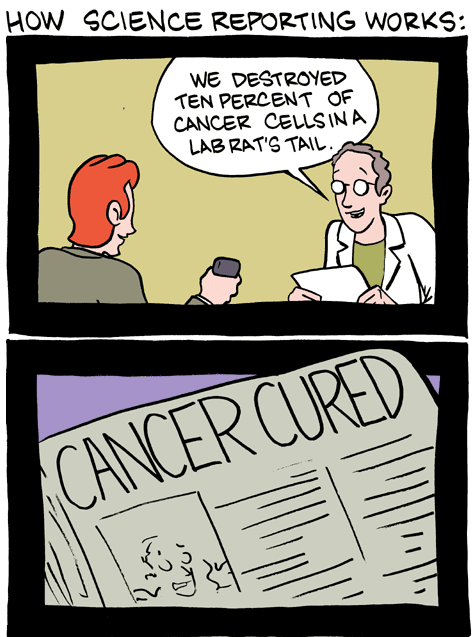
You hear this all the time from the less informed.  "Them Scientists never make up their minds!  One day they say eating one thing is bad for you, the next day they say it is good!  Next thing you know, they'll say smoking is actually good!"  Or some such nonsense.  And part of the problem is the media, who distorts what science is, and mis-reports developments and exaggerates claims.

This SMBC comic illustrates the point.

Of course, science isn't based on popular beliefs, and what people understand today about science and technology is probably less than in the more recent past.  In part - a large part - this is due to trolls from various foreign countries trying to stir up dissent by getting people to not believe in our country's greatest accomplishments, and instead, rely on superstition. But in part, I think it is due to the complexity of technology today - and our corresponding decline in educational standards - which makes modern science and technology seem more like Magick than anything else.  An anti-vaxxer Soccer Mom may not understand how her smart phone works, but she is "smarter" than you (or all those egg-head "scientists") because she knows the world is flat and 5G will set off the microchips in your body (or whatever the fuck stupid shit they got from Facebook this week).

I noted before that conspiracy theories - which are just belief systems like religion - allow the believer to believe they are smarter and superior to the non-believer.  No doubt you've tried to have a conversation with a conspiracy theorist and realized how pointless the conversation was, and how smug the believer is, that they are better than you, because they've "done the research" online.  It is no different from the smugness of "born again" Christians, who cry "I've been saved" while implying (or outright stating) that they are God's chosen special people and you're going straight to hell.

And maybe that's the motivation behind belief systems.  People want to feel part of something greater than themselves, elevate one of their own above them, and look down on those who do not believe - or better yet, stuff them in an oven.

Science doesn't have all the answers - in fact, all it is, is an endless series of unanswered questions.  Belief is a set of pat answers made up out of whole cloth.

But, it never pays to tell a believer that!

Wednesday, November 8, 2023

The Worldwide Wine Glut of 2023

Vintners are dumping wines because prices are too low!

I wrote before about an inexpensive Cava from Spain, sold at Walmart as "Winemakers Select" for $4.78 a bottle or so.  Today, it is down to $3.79 a bottle - along with other varieties in the same series.  What is going on?

A wine glut.  We should be so lucky!

I noted before that we are in a worldwide wine golden age, as cheap wines from America, Australia, Argentina, New Zealand, and even France, are flooding the market.  The head of Bronco Wineries (the largest winery in the world you never heard of) Mr. Franzia (you've heard that name!) one opined, over a decade ago, that no bottle of table wine should cost over $11.

Well, since then, inflation has taken its toll, but the price of wine has dropped, to under $11 a bottle, and in fact, under $5 a bottle for very serviceable table wines.

Table wine, or vin de table as the French call it, is every day wine you have with lunch or dinner or even breakfast, I suppose.  This is not wine you "lay down" in a cellar or make a big deal about opening the bottle with a Sommelier or something.  It is akin to the light beer of wines - nothing fancy, but nothing unpalatable, either.

The wine business really took off in the 1990s or so and everyone got in on the act.  In Virginia, farmers were encouraged to grow grapes - instead of tobacco.  In New York, everyone on the Finger Lakes "Wine Trail" opened up a winery - to make a few bucks or get a tax deduction.  Some are quite good, too.  But the major growth was in South America and in Australia and New Zealand, where low production costs and favorable exchange rates meant that we were awash in a sea of cheap and really good wines.

But all that has changed.  In part because the younger generation seems to prefer cocktails and flavored liquors and flavored seltzers over beer and wine. In part, too, because too many people got into the business and flooded the market with product.  It has reached the point where - like farmers right before the 1929 crash - are being paid less for their product that the cost of making it.  As a result, some countries, such as France are dumping wine to prop up wine prices.  We saw this back before the great depression, where farmers dumped crops to prop up crop prices - and afterwords and even today, farmers paid not to produce in order to prop up prices.  Crazy - no?

Most of what is being dumped is table wine, which it not usually aged much.  These surplus wines can't be put in a cellar somewhere and saved for future consumption, when demand goes up and supply goes down.  These are not wines designed to be laid down for years like fine wines - getting only better with age.  Table wine rarely stays on the shelves for more than a few years, it is not aged or cellared very often.

Of course, you may not notice this, much as consumers failed to note it prior to the Great Depression.  But farm failures seem to predict such recessions and depressions.  Most mid-priced wines seem to be holding their own, in terms of pricing.  But at the lower end of the spectrum, well, prices seem to be in free-fall.  $3.79 for a bottle of Cava!  It is like Nirvana!  But how long will it last?

The thing also is that when prices fall in one segment of the market, they drag down other segments and markets as well.  Wine, like crude oil, is a worldwide market.  So a surplus in one country drives down prices in another country - and so on down the line.  Not only that, when a $5 bottle of wine sells for $3.79, that puts price pressure on the $10 bottle of vino as well.  When consumers see a real bargain, they may be enticed to switch.

And switch we did.  With inflation increasing the price of everything else and eating into our retirement savings, we have to look for discounts and cheaper alternatives wherever we can.  We used to stock our refrigerator with a case of Jaume Serra Cristalino Cava (and I still have a bottle of it in there today).  It was quite the bargain at $6.99 back in the day, sometimes on sale for as little as $5.99.  But like others before it (I'm looking at you, Frixnet!) the price crept up to $7.99 and then $8.99 and sometimes even $11.99.  Pretty soon, an inexpensive Cava is as costly or nearly as costly as some French sparkling wines or even Champagne.

So we switched.  And that means a few cases of Juame Serra at $8.99 will remain unsold at the local liquor store, which may, in turn, mark them down to move them out (at which point I may snap them up).  Free market economy at work!

Since we are moving downmarket from the $11-a-bottle range, the consumer may be inclined to look at bargains we are passing up - decreasing demand in the $15 to $20 range, and so on and so forth, up and down the pricing scale.  It is only at the very upper end of markets that prices might not be affected.  During the recession of 2008, yacht sales took a nosedive - but only for smaller yachts and boats that middle- and upper-middle-class people could afford.  The multi-million-dollar yacht market was largely unaffected.  Those people have real money.

I digress, but I heard a comment once about the difference between a yacht and a boat.  A yacht doesn't move when you step aboard.  And that is a pretty good definition.  A 30 to 50 foot boat may rock and roll when you jump aboard.  A 100-foot yacht doesn't move an inch when you walk up the gangplank.  Two different worlds, entirely - just as the world of table wine and fine wines are two different worlds.  People like you and me have no business paying hundreds of dollars for one bottle of wine, much less thousands.  Even $50 a bottle, unless at a restaurant, is kind of pricey for middle-class Americans.

Sadly, I think "wine snobbery" is one reason the next generation shies away from wines and seems enamored of flavored vodkas.  The beer thing, particularly IPAs, seems so boomer-esque to them.  And as I heard one 20-something explain, wine seems so confusing as there are so many brands and varieties, so they have no idea what to order - and don't want to appear to be unsophisticated or be mocked by ordering the wrong kind.

But it really isn't all that hard, really.  Your budget will indicate how much you can afford to spend, which filters out 90% of the wines on the shelf or on a wine list at a restaurant.  Why restaurants put these mega-expensive wines that no one orders on the wine list is beyond me.  I mean, really, why does Chuck's Weenie Shack have Veuve Clicquot on the wine list is beyond me.  Why would they even have a wine list - beyond "red or white?"  But I digress.

You either like sweet wines (usually younger people do) or drier wines (as you get older).  You find a type of wine you like and tend to gravitate toward that.  When you find a particular brand or vintner you like, well, that helps you focus even more.  Discovering is half the fun.

But again, I digress.

Getting back to the wine glut, it is an interesting development, particularly in an era where a bag of potato chips is selling for six bucks or more - because people keep paying it.  I saw a posting online from Australia where a bloke complained of paying sixteen Australian buck-a-roos for a bag of crisps.  The problem he failed to realize is that by paying that price, he validated it was a price he was willing to pay.  If he walked away or bought an alternative product for less, well, maybe consumption would decrease, retailers would have a surplus on their hands, and prices would be marked-down to move inventory.

You know, it just might work - it has worked for wine, anyway.

Maybe our Aussie friend should try a liquid lunch - a lot of fine, inexpensive wines down under.  And it would be probably as healthy as a bag of chips and a helluva lot more fun!

Oh, brave new world, to have such wines in it!

Tuesday, November 7, 2023

More Made-Up Bullshit

Nonsense like this "political compass" are just someone's made-up bullshit.

As an expert bullshitter, I know bullshit when I see it.  And lately, it seems, people are enamored of this "political compass" which tries to pigeonhole people on some sort of two-dimensional "spectrum" - which is also the word du jour for the self-diagnosed autism set.

Why is it bullshit?  Because this isn't science, not even "Social Science" but just some idea that one guy came up with, without any vetting or analysis or testing or other form of validation.  And I suspect it is the work of a "Libertarian" which is not a politcal view, but a form of insanity.

Not only that, what's the point?  Suppose you "plot" your political views based on this flawed "compass" - what does this tell you?  What good does it do?  The answer is, of course, nothing.  It is about as illuminating as an Ouija board.

Supposedly there is a "questionnaire" attached to this nonsense, and based on the scoring on this questionnaire (apparently prepared by the one guy who created this "compass") you can plot yourself on this graph.  So, in other words, all this really represents is one man's opinion about where political views lie on a chart he invented.

It just smacks of a "personality test" or the Myers-Briggs nonsense which was long ago proven to be nonsense developed by two people (guess their names) who had no training or expertise in the area of "personality testing" (whatever the fuck that is) and created the whole deal from whole cloth.

Harmless parlor-game fun, right?  Well, no, as some companies and even government organizations have adopted "tests" like these and have ruined people's lives and careers with the dubious results from them.

It is not science, it is pseudo-science.

As both a Lawyer and Engineer, I am trained to rely on facts, not opinions or emotions.  You cannot go into court and say to a Judge, "Your honor, I believe my client is not guilty!" and expect the Judge to say, "Well, why didn't you say so before?  Not Guilty!  Case dismissed!"  Stupid, yes, but most "Lawyer" shows on television cater to this premise.  Even old Perry Mason dabbled in this nonsense, where legal procedures are thrown out the window and witnesses confess, on cross-examination, to the crime, and the accused goes free.  That happens all the time in court!

Similarly, in Engineering, you can't build a bridge truss based on belief, but careful calculation, testing, and more testing.  Even then, bridges collapse on occasion, usually when someone changes a design element and fails to consider the consequences.  You can't just make up some sort of "test" for bridges based on your imagination and belief.  That is not Engineering, it is not Science.

It is bullshit.

Sadly, it seems a lot of people cannot distinguish between Science and Bullshit. To them, the two are interchangeable. People today still believe in UFOs and Aliens visiting Earth, even as every bit of "evidence" (such as the pathetic papier-mâché "mummies" shown in Mexico) are proven to be hoaxes. But people believe and they think belief is as good as facts and science and reality.

When confronted with reality and facts, their response is always the same - "Well, you never know, in an infinite universe, anything is possible!"  And right there is the problem - people have no clue about the difference between possibility and probability - and we live in a world of probabilities, not possibilities.

Granted, you can argue things like Myers-Briggs or "Political Compass" are harmless parlor games that are not to be taken seriously.  But so many people do take such things seriously and even arrange their lives around them.  You probably know one or two people who think that the position of the planets at the moment they were born is the most important thing in their lives.  Myself, I am not so sure.  If you have induced labor or a C-section, should you consult with your horoscope advisor first to schedule a time for the procedure, so that the baby is born under a good sign?  Sounds like I am being sarcastic, but it is an honest question.

To many people, the world is a scary and unpredictable place.  They think emotionally and rely on belief - even thinking these things are an advantage.  I kid you not about this - I knew people who spend countless hours contemplating and trying to "understand" their emotions, which, as I have noted before, are like farts - transitional events based mostly on what you ate a few hours a go.  Similarly, people - particularly religious types - talk about how "beautiful" belief is, ignoring the fact that belief systems are not-so-beautiful for the apostates, heretics, or accused witches who are beheaded, stoned to death, or burned at the stake.  So beautiful!

But I get it - people use these things as crutches to prop up their lives.  Science is a mystery to them.  Mathematics is confusing and "hard."  Yet - as I noted before - if you really want to see the fingerprints of God on the Universe, take a course in Number Theory, not Theology.  You'll understand then why the SETI project, in its futile attempts to contact alien life, is transmitting a string of prime numbers.

We live in a scary, technological world, and most people have no idea how their smart phone works, even as they spend most of their waking hours looking at it.  It is the reason why we have these "back to the land" movements over time, as people try to eschew our technological society and retreat into superstition and belief.  It is comfort food for the brain.  And by studying a belief system (which isn't as hard as, say, Electromagnetics or Thermodynamics, because belief systems are all made-up) you can become an "expert" in something without all that hard work.

It is the same motivation driving conspiracy theory buffs - by studying the Kennedy assassination, they can become online "experts" and for once in their live know something instead of being the stupid kid who sat in the back of the class, confused and ridiculed by the other students.  They get to be in charge!

And so it goes for "political compass" nonsense.  The people who create this kind of crap and the people who follow and analyze it, can claim to have some sort of spurious "expertise" in a system that really tells you nothing about nothing, but provides the appearance of a system of categorization.

It is a way for people to delude themselves that they are accomplishing something without actually doing anything.  And sadly, today, it seems like an awful lot of people spend their lives doing just that.

Or, perhaps, blogging!  ;)