Monday, February 23, 2015

Are We Ahead of Europe?

AMA cruises offers great river cruises in Europe, apparently only for older white people.

We are on a mailing list for AMA river cruises and Viking river cruises (the latter being the only one endorsed by Dr. Evil!).  While they sound like a lot of fun, one thing that keeps me from going (besides the staggering prices) is that in the brochures, all the folks they show are mostly older white people.  Most of them look like my Dad, and going on a cruise with my Dad is not my idea of a fun time.

But it struck me that in all the brochures, they show nary a single person who is not white - other than the smiling, helpful natives in the African and Asian tours.  And it struck me that in America, there would be hell to pay if you tried to market your services using brochures that were so mono-chromatic.

I remember back in the 1970's, most American companies did the same thing.   If you got an advertising circular, brochure, or other document with photos of people in it, they were all white folks.   And some people started to get upset about this.   I talk a lot about normative cues here and how they affect the way you think - and how subtle they are.

For example, the "flesh" color of band-aids is a very subtle cue as to what "normal" skin tone is - and the band-aid people are not happy when you bring this issue up.   Sure, a lot of people say this sort of thing is trivial, but in a larger sense, it really isn't.  If you are told, every day of your life, that you are not "normal" and are less desirable just because of who you are, it does tend to sink in, over time.  Trust me.

So starting in the late 1970's, Corporate America started to diversify its photo stock.   No longer was the Sears catalog all-white, but the occasional black or Asian person or family was shown.   And before long, this became the norm in the US, as companies found out it not only didn't harm them at all, but that it was good for business.

Our European friends like to chide us all the time for having "racial problems" but when you look at their record, you easily see they are behind the times.   And I am not just talking about how races are represented in brochures.   Most European countries are mono-cultural, and as such, tended not to have racial problems, that is, until recently.   Yes, many black American performers went to Europe in the 1900's and found a more receptive audience there.   But that was because there was no large black population in Europe, so racial discrimination was not the norm.   When you are a novelty there is no threat.

Since then, in more recent times, a large number of people from the Muslim world have migrated to Europe, and our better-than-us European friends have started to show their true racist colors.   Things that would never be dreamed of in America, are routine in Europe.  Banning Mosques, banning headscarfs, and the rise of right-wing parties (that actually are winning votes and seats in Parliments) are just a few examples.   More and more racist incidents are popping up, and of course, Anti-Antisemitism (Europe's dirty little not-so-secret) is again on the rise, even though the Jewish population of Europe has largely been diminished since the last pogram.  That is one place the Europeans surely have us beat - antisemitism.  Hell, they invented it.

To me, this is ironic, as Europeans look down their noses at us Americans - calling us primitives, violent, gun-toting, and racist.   We are painted as rapers of the planet, war-mongers, colonialists.   In short, everything they want to be.

But a funny thing.  The US has been on the forefront of environmental regulation.   We required pollution controls on cars decades before they were required in Europe.   Catalytic converters were standard here in the 1970s, but not mandated until the 1990's in some European countries.   Much of the science behind ozone depletion and global warming came from US Scientists, not European.   In fact, the greatest "contribution" our European friends have made is the "Climate-gate" e-mails.  Nice going, Europe!

In terms of auto safety, we were ahead of Europe in mandating airbags in cars, as well as other safety features, such as side-impact requirements.  Of course, one reason we are ahead in terms of auto safety is that our accident rate is so much higher than in Europe - nearly double.  But when you look at it in terms of miles driven, while still higher, it is on a par with some European countries like Spain.  Nevertheless, while we obsess about self-driving cars here, Europeans are better at actually driving.

Granted, we have not embraced socialism and high taxes to the extent Europe has.  Our society is more of a dog-eat-dog world, where you have to work to get ahead.   But that does not mean we utterly lack any sort of safety net.  The number one medical problem we have among the poor in America is obesity, not malnutrition.   There are a host of government programs and giveaways to the poor here in the States.  We are not exactly a feudal system.

And yes, we are nuts about guns in this country - or at least a vocal minority of us are.  But despite its vaunted gun control laws, one does read about mass-shootings and other gun-related crime in Europe.  And France beats us, in terms of suicide rates.

Now some might argue that the reason for so much religious tension in Europe has to do with the fact that in America, the Muslim population is more moderate - fewer "radicalized" Muslims live in the USA.   And I would have to agree with that.  But I think one reason this is, is that our culture tends to smother other cultures, and since we are more inclusive than our European pals (who concentrate recent Muslim immigrants in suburban high-rise ghettos), perhaps American Muslims tend to feel less alienated than their European counterparts.

SMOKING is of course one area where we are light-years ahead of the Europeans and Asians.  While we have banned smoking in restaurants, bars and airplanes, our European counterparts have been behind in every way.   And oddly enough, we export a lot of tobacco and tobacco products to Europe, so you would think that general anti-Americanism would be enough reason to get them to quit.  But they still smoke like chimneys over there, and often in public spaces where you can't get away from it.

Well, that's what I get from reading a European river cruise brochure.   I am not sure I am going to go on one anytime soon, only because it costs about $10,000 for a week's vacation, and to me that sounds like an awful lot of money to spend on one week.   For a lot less, I can rent a boat in Europe and have a lot more fun that sitting around with a bunch of old white people, whining about the service and going on guided bus tours.

There are cheaper ways to go boating in Europe, and you aren't stuck on a cruise ship with a bunch of old white folks!

UPDATE MARCH 2022:  AMA pulled the original image from this posting, apparently.  I went on their website and lo and behold, not a single old, white-haired person in sight!  In fact, it is all younger people and a mixture of races!  Maybe someone read my posting...?

Sunday, February 22, 2015

High Maintenance Homes

A garden can be a beautiful place to relax, but ironically can make your home hard to sell.  Click to enlarge.


As we get older, the idea of a high-maintenance home becomes less and less attractive.  What is a high-maintenance home and why are they a problem?

Well, the latter issue is easier to address.  A house that requires constant maintenance is going to be more expensive to maintain, in terms of hiring people to maintain it, paying for utilities and repairs, and in terms of personal labor to perform various maintenance tasks.  It will also be harder to sell, when the time comes, as others may be turned away by high-maintenance features.

What defines a high-maintenance home?  A number of factors:


1.  Lawn:   As I noted in the great American Lawn, getting a lawn to look "perfect" is an exercise in futility and a great way to empty your wallet.  Between fertilizing, weeding, seeding, thatching, mulching, mowing, and hiring a lawn service, it can get really expensive, very quickly.  And the moment you let up, it all goes back to weeds.   Planting a lawn is to declare war on nature.   And yet many people today have more than an acre of lawn.   I had a house (shown above) with five acres of lawn.   It was fun - for a while - but also a pain in the butt to keep it looking park-like.

A more reasonable-sized lawn - or none at all - is a lot easier to deal with.   I will never own a house again with a huge lawn.


2.  Basements:   There are two kinds of basements - the kind that leak, and the kind that are going to leak.   Living underground is never a smart option.   When you first build a house, they parge (waterproof) the walls of the basement from the outside, and install a french drain to drain water away from the house.   Concrete is actually as porous as a sponge, and if water can reach the concrete, it will flood your basement, if your basement is below the water table.   And unless you live in Arizona, chances are, you basement is below the water table, at least part of the year.

Our house in Virginia was over 60 years old when we sold it, and the parging had long ago been breeched and the french drains long ago had been clogged with soil.  Re-parging the foundation would require getting a backhoe to dig all around the foundation, re-seal it, and then install a new french drain.  It would cost thousands and thousands of dollars and tear up the lawn and all the plantings.   Plus, it would require tearing the deck off the house.   Fortunately, the house was torn down shortly thereafter.

The house stayed afloat (literally) by installing six sump pumps to draw water from the basement (and crawl spaces and even window wells) and ejecting it out to the road.  Maintaining these pumps, which had a service life of about five years, was a nightmare.   And the basement flooded regularly anyway, when pumps failed, power failed, or both.

Finishing a basement is often an invitation to heartbreak, as if a flood occurs, the cost of repairs expands considerably.


3. Gardens:   Gardening is a fine hobby.  The problem is, you plant some things, it looks nice, and then you plant some more.  Pretty soon, you have an amazing garden and then you can never leave your home, ever.  If you go on a two-week vacation, you will come back to a yard full of weeds that will take the rest of the year to pull up.   It starts out as a fun hobby, but turns into a never-ending chore.

It is possible to landscape with low-maintenance plants and shrubs.   They are not as colorful or beautiful as some flowering plants, but they largely don't require any labor or maintenance.

We had an amazing garden in Virginia that made our house basically unsalable.  People, when they see elaborate gardens, are not impressed but concerned that they are buying a maintenance nightmare - and they are often correct.   We did a slightly smaller garden in New York, and it was very nice (see above) but a batch of mulch with thistle seeds was our undoing.  It took a year to kill off all those thistles!   Pulling weeds became a way of life (that or spraying constantly).

Our house in Georgia has no real garden, just some plantings.   We may add some shrubs down the road but are in no hurry to do so.  We like to travel for weeks at a time, and a high-maintenance garden simply isn't part of that plan.


4.  Gutters:   If you have a basement, chances are you have gutters.   In order to help keep water away from the basement, it helps to use gutters to draw rainwater away from the house (hopefully far away) and thus prevent the soil adjacent the house from saturating.

The problem with gutters is that they fill with leaves, and you have to go up, two, three, or four times a year and perform one of the most distasteful messy jobs outside of toilet cleaning.   The leaves form a mulch up there, and often it is cold and damp when you do this, which insures you catch a cold.

Cleaning gutters is one of the top-cited reasons people mention when asked why they decided to sell their home and go full-time RVing.   There are, of course, less drastic solutions.

Many homes have larger eaves and no gutters.  We have no gutters here on the island - no one does.   The water runs off and away from the house.  And since we have no basements, it is not an issue.  We had a screen porch installed and the man wanted to put a gutter on it.  I told him, "No way!" - we want to remain gutter-free.


5.  Pool:   A pool is a really cool thing to have and I enjoyed having one at one time in my life.   However, after about five years, you find yourself using it less and less. So you put in a pool heater, thinking this will rekindle the romance.  It does, for a while, and then you find yourself using it even less.

In colder climates, it has to be winterized and de-winterized, which is cold, wet work, as you do this in the coldest weather.   The alternative is to pay someone to do this.   It requires constant cleaning to keep out dust and leaves.  A robotic vacuum helps, but skimmers still need to be cleaned and pool chemicals monitored.   Again, you can pay someone to do this, but that costs more money.

And the 220V pump does use a lot of electricity.  Add in more for a heat pump pool heater or even more if you use gas or propane.

We've thought about adding a pool to our Georgia home - and we keep thinking about it.   Most of our friends here who have pools rarely swim in them and unless caged in with screening, it is too buggy anyway.   The screening will keep leaves out of the pool, but can collect pine needles and leaves.

I had a pool.  It was fun.  Been there, done that.  Not sure I need to do it again.


6.  Fancy Home Equipment:   I wrote before about hydronic heating and solar hot water heaters.   It is tempting to go all "high tech" on your home by installing such expensive and fancy systems, on the premise that they will "save you money in the long run".   I have a relative in Maine who is paranoid about leaving home in the winter, lest the power go off, and the pipes in his hydronic system freeze.  It is no way to live!

I have friends who installed $10,000 "wood burning furnaces" next to their homes, and they spend all Spring, Summer, and Fall, cutting, splitting, and stacking firewood, and then all winter stocking the outdoor furnace which smokes like an airplane crash site.   All this to save a couple-hundred dollars a month on the heating bill.

Another friend has covered his home with solar panels.  It seems to be working out for him, but I wonder how these systems will perform as they age and when tree limbs smash through them.

Elaborate lawn lights, security systems, yard fountains, and so on - all serve to complicate your life.   The Internet boy-wonders tell us we "need" Internet thermostats and other electronic garbage to run our homes.  I am not so sure.


7.  Tile Showers and Tubs:   At this moment, Mark is re-caulking, for the third time, the custom walk-in travertine marble and tile shower we have.  It certainly looks cool, but the seam between the floor and walls constantly needs to be re-caulked, as the caulk wears out due to age.   The more I think about it, the more I like the idea of the one-piece fiberglass shower or tub with surround.   It simply won't wear out and requires no maintenance whatsoever, even if it doesn't "look cool".


8.  Paint:  On "This Old House" they pooh-pooh any kind of modern siding material, such as vinyl, and promote the idea of using real wood siding and paint.  The problem is, even for a very well prepared surface and very carefully done paint-job, the most you can expect is about five years before you have to do it all again.  If you have one of those fussy Victorian homes in several colors, just hire a full-time painter and make an apartment for him in the basement.

And in the olden days, that pretty much was what one did - constantly scrape, sand, and paint, every year, to keep the house looking like new.  Yea I know, vinyl looks like crap, but all you have to do is pressure-wash it once in a while and it looks like new - for 15-20 years or more.

Our brick sided house needs even less maintenance than that - and has lasted over 40 years without any signs of wear.   Sadly, our brick-sided house in Virginia was the worst of both worlds - sided with a "white" concrete brick, and then painted.   It needed re-painting about every five years, which was a pain in the ass.


9.  Size:  Today's homes are larger than ever before, even as family size has shrunk dramatically.   No longer do you see families with five or six or seven children - yet many suburban homes have five bedrooms and four baths.  Most of these rooms end up empty or unused, or made into made-up rooms with names like "craft room", "sewing room", "library", or "man cave".   They quickly become a cleaning and dusting nightmare, and a lot of work, unless you hire a maid, which becomes a lot of expense, quickly.


10.  Trees:  I love trees, don't get me wrong.   They can shade your house in the summer and save on cooling bills.  However, all trees get old, and eventually have to come down.   You can't just let them fall down, as they will crush your house.  I have about eight Georgia pines on my property, and they are all near the end of their lives.  They are about 100 feet tall, and have trunks about 3 feet in diameter, if not more.   One has been removed (cost $800) the remainder will be tricky, as they are very close to the house.  They drop limbs all the time on the roof - which is disturbing - and pine pollen and pine needles everywhere.

Leaves and pine needles are problematic as they can clog gutters and can be a maintenance mess to clean up (I prefer to run them over with the lawn mower, others use a rake).

Having a modest amount of trees is a fine thing.  Too many trees makes a house too dark, invites mold and algae to grow on your roof, and can be a costly expense to keep trimmed, raked, and taken down.  There is a fine "sweet spot" between living in a forest, and living in a denuded lot.

* * * 

Now, I know what some of you are going to say right now - "Well, if you don't have all these fun things  then what is the point of living?  You might as well enjoy yourself!"

And that is true to some extent.   However, we all get older and become less and less interested (and less able) to maintain high-maintenance houses.   And ironically, many older people, in early retirement, make the mistake of building a high-maintenance home - with elaborate gardens, a perfect lawn, and so forth.   They have a lot of time on their hands, so they turn their homes into showplaces.

The problem is, they get older and money becomes more dear, and they have neither the inclination or the ability to keep it all up.   And the resale market for a high-maintenance home is narrow.  Working people don't want to deal with your elaborate gardens, and other retirees are wary of it as well.  I see this happening to a lot of my neighbors.

Myself, I am starting to appreciate public space a lot more.  I live in a State Park with an historical district.   Rather than trying to build a private garden of my own, I can drive to a lovely and brand-new picnic pavilion, let the dog run free, and sit among a carefully tended garden and not pull a single weed.

I am less and less interested in creating work and expenses for myself in the place where I live.  And as I get even older, I suspect I will move to an even less maintenance-intensive lifestyle - a condo (hopefully rented) or apartment, where my obligations begin and end with my signing a monthly rent check.

And no, making your home into a high-maintenance home isn't going to increase its value by very much - if at all.  The price spread between the fanciest house on the block and the plainest is not very large.   Not only that, high-maintenance homes can be harder to sell.  Before you install a lot of high-maintenance items into your home (or buy a home with high-maintenance items) think about where you are going with this.   You may find that you lose interest in high-maintenance hobbies, over time, or never have much interest to begin with.

Owning a home doesn't mean you have to be a slave to one.  And yet we all tend to do just that, when you create high-maintenance homes.

Saturday, February 21, 2015

Why Racism Doesn't Work


Racism doesn't help you personally, but rather hurts you.  So why bother?

I was on Reddit recently.  You really have to take a bath afterwords, as it is full of kooks and nuts.   If you hit "random" it will take you to some odious forums.  The place is a haven for racists, anti-government nuts, conspiracy theorists, and homophobes.

In other words, Americans.

One of the postings was a racist diatribe by a fellow who "bet" his friend that the perpetrator of a crime in his building would be black.   Of course, he used different words in describing this bet.  Pretty odious words.

I would not have taken that bet, not because I am racist and think all blacks are criminals, but that in actual crime statistics, black people are over-represented, both as perpetrators and as victims.  The law of probability, not racism, would make this a bad bet.  The odds were pretty even the perpetrator would be black.

But where I live, in an all-white enclave, the bet would be off.   You see, where we live, the poor people are mostly white, so the crimes are committed by.... ta-dah!  White people.   Funny how that works.

Blacks are over-represented in crime statistics, both as perpetrators and as victims simply because they are also over-represented in poverty statistics.   Poor folks live in poor neighborhoods, and they tend to think poor, think crime is a "solution" to their problems, and tend to be victims of crime as well.

Here in South Georgia, there are counties that are mostly white.   And there is a lot of "white trash" living in trailer parks and doing methamphetamine.   Guess who is committing all the crimes in those counties?  And guess who are the victims most of the time?   Poor white folks.

The idea that black people are more inclined to criminality is flawed. It is a funny thing, but successful black folks living a middle-class lifestyle are not likely to be burglarizing your house.   Actually, it is not a funny thing, but a predictable one.  Wealthier people are less inclined toward crime.

But what got me thinking was the person posting this sort of odious trash must not be a lot of fun to be around at parties.   He spews racist dialog, calls black people all sorts of names (some I never heard of) and claims that anyone who disagrees with him is an "[N-word] Lover."

As you can imagine, his dating prospects are pretty limited.  Any intelligent girl is not going to be inclined to want to date such a hateful, racist, person.  His only hope of finding a spouse is at a "white power" rally.

And in terms of finding and keeping a job, his sort of attitudes - which always eventually leak out - will make him toxic to employers.   No one wants a virulent racist on staff, as they turn away customers and create legal liabilities.
  ___________________________________

Racism can become a feed-back loop in short order (as can conspiracy theories).  The racist drives away fellow humans by spouting racist theories.  He then blames his woes on minority groups, thus reinforcing his racist beliefs.
___________________________________

And let's not forget that folks like him are the type that never do any real work anyway - and then blame their lack of advancement on "racial quotas" or whatnot.  The are losers of the first order, who externalize their problems by blaming convenient minority groups.  It is classic weak thinking.

It is like believing in conspiracy theories - how does that help you, personally?  The answer is, it doesn't.  It makes you a toxic person to be around, unpopular, unloved, unemployable.

I noted before I had a friend - who had an Engineering and Law degrees - who was inclined to believe in conspiracy theories.  He also got suckered into a "tax denial" scheme (even smart people can be dumb!) and he had a huge gun collection (but struggled to pay his bills) and of course, was virulently racist.

Not surprisingly, he found it hard to get and keep a job.   When he went out dating, most women took a pass on him, when he started spouting his unorthodox views.   But of course, when these things happened, rather than look inwardly and say, "Gee, maybe believing paranoid conspiracy theories and blaming all my personal troubles on blacks is really not working out for me, personally!" he doubled-down his bet and blamed all his troubles on blacks (for taking his job, or taking the women, or whatever).   Racism can become a feed-back loop in short order (as can conspiracy theories).  The racist drives away fellow humans by spouting racist theories.  He then blames his woes on minority groups, thus reinforcing his racist beliefs.  Perfect feedback loop.

Of course, everyone is a little racist.  That goes without saying - and people of all races are guilty of this.  There is a human instinct to be with people of your own "tribe" and that dates back to cave-man days.  It likely was a survival skill back then - and even today.

For example, I was recently at John U. Lloyd State Park in Ft. Lauderdale, and saw a sign there commemorating that the park used to be the "black beach" during the days of segregation.   What was interesting was that a black family was setting up a large wedding reception at the pavilion and all of the people and guests were black.  These folks apparently did not know even one white person.  One small child stared at me as if I was a man from Mars.   We have "integrated" legally in our society, but most of us still self-segregate in terms of race.   I live on an island which is essentially all-white.   There were more black people living here during the segregation era, when a section was set aside for blacks.   It is ironic, but predictable.  People like to self-segregate, to some extent.

But that sort of racism isn't what I am talking about.  And sadly, this sort of background racism is what many Liberals attack all the time, thinking that they can change people's behavior patterns.   We will always have some forms of racism until people interbreed to the point where racial differences don't exist.

Rather than focus on such trivial things, we should concentrate overt racism - the type that dominates a person's life and becomes the focus of their, well, rage.   These are the sort of people who are really dangerous and unhinged.  And sadly, their racism keeps reinforcing itself, until it becomes stronger and stronger and ends up taking over their lives, usually with tragic consequences.

And for the life of me, I cannot understand the point of these "White Supremacists".   If the folks going to "White Power" rallies are an example of the "superiority" of the white race, then the white race truly is in trouble!   Because they are all fucking morons and idiots!  Not a rocket scientist in the bunch.

Racism is a dead-end.  It isn't an "answer" to anything, either personally or on a national level.

Friday, February 20, 2015

The New, Friendly IRS!

The New IRS is user-friendly.  No, really.

Today in the mail, an ominous notice from the IRS that I owe them $1589 in additional taxes due to under-reporting of income.

The form is typical government bureaucrat-ese and is a little hard to fathom.  But after reviewing it - and last year's tax returns, I quickly figure out the problem.

We have a number of stocks held as Joint Tenants with Right of Survivorship, and the 1099 data reported to the IRS is based on the Social Security Number of the first person listed.

We sold some stock and had some dividends in 2013, and I reported this as income on Mark's return, not mine.  This is permissible.  You can report it on one owner's return, or the others, or both (dividing in half).

The problem was, the form provided did not make it clear how to appeal this decision.  So I called the 1-800 number, which provided a DTMF telephone tree of canned answers, none of which was satisfactory.   At the end it said, "Do you wish to speak to a representative?" and I pressed O.

Within a few rings, I got a representative, without musical hold, and I explained the problem to him.   He excused himself and went on hold for a few minutes and came back.   He verified that what I had done was permissible and that the taxes were properly paid on the Capital Gains, and that he would send a new notice showing only taxes due on the dividends.

So I told him the dividends were reported on Schedule B on Mark's return, and he said he did not have access to the Schedule B on his return.   Well, OK, I said, should I send in a copy of the return, along with a cover letter?

"No need," he said, "I trust you.   I'll show the tax as being paid and send out a new notice showing no balance due."

I trust you?   Did I dial the wrong number?   After all, we've all been programmed since birth (and Reader's Digest) to believe the IRS is this money-hungry agency that devours small children for breakfast, and then eats their parents for lunch.

Well, not exactly.  And maybe to me, being a former government bureaucrat myself - as well as a lawyer - I realize that the big scary old IRS is just a bunch of people like you and me trying to do their job.  And it isn't an easy job.  Most people who call in start off by screaming into the phone or making veiled death threats.   The view the government as the enemy and paying taxes as some sort of odious burden that no one else in the world has to deal with.   Oh, they should live in Europe, just for a year - and see what real taxes are like!

The key, of course, is communication.   Calling right away was the right thing to do.   Not responding at all is the wrong thing.   As noted in the notice I received, if I failed to respond, not only interest ($44) would be due, but penalties as well.   And that is where a lot of people get into trouble with the IRS - by simply "blowing off" letters like this.

I will wait for the updated response from the IRS, and if it doesn't arrive in a few weeks, I will send them copies of the tax returns and a cover letter - as well as the signed form indicating I don't agree with the changes, by the due date of March 19th, 2015.

Sadly, so many people are intimidated by the IRS that they simply refuse to respond.  I have met more than one person who has failed to file returns for years on end, convinced they will go to jail if they start filing now.   When they finally go to a tax accountant, they find out that not only are they not going to jail, but that they are owed a huge refund check for all those years they failed to file returns.   It is, to say the least, idiotic - give yourself an ulcer when you've done nothing wrong.

Sadly, too, some right-wing political groups are making hay out of people's irrational fears of the IRS - and using this fear to push odious political agendas.   But then again, people will believe anything these days, including the absurd proposition that you never have to pay taxes.

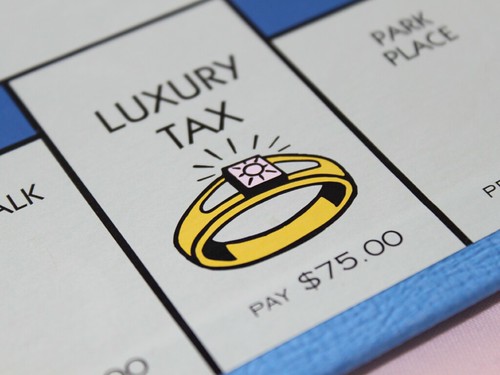
Luxury

What the heck is "Luxury" anyway?


We just returned from a trip to South Florida to see the Art Show at Cocoanut Grove.  It was fun, but it was also interesting.  One of the sponsors was Lincoln, which like Cadillac, is trying to figure out exactly what it stands for.

In South Florida, a lot of stuff is sold on the premise that it is "Luxury".   Luxury cars, luxury condos, luxury apartments, luxury SUVs - whatever.   The phrase is so trite and overused, one wonders what it means anymore.

Marketers have been using "Luxury" to sell us stuff since time began.   After the war, Chevrolet sold cars with imaginative names like "210" or "Master Series".   It wasn't until they came up with the "DeLuxe" moniker that sales took off.   It was the same old car, of course, with a few gee-gaws and trim pieces, and some optional "luxury" items (like a dome light) made standard.   But sales took off - people wanted to be able to project the image that they could afford to spend more than their more plebeian neighbors.

And since then, special "Luxury Editions" and whatnot have sold cars and other goods.   And we buy them - in bulk.

Technically speaking, the term "Luxury" traditionally applied to anything that was not a necessity.   So if you had "all the luxuries" in life, you were doing pretty well, as opposed to the slug who was just getting by with oxygen, food, and water.  But over time, the term has taken on a new meaning - and a meaning that really defies explanation or definition.

Luxury goods today are often the same goods sold in more plebeian forms, but under a different brand name and with a slightly different trim or decoration.   In cars, this is readily apparent, and the problem for Lincoln and Cadillac.  You can look at those cars and see their Ford and Chevy counterparts hiding underneath the glitz.    The doo-dads and gee-gaws are mostly all available as options on the lesser cars, so there is less and less distinguishing these "Luxury" brands from their base models.

And often, "Luxury" goods are far less reliable and durable than plain-jane products.   A fancy Swiss watch can cost more than a nice car, but it doesn't really tell time any better than a cheaply made Japanese digital watch.   In fact, the latter is often more accurate and doesn't need winding.   And if it is lost, stolen, broken, or damaged, you can simply throw it away and get another one - and do this almost daily for years, and still not spend more than the fellow with the Swiss wind-up.

In short, there is no technical advantage to owning the fancy watch.   It is purely cosmetic.  It is purely for showing off.   When you have the fancy watch, and people notice it, they understand that you have enough money to buy a watch costing thousands of dollars (or at least think you do).

Handbags are a similar thing.   A Kate Spade bag is nice and all, but at the Art Show we were at, we saw handmade bags made by leather crafters that were far superior in terms of aesthetic design, quality of leather, and quality of construction.   However, the lady next to us, who had a bag that said "KATE SPADE" in inch-high letters, was not about to buy some no-name bag, even if it was more beautiful and better made.   No one would know how much she spent on it, so what's the point?

The same is true of home appliances.   My neighbors bought a Sub-Zero built-in refrigerator, which easily cost twice what I spent for my side-by-side.   My "cheap" refrigerator cost less than $1000 and never needed maintenance or repair for a decade.   Theirs had the Sub-Zero repairman at the house several times over that same time period.  And mine had ice through the door.   In terms of features and performance, the "cheap" refrigerator from Home Depot was a better deal.   And as I have learned over the years, even cheaper refrigerators in the sub-$500 price range, perform just as well as the $1000 ones.

And so on down the line.  Today, people are not content with "look at me!" kitchens and baths anymore - they have to have the "look at me!" laundry room as well, complete with odd-colored front-loading washers and dryers on $500 pedestals.  But these machines, despite costing far more, don't wash clothes any better, save that much energy, or are more reliable (actually less so).   So why do people do it?

Luxury today means only that you spent more on something and not that the item in question is inherently better or longer lasting.   And the entire point of "Luxury" today is to show off to other people your apparent wealth.   What is the point of being wealthy if you can't rub someone else's face it it?  That is what marketers are selling these days.

So what is the point of all this?   Well, to begin with, the word "Luxury" should trigger a response in your brain - if you want to save money, that is.   View it as you would police tape roping off a crime scene.   As soon as you see the word "Luxury" attached to any transaction, chances are, some marketer already has his hand in your wallet.   It is an emotionally-laden word, used to sell products and nothing more.  And it usually is designed to sell you things you don't want or need.

And they way they do this is by appealing to your most base and vulgar instincts - the instinct to think of yourself as "better" than other people, in one way or another.   What the BMW buyer of 40 years ago was buying, was a sporty performance car.   What the BMW buyer of today is buying is a status symbol designed to tell other people, "Look how much money I have!" - even if they don't really have that much.

It is an ugly and repulsive part of human nature, but one that is present in all of us.  The desire for status in our society is very strong.   And as I noted in another posting, status-seeking behavior can take on all sorts of weird forms.   The hippie environmentalist claims "caring about the planet" as status, even as they speed in their Prius.   The anti-status person claims "not caring about status" as status - because they are morally better than you for not caring.

But most Americans go for the plain old status kind of status - owning things to project an image about themselves.  And this is where the marketers have us, with the selling of "Luxury" appointments in nearly everything in everyday life, from grocery shopping (at the designer store) to designer coffees (at Starbucks, natch!) to what sort of electronic jewelry you carry about (logo facing OUT of course!).

I try not to fall into the anti-status as status trap.  I am no better than anyone else in that regard, having bought my share of "look at me!" luxury items over the years.   What I have learned, however, is that no matter how much (or how expensive) the crap you buy, there is always someone with more crap or more expensive crap so you can never "win" at this game.

Moreover, in order to play you have to keep spending, spending, and spending.    When I had a fancy BMW convertible cruising down A1A in Fort Lauderdale, I was king of the world.   But then a decade goes by, and it is just another used car, of course.   Still a fun ride, but not something the valets are going to leave out front, at the restaurant (the ultimate status trip!).

You start to realize that it is a pretty stupid game, and one that just cleans out your wallet more than anything else.   You also realize that impressing people you don't even know (assuming that they are impressed) is pretty stupid as well.

I live on an island now, where all the houses pretty much look the same.   Since I don't drive or go to the office, no one notices what kind of cell phone I have or how fancy my car is.  And in fact, this ends up being sort of better than status-seeking, as you blend into the background in life.   Nobody will notice you in a beige Camry, and that has certain advantages.

And my experience is probably pretty typical.   It is easy to sell "Luxury" goods to a 30-something who is starting to make good money.   It is a lot harder to sell to a retiree.   And that is one reason why marketers love the younger demographic - they will spend more on status items, up to the point of bankruptcy.

For old people, "Luxury" means not having to work, or having to worry about money.   That is, indeed, the ultimate luxury.   And it can't be bought, either, only saved up for.