Saturday, January 23, 2016

Gun Stocks (and Bonds)

This is not what I am talking about.

In the idiot media in the last few days, are articles touting how well gun manufacturers have done and why gun stocks (stocks in companies making firearms) are a "sure thing" investment.   This is, of course, idiotic advice on three levels.

First, the best time to buy a stock that has shot up in value is before it shoots up in value (and pardon the pun).  So, the best time to buy a firearms stock would have been before Obama was elected, or at the nadir of the market in early 2009 or before one of the mass-shootings, say, in 2011.   Today, it may be too late as we will discuss in more detail below.   Timing the market is hard to do, without a working time machine.

Second, you have to buy the right stock.   Even if you (a) successfully identify the right market segment to invest in, and (b) successfully identify the correct time to invest, you still have to (c), successfully identify the correct company to invest in.   If you thought, for example, that Colt Firearms, which seems like the GM of the gun business, would have been a good bet, you would have lost everything.   Yes, in the middle of crazed gun-buying, they found some way to go bankrupt.

Third, you would have to know when to sell.   And that is the real problem with stocks that are identified by the media after they have gone up in value.   Apple, for example, wasn't talked about by the financial media when the stock was in the toilet, not so many years ago.   It was only when the company stock price went ballistic that everyone shouted "Buy Apple!" - but of course, by then, it was too late.   And the same could be true for firearms stocks.

There is such a thing as market saturation, in the smart phone business, and yes, even in the gun industry.   Paranoia about Obama "taking our guns away" only goes so far.   Once every American has an AR-15 and a closet full of ammo, eventually they will stop buying.   And once they realize that the second amendment does indeed protect the rights of law-abiding gun owners, the paranoia will dissipate as well.

So you buy the stock now based on media reports, and well, it may go nowhere.  Taking another firearms stock - Sturm, Ruger & Co. as an example, if you selectively filter the stock price for the last five years, the returns look pretty amazing:

Ruger had a gain of about 273% over the last five years.  Do you think it will increase by 273% more over the next five?


Ruger started out in 2011 trading at about $15 a share.  Today after peaking at nearly $80 a share in 2014, it has fallen back to about $56 a share.  That's a 273% gain, which looks pretty appealing compared to about a 50% gain in the overall DJIA during the same time period.

The question is, of course, can the company grow another 273% in the next five years?  Or even 50%?   In order to sustain such growth, sales have to grow exponentially.   Sales of smart phones went like gangbusters over the last decade, as people switched from older-style flip-phones, to the ubiquitous bar-of-soap brain enslaver.   But the market is slowing in 2016, as penetration reaches maximum.   As with Facebook, real growth remains overseas (which is why Zuckerberg so generously is giving away free WiFi in India - WiFi that only allows access to Facebook).

But again, every time we look at share price graphs, we have to realize that we are filtering data, based on time range, which can skew perceptions.  If we look at a longer timeline, we may see some interesting trends.

Going back to 1980, we see that the stock peaked during the Clinton years, and then fall back during the Bush years.   Could the same thing happen again?   Does this look like a stock on the way up, or a stock in a bubble?

In a way, this chart resembles the gold charts of the last 20 years.   Smaller bubbles in the past, followed by a huge rise up after 2009 or so.  And in both cases, the prices have corrected somewhat.  Note that during the Clinton years, when the fear of firearms confiscation (those Democrats keep threatening it, but never follow through!) were high, the stock price rose up - and then fell during the Bush years, as fears subsided.    Could we be seeing a similar pattern here?  After each mass-shooting, people buy guns, out of fear that new regulations or laws will be enacted, and profits (and share prices) go up.

But after a few months or years, people realize that, yes, the Second Amendment prevents the government from outright banning firearms sales.   So the idea that "the gub-ment is going to take your guns away" starts to lose currency, and sales slacken off.    Since guns basically never wear out (or rarely do) each time a gun enters the stream of commerce, the market becomes more and more saturated.

This is not to say that the stock is a bad buy either.   With a fairly reasonable P/E ratio and a not-too-bad dividend yield, the company stock is only a little overpriced, compared to other traditional manufacturing stocks.   The problem is, as Colt found out, there are few barriers to entry in the business, a lot of "new names" have sprung up over the years, and no one has a monopoly even on one design.  Throw in market saturation, and well, you could see some of these players go bankrupt (particularly the highly-leveraged ones) in the next few years, if demand slackens, which it likely will.

Colt is famous for two firearms.  First is the Colt .45 M1911, which was made in massive quantities by Colt and also many other arms manufacturers.  As the name implies, it went into service in 1911, and was an antiquated design, compared to today's more modern automatic pistols, which among other things, hold far more rounds.   So the time-honored 1911 has been supplanted by the Glock 17 and other more modern weapons, and Colt didn't seem too interested in updating their designs (which would you rather have, 7 rounds, or 17?) or going after the consumer market - concentrating instead on military sales.  

The other weapon - the AR-15, which originally was designed by Armalite, but was bought by Colt.   AR-15 is now a generic term to identify a number of assault-type rifles using the same basic architecture.  And today, it is one of the hottest selling weapons in the US.   When I was a kid, you simply couldn't buy military-style weaponry like this.  Today, it is on the shelf at every gun store.

Again, you would think Colt would be printing money with this design, given its popularity with gun owners.   However, once again, there are few barriers to entry in the business, and other companies - most with names you've never heard of - have built similar weapons, often of better quality and with design improvements, and have far outsold Colt in the civilian market.

NOTE:  A reader points out that Colt was, prior to bankruptcy, privately owned.   Even though a company goes private, you can still participate in it, through bonds.  For example, Dell went private, but I bought some of their corporate debt, which has done well - better than my purchase of Yum! brands corporate debt (you stoners - go out and eat more tacos!).   And apparently, the problem with Colt was, there was an awful lot of corporate debt!   Even though a company is in a "hot" market, they can still screw things up royally, as is the case with Colt.

I am sure a gun enthusiast could point out more nuanced differences.  The point is, with little in the way of intellectual property or other barriers to entry, new manufacturers can (and have) enter the field at any time when it seems sales are going up, and steal away market share from mainstream companies.   These same johnny-come-latelies are usually the first to fold when the market calms down.   It is not dissimilar to the marginally operated oil businesses going bankrupt in the Bakken right now.

And then there are the real threats of regulation in the marketplace - although I do think these are more of a long shot (again, no pun intended).   While it is unlikely the government could "take away your guns" or "outlaw gun sales" it is possible that certain gun designs could be made harder to get, or be outlawed for the civilian market.   For example, in the past, so-called "open-bolt" semi-automatic machine pistols were outlawed, as they could be easily converted to full-auto.  The MAC-10 is one example of such a design, and the company making it eventually went bankrupt as a result.

So today's hot "assault rifle" manufacturer, could be tomorrow's "out of business" manufacturer if such a weapons ban were in fact enacted (it was tried in the past, with mixed results).   Either way, you have the prospect of a diminished market, it doesn't matter if the gun control people win or lose.   Market saturation eventually kicks in, if it is not already here.

(By the way, no flames from the "there is no such thing as an assault rifle" people.   Just like the "there's no such thing as a Palestinian" people, they are trying to control the debate by controlling the terms of the debate.   Like pornography, you know an assault or "tactical" rifle when you see it.   You're fooling no one with these semantic arguments.  Maybe it is hard to define from a legal point of view, but we both know exactly what the term means).

Now, for those of you who think emotionally about the issues relating to firearms (for or against) you will both undoubtedly miss the point.   From an economic standpoint, it doesn't matter if you think you have the right to own a Howitzer (you don't) or that anything other than a BB gun should be outlawed (that can't happen either).  The issues is the same old thing - supply and demand, market saturation, and so forth.  You know - economics.

But the ultimate deal is this, though:   If the financial media is talking about a stock after it has gone up in value, chances are, it is a shitty time to buy that stock, as it has nowhere else to go.

Stock-picking is for chumps, and I know this from experience.    Individual investors simply don't have the knowledge and market research to properly be able to (a) identify market segments to invest in, (b) properly time those investments, and (c) know which stock in that market segment to buy.

And if you doubt this, ask the guy who bought Colt stock a few years back, convinced he was going to "hit it big".   Hey, gun stocks - a sure thing, right?


UPDATE:

Buying gun stocks is the same as the 3-D printing deal.   Folks like Motley Fool are hyping 3-D printing as "the next big thing!" but the same problems occur.  Which 3-D printing company do you buy?  Because some are successful and some go out of business, and most of these printers are being made cheaply in China.

Gun stocks (or bonds) are the same deal.  Which do you buy?  Because even though the market is booming, not all companies will thrive, as Colt shows.

Basically, when the media hypes a stock or an area of investment it is too late to buy in.

Second, as I predicted, a lot of folks cannot separate a logical analysis of market conditions from emotional thinking about firearms (whether you are pro or con).   I received e-mails from people who thought that since I believed that gun stocks were not a good investment, that I was "anti-gun".   Others, who are "anti-gun" chastise me for even thinking about investing in the "merchants of death".

People are fucking morons, aren't they?  Emotional thinking will never move you forward in life, but sadly, when it comes to firearms, emotional thinking predominates on both sides of the debate.

Another reader opines that weapons themselves are a "good investment" which may or may not be true.  If you buy a firearm for retail price at a gun dealer, odds are it will merely hold its value, or likely, depreciate, because like with gold, they are making more every day.   Few barriers to entry and assembly lines cranking them out - and little fear of "Obama taking your guns" means that supply will always outstrip demand, even if there are spot shortages.

You could, if you were smart, buy weapons on the secondhand market and then re-sell them for a profit.   recently, there was a glut of such product on the market, as a lot of folks who spent $1000 or more on a firearm on the premise "Obama will take our guns away" realized a year later that they had a very expensive paperweight in their living room, and that they had important bills to pay and real expenses in life and couldn't really afford such a luxury as an AR-15. 


As this chart illustrates, gun sales spiked in 2013, then plummeted in 2014.   They will likely go up in 2016 as there is more talk of expanding regulations (and the NRA cranks up the "gun ban" siren).   But I think long term, this has all the makings of a gun bubble.  The market will be saturated eventually, and people will realize that the government can't "take their guns away" after all.   If Obama can't do it in eight years, no one can.


And that is why you see all these "GUN AND PAWN" places in rural areas - guns are probably the most pawned item on the planet.   There is an old redneck joke that goes something like this:  "Oh, yea, buddy?  Well, if you piss me off again, I'll go get my gun out of pawn and shoot you!" - which sort of illustrates how "gun ownership" works in the rural South.

So you could buy low, I guess, between school shootings, and then sell high when the NRA cranks up "gun confiscation" rhetoric.   But then again, I suppose it would be a pretty marginal business, much like buying and selling used cars.

Buying and HOLDING guns as an investment would be far trickier.   Unless they have collector item value (antiques, etc.) they likely won't hold their value much.   The rifle you buy at Wal-Mart is going to sell at Wal-Mart for the same price next year (adjusted for inflation) and no one is going to pay you huge amounts of money for a used weapon over a new one.

I suppose, given the loophole in firearms laws, you could buy from legitimate dealers and then sell to friends who don't want to wait for background checks.   But that might violate a number of laws and land you in jail.  Not recommended.

It is sad that people can't analyze things without investing a lot of emotional freight into them.



Friday, January 22, 2016

Snopes Digest

I used to visit Snopes once a day to see what the latest rumors were.  Now I have an easier system.

UPDATE:  Apparently even Snopes is getting tired of having to debunk 20-30 rumors a day spread by social media.  They now have a page devoted to "how to spot fake news" because people are so stupid they can't tell the difference.

* * *

Over the years, I have relied on www.snopes.com to figure out if something was true or not on the Internet or in the news.  It was, back then, the "urban legends reference page".

But in the last year or so, something weird has happened - not to Snopes - but to the Internet.  On any given day, you can go on Snopes and find five, six, or even seven new urban legend "sightings" per day.

What the heck is going on?

Social media is what is going on - the sewer of the internet, full of mis-truths, half-truths, and outright lies, along with made-up stories, clickbait, and fake news.   It is all designed to get you riled up, to get you to click, or whatever.
 
So, to save you a lot of time, I have compiled a Snopes Digest.  In one page you can determine whether or not an Internet rumor is true or not:

1.  Did you see it on Facebook?   Then it was fake.   Other than pictures of the last meal your ate, or your dog, or your kid, everything on facebook is fake.  The latest political outrage?  Fake.  Famous quotes from our forefathers or Albert Einstein?  Fake.   The latest outrageous news story?  Fake.   Police officers or servicemen "refused service" at a convenience store or restaurant?  Fake.   Nothing - nothing at all - on Facebook is real or reliable.  Using it as a news source is a dangerous thing to do.
Abraham Lincoln was wrong.  Don't believe any quote you see on the Internet that is attached to a picture.  They are all invariably fake.

2.  Was it on Twitter?  Odds are it's fake, too.   Either the twitter account was hacked and someone is posting nonsense, or someone has created a fake twitter account with a sound-alike name.   There is nothing - nothing at all - worth getting worked up over on twitter.   You are just better off not using it. The signal-to-noise ratio is about 1 to 1 - for every "true" thing on twitter, you are going to read one false thing.   And most of the "true" things are just banal inanities.

Twitter is like texting - it is akin to passing notes in class in the 7th grade.   Grow up, for chrissakes.   No one wants to hear the latest gossip other than immature people.   No one wants to hear your opinions, minute-by-minute on events as they happen.   And what we learn about events as they happen is usually the most unreliable information of all.

3.  Was it on Reddit?   Reddit is supposed to be "the front page of the Internet" - whatever that means.   What it really is, is a glorified anonymous Facebook, where pictures of people's cats competes with fake news and doctored photos and "reposts" that appear over and over again.   Due to its "upvoting" system, the absolute dregs float to the top of that septic tank, while hard data is downvoted to oblivion.   Since most of the "voting" is done by people who are internet-addicted (young kids and gamers) the most idiotic stuff ends up on top - stuff you'd expect fascinates an 18-year-old tech geek who likes to play video games and dress up as Batman.

Inaccurate stuff appears on Reddit all the time, and then people compete to see who can make the most witty comments (and by witty, I mean on a high-school scale).   If someone posts, "Oh, by the way, this photo was shown to be fake about a year ago!" that comment is downvoted to the bottom of the page.   The end result is an "internet circle-jerk" where people continue to post witty comments or act outraged (if that is the expected response by the troll who put up the link in the first place) over and over, for days.

4.  Was it on Website You Never Heard of?  There are tons of fake news sites out there these days, and then others who claim to be real, but are just political blogs that spread rumors or exaggerate the hell out of things.  These sorts of "sources" like Beritbart or The Daily Current are just not reliable, period.   Sadly, even The Washington Post and The New York Times (and it goes without saying, Murdoch's Wall Street Journal) are resorting to click-bait to gain "readers" these days.

5.  Does it have a clickbait headline?   "You'll never believe...."  or "The 10 best" (or worst) or "Banks hate him!" or other come-on nonsense that requires you to click on the link in order to find out - and even then, you have to click on ten more slideshow links in order to find out what the headline promised.  This is not "news" nor is it accurate.   The best you could say is that things like "the 10 greatest muscle cars of all time!" is merely subjective opinion.   The worst is, well, it is just lies.

* * *
Sadly, what this means is that most of what you read on the Internet is simply untrue.   And that leaves us in a conundrum - where do you get hard data to perceive the world as it actually is?   When The Daily Show and The Onion have more relevant information that the "paper of record" does, it make you wonder - how did we get to this place?

There are, however, ways to vet real news from fake.   And this responsibility begins and ends with YOU.   NEVER, ever, ever! just re-post or "like" or forward a piece of "news" that you have not vetted yourself.   Don't assume that just because someone you know sent you a link or a story, that it is indeed true.

Google it.   Does it appear in other news sites - you know, the real kind?   Even if so, do they reference anything other than the original story on a sketchy site?

Is there hard data in the story - names, dates, and so on?   So much of these fake shit is supposed to have happened "just last week" or "yesterday" which are ambiguous terms that never date a story.  Names and locations are not given, or are made ambiguous.

The problem with fake news isn't the people creating it, it is the idiots who spread it.   And this in regard, your second responsibility is to ridicule and shame those who spread such stories.   Yea, I know, these are your friends.    Educate them to be more skeptical or find new friends.   Hanging out with people who believe in UFOs or Sarah Palin will inevitably cause you a world of woe.

Wednesday, January 20, 2016

American Car Companies are Back - And Headed for Bankruptcy!


2015 was one of the best years on record for the American auto industry.   So why are so many predicting gloom and doom?   Turns out, the industry's strength is also its weakness.


Ms. Barra politely declined.   Maybe she didn't see value in the proposition.   Maybe she thought that the two companies wouldn't blend well.   Maybe she thought that the basic strength of both companies (SUVs and Trucks) were redundant.

But I think the deal-killer was what she read, on her first day as CEO of GM, scrawled on the inside of the desk drawer of her desk by a previous GM President: "Beware of Italians bearing gifts!"

You see, many years ago, in the 1990's, GM paid $2 Billion dollars to buy Fiat.   They then realized what a horrific mistake they made and paid $2 Billion more not to buy Fiat.   Fiat took its four billion and bought Chrysler instead, and using technology from Chrysler's previous owner (Mercedes) as well as the GM tech they were privy to during their brief honeymoon, built some nice cars and made money.

And now Sergio comes a-calling with a box of candy and a bouquet of flowers and says, "Heya, pretty lady, you wanna buya car compagnia?  I sella to you, best price!"

What exactly is going on here that would make Marchionne so desperate as to propose a merger of GM and Chrysler?   And remember, he did this right after selling off cash-cow Ferrarri.

Well, despite record sales in the US last year, the car business is far from being out of the woods just yet.  Globally, manufacturing overcapacity is still an issue.  There are too many car companies, too many brands,  too many factories.   As a result, factories don't run at peak efficiency.

In addition, the cost of bringing a new car "platform" from design to production is staggering.   Not only are design cycles becoming increasingly shorter (requiring more intensive and expensive design staff and testing capabilities) the technical requirements for autos today are staggering.   Today's cars are more complex than civilian airliners of the 1960's.   Cars not only have dozens of computers in them today, they may have hundreds.   And consumers are no longer wowed by technical gimcrackery - they expect it and expect more with each new generation.

If you want a seat at the table, power locks and windows ain't gonna cut it no more.  You need all the bells and whistles.   And it better be the safest car yet, drive itself, and product hardly any pollution.

No easy task, if you understand Engineering.

So it makes sense to consolidate.  Why design five different kinds of pickup trucks, when they are all about the same, in terms of performance and capabilities?   Use one design, save money.

But a GM/Chrysler merger would be problematic.   Which do you keep and which do you dump?  The Chevy Silver-a-do or the Dodge Ram?  Both have loyal followings.   Do you keep the Challenger or put the "Hellcat" engine in the Camaro?

Or are you, in effect, just buying Chrysler to shut it down and reduce your competition?   I am sure Ford would thank you for the effort.  Of course, that may raise anti-trust issues.

No wonder Ms. Barra turned down the offer.  It just didn't make any sense.   For GM to acquire three more brands after struggling to dump three old brands, simply doesn't make any sense at all.  And to make products that compete with each other across the line makes no sense.   All GM would be buying is factory capacity, and it has enough of that.   Building Dodge Rams on Silver-a-do platforms makes even less sense.  GM might find value in the Jeep brand - which is the core of Fiat's profit in the US - but that's about it.

I think the car companies, worldwide, are vulnerable in the next few years, for a number of reasons.   For starters, just as in 1957, we've had a few record sales years in a row.   Everyone bought a car and now there will be a pause as the market saturates and sales slow down.   The China market, once going gangbusters, is slowing way down, as the market saturates and goes from a "let's put everyone in a car" mode to "Hey, that old car worn out yet?" mode.

And since capacity in China is high and demand is low, it will not be long before the Chinese start to think about exporting cars.   When this happens, well you know the pattern.  The US automakers are already losing money on small cars (Ford, after pledging to build the new Focus in Michigan, pulled up stakes and moved the plant to Mexico, so that SUVs and trucks -which are more profitable - could be made here).

The CEO of Ford (of the same name) laments that the industry is going back to its old tricks of extended financing (as long as seven years) which tends to bankrupt customers and take them out of the new car market for longer periods of time (as they are upside-down on their loans longer).

And then there are gas prices.   In the short term, US companies will remain profitable as - once again - we all go out and buy gas-hog vehicles because gas today is cheap.   Then, five years from now, or ten, gas goes up in price.  The economy stalls, and then people dump their gas-guzzlers and go looking for cheap fuel-efficient cars to buy - this time from China.

Oh, yea, it will get bad, again.  Round 1 was to the Germans, who invaded the US with their cheap Beetles.  Round 2 was to the Japanese, with their Corollas and Civics.  Round 3, to the Koreans with their Hyundais.   China is slated to make the knockout blow.  Hell, they already own Volvo - which they bought at Ford's garage sale.

So what does this all mean?   Well, the auto industry is consolidating, worldwide.  It is a mature industry and the product has reached a level of maturity to the point where product differentiation is no longer an issue.   You look at the high-tech features on one brand of car, and chances are, the competing brand has the same features, possibly made by the same supplier.

We may, as I predicted years ago, reach the end of the car-based economy.   People in the future may travel less and stay home more.   Owning a car may seem less important in an era where you can summon one on your cell phone.   As the cost and liability of building cars becomes so steep, designs may become more standardized, with common platforms being used to support a rage of similar-looking vehicles.

And I say this, because it is happening already.   Small players like Suzuki and Isuzu are out of the car business already.  Mitsubishi may soon follow suit.  Mazda, cut loose from Ford, needs to find a big brother to share expenses with.   They've already sold the Miata (MX-5 as they call it) to Fiat as the new Spider 2000.   They'd probably like Marchionne to buy them out, but he ain't got the money.   And a merger of the two would be as disastrous as the merger of Packard and Studebaker - two weak companies that combined, still could not survive.

Many countries, such as Australia, are seeing their domestic auto industries disappear entirely.  I expect you will see the same trend in places like France and Spain.   Just ask the British.   The few cars made in the UK these days are no longer made by British companies.

I think you will see some car brands disappear.  If Mary Barra wants excess production capacity, she can buy it at Fiat-Chrysler's bankruptcy sale.  Or Mazda's.   But I suspect they have all the production capacity they need, so why buy someone else's rundown factory and besmirched brand names?

Of course, it is hard, without a working time machine, to predict which companies will go and which will stay - and the timeline of when this will happen.   We can only say for sure that something is indeed happening in the marketplace right now, as smaller car companies struggle to compete with their larger brethren to develop new platforms.

VW, facing a crises, may be forced to sell off its luxury Bently or Bugatti or even Lamborghini divisons, which are not big money-makers, but require huge amounts of R&D to come up with cutting edge products.   Such divisions are also very susceptible to recession, as people cut back on half-million-dollar cars during down years.  VW may in fact end up, due to this debacle, being a merger candidate itself.

Even companies with large market shares could be vulnerable, if their profit shares are not correspondingly large.  We saw this with GM, once the world's largest automaker, but losing money on each car it made.  It doesn't take too many years of negative earnings in the car business for things to come to a screeching halt.   And will Congress bail out these companies yet again?   Or will another merger be forced as the last time around?

It could very well be high-cost producers like BMW or Mercedes - who sell high-tech cars at high prices, but who are increasingly being undercut by other producers who offer increasingly comparable goods at far lower prices - end up being the ones in trouble.   It is not just Lexus that they have to worry about anymore, but even Hyundai with its Genesis and KIA with its K-900.  For the time being, they are safe, as people still buy German cars for the three-pointed star or the blue-and-white roundel.   But if people's perception of status and luxury every change..... well how do the Germans win back their buyers? 

Of course, none of this is going to happen overnight.   Just as it took a decade or more for Radio Shack to topple (longer after people wondered why it was still in business) and just as Sears/Kmart  keeps going on as a zombie business well into 2016, these long-term trends will take a long time to materialize.

But you can see the signs now.   And when Fiat-Chrysler, coming off a banner year, decides to unload Ferrari and then peddle the entire company to GM, you have to wonder what it is that they know about the business that we don't.

 Strange days, indeed!

The Box Cars


Boxy small cars are the new station wagon.   Sadly, most are now out of production.  2015 KIA Soul Exclaim, with the "whole shebang" package, sun and sound package, and umber leather, in Fathom Blue.

As I noted in my Station Wagon posting, the almighty SUV is slowly crushing the American car market to death.   These ugly beasts are so profitable and so popular, that they are slowly displacing every other car from the market.   Before it went bankrupt (for the second time) Chrysler had a lineup of nearly all SUVs.   Sports cars, convertibles, station wagons, and sedans almost went extinct in that era - and may still be endangered today.  Auto executives love the profitable pickups and SUVs that are largely "empty steel boxes" sold by the pound to gullible consumers.  Small cars, however, command small prices and small profit margins - and as a result are not as heavily promoted.

For a brief period, however, during the early 2000's to the early 2010's, a number of "Box Cars" came on the scene.   These were practical vehicles that weren't quite wagons, weren't quite mini-vans, and certainly weren't SUVs.   They were boxy, ugly, and funky-looking and certainly not speed demons or racing machines.    But they were cheap, fairly reliable, had a modicum of style, and were as practical as hell for hauling all your shit around.

I suppose they were the spiritual successor to the hatchback - another vehicle that is extinct or nearly so - driven from the market by focus groups and the wisdom of advertising execs.   The old VW Rabbit/Golf was an example of this - a tiny car with an enormous amount of room in it.  I remember driving home from IKEA in Mark's 1987 GTI with an entire king-sized bed inside and strapped onto the roof (two box springs and one mattress in the hatch, another mattress and bed frame and headboard on the roof!).  

Practical cars, for hauling four people, and occasionally loads of "stuff" that most people need to haul around.   Of course, the Golf is still around, but is now a very expensive "luxury car" - or so the people at Motor Trend claim.  And of course, we know how the Motor Trend Car-of-the-year curse works on car companies.  Oh, right. Diesel emissions scandal.  Sorry, VW!

Anyway, these boxy cars came and largely went, although one is still in production today.   In terms of practical transportation, you could do a lot worse.


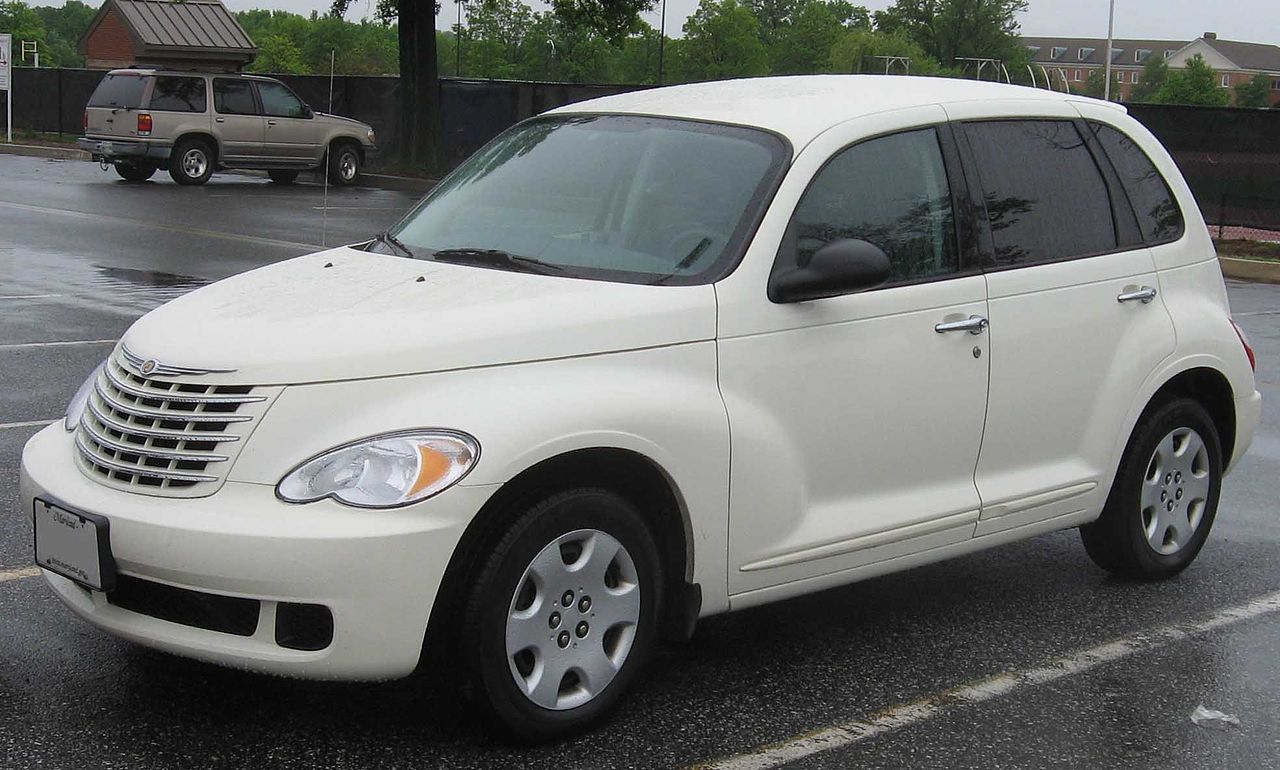
1.  PT CRUISER   (2001-2010)   You might argue that the PT Cruiser was the first "box car" although it was not very boxy.   But it had all the basic box car design elements:  Funky retro design, a raised station-wagon like roof, kitchen-chair like seating, all based on an economy car platform.   They were not expensive cars, but got decent gas mileage and hauled your stuff around and looked a lot cooler than the Dodge Neon they were based on.

Sadly, Chrysler decided to replace the car with something called the "Dodge Caliber" which the President of the Corporation called "an abomination" - while it was still in production.   Today, Dodge has no box cars, just ugly SUVs.


2.  CHEVROLET HHR (2006-2011).   Ford made the Falcon, and Chevy copied it with the Nova.  Ford made the Mustang, and Chevy copied it with the Camaro.  VW made the Beetle, and GM copied it with the Corvair.   And so on down the line.  GM is never short of original ideas - they just prefer to copy other peoples' as it is easier to do.

And once Chrysler showed some promise with its retro-styled boxy wagon based on an economy-car chassis, GM decided to do likewise, creating the oddly named "HHR" based on the Cavalier/Cobalt platform.   In fact, they hired the designer of the PT Cruiser away from Chrysler.  He too, was apparently out of original ideas.

Again, it was not a bad car, with lots of room, reasonable gas mileage, and cheap to buy.  But when GM went belly up, the HHR went away, replaced with the SUV "Equinox" which has less interior room, a higher ride height, and all the other sins that SUVs are prone to.
.


 2.  HONDA ELEMENT (2003-2011)  Honda jumped into the game with a huge boxy wagon-like "thing" with rear suicide doors and odd features like a flat, sweep-out rubber floor.   While early reviewers opined that one could clean out the car with a garden hose, Honda pointed out that water could ruin sensitive electronics and void the warranty.  So Element owners resorted to leaf blowers, instead.

The element was an anti-car, designed for people who were not car people.   The fenders (in early models) were made of pebble-finished plastic - like a computer case.   You didn't need to wax it, or even wash it.  Just load the dogs in it and go.   It was a car for people who saw their vehicles as a means to an end, and not an end in and of themselves.

Sadly, such folks were in the minority.  And with a CRV being priced about the same, many buyers would jump ship to the dark side (SUV) so they could be perceived as "sporty" instead of "dorky".

But a funny thing, when the anti-car was cancelled, many Element owners actually cried.  It turns out, they were more attached to their Elements than they let on.


3.  SCION xB (2003-2015)  F. Scott Fitzgerald once said there are no second acts in American lives.  But the Scion xB went through two generations, and may emerge in a third as the iM.  We'll see.   The first generation xB was a boxy Japan-market minicar that was brought into the new Toyota Scion lineup at the last minute to fill in the range.   No one thought it would sell well, but it ended up beating sales of the rest of the lineup.   Small, boxy, tinny, and underpowered - and cheap - people loved them.  And while aimed at the 20-something market, many older people, who wanted inexpensive easy-to-drive transportation, snapped them up.

There were problems, of course.  To begin with, as a Japan market car, it barely met US crash test standards, and with side-impact requirements ramping up (not to mention insurance institute ratings issues) they re-designed the car (second generation) to make it bigger, bloatier, and more stylized.  The xB faithful revolted.   But they sold a lot of gen II's - perhaps more than the Gen I's.

Another reason for the re-style was the Koreans.  KIA (see below) introduced their own box car, and based their advertising campaign on ridiculing the Scion xB - comparing it to a cardboard box or a washing machine.  "You can have this, or you can have that" the Black Sheep rapped.  And why have a tinny box, when you could have so much more?

So Toyota re-designed the xB to make it more "like that" but the results were mixed. 


NISSAN CUBE (2002-2015)  Nissan jumped on the box car bandwagon with its Japan market auto-show theme car, which turned out to be thinking a little too much "out of the box".   With an asymmetrical design, the cube flirted too close to the line where "so ugly it's cute" becomes just plain ugly.   Never a big seller, it is slated to disappear, at least from US markets, in 2016.

Like most Nissans, it probably was a sturdy and inexpensive car, but most buyers likely opted for something more conventional - like the Nissan Rogue, another gawdaful boring run-of-the-mill mini-UTE.


KIA SOUL (2008 - Present)  KIA got into the game pretty late, but shook up the segment by offering something a little more than the competition.  While the Soul could be bought as a "stripper" for very little, you could also option up the car with leather interior, a powerful sound system, as well as electronic gadgetry that appealed to the younger generation.  Why, as they posited, would you have that, when you could have this?

In 2014, KIA introduced a second generation Soul, which looks, at first glance, identical to the first.  However, it is built on an entirely different platform, and no body panels or parts interchange between the two.  The new Soul is slightly longer and bigger than the old, and is also moved even further upscale.   Luxury car features like lush leather interiors, heated seats (even in the rear!) heated steering wheel, air conditioned seats (front only), panoramic sunroof, push-button start, Infinity sound system, and of course, all the electronic gadgets, are now featured.

With the wheels pushed to the corners of the car, the Soul, like most box cars, rides better than most economy cars of the same size.

KIA realized that these Box Cars appealed not only to the young, but to the old, who wanted simple, basic cars to get around town, get reasonable gas mileage (32 mpg, here), and be easy to get in and out of.
* * * 

The box cars are not dead - yet.   But the SUV continues to ruin the US car market.  SUVs are fine and all, but most of us don't need or want all-wheel-drive and the accompanying cramped interiors that driveshafts and raised suspensions require.  And let's not even talk about the shitty gas mileage.

While the great unwashed masses flock to the SUVs, maybe thinking "outside the box" these days means thinking inside the box.

Carrot and Stick and Obamacare


This chart, illustrating Obamacare subsidies, is rather scary.  Click to enlarge.

A reader recently sent me a link to a story about a guy who decided he was going to avoid paying $2900 a year for Obamacare and pay the $1800 penalty instead.  In his mind, it was a "smart choice" as the high deductible for Obamacare wouldn't "cover anything at all" so why bother?

(Note, see this ACA PENALTY CALCULATOR for more information about the penalty.  $1800 seems a little high at first, but when you add in dependents, the penalty can easily top $2000).

His math is, of course, more than a little off.   To begin with, you don't get "nothing" with a $2900 a year Obamacare plan.   All basic preventative medicine office visits are free, as are colonoscopies and other preventative medical procedures that could cost thousands of dollars if you are uninsured.

Moreover, if you do need an office visit or a prescription that is not free, you may only have to pay only a co-pay or a subsidized amount.

And even if not covered at all, the charges you pay for services are the pre-negotiated prices that the insurance companies pay, which is often 50% less than retail prices at a hospital.

For example, the "retail price" of a colonoscopy is about $3000 to $4000, but with my old "legacy" $10,000 deductible Blue Cross plan, I paid only $1800 or so, as that is the negotiated  price that Blue Cross would have paid had it is exceeded my deductible for the year.   The discount pricing alone is a good reason to get health insurance.

Of course, with Obamacare, the procedure is now free, but the same logic applies to other procedures which are not free under Obamacare.
 
But the math problem goes further.  If you think about it, the amount of money he is "saving" by not having health insurance is not $2900, but $2900 minus the $1800 penalty, or about $1100 which is what I pay in one month for my Obamacare plan.   If I could only get a plan that cost only $2900 a year, I would jump all over that shit!

But I am sure you know the drill - another "paycheck to paycheck" consumer who cannot afford $250 a month for health insurance, but can cough up his tax refund on April 15th to pay the penalty - and not see the overall cost of the transaction is killing him.

Myself, I am not happy about the new premiums for Obamacare, having made my first $1098 premium payment this month.  It is a staggering increase from $368 the month before.   But I will give it a shot and see what happens for a year.   Mark, turning 50, is due for a colonoscopy, which as I noted, would cost about $1800 at insurance rate prices.   With the Obamacare it is free, as are our office visits.   So it does cost a lot more, but we are getting more as well.

But $2900 a year?  Consider yourself lucky!

But wait, it gets better.  Depending on your income, you can receive a tax credit which can offset a lot of the expense of your health insurance.  If I can keep my income below $62,000 a year or so (which isn't hard to do these days!) I can qualify for a generous tax credit.   In fact, if my income in 2016 mirrors that in 2015, I could easily end up paying no taxes at all.   In other words my payment to Blue Cross replaces my payment to the Department of the Treasury.  I could receive a credit of $600 to $900 a month toward that $1100 health insurance bill.

In fact, I may have been a fool to keep my "legacy" plan as long as I did, as I could have ended up paying less for Obamacare than I did for my $10,000 deductible plan!

But that is one problem with Obamacare - it is hard to see the overall costs for the average consumer, unless your income is very regular.   So the amount of payment may be very scary - or it may be free - but the actual cost to the end consumer is not very transparent.

But to pay the penalty?   Even if it is "less" than the cost of premiums, even a few office visits for an uninsured person could make it a break-even proposition.   And if you have even one hospital visit, it could end up costing you tens of thousands of dollars - and even bankrupt you.

And that would be sad, medical bankruptcies in this era of Obamacare.

But this got me thinking about the carrot-and-stick aspect of Obamacare and of course, unintended consequences of the plan.   And one of these unintended consequences is that Obamacare, at least in my area, creates a pain point around $65,000 a year in income,  when subsidies drop to zero while premiums remain fixed.

The above chart was prepared using data from the Kaiser website.  The data appears to be correct, as the $1100 quoted for a couple aged 50 and 55 is close to the $1098 I am presently paying under Obamacare with Blue Cross.   What is interesting (and scary) is that the subsidy for premiums begins at about $16,500 in income.  Below that level, you don't qualify, but would be forced to go on medicaid, if you qualify for that (and if your State, like mine, did not expand Medicaid, well, you're fucked proper).

As you can see in the chart, at that income level, your premium is nearly zero.  And as your income goes up, the subsidy (dark blue line) drops off linearly, and your effective net cost (yellow line) goes up linearly as well.

So far, so good.

Of course, at $18,550, you enter the 15% tax bracket, so anything above that, and until $73,500 is taxed at 15%.  The raw income tax (Federal) is shown in the light blue line.   We'll get to that later.

As you can see, all hell breaks loose once you start making more than $65,000 in combined income ($63,720 seems to be the actual cutoff).   Once you go beyond this point, your subsidy immediately drops to zero and your effective premium goes to $13,200 a year.

From a tax perspective, these sort of "cliffs" are idiotic.  If you make $63,720 a year, you get about a $7380 subsidy.  You make $63,721 a year, you lose it all.  You would have to make $71,110 a year in order to break even with a guy making $63,720 a year.

So, when the boss asks you to work overtime, and your income is just topping $60K a year, you might be inclined to say "no thanks" as you will lose seven grand in tax credits for doing so.  This is an utterly idiotic result that makes no sense whatsoever.

Since the GOP wants Obamacare to fail, and the far-left (Bernie Sanders) wants Obamacare to fail, no one will fix this "gap" in the chart to make that yellow line go smoothly up, instead of jumping up at around 65K.

Of course, for the middle class (slightly upper middle class) it gets worse.  At $75,300 you enter the 25% tax bracket, so your marginal income is taxed at a rate 10% higher than your income below that level.   So if you make around 80 grand a year, you are really getting fucked proper.   For each additional dollar you make, you are getting slammed.   Between $63,720 and $71,110 you end up with less money to take home as you lose the Obamacare subsidy due to the "cliff".   People making less money than you have more take-home pay.

And when you make above $73,500, you get slammed with more taxes.  The Social Security cutoff is again for 2016, at $118,500, so between $73,500 and $118,500, you are getting the upper-middle-class tax screw-job.    It used to be that making this much money was a good thing.  

Today, you either have to make hundreds of thousands, or keep below this $63,720 limit.

Now you may ask why this happened.   In some States, this is less of a problem, as health care premiums are less.   In other States, such as Georgia, where I live, premiums are very high.   I think the architects of this act didn't believe premiums would be so high, and didn't anticipate this "cutoff" cliff would be created.

Another factor, of course, is that the upper middle-class has access to a lot more deductions, such as IRA, home mortgage interest, and things like depreciation (if they bought an investment property, for example).  People in this bracket can also afford tax advisers, accountants, and the like.

Still, though, this cliff seems kind of unfair.   And if I was basing my subsidy on my 2014 income,  I would be royally screwed.   Today, I will keep a close eye on my income, and if it shows signs of going over this $63,720 limit, you can bet I will close down shop, take a vacation, or "forget" to invoice my clients until the first of the next year.

Yes, these are the kind of unintended consequences that occur when you screw around with the tax code, particularly when you do it badly as is the case here, with a tax "cliff".

Tax "cliffs" are nothing new, but most responsible legislators are smart enough to avoid them.   The City of Alexandria, Virginia, for example, decided to implement a 4.5% "gross receipts tax" on businesses in the city.   To help out small-time business, they decided to make the first $100,000 of income exempt from the tax.   However, if you made over $100,000, you owed tax on the entire amount.

It was an insane tax schedule, put together by amateur politicians with no sense of rhyme or reason.  If you made $99,999.99 a year, you paid no tax.  If you made $100,000.01, you owed the city $4500.  At the very least, the tax should have been levied at income above the $100,000 level as that would make more sense.

Oh right, we're talking politicians here, many of whom can't do much math.

I am, of course, happy that I have found this loophole in the Obamacare law.   From now on, you can bet your ass, mister, that I won't be busting mine!   I will work down to the level dictated by the law - $63,720 or bust!

Because there literally is no incentive to make even a dollar more.   In fact, I would  be punished for it.

Such is the idiocy of the tax code.