Monday, July 24, 2017

Guru Books? Beware!


Should you look for investment advice in a book? Probably not.

A reader writes, asking whether I know of a good book on how to invest your money.   I am not sure how to respond to that.  I think he is still searching for the "sure thing" or the quick, easy money.  I get a lot of inquiries from people who see my blog but never really read it and understand it, and they want to know how to make a lot of money in a short period of time.

Sorry, wrong blog.   And the ones promising you that information will cause you untold heartache.

The majority of the money you end up with in retirement will be the money you set aside - the money you save.   The best basic "investment" advice is to put as much aside as possible.   The idea that you can invest a buck and turn it into a million bucks is just not feasible or probable.   You have to save heroic amounts of money.

But, everyone wants shortcuts.  They don't exist.   If they did, no one would tell you about them in a book.  People think they can "invest" a few hundred or a few thousand and become millionaires, as if a fully-funded retirement is something you can buy for not a lot of money.   It just ain't so.

This is basic common sense - logical thinking versus emotional thinking.

I've perused a few of these investment "gurus" and found them lacking.   Suze "Sooze" Orman, for example, started out saying what I have said all along - spend less, save more, diversify your portfolio, and wait.  Time is on your side.  Good Advice.

Then she became a spokesperson for Buick and Sea Ray boats, and then got a TV show where she "approved!" people to buy shit.   And it all fell apart.  She went for the money because, I think, she realized that people desperately want to believe the emotional theory - that you can "have it all now" and somehow leverage investments.   No one wants to hear about the drudgery of cutting expenses and counting pennies.   No one.

And you can't blame her for seeking personal gain.   The powers-that-be want you to spend money on a leased car, or a new boat, or a cell phone plan, or cable television.   They don't want you accumulating wealth and becoming independently wealthy.

Oh sure, they want to you pretend invest by buying stock in an IPO that friends of theirs are running.   The shouting guy wants you to BUY! and SELL! on his command, like you are a Pavlovian dog.   You will go broke this way.

I have been approached - twice now - by a "reality" TeeVee show that wanted to have "stingy" people on their program.  They wanted kooky people who annoyed their families with their stinginess.   You know, saving dryer lint to knit a sweater - that sort of thing.   Of course, they wanted to make saving money and cutting spending look like ridiculous things to do.

Gee, I wonder why?   "We'll be right back to 'Crazy Stingy People' right after these messages for leasing new cars, refinancing your house to pay off credit card debt, and a fun new miles rewards credit card!  Stay tuned!"

Oh, right, that.   The TeeVee, which I rail against, is full of horrific messages.  And most of them are along the lines of "we're all victims here, living paycheck to paycheck!  The only way to get ahead is by extreme couponing or buying your Abercrombie shirt on sale!   If you just shop enough on Amazon, you'll be wealthy!"

In other words, just give up on saving and spend it all now.   And I get that from a lot of readers who think I am crazy (why do they keep reading, then?) and that you can "score" with a car lease, and you should mortgage yourself up to the hilt and then invest in dot-com stocks.

I had a friend who did that - he tried to kill himself later on.

I saw a book from Dave Ramsey once in a supermarket.   I was reading it and thought, "Well, this guy gets it!"  And like the Sooze, he had  some good advice, save your money, pay down debt, invest in rational things.   It all sounded so good until I hit chapter 3 and he started talking about how much to tithe to a church.   He said 10% of pre-tax income was a "baseline" and that selected "gifts" on top of that were expected.

I put the book back on the shelf.   I learned later that he gives seminars at churches, who pay him to tell parishioners to tithe to their church and not the evil Gods of Mastercard and Visa.   My advice is more to the point - tithe to no one but your own self.   And no, this is not "selfish" it is a matter of survival.   Moreover, we don't need more victims in the world, so you do me a favor by taking care of yourself, as much as you do yourself a favor.  If you get your finances in order, you are one less person I have to support with my tax money.  Let me thank you in advance.

You see, there is no "trick" to investing or getting ahead.   It is basic logic.   You can't spend your way to success.  When you decide you need a fancy car and a fancy kitchen and an oversized house, you are bankrupting your future.  There is no way out of this other than to shed the material and use that money to provide for your future.

"But Bob, isn't there a way I can still have a new iPhone 8, granite countertops, a new leased Acura, and still make money in the stock market?   What if I buy all these new IPO stocks, surely I can get rich and have all my toys, too!"

You haven't listened to a damn thing I have said, have you?

Getting ahead requires sacrifice, not indulgence.   You can have a Jet-Ski or $8,000 more in your IRA.   You can't have both.   You have to learn to do without, and that is the hardest thing to do.   And no one wants to hear this, hence it doesn't appear in investment books or seminars or on the TeeVee.

The idea that there are "secrets" to making money is just idiotic.   And again (and I have repeated this so often, I sound like a broken record) if there were such secrets, no one would ever tell them, as then they would no longer be secrets and no longer be effective.

"But Bob!" a reader writes, "Maybe he wants to tell others these secrets to help his fellow man!"

No, people really think this way.  Some days, I feel I should just give up.

A Hedge Fund manager recently promoted an underling to run his fund, paying him $250 Million dollars.  Why did he do this?  Because he felt this 34-year old had the secret to making money.   If he felt he could get this information from a $39.95 seminar or book, he certainly wouldn't be paying him all that money.   And the hotshot kid ain't selling his "secrets" if indeed he has any, in some stupid book.

People want to believe in the tooth fairy.   And if you want to believe, that's fine.   But don't expect me to validate belief-based investing.  It is emotional thinking, not logical.

There is no big secret to wealth.   Spend less, save more, put money aside in a plurality of rational things, avoid hyped and promoted investments, invest for the long-haul.   You will do OK in the long run.

That has always been my rational message.   If you are looking for something else, you are barking up the wrong tree!

But then again, I guess if the TeeVee people offered me a million bucks to tell people they're "Approved" to buy a Jet-Ski, I would probably go for the money.

So, fuck it.  Buy nothing but IPO stocks!   Lease a new Acura!   Buy that mini-mansion - you'll get a huge tax deduction!   Leverage yourself with as much debt as you can handle, because the more debt you have, the wealthier you are!   Tax deductions are the key to success!   Buy more - the more stuff you buy "on sale" the more money you SAVE!  It all makes sense now!  What the fuck was I thinking?

Mea culpa!  The American way of debt is the only way to live!

The sarcasm light is ON.

Why I Don't Own an Airplane

Owning an airplane is a major commitment of time, energy, and money - and not something you can do part-time.

At one time, I was quite the airplane enthusiast.  We used to go to Oshkosh every year, as well as Sun 'n Fun in Lakeland Florida, to see all the airplanes.   And it was interesting in that you would see everything from commercially manufactured planes, to kit planes, homebuilts, ultralights, antiques, warbirds, and whatever.

And for a brief time, I thought about getting my pilot's license and maybe buying an airplane.   But I never did and it is not hard to understand why.   It is a major commitment of time, energy, and money, particularly the latter.  It is not something you can dabble in, part-time, and expect to live very long.  And if you decide you want to fly, well, it kind of has to be your life.  And if you do this, you have to live in an area where it is easy and inexpensive to fly.   You can't tie down your Piper Cub on the apron at National Airport.   You basically have to live in the country.

Flying lessons is the first hurdle.   Getting your private pilot's license is an expensive and time-consuming process that can cost thousands of dollars.  Not only do you have to hire an instructor, but you have to pay for use of the airplane and pay for fuel.  And you will have to take these lessons regularly, plus learn everything out of the book, before they will let you solo.   Oh, and you have to visit a doctor and get a medical certificate.

Once you solo, it isn't over.   You have to "stay current" by flying every so often, which means you have to make time in your schedule and fly, and if you don't own a plane, renting one.   Again, if you live in a big city, this is hard to do, as you may have to drive an hour or two to a rural airport, outside the restricted airspace of large cities.

And it doesn't end there.   So far, all you have is a "VFR" or "Visual Flight Rules" license that allows you to fly on nice clear days where you can see what is going on.   The problem is, of course, not every day is a nice clear day.   You may want to fly at night, or in overcast conditions.   Or worse, these conditions may occur when you are flying from point A to point B, and you may find yourself in a lot of trouble.  "Instrument Flight Rules" or IFR requires an entirely different skill set, and you can't fake it.   One of the largest cause of accidents in general aviation every year is VFR pilots flying into IFR.   "Spatial Disorientation" occurs, and they stall the plane and auger into the ground.

So, back to school for IFR lessons, and if you want to fly IFR, you need an IFR equipped airplane, which is going to cost more to buy, rent, or own a share of.   You see, VFR is fine and all, if all you want to do is drive out to a rural airstrip, rent a plane, and take it up to see the sights.   But that kind of gets boring after a while.   You want to go somewhere in your airplane, not just fly it in circles.  And while it is possible to fly to a neighboring town for the famous "$50 cheeseburger" (the actual cost, with plane  rental, fuel, etc.) this isn't the same as traveling by air.

Now, if all you want to do is fly in circles, there is a new form of license available called the "Light Sport Pilot" which is easier to get.   For the medical, all you need is a driver's license.  The training is less onerous and the requirements to "stay current" are less as well.   But again, this allows you basically to fly a small plane in circles around a rural airport, or perhaps to a nearby airport.   It really isn't meant to be used for people who want to fly cross-country.

And "staying current" is still important.  Inexperience or rusty skills also kill a lot of people every year.   So the idea you can get a license and fly once or twice a year is kind of flawed.   And yet a lot of people try to do it.   I am just not so sure I want to be one of them.

So far, we haven't even talked about buying a plane.  Now it gets really expensive.   Some folks tell me, "Well, Bob, you can find an older plane for about the price of a car!" and that is true, but often we are talking about pretty expensive cars.   And the problem is, unlike a car, you have to take your plane in for an "annual" inspection where the mechanic - who has zero incentive to not find something to fix, will often tell you that your plane needs a lot of work, perhaps an engine overhaul, and suddenly you are spending more on maintenance in one year than you paid for the airplane.

Again there are workarounds for this, as there are ultralights, homebuilts, kit planes, and Light Sport Aircraft that skirt some of these rules.   But again, many of these planes are not suitable for transportation but merely for flying around the pasture.

If you really want to travel by airplane, well, you'd better be ready to pony up a lot of dough for a fast airplane that is designed for travel.   And such planes are a lot harder to fly as they often have higher landing speeds and stall speeds.   You'll need to go back to school again to learn how to fly a high-speed, twin-engine, retractable gear aircraft.  And yes, multi-engine requires a new endorsement on your license.

So you see, this becomes a real commitment.   And even if you have the go-fast plane, you aren't going all the fast.  Because as you putz along at a couple hundred miles an hour, watching the cars below you travel at ant-like speeds, far above you is an airliner traveling twice as fast.  Maybe that's the ticket - a personal jet!

Few can afford the rarefied air of the personal jet.  And despite the promises of the past, it doesn't look like the low-cost personal jet will be a reality anytime soon, or at least one that will allow you to fly with "the big boys" at "the levels" and go coast-to-coast in a few hours.   And even if you could afford a jet, well, you guessed it, its back to school for a lot more difficult lessons.


The other problem with owning an airplane is that machinery doesn't like to sit.   Whether it is hobby cars, motorhomes, boats, or airplanes, often the worst thing for any piece of equipment is to have it sit idle.   An airplane parked on the ramp will fade in the sun and acid rain.   Fittings corrode, things degrade.  Insulating on wiring becomes brittle in the heat.  Tires dry-rot. Birds build nests in the engine compartment  - and wasps to as well.

Worst of all, in any internal combustion engine, when stopped, at least one cylinder has an open intake valve and another has an open exhaust valve.   So in moist, humid environments, rust can form on the cylinder wall.  Not a lot, but enough.  Iron oxide and aluminum oxide are incredibly abrasive - it is what they make sandpaper from.   Moisture in the crankcase (most small aircraft have crankcases vented to the atmosphere) can corrode the camshaft.  Yes, hangering your aircraft will help avoid some of these problems.  Running the engine regularly is the best preventative medicine.

We have a friend who kept an airplane in Michigan so they could fly to an island they had a cottage on.   It always disturbed me that he was flying (at well over 70 years of age) an airplane that sat in a hanger, unused, for six months of the year.   Trying to stay current with your license in that scenario is tough (eventually he lost his medical).  Trying to keep an airplane in good running condition with such intermittent use, is also difficult.

As with cars, you are paying a lot of money to own something that spends most of its time sitting.   Some folks, to cut the cost of flying will go into together on an airplane in a "flying club".   My Brother-in-Law does this and initially it was a good deal.   The older members had lost interest (a pattern we shall see later) and he got to fly this airplane a lot.   Of course, several of his flights were to neighboring airports to see mechanics for repairs and upgrades.  Some fun.

But he enjoyed flying the plane, although it was more just flying in circles than actually going anywhere.   Oh, and his wife wanted little to do with it.   If your wife doesn't want to fly with you, the deal is essentially off.   The most successful pilots in General Aviation have spouses that are as enthusiastic about flying as well.

So, given all this, why do people own planes or fly for recreational fun?   Well, that is the problem right there - fewer people are doing this today, even as the population has increased.   Owning your own plane and recreational flying is something that really came into being after World War II, when many returning GI's had learned to fly courtesy of Uncle Sam.   There were a lot of surplus aircraft to be had, and the factories that had churned out fighter planes now turned their hand to churning out General Aviation aircraft.  These were the golden years for Piper, Cessna, Grumman, Luscombe, Stinson, Champion, and a host of other smaller manufacturers.   And many of the planes flying today are from that era still.

By the 1960's, the market had been reduced to a few players.   Sales were still going strong, and many a small businessman would buy an airplane on the grounds they could use it for "business".   It was, of course, a luxury and having the business buy it made it a neat tax write-off.  But as time progressed, the cost of airplanes skyrocketed.   Litigation was partially to blame.   Like I said, many of the planes from the 1950's, 1960's, and 1970's are still flying today.   Since planes are so expensive, they get rebuilt time and time again.   Every small plane that leaves the factory basically is kept flying until it crashes.  Few are "junked" as cars are.

And when a plane crashes, the widow sues the manufacturer, who built the plane a half-century before, claiming a "factory defect" in a plane that has been overhauled and rebuilt four times in its history.   Since every small plane's life will eventually end in a crash, the lawsuits are built-in.   And the plane manufacturers had to put the cost of the lawsuits into the cost of the planes.   Prices skyrocketed and many companies, such as Cessna, decided it wasn't worth it to make planes anymore.

A Statute of Repose was passed by Congress, limiting liability on new aircraft to a number of years.  Manufacturers were no longer liable for crashes of planes they made decades ago.   Cessna went back into production.

But crowded skies, urban living, and the high cost of training and staying current, as well as the high cost of aircraft, maintenance, and fuel, has kept a lot of people from getting into flying.   And let's not forget, the middle-class is shrinking today, leaving people with a lot less money to spend on things like airplanes and other hobbies.  More and more small airports are closing, leaving aviators with fewer places to learn to fly and to keep their plane.  It remains, for the most part, a rural hobby.

When I was living near Washington, DC, the nearest place I could fly a private plane  was in Manassas.  So I would have to drive at least an hour each way to go fly for a few hours.   Not only was this not practical, I was kind of busy at the time - starting my own law practice and buying and re-habbing rental properties.  It sort of took up most of my life.   In addition, I was tinkering with some old cars and had an RV.   There wasn't enough time in my life to do everything and flying an airplane is something you don't want to do half-assed.

As I explained to Mr. See, you can be Mr. Hobby Car, or Mr. Motorhome, or Mr. Recreational Boater, or Mr. Airplane.   But you can't be all of them - and indeed, to be even two of them is more than most people can handle.     Toys, when neglected, will bite you on the ass.   Like I said, machinery doesn't like to be left to sit.

When we bought our boat, I told Mark we had to sell the motorhome.  He couldn't understand why.  Can't we have a motorhome and a boat?   Yes, that would be nice, but the reality is, of course, that if you are spending each weekend on the boat, when do you use the motorhome?  There is such a thing has having too much, as I found out the hard way.

Today, I live in an area where a small airport is within walking distance of my house.   The guy who runs the airport, a Delta pilot for many years, has even offered to give me flying lessons.   I could probably afford to own a small plane and fly around the patch, or even a larger plane that might take me to Florida or the Carolinas.    And maybe someday, I will take him up on his offer.   But Mark isn't that keen on it, and spousal support is essential in any endeavor.

And besides, he wants to get a boat.  And you can't be Mr. Boat and Mr. Airplane, it just won't work.   Well, you could try to make it work, but it won't work out well, and a neglected airplane and neglected flying skills could kill you in short order.

If you live on a farm, ranch, or in some rural area, or maybe a fly-in community, it is a lot easier to commit to flying on a regular basis.   But for the vast majority of us, it just isn't a workable part of our lives, which is a shame, as flying in a small plane can be exhilarating in a way that jet travel is not.

You have to really be an enthusiast, I believe, to own an airplane.  You can't be a dilettante or a part-time pilot.   If you really want to learn to fly and spend a lot of time flying, then maybe get a job flying airplanes.   A friend of mine did just that.  He always wanted to fly airplanes, so he went to Embry-Riddle, learned how to fly airplanes, built up his time and is now flying freight for FedEx.   He gets paid to do this, and someone else has to deal with the cost of the airplane and maintaining the engines.   As he puts it, he gets paid to do something he would have done for free - or would have paid to do.


That's the best way to fly!

Sunday, July 23, 2017

Bank AmeriDeals and Online Couponing


Why does Bank of America want me to click on these "deals"?

One of the strangest online offers I get on a regular basis are BankAmeriDeals®.  Since I have account with Bank of America and one of their credit cards, they're constantly sending me emails telling me I have all these great deals waiting for me.  They really are not so great.

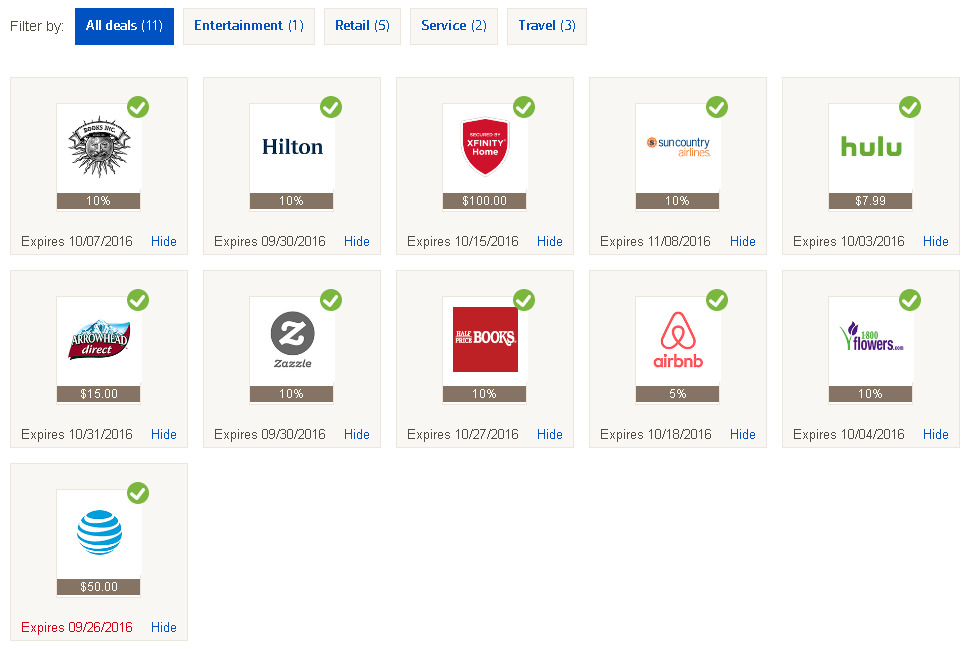
If I go to the website, and click on the correct tab, there is a list of these deals presented as a number of icons as shown above.  The deals are usually 10 to 15% off for various retailers such as Starbucks, 1-800 Flowers, AutoZone, Ruby Tuesday's, Hilton, and something called Stitch Fix, whatever that is.

In order to get one of these deals, you must check off the box on the corresponding on the list.  There is no cost to you for checking off a box (nor does it obligate you in any way), so you can check off as many boxes as you want, or just all of them.   So initially, I was puzzled as to why they made us go to the website and check off these boxes on the deals we wanted, instead of just automatically offering us these deals.

And then I realized this is an example of incidental discounting.   Incidental discounting occurs when you offer a discount as an incentive to attract new customers, and one of your old customers obtains the discount as a matter of course.  You are not optimizing your overall income from each transaction.  You are giving a discount to someone who would have paid full price.

As we learned an economics class, in a perfect theoretical retail environment, each customer pays what they feel a product is worth. Thus, Mrs. I.M. Gottrocks will pay $500 for a new widget and think it is a good bargain.  Meanwhile Larry Witetrash will pay $100 as that's all he can afford.  If each person pays the maximum amount they feel is appropriate, then you sell as many widgets as possible and maximize your income stream.

It is like the situation with outboard motors as I noted earlier posting.  Back in the day Johnson used to make a V4 two-stroke outboard offered it in 3 horsepower sizes, 85, 100, and 115 horsepower.  Each engine was the same exact size externally the only difference being changes in bore and stroke and carburation.  The parts cost and assembly cost were identical. And yet the hundred 15 horsepower model sold for an awful lot more than the 85 horsepower model.

And this struck me as odd, as a young man, because I wanted the 115 horsepower model, but wanted only to pay for the 85 horsepower model.  But what was explained to me, was that they're not selling engine parts, they're selling horsepower. And when I was working at Carrier we had the same situation with industrial chillers with different capacities.  The parts count and components were largely the same, and the costs were largely the same.  However we were not selling blocks of iron to our customers we are selling tons of chilling capacity and if you wanted more chilling capacity paid more money.

Thus, there is this entirely irrational relationship between the price of things and the cost of things that most of us don't realize.  As consumers we think that larger things should cost more, smaller things should cost less, even if they both cost the same to make.  But not only that, we all expect the same pay the same price for goods in an egalitarian democratic society.  However from an economic point of view, it makes a lot more sense to sell rich people things at a higher price and poor people at a lower price.

And if you read that last sentence very carefully, you'll see one the keys to getting head in America as a middle class person.  Live what I call the Walmart lifestyle, buying things at the low price rather than paying the Whole Foods lifestyle price.  Yes, a surprising number of Americans prefer to pay high prices, as they perceive a status in shopping at certain stores.  And some people can truly afford to overpay for things as they are Millionaires or Billionaires.  But a lot more of the people shopping in these upscale stores are nearly strivers who want to appear to be wealthy and spend what little income they have on overpriced Goods.

But getting back to discounts and couponing, I wrote one of the original patents on internet couponing for a client and I learned it off lot about the couponing business.  Coupons have a number of uses.  One is to entice people to buy products that they might not ordinarily buy, either because they are really can't afford them, or they are not aware of the product.  Another use of coupons is to get people who cannot afford to buy your product to buy it on regular basis using the coupon.  In other words, coupons allow you to provide a range of pricing for different consumers.  A third reason is to obtain "conquest" customers who are loyal to other brands, who may be induced to switch by a coupon deal.

Mrs. I.M. Gottrocks goes to the upscale supermarket and buys her Tide laundry detergent and pays full price.  Larry Witetrash clips the coupon and buys the same Tide detergent, but pays a far lower price than Mrs. Gottrocks.  The net result is that Tide sells two boxes of detergent rather than one, even though they don't make as much money off of Larry, they still make more money than they would if the box just sat on the shelf and Larry bought store brand.

And this works fine in the paper coupon environment, as Larry has to go to the trouble of buying the newspaper, finding the coupons, clipping the coupons, saving the coupons, and presenting the coupons which is a hassle.  You make Larry work for that discount and he doesn't get the discount unless he does the work. Not only that, Mrs. Gottrocks doesn't get the discount because she views clipping coupons is beneath her and a waste of time (which is largely is). So she doesn't get the coupon discount.

With internet or online coupons, the problem arises that if you offer discounts to everyone via a simple click, that everybody will get the discount whether they really deserved it or not.  That's the incidental discount that arises where people like Mrs. Gottrocks end up getting a discount on items and services, and the retailer doesn't get the advantage out of the bargain as they had in the past.  Sally would have bought the product anyway, so they are not getting a conquest customer for another brand.  And Sally would have been happy to pay the higher price so they're not selling an additional box of detergent to Sally that otherwise would have sat on the Shelf, they were just selling it in the lower price and thus come out behind on the deal

How do you avoid this problem?  One way that Bank of America uses is to force you to go on to the website and click on the icons.  It seems like a pretty stupid waste of time until you realize that it forces the consumer to look at these deals and remember the physical act of clicking on them which creates a psychological tension in the brain.  Now, the next time the person drives by a Starbucks they will think to themselves, "Gee, I get 10% off on Starbucks! I should go in there and buy a cup of coffee even though I'm not really in the mood for coffee!" And you might laugh at that last statement but a lot of people actually think that way.

Even worse, Bank of America sends emails reminding of these deals are expiring, further prodding you psychologically to use these virtual coupons.  There are a lot of people in the world who feel they're missing out on a bargain if they don't use a coupon before it expires.  I recounted before how a friend of mine was at Michael's one day running around the store looking for something to buy because the coupon was set to expire that day.  She was going to buy things she didn't really need or want, just to take advantage of a perceived bargain.  This was a total of victory for the store.

So yes as stupid as it sounds, there are people who not only will click on the coupon for Starbucks and then get the coffee that they don't want because they perceived they are getting a value, but those who will think, "Gee I should use the Starbucks discount before it expires today, and buy a coffee even though I'm not in the mood for coffee!"  People are that stupid.

It's also a sneaky way for Bank of America to put advertising into their banking website and also spam you via email for third-party vendors.  Since you're not about to shut down emails and blacklist your own bank (you want to receive important notices from your bank)  you are allowing the flow of data into your life that advertises for other companies.  Moreover when you log on to their website, these advertisements - and they are advertisements - appear for these other companies in the form of these "deals" you are reminded about.  You go to the deal page, and click on these things and they know that you've clicked on them and tell their affiliated advertisers that you actually clicked on these physical icons showing an interest in the product.

It may sound like a trivial thing, but Bank of America probably makes enough money off of this to pay for the entire operation of their website, which by the way was crashed for almost four hours yesterday.  And by offering "discounts" they come across as the good guy finding and scoring deals for their loyal customers rather than as a heartless advertiser who is flinging commercial messages into their face whether they like it or not.  Pretty clever shit, that's why I own stock in Bank of America.

I did mention in passing earlier that couponing is a waste of time.  I covered this before with several postings on this site.  The reason why couponing is a waste of time is that Mrs. Gottrocks and Larry Witetrash might both by The Tide detergent, with Larry using his coupon.  However both of them could find a better deal by buying store brand detergent, which is often just as well and it's always priced lower than the name brand, even with coupons.

"But Bob, what about all these extreme couponers we see on television?\" They have garages full of food neatly stacked on racks they all got for free! Sometimes they even get money back!" That is indeed true, but these are often stunt buys.  They save up coupons over time and cash them all in at once at stores that offer double coupon days, coupon stacking, or other discounts and get amazing bargains.  However, in order to get any of these coupons, they actually had to buy product in the past. So you are not really getting a free bag of dog food if you had to buy 5 bags of dog food to get the coupons.

Moreover, the weird fascination these extreme couponers have with carefully storing and sorting their "coupon wins" in racks in their basement or garage is somewhat disturbing.  This is not so much shrewd purchasing as it is merely hoarding.  And it strikes me as odd that some of these people will obtain these products via coupons and then keep them displayed on these racks, but never actually use or consume the products.  I think the conquest part of the deal is the entire deal for them, and having racks of products and showing it off to their friends and bragging about how they got all this stuff for free is the real payback for them.  In other words it is a form of status seeking. A form of status seeking that actually costs you money like most forms of status you can, and could lead to hoarding disorder later in life.

Couponing in the internet age is an interesting sport. And it's interesting to see the techniques people are using to prevent giving discounts to people who were not seeking discounts.  And the way of granting coupon discounts and distributing them is also very complex.  I'm sure you've been to more than one website where at the checkout they say "please enter coupon code here."  And if you open another window and search online, sometimes you can find these coupon codes at various websites. Again, another example of incidental discount.  You are already in the process of checking out and willing to buy, and they just gave away 10% for no reason at all.

And possibly coupons and their ilk could disappear as a result of this.  Maybe we will go to a more egalitarian pricing model and perhaps we already have.  But so long as they are people willing to pay more for the same product than others will, retailers will continue to figure out ways to offer the same or similar products, for different prices for different buyers.

Your Service Drop and You


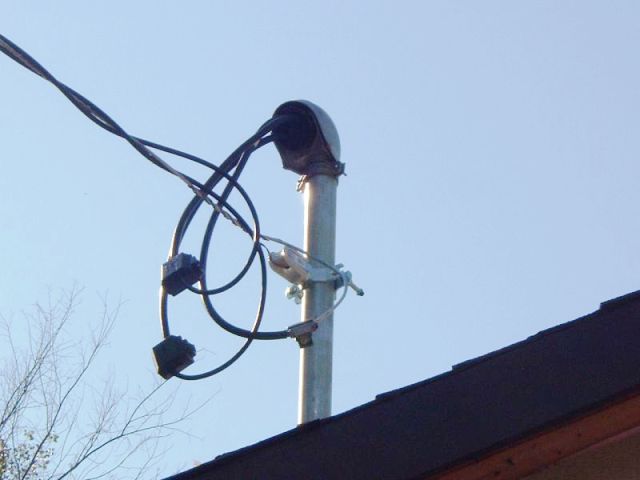
Hard to believe 220V power just lays out in the sunshine like this, but it does.

Today was an interesting day.  I went to sweep all the pine needles off the roof, which is a routine chore for our house (otherwise, you will have a garden growing up there).  Still sure owning a home is such a sweet deal?

Anyway, in the 90 degree heat, I am sweeping and something catches my attention.  The wiring on our electrical service drop is bare.  The insulation on the "hot" leads has cracked and peeled off, and more over, the neutral/ground lead has frayed and some of the strands have clearly been touching the hot leads - as evidenced by welding marks.  We had been having problems with lights periodically dimming, particularly in wind storms.  Now I know why - in the wind, the loose strands of the ground/neutral wire are touching the bare hot leads and making sparks.  Some fun, eh?

NOTE:  Do not even get NEAR your power drop.  If you slip and fall on your roof, you could end up touching these wires, and even a tiny crack in the insulation could cause you to be electrocuted.  If you didn't die right away, the fall from the roof would finish you off.   I am not suggesting that you attempt the repairs I have made, and indeed vehemently suggest the opposite - call an electrician.  I am not only an Engineer, but was trained in this kind of wiring at Carrier.  You could easily kill yourself doing this.  I am only discussing this repair to point out that home ownership is basically nothing but a series of repairs.  Which is why you never see your friends at the bar, once they buy a house.

By the way, this goes double for downed power lines.  Just stay away, period.
So I call Georgia Power, figuring I'd leave them a message and someone would come out next week and fix it.   They came out in under an hour.   The fellow glances at the wiring and says, "Well, we're gonna have to cut your power!"  and I replied, "to fix it?" and they said, "no, so you can fix it!"

Seems the power to the drop is their responsibility.  Anything from the splice blocks (those black square things in the photo above) onward is your deal.   I didn't mind them cutting the power in a heatwave, but did they have to seem so happy about it?

Once again, we are reminded that a house is just a machine for living - a complicated machine with a lot of expensive parts that break on a regular basis.   Appliances, maybe 15 years.  Air conditioners and furnaces, maybe 15-20.   Roofs, maybe 15-30 depending on type.   Main sewer connections, water lines, electrical service entrance - 40-50 years before problems develop.   Eventually all of these things have to be replaced or overhauled over time - even foundations.   And foundations get expensive, really fast.

Are you still certain that renting is a bad deal?  Because I'm not.  But I've owned a number of properties and had them for years.   So I've seen a lot of bad go down.  Leaky basements, tree-root clogged sewer lines, broken water mains, outdated electrical panels, and appliances, hot water heaters, and air conditioners, several times over.

A house is just a thing, and no it is not the American dream.

Fortunately, I am an Electrical Engineer.  But more importantly, I was a lab tech, and I used to hook up three-phase chillers with triple-ought copper wires, so the big wires don't scare me too much.   For you?  Hire an electrician.   I am serious about this.   There is no surer way to get killed that dealing with high voltage if you don't know what you are doing.

It is odd, that such a dangerous thing and such an important thing is left out in the open, exposed to the elements (where wind, rain, ozone, and sunlight degrade the insulation).  And also where falling tree limbs can damage it, or squirrels can nibble through it.   Just sitting right there on your roof, waiting to kill you the first time you accidentally put an aluminum step ladder up against it.  Odd, ain't it?

We drive to Lowes, which has 4/0 4/0 2/0 wiring which has four-ought for the power leads and two-ought for the ground/neutral.   This is what Georgia power uses, but for some reason the house is wired with 4/0 4/0 4/0.  So we go to Home Depot.   One advantage Home Depot has is they are staffed better, have a larger selection and are more helpful.  At Lowes, you have to press a button to get help, and then they act dumb.  At Home Depot, the fellow and the lady there were very helpful.

(Amazon offered to drone the wire to me, but then admitted that drone delivery was a fantasy).

We run into a Canadian at Home Depot who says, "Well, that's odd, in Canada, Hydro Quebec would come and fix that for me!"   Good for Canada.   But this isn't helping me, my friend! 

It took less an hour to replace the cable.  The meter box was full of skeletons of dead gecko lizards, who probably tried to rest on the hot and neutral leads at the same time.   What a bug-zapper that was.

I call Georgia Power and believe it or not, they agree to send someone out, on a Sunday, to hook the power back up.   He arrived just as nightfall is upon us, and within 30 minutes, he has crimped the new lines to the main power and we are back in business.   It is a lot easier to like the guy who turns on your power than the guy who turns it off.

Total cost, including some electrical tape I bought for other projects, was $55.11   I was lucky, as most electricians would charge "emergency service" prices, and probably not come out for hours, and we'd be looking at tomorrow before we were hooked back up to the grid.  I suspect it would have cost over $1000 for a service call.

And again, this is what I strongly suggest you do - call an electrician, as you are not me, and would likely kill yourself attempting such a repair.

Of course, the fun is not over.  I still haven't replaced my fire-prone Pacific Electric junction box, and probably should replace the rest of the main power lead when I do that.  Then there are carpets that are wearing out.   The garage needs painting.   After 12 years, probably every room the house needs painting.  Heck, we've already repaired a lot - remember the toilet flange job?

And it is not like we live in an "old" house - well, OK, it is 50 years old.  But it was basically gutted and remodeled 12 years ago.   Which means most of the appliances are about ready to fail in the next 5-10 years.

So what's the point of all this?   Well, if you buy a house and are "house poor" you will end up in trouble, as "unexpected repairs" are to be expected.   Even when you buy a newer home, these problems crop up.   And with a brand-new home, you might be covered with a home warranty from the builder, getting him to come back and fix things can be a nightmare.

Home Warranties are an interesting beast, and often sold to first-time buyers.    If you are stretched thin on your financing, it can be comforting to know that if you have a broken pipe or bad wiring, it will be covered.   And they are remarkably inexpensive.   I've never bought one myself, but Mark used to recommend them to buyers.   If you are not handy and skilled, then maybe such a thing is for you.

But for those of you renting, well, don't fret that you can't "afford" to buy a house or whatever.   I suspect you spend a relaxing Sunday at the park or beach, or just reading a book or going on a picnic.   You probably didn't spend it driving to lumberterias looking for four-ought cable, or standing out in the rain stripping cables and wrestling them into the meter box.  Some fun, being a homeowner!

Even worse would be trying to figure out where to put all the food melting in the freezer or where I was going to sleep tonight with no air conditioning or how to shower tomorrow with no hot water.  And for most people, that would be a real concern as well (and yes, hotel rooms and throwing out food is also expensive).   Fortunately, we have the camper as a back-up plan.

But this experience drove home to me that a house is just a thing, and expensive complex thing with a lot of components that break down over time.   When you buy a house, you are not buying a place to live,  just the repair rights.   The previous owner put in new windows, new doors, and a new A/C unit.  Now its your turn to replace the carpets, upgrade the kitchen, and rewire the fuse box.   Some fun, eh?

Keep that in mind before someone tries to sell you on the "dream" of home ownership.   It can also be a nightmare!

Fake Living Stingy Site

Someone is impersonating me!  I guess I should be flattered.


A reader notes that someone has obtained the "Living Stingy" domain name and copied my entire blog to it.   I notified Google and the content was removed.  The site remained blank for several weeks but today has new content (undoubtedly scraped from someone else's blog).

Most of the stuff posted is dreck - "50 ways to save money" for example, which suggests becoming a "secret shopper".   Most "secret shopper" deals are rip-offs.   They ask YOU for money, not the other way around.

Anyway, I could care less, other than someone might stumble upon that site and think I wrote it.

I did not.


UPDATE:  While the "50 ways to save money" page is kind of lame, some of the other stuff isn't too horrible, such as the "how to save" page after it.

The compound interest calculator is a nice touch as well.

I wonder whose blog they are stealing from now?   Some of it appears to be too well-written to be from some Indian blog farm.

Hmmmm...... maybe I should just cut-and-paste their content and put it here and retire.

Turnabout is fair play!

Oh, wait, a simple google search shows they cut-and-pasted it from a book:

https://www.amazon.com/Money-Happiness-Guide-Living-Good/dp/0470067799

Gotta love Indian blog farms! Or maybe not.