Friday, January 20, 2023

AirBnB - The Tech-That-Is-Not-Tech Crash of 2023?

Renting a house for vacation isn't a new thing.  Renting someone's in-law suite instead of a hotel room, is.

We live on a resort island, and since the 1970's, people have been renting out beach houses to tourists on a weekly basis or longer.  And we are not unique in this aspect - many vacation areas have local real estate agents who handle such rentals, and vacation homeowners would use such rental income to offset the cost of owning the home.  Decades ago, before AirBnB or VRBO existed, we rented such a house in Duck, North Carolina (the Outer Banks) in the off season, fairly cheaply, through a local real estate agent.  Pretty much every house you see on the outer banks is for rent - or was, at one time or another.

And when we had our condos in Florida, we rented them out seasonally (three or four months at a time) to Canadian "Snowbirds" through the relatively new VRBO (Vacation Rental By Owner) service.  This was in the era of CRT televisions and whatnot - the dark ages.  And it worked out pretty well for long-term rentals.  The advantage of a local real estate agent is that they can hand the keys over to the tenant and arrange for cleaning after the tenant leaves.  They can also handle minor problems as they arise - a clogged toilet or a broken light fixture. The "online" rental companies really don't offer that kind of service.

VRBO and AirBnB are basically the same idea, although I guess VRBO, as the name implies, is more geared toward weekly vacation rentals, while AirBnB started out as more of a nightly rental company. But something changed over time as well - AirBnB turned more into an ersatz hotel, and people started buying houses in non-vacation areas to rent them out full-time as hotel rooms - often pissing off the neighbors in the process.

When we moved to Jekyll, the neighbors cautiously asked us if we intended to rent our place out when we weren't here.  When we told them "No" they said "Thank God!" as they didn't want to live next door to a stream of strangers coming and going every week, having loud parties into the night and parking cars and boat trailers all over the lawn.

And it is a thing.  Not so much on our "quiet" side of the island, but on the beach side, during the summer (when it is ungodly hot) local Georgians will rent a house for a week and invite every extended relative in a three-State area to join them.  They may be five or more cars parked on the lawn, along with utility trailers (for the golf carts and massive barbecue smokers) as well as the inevitable bass boat or jet skis.  Those houses get ridden hard and when they do come up for sale, they often need a complete overhaul.  But you can make a lot of money renting out a place by the week, as opposed to the month or the year - about five times as much, in fact.

If you buy a beach house in a vacation area, well you know what to expect.  Chances are, you'll be renting your house out as well, to help pay the staggering mortgage.  We know quite a few folks who had houses on the beach side, and when they retired and decided to live there "full time" they sold the beach house and bought a house on the "quiet side" of the island, after only one year of living with the Yee-Haw neighbors.

So the problems with vacation rentals are well-known - but people know what they are getting into when they buy a beach house on the Outer Banks.  They can't act shocked when the weekly neighbors throw a luau every Saturday night. AirBnB however, has expanded this concept to ordinary neighborhoods.   Why pay top dollar for a hotel room, when you can rent a condo for a night or two for less?

Some Condos (and homeowner associations) and local zoning laws forbid this. Our condo in Virginia does not allow renting for less than a year.  We would be fined to death if we rented out our condo as an AirBnB.   But we'd make hella money at it, though!  So you see why people do it.

Over time, a number of trends have accelerated to make the whole thing more and more untenable.  People are buying houses on "AirBnB loans" which factor in nightly rental income to pay the mortgage.  These nightly rentals are invading more and more quiet neighborhoods, often in violation of zoning laws, and causing havoc for the neighbors.

In some instances, people are renting out houses not as a place to stay, but as a place to hold a rave or a party - inviting dozens or even hundreds of people, charging admission, serving drinks (and drugs) and providing a DJ and other entertainment.  The neighbors are not amused but the owner doesn't care because they charge sky-high fees.  The renter makes money as well, until the Police shut them down.

We rented a boat (a hoary old SeaRay 42) at a marina in Jacksonville through AirBnB or VRBO when we went to see a show there at the local theater.  It was an interesting idea, but the "harbormaster" admonished us not to have wild parties.  Apparently a previous tenant had thrown a bash onboard and other liveaboards complained about the noise.  It was an interesting experience, but the next time we went to see a show, we booked a room at the hotel across the street.  It was more relaxing, they had a free breakfast and secured parking, and we could walk to the theater across the street.   Oh, it was cheaper, too.

Many AirBnbs have tacked on outrageous cleaning fees - in the hundreds of dollars, even if hiring a cleaning company costs maybe $100 or so.  For a weekly rental where you "trashed the place" maybe that makes sense - maybe not.  In addition to cleaning fees, many owners require that the renter do the dishes, take out the trash, or even mow the lawn!   Since the owner is not "boots on the ground" and has no local real estate agent to manage the place (that's too costly!) they rely on the tenants to manage the place for them - and often the next tenant arrives to find that the cleaning tasks assigned to the previous tenant were not done.  Hilarity ensues.

For a nightly stay, a hotel often beats an AirBnB in terms of cost, particularly when onerous "cleaning fees" are tacked on.  It may also beat an AirBnB in other areas as well - such as safety, predictability, amenities, location, parking and whatnot.

What is interesting is that AirBnB and VRBO are taking what was an existing business (vacation rentals, hotel rooms) and then putting it online on an "app" and then charging onerous fees.  In other words, it is like the rest of these "tech-that-is-not-tech" companies that take mercantile endeavors (taxi service, delivering food, hotel rooms, vacation rentals, car rentals) and turn it into an "app" that basically exploits everyone involved and funnels off a huge percentage of the money to Silicon Valley, while breaking a host of local laws and regulations (taxi medallions, zoning, minimum wage, etc.).  Everyone becomes a "contractor" and works for pennies, while the CEOs of these companies make billions in stock options.

During the recession - and then the pandemic - many of these companies thrived.   After the debacle of 2008, young people were told to get a "side hustle" driving for Uber and then basically sold their cars to Uber, one ride at a time (often buying their car financed through Uber, thus "owing the company store" and being little more than wage slaves).  It is only today that Gen Z is seeing through this ruse - why should they have to "side hustle" at several low-wage gigs when our recent ancestors made a living - if not an extravagant one - just working one full-time job?

The pandemic was a boon for delivery services and, oddly enough, AirBnB. With many vacation venues shut down and hotels seeming like virus pits, the idea of renting a house for a family vacation seemed appealing.  And sales of vacation homes soared - and continue to soar, although I think we are in bubble territory these days.  Houses that sold for $400,000 a few years back are under contract for over a million dollars - with cash buyers, sight unseen, buying remotely!  Well, that is what is happening on our island.  We couldn't afford to live here if we had to move here today.  Mark's brother thought about buying a house here, and not a few years ago, could have snagged a "fixer upper" for $300,000 or so.  That ship has sailed.   I kick myself for not snagging a duplex (both sides!) for $200,000.  Today, each side commands close to a half-million dollars.  Nice work if you can get it.

This is the conundrum for our Condo sale this year.  They are tearing it down and paying us $160,000 cash (no real estate agent fees, few closing costs) but what can you buy anymore for $160,000?  Not much these days, and many of the properties in that price range would be nightmare rentals as they are in bad neighborhoods and attract insolvent tenants.  We may just end up biting the bullet and paying the capital gains tax.  With the loss of Obamacare subsidy (for one year) it would cost us $50,000 overall. 

First World Problems, I know.

I think things may change, however, in 2023.  If the worldwide recession takes hold in America, we could go from labor shortage to labor surplus in a real hurry.  Good news for Uber and Doordash, as they would have a larger pool of desperate people to draw from.  But on the flip side, people laid off from work (or worried about it) will tighten their belts and be less likely to order out for food or take an Uber to the bar.  And many folks may cut back on vacation expenses as well.

Already, we are seeing a decline in AirBnB bookings in some areas.  This may be due to a number of a factors, including over-saturation of the market (too many people buying houses and turning them into AirBnBs), as well as the increase in ridiculous fees and "chores", but also, I think, due to a slowing economy.  When the shit hits the fan, vacations and other luxuries are the first thing on the chopping block.

Of course, the founders of AirBnB made their money during the IPO.  In recent months, despite record earnings and profits, the stock has halved in value, bringing the P/E ratio back down from the stratosphere.  Once again, a declining P/E ratio - is that a good thing? Or do people smarter than us see something we don't?  Like perhaps, recession.

Personally, I kind of gave up on AirBnB, Truro, Lyft and Uber, as well as VRBO, as I found the process to be maddeningly complex, the pricing opaque, and the service sometimes less than expected. When traveling to a distant city, you might select from a handful of hotels near your destination and book with one you know to be a known quantity.  AirBnB, on the other hand, presents a bewildering array of properties and you have to scroll through all of them, read the reviews (and read between the lines) and watch out for those hidden fees.  And as for food delivery, well, I haven't had that in well over a decade - it just isn't a worthwhile proposition.  For the life of me, I don't understand paying substantial sums of money to have fast-food delivered.  Maybe there are wealthier people out there who just don't care - or maybe there are a lot of fools.  I suspect the latter.

There seems to be a drumbeat online of hate for AirBnB in particular (someone is shorting the stock?) with people posting horror stories about wild raves going on at AirBnB properties, or messes they as tenants have to clean up, or "hidden" cleaning fees in the hundreds of dollars (sometimes over $1000!).  There is not a lot of love for the company.  At the same time, I am seeing saturation advertising for both AirBnB and VRBO, showing pictures of idyllic vacation homes with friends and family gathered 'round the hearth for a sing-along.  It smacks of desperation.

Over the years, we have seen tech recessions occur again and again.  In the late 1990's, it was hardware companies that bit the dust, as computer components became a commodity and profit margins became razor-thin.  Then there was the dot-com bust - websites that were never profitable finally went bust.  After that, we've seen many social media companies come and go - with only a few having any staying power.   Today it is the tech-that-is-not-tech sector (I think) that is next on the chopping block.  There just isn't enough bandwidth to support a half-dozen electric scooter rentals or city bikes.  You can't have five or six food delivery services and offer "free delivery for a month" and make money (and they aren't, either!).  Even companies like Uber which seem ubiquitous, are losing money.   Eventually you have to at least break even to stay in business.   You can't borrow your way to success for long.

Some of these services may turn out to be a thing, but just not "The Next Big Thing!" - they will consolidate and the newness will rub off and life will go back to normal.  And we'll wonder why we thought these companies were so groundbreaking, when all they were doing was putting minimum wage jobs on an app - and then stealing the lion's share of the money from everyone involved.

And I think that is why you see the share prices of many of these companies in free-fall.  It is the same pattern over and over again, and the people who really understand the market (not the idiots who fall for the hype) see the writing on the wall.  There are no big bucks in delivering pizzas, unless you are Dominos.  There are no huge margins in making cars - as Tesla may realize shortly.    All this talk about "disruption" and whatnot is just the same old Silicon Valley happytalk that we've heard before.

2023 may end up being a bumpy ride.

Thursday, January 19, 2023

Stop Helping!

People mean well, but for the love of God, please just stop, OK?

The latest "con-traver-sea" (as they say in the UK) involves some hockey player - and it really isn't a controversy at all.  Some brilliant genius in the front office of a hockey team decided that to show solidarity for LGBTQ people that the team should wear rainbow colored jerseys during practice.  One player noped out of that, and now the media is having a field day.

Please stop doing this - stop trying to do us "favors" with these shitty stunts.  It is just awkward and  embarrassing and generates a lot of hostility - and not a lot of understanding. It does the exact opposite of whatever whoever came up with this intended.

Look, I probably wouldn't like this particular hockey player.  He's Russian (boo! hiss!) and Russian Orthodox (hiss! boo!) but that's his choice.  Well, the religious part, anyway.  And forcing him to wear a jersey promoting political beliefs he is against, isn't right.

It gets back to this:  what people really want in life is the right to be left the hell alone.  We don't want to be forced to do things we don't want to do - other than the bare minimum necessary to get by and function in a society.  No one should be forced to support a cause they do not support, not just because it is wrong to make them, but because it will make them hate that cause even more.

I mentioned before many times in this blog that anti-bullying attempts in school have been ham-handed.  Instead of going after bullies for the crimes they commit (e.g., assault and battery) well-meaning teachers and administrators try to "intervene" to make everyone friends!  "Now you boys play nice with little Billy and stop calling him names!" the teacher says.  During recess, the kids beat the crap out of little Billy.

You can't force people to like other people, or other causes, or things, or whatever.  You can force people to obey the law and leave other people the fuck alone.  Sadly, this seems to be at the bottom of the do-gooder's list, as they rather want to make everyone sing Kumbaya together, while holding hands and sharing a Pepsi-Cola or whatever.

Stop trying to force people to like things - and shaming them if they don't!  Why?  Because when you do, the opposite occurs.  The thing that you are trying to get them to like, they may have felt neutral about, or mildly negative.  But when you tell them they have to like it and support it, there will be push-back.  Strong push-back.  Because no one likes being told what to do, or worse yet, what to think.

This is at the heart of the poorly phrased objections raised by the right these days.  They call it "cancel culture" or "the war on Christmas" or whatever.  It is not a major thing, just a few well-meaning do-gooder idiots who decide that a manger scene in the town square is an affront to humanity, or that a poorly worded tweet necessitates that someone lose their job and career.  Yes, the far-right overstates this sort of thing and plays snowflake victim as a result (oddly enough, what they accuse the left of doing!).   But there is a nugget of truth here - as illustrated by this jersey incident.

It is one thing for someone (and according to the Supreme Court, that includes companies) to support a cause - including gay pride.  It is another for an employer to say, "we support this cause, so you have to wave the flag, carry the banner, and wear the T-shirt."   And that's all a hockey team is - an employer.

Suppose your company put out a press release saying they were supporting Russia in their war against Ukraine?  OK, you have a shitty employer.  But suppose they then said you had to wear a company uniform with a Russian flag on it or a Russian flag lapel pin?   Here they are making you wear something that promotes a politcal cause you don't believe in.  Is that right?

And suppose that company is a hockey team and you are obligated under contract to work for them - and stand to lose millions if you quit?

I get it that this hockey team is trying to be inclusive and progressive and supportive.  There are gay hockey players and gay hockey fans.  Maybe they want to reach out to this demographic and show support.  Hey, that's great.  But the ham-handed idea of forcing players to wear gay pride jerseys?

No, that's just wrong.  And while I probably would find this particular player's opinions and views repugnant, he has a right to be wrong about everything.  Shaming him for not wearing the jersey is wrong - and creates a backlash that I didn't ask for.

Please stop trying to do me "favors!"  Just stop.  For the love of God, please stop!

As usual, Seinfeld was ahead of its time...

Sadly, this seems to fall into a pattern of overly-aggressive protesting and demonstrating as of late - actions which often discredit the causes they purport to support.  PETA has made a joke out of animal rights with its crazy click-bait promotions like "sea kittens."  Global warming protesters are raising the ire of everyone and discrediting their cause by trying to block highways.  Animal rights activists have tried to block entrances to slaughterhouses to "give water to the pigs" on their way to the abattoir (what's the point of that?).  One got run over and killed.  Stupid! Stop. Trying. To. Help.

Of course, I am just a paid shill of the bacon lobby, right?

I should note, however, that if I was trapped by a crowd of protesters, banging on my windows, standing on the hood of my car or whatever, I would likely floor it and if they got run over, too bad for them.  If you are being attacked by a mob and are "in fear of imminent death or great bodily harm" you have a right to defend yourself, and a 4,000lb car is a terrible weapon.  Get out of the damn road, idiots!

The right is no better (but ironically, more poorly organized). The "Trucker Convoys" in America amounted to nothing - lost in our traffic and hardly noticed.  The one in Canada just annoyed people for several days by parking downtown and honking horns.  They were protesting pandemic mandates that had already been lifted.  Fucking brilliant, that bunch.  The only right-wing protest of any note was the January 6th insurrection, and even that was poorly thought out and half-assed - and got people killed as a result, for no reason whatsoever.  The only real consequence of that protest was to drive the GOP away from Trumpism.

There are ways to protest that can call attention to an issue without being a jerk or forcing people to conform to your views.

This jersey thing, while well-intentioned, was just a dumb idea.  Please Stop!

Wednesday, January 18, 2023

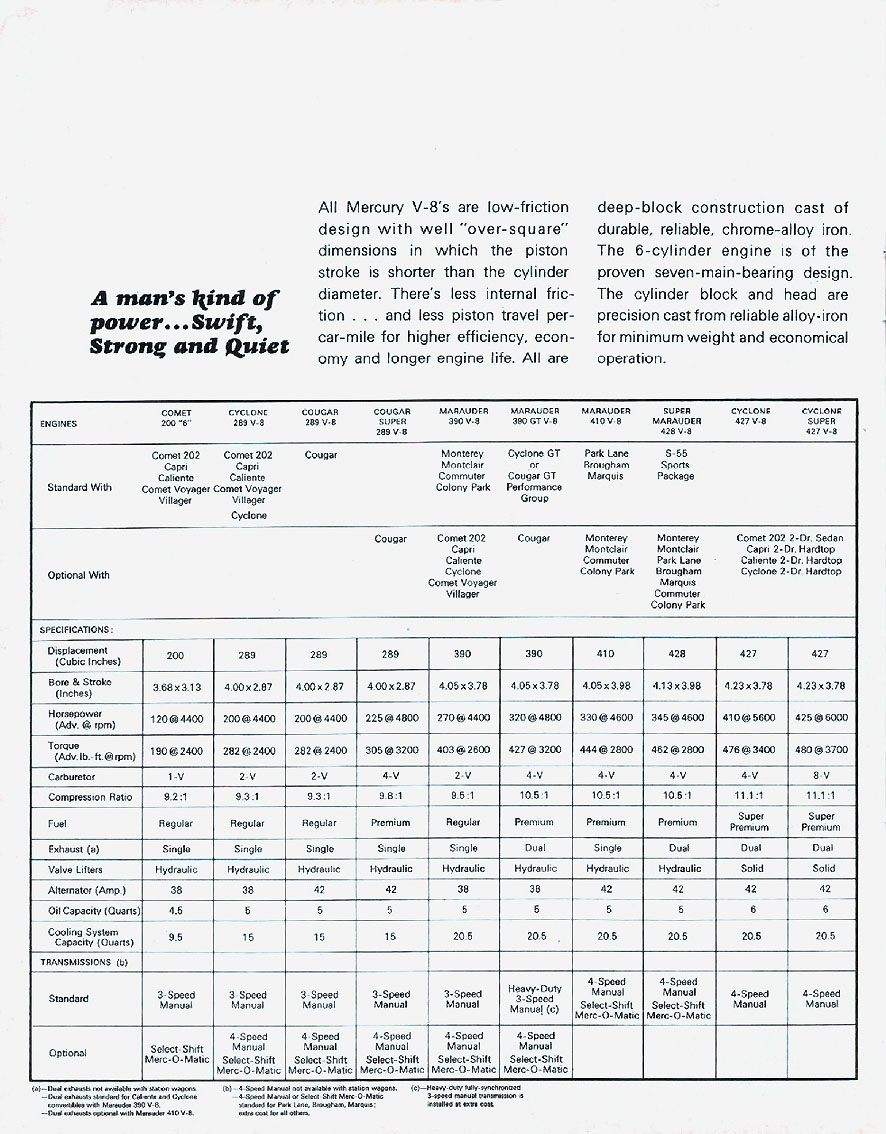
Mercury's Little Nightmare: The 1967 Comet 202 427 8V!

They don't make 'em like they used to - for good reason!

I was perusing some old car brochures and came upon an interesting little tidbit.  Back in the mid-1960's, you could order some pretty bizarre cars - station wagons with four-on-the-floor (and rear air conditioning!), midsize cars with huge engines, and of course, all the esoteric shit GM tried and discarded - turbocharging, fuel injection, aluminum block engines, and so on and so forth.  By the late 1960's and early 1970's the party was over - most big engines came standard with automatics and four-speeds were limited to a few sport models.  Turns out no one wanted a Mercury Park Lane with a four-speed.  Funny that.

In the back of the Mercury catalog for 1967 was listed their bottom-of-the-line car, the "Comet 202".  The Comet by then was a doppleganger for the Ford Fairlane - a "mid-sized" car made from a stretched Falcon platform.  In fact, at that time, if you ordered the "Falcon Wagon" it was a Fairlane body with a Falcon "front clip" on it.  The Comet 202 was Mercury's base model, with a standard Comet front end, with the truncated rear of the Falcon.  It was offered as a "Capri" hardtop or as four-door sedan or as a two-door post sedan.  And you could get any engine Mercury offered, up to and including the legendary 427 with dual four barrels.

Of course, Ford offered a similar layout in the Fairlane line - including the legendary "Thunderbolt" Ford drag cars of 1964.  Again, they were huge engines wedged into the smallest car possible - a simple formula that all the big-3 car makers were trying out, to entice "performance" buyers.

Mercury only made a few dozen of the Comet 202's with the 427 - drag racers ordered the two-door post sedan (more rigid than the hardtop) which was shorter and lighter than the standard Comet.  With the 427, dual quads, and four-speed, you could go to the drag strip and race it stock and do 0-60 in about six seconds and the quarter mile in about 14 - not bad for out-of-the-box.  The cars sold for drag racing had the sound deadening deleted, along with no body caulk, saving a hundred or so pounds in weight.

At first, it sounds like a cool car - a humongous engine in a tiny, lightweight car.  Should be fast, right?  Well, maybe in a straight line, and even then, not so much.  I read an article online where they interviewed one owner of such a car and he basically said it was undrivable on the street - with the bias ply tires of the time, the handling was sketchy at best.  And with no sound insulation or body caulk it would be noisy as all get out.  Most were ordered with "heater delete" - forget air conditioning (it was, ironically, an option) or power windows, door locks, stereo system or... anything.

These "rare" muscle cars were designed for drag racing, and today they are talismans of that era - 4,000lb paperweights (or 3,000 lbs anyway) - fun to trailer to a car show and show off, or maybe take to a "vintage" drag meet (doubt they would meet today's safety standards, though).  In terms of a car, they really aren't much.

Today, we expect so much more - and we have so much more. The Comet 202 oddly enough came standard with power front disc brakes - Ford knew at least that much. But in that era, even power brakes (four-wheel drums!) were an option on a lot of "muscle" cars - they were literally all go and no stop - and no cornering, either. Disc brakes didn't become available for most "muscle" cars until the late 1960's and early 1970's - and then, often only as an option!

Now consider one of the most plebeian cars you can buy today - a 2019 Ford Fiesta.  It does 0-60 in about 6 seconds, the quarter mile in about 15 seconds.  It does that with four-wheel disc brakes, radial tires, six-speaker stereo system, six airbags, power windows, power door locks, and a warranty that goes on for years, instead of months (back in the day, these "special order" race cars often came with no warranty whatsoever or at most 60 days).

Oh, and the Fiesta gets 30 miles per gallon, whereas the Comet 202 - or any muscle car of that era - would get in the single digits.  Dual four-barrels and 7 liters are awfully thirsty!

The Comet 202 stickered for about $3,200 according to some sources while the Fiesta started at about $15,000.  But $3,200 in 1967 would be over $28,000 today (!). So not only do modern cars have more features, go as fast (if not faster), handle better, stop quicker, are far, far safer, and wildly more comfortable - and get better gas mileage and are far more reliable as well (and last longer!) but they are staggeringly cheaper, too.  In fact, in this example, almost half the cost.

The "good old days?"  Fuck the good old days.

This isn't even addressing the rust issue - cars of that era rusted out in most wet climates within three years or so.  Exhaust systems lasted about that long, tires maybe 30,000 miles (if you were lucky), batteries about 24 months.  Few cars of the 1960s went over 100,000 miles, much less 200K or more.  Most went to the junkyard at about 80K when the transmissions blew out.

So what killed off the "muscle" cars of the 1960's?  Well, the whole thing peaked in the early 1970's.  The venerated 'Cuda came out just a little too late in the game.  The cars were wildly unsafe and in fact, death traps, particularly in the hands of inexperienced drivers - or even experienced ones. Insurance rates skyrocketed and young people (the target audience) couldn't afford to own such cars.  The Arab oil embargo sealed the deal in 1973 - cars getting eight miles per gallon were just un-affordable. Sure, 5-MPH bumpers in 1974 increased car weight, and pollution controls in the mid-to-late 1970's lowered compression ratios and power output.  But the muscle-car party was over long before then - the story that "them darn-gum gub-ment pollution controls killed the muscle car!" are just bunk.  And by the way, today's emissions standards are far more stringent than back then, and yet today cars have more horsepower than ever before!  And get better mileage.  Thank God for electronic fuel injection.

Now, of course, you might argue I am making a selective comparison. Sure, you could get the 427 in other cars, from the larger and much heavier Park Lane or the famous Ford "7 liter" - but those were heavy luxury cars with such options as air conditioning, power bucket seats, center consoles, and power windows, power door locks, power steering and power (front) disc brakes.   Even then, though, there were no airbags, and handling was atrocious.  And the best sound system you could hope for was an "AM/FM" radio (no stereo) with a "reverberator" rear speaker.  Hoo-whee!  And of course, such cars cost far more than the stripped down street-drag machines.

If you go down the line and compare any car of that era to its successor today, you'll find the same thing.  A stripped Mustang of 2023 is cheaper, faster, safer, handles better, rides better, has far more features and pollutes less than a stripped Mustang of 1964 - or almost any year in-between.   A top of the line "Shelby" Mustang of 1968?  Trounced by the Cobra of today - in every category.  Those old-time cars were just not as advanced.  The "Old School" went out of business for a reason.

Ford reworked the Mustang onto the Fairlane platform (it was built on the plebeian Falcon at first) to accommodate larger engines, probably at the urging of Carol Shelby.  Shelby was famous for stuffing large engines in small cars.  The legendary Cobra, based on a tiny British sports car, was apparently a difficult car to drive, due to its insane torque and unequal weight distribution.  But back then, automotive Engineering was a far simpler task - you wanted more power, you upped the compression ratio and displacement (as my Thermodynamics professor at GMI taught us).  Things like turbocharging ("Too complex!  Too unreliable!") were dismissed out of hand.  Fuel injection?  "We tried that back in 1957 - it never worked right!" (Oddly enough, I have read that the Bendix fuel injection system, which also had an aborted history as the Rochester system, was sold to Bosch - and the rest is history.  Ze Germans didn't give up so easily!).   Things like variable valve timing were not even conceived.  Today, these are features on base economy cars.

Oh, and one more thing:  Cars back then polluted like hell!

Granted, cars today are more complex and thus require more knowledge and special tools (a laptop and a OBD II interface) to work on.  The good news is, of course, that many modern cars today can go 100,000 miles with nothing more than oil changes, a set of tires and maybe a battery - perhaps a set of brake pads as well.   You look back at the service intervals of the 1960's - spark plugs being changed every 20,000 miles, for example, and the "annual tune-up" of plugs, points, and condenser.  And carburetors constantly needed adjustment and cleaning.  Valve lash adjustment, particularly on some foreign cars, was a regular thing (5,000 miles on my 1974 BMW!).   Cars may be more complicated and "harder" to work on, but then again, you may never need to work on it.

So what's the point of all this? Well, again that nostalgia is always suspect.  People like to run down the present and pine for the past - which they view through rose-colored glasses. I hear all the time (although the noise has died down in recent years) from know-nothing blowhards (worse than me, even!) about how cars were "better back then!" until the "gubment" instituted all these rules and laws!  If only we could go back to carbureted big-blocks!

But that 427 side-oiler, on a good day made 425 HP (which was SAE raw HP, not including accessory drag - one reason horsepower declined in the early 1970's wasn't "pollution controls" but the switch to reporting SAE Net HP, which subtracted parasitic losses from the water pump, alternator, power steering pump, etc.).   Today, you can go to the local Ford, Chevy, or Dodge dealer and buy a car with 300, 400, 500, 600, or even 700 HP and above - and in many cases, these are cars in stock, not special-order limited-edition deals.  And they are making this kind of horsepower from smaller engines.  Ford is cranking out close to 400 HP in its 3.5 liter "ecoboost" engine - a motor that size might make 100 HP back in the 1960's.

These are the good old days of hot-rod motoringAnd it shows no signs of letting up.  Electric cars, once thought of as slow and pondering econoboxes, are proving to be as fast - if not faster - than exotic Italian and German "supercars" costing many times as much.   0-60 times of three seconds were thought of as staggering only a few years ago.  Today, many electric cars can do this without breaking a sweat.

The future is bright, despite what the naysayers think.  And the present is pretty decent, too!

Tuesday, January 17, 2023

"How Can Anyone Survive in America???"

If your only impression of America came from the Internet, you might think it was a dystopian hellscape.

UPDATE: I wrote THREE TIMES in this entry, "I am not defending our system, just explaining it" but some readers seem to think the opposite - that I am promoting "The American Way" as better than the rest of the world!  That is not the case.  Read!  The point is, the "memes" bandied about online make the system seem worse than it is.  For example, today is posted online a bill for a kidney transplant - about a quarter-million dollars. That's how much they cost in any country - you just may never see the bill.  The patient's responsibility? Four-hundred dollars. That part is never followed-up in a "meme" which is why we should not get our information from them.

People do quite well in America. You have to be astute and on your toes, however, as our system is admittedly harsh and unforgiving on those who don't pay attention or those who intentionally flaunt the rules.  Can things be made better?  Let's hope so. The patchwork setup that is our health care system makes government bureaucracy look efficient in comparison.  And the gun thing.... crazy.

But if America was really that bad, you'd see an outflow of migrants from our country, not into it.  It isn't a horrible dystopian nightmare.  No, that's Russia.

Please read before flaming, though.  Let me repeat it again, three more times:

I am not defending our system, just explaining it.

I am not defending our system, just explaining it.

I am not defending our system, just explaining it.

* * *

I read online some folks in Europe asking, "How can anyone in America survive?  Medical bills in the hundreds of thousands of dollars! Student loan debt of a hundred grand or more!  No unions!  Minimum wage jobs!  Everyone getting shot on a daily basis!  No public transportation to speak of!  People starving in the streets!  Drugs!  Homelessness!  Surely this is a dystopian hellscape!"

Well, it may seem that way if all you saw were movies and television or memes on the Internet.  People like to post pictures of medical bills in the hundreds of thousands of dollars - but never post the actual amount due to them.  Granted, our medical system is weird.  A friend of mine has recently moved from Canada and I have tried to help them navigate our medical system. They are on the ACA (Obamacare) and should be all set.  But the crazy world of deductibles, out-of-pocket limits, and "co-pays" are quite confusing to them, particularly when you come from a system where you never see a bill at all (but there is a bill, somewhere, you just don't pay it).

UPDATE: Rob Ford, the Queen of Canada and Trump wanna-be is apparently trying to privatize hospitals in Ontario!  So weird.

Bear in mind I am not defending our system, just explaining it and pointing out that it isn't quite as bad as trolls on the Internet make it out to be.

Our Obamacare plan costs us $125 a month, and it has a max out-of-pocket every year of about $3500.  These are not big numbers. And for routine things, they are often covered almost entirely, but understanding medical billing not only requires an advanced degree in mathematics, but metaphysics as well.  I went to the doctor to have a mole removed.  They tested it and it was not cancerous.  I get three bills from the  doctors and a "statement of benefits" from the insurance company.  I owe the doctor's office a $25 "co-pay" for a standard office visit.  Another practitioner bills me $185 for the procedure, but the insurance company knocks this down to $45, of which I owe $18 for some reason.  Finally, the "lab" sends a separate bill for testing, which again, was a couple of hundred dollars, but insurance limited part of the claim and paid part and sent the balance due of $35 to me.

It is weird and trying to figure it all out will drive you nuts.  It pays to have even a high-deductible plan, as the insurance company crams down the prices on services.  So a colonoscopy "retails" for $3500 but if you have insurance, the doctor charges only $1500 (the rate they negotiated with the insurance company) and I owe a few hundred of that for some reason.  And yes, I get three bills - from the hospital, the doctor, and the anesthesiologist.

Yes, it is a crazy system, and it does require that you sign up for insurance.  Some people don't - often for stupid reasons.  "I ain't signing up for no Obumma-care!" one Tweets, "I'm waiting for TRUMP-care!" - and they get it, too, a grifter-plan that costs more than Obamacare (ACA) and covers Nothing.  Yes, you are free in America - free to be as dumb as a bag of doorknobs.  The sad part is, some people mean well but are just dumb, and they get exploited mercilessly in this country.  And yea, we should protect people who are vulnerable like that - and we do, to some extent.

Do these $100,000 medical bills exist?  Yes and No.  A friend of mine just had a heart procedure and it saved his life and cost $100,000 which the hospital said Medicare would pay for.  He gets a heart-stopping letter (no pun intended) from Medicare, saying, "Nah, we ain't payin' it!" because - get this - the doctor didn't perform two tests first to see if the procedure was necessary.  He may have performed these tests, the problem is, he didn't code them properly on the patient sheet.  They even listed the codes he should have used in the letter they sent!  So the hospital just needs to re-submit the paperwork with these two codes and no problem, right?  Except that the hospital probably won't figure that out.

The medicare people tell my friend not to worry about payment as it was the hospital's fault they said medicare would pay for it, so the hospital has to eat it.  And you wonder why medical care is so pricey these days.  You wonder why they have ridiculous rules like this.  Who has a heart procedure just for funsies?  Well, besides me, that is.

Real horror stories occur when people go to the ER and a physician sees them - a physician who is not "in network" as he is a visiting doctor filling in during this era of labor shortage.  Since he is "out of network" his charges are not subject to the pre-negotiated rates and the health insurance company might not cover all or any of his charges.  This results in nightmarish bills and confused patients.  When you are in a coma, having a heart attack, or having a stroke, you don't think to ask, "Say, are you in-network or not?"

It is a pretty stupid system.   In many cases, after a lot of negotiation, these bills are whittled down.  The deep dark secret of medical billing is that hospitals don't expect most of these bills to be paid.  That's why you NEVER put a medical bill on a credit card or take out a second mortgage or use a HELOC to pay one.  Once you do, it is ordinary debt and subject to ordinary debt standards of collection.  But medical debt?   Most hospitals will negotiate this down dramatically.  They may slash it (particularly if you go through the bill and note any discrepancies - and there are usually a lot of them) and then offer an interest-free payment plan - $5 a month for life (just kidding, but a friend of mine paid a hospital $10 a month for years, to pay for his first daughter's birth expenses).

Hospitals know that if the patient is poor, they can declare bankruptcy easily and have most of the debt wiped out.  Better to collect $10 a month than nothing.

Again, I am not defending this practice - why should it be a burden to the patient (who is going through enough as it is) to decipher endless bills that make little or no sense, navigate the bizarre world of medical billing and coding, and then negotiate with a hospital?

In other instances, people get humongous bills simply because they have no insurance at all and thus are charged "full retail" prices for all services and the bill ratchets up quickly.  Again, it is scandalous that someone with no insurance is charged the highest rates, while the wealthier person who has insurance  gets discounted rates.  Usually, such folks declare bankruptcy and the hospital gets little or nothing.  The costs are passed on to the rest of us.

And insurance is expensive.  Before Obamacare, when I was in my 40's, I paid $500 a month or so for a $10,000-deductible policy for me and Mark.  As we got older, the price went up as the risks were greater and the cost of medical care continued to escalate.   Obamacare saved the day, but if I had to pay the full premium it would cost $1500 a month (read that again, slowly) instead of $125.   It is the reason I retired - if I continued to work, I would have to spend $18,000 a year on health insurance, as the subsidy would disappear.

Like I said, I am not defending this system, just explaining it.

Rarely, though, are people forced to pay these extreme bills.   There are outliers, of course, and the news media likes to hype these.  Ambulance rides are a particular problem as the insurance company might pay a flat fee of $1000 per ride, but for some reason, the ambulance company charges $3000 - and you have to pay the rest.  Air Ambulances ("Life Flight") is even worse - $14,000 or more per ride and the insurance company may leave you on the hook for ten grand of that.  Worse yet, if you are out cold, a medical technician decides if you need a life flight.  He often decides you do - after attending a free "life flight" seminar in the Bahamas, courtesy of the company.  Conflict of interest?  Nah!

So why don't we have single-payer, national health, socialized medicine - or whatever you want to call it? Good question.  Many (including myself) have noted how much it would cost in terms of the Federal budget.  It could expand the Federal budget by 50% or more.  But that argument fails to consider that we are already paying that amount, as a country, to insurance companies, hospitals, doctors, laboratories, ambulance companies, and the rest of the "medical-industrial complex" (one of the largest, if not the largest, industry in the United States).

So if Comrade Sanders' idea of "Medicare for All" was instituted, it would expand the government budget, but at the same time, zero-out the amount paid by companies for medical plans, the amount paid by individuals for insurance policies, the amount paid by Obamacare for subsidies, and the amounts written-off by hospitals every year.   The costs would be the same (if not less, as the Medicare system is very aggressive about cramming down prices) just paid by different entities.

Incidentally, "Medicare for all" would not mean an end to private health insurance.  One big decision  you have to make when you qualify for Medicare (age 65 right now) is what supplemental insurance plans to get.  Part B, Part D, Part Z or Part-T!   It is very complicated and again, we are asking the bag-of-doorknobs set to navigate this.  So Medicare-for-all would still require supplemental insurance and my elderly friends (who are 10 years older than me) are paying hundreds per month (sometimes over $1000 a month) for these supplemental plans.  Kind of sad, ain't it?

But that is the rub - under medicare-for-all it would be harder for doctors, particularly specialists, to charge outrageous amounts and make tons of money, as medicare has strongly negotiated the prices of services and some medicines.  So, as you might imagine, the AMA lobbies heavily against this.  Obamacare was the shot across the bow.  Medicare-for-all might come about, if Democrats can regain power and get a working majority in both houses.   This might not happen for a long time.  It still would not be "socialized medicine" like in many European countries.

But what about Student Loan debt?  "In my country, college is free - or at least inexpensive!" our Euro friends say.  That may be true, but many of the "crippling student loan debt" stories are indeed outliers. Depending on which source you read, the average student loan debt is closer to $35,000 than $350,000.   It is only those who pursue advanced degrees that end up with hundreds of thousands of dollars in debt - and that is because they charged their living expenses as well as tuition, to student loans.  It is also because they chose an expensive "name brand" university, rather than a State school (in-State, please!).  In addition, if they are "middle class" they might not qualify for much aid or scholarships.

And if they got a useless advanced degree, there is no way they can ever pay it back.  Whose fault is that?  (One way to tell if someone has a useless degree is if they post online that they have a "Masters" degree but cannot find a job that they think they deserve.  They never say Masters in what.)

There are alternatives.  I worked my way through college - all 14 years of it - and I would have it no other way.  I learned far more by doing this, as I actually worked in my field (as well as others - Planned Parenthood?) and got a lot more experience than simply figuring out how to pass tests and write essays.  Anyone can do this, to some extent - few choose to.   Many young people today feel that working some "job" while in college is beneath them.  They graduate with a useless degree, tons of debt, and mediocre grades and find out they are qualified only for the shitty jobs they deemed beneath them while they were students.  These are the agitators who are pissed off.  College was a great fun time for them, and now they graduate and everything sucks.  But whose fault is that?

There is some evidence that the latest generation is figuring this out - after 20 years of news stories about how expensive and useless many college degrees are, as well as the horrors of student loan debts (which, unlike medical debts, survive bankruptcy) many of "Generation Z" are giving college a "pass" or at least figuring out other ways of approaching it.  People will do that, if things get bad enough.  Sadly, many an 18-year-old will trade his entire life for four years of partyingWe shouldn't ask 18-year-olds to make decisions like that.  Then again, that's how you staff an army - with 18-year-olds.

But yea, the student loan thing sucks, and it should be fixed. I am not sure "free college" or total loan forgiveness is the answer, however.   But the "meme" that every college grad is hundreds of thousands of dollars in debt is a false narrative and one perpetrated by people who want to run us down (i.e., the Russian "Internet Research Agency" otherwise known as Putin's Troll Farm).  Student Loan debt, unlike medical debt, is voluntarily taken on.  Sadly, it is taken on by hormonal teenagers, who end up in a world of woe as a result.

Note also that in terms of poor choices, getting private student loans (which often have higher interest rates) is another poor choice some students make because, hey, free money - right?  And of course, those same private loan companies will offer to refinance your student loans over 30 years or more, at a higher interest rate, but a lower monthly payment.  It is a bad choice, but many bite on it as they think it will be more affordable.  But in most cases, they bite on it so they have more money to spend now - and not on bread and water, either!

As for jobs and unions, it is correct that the union movement has been severely set back since about 1980.  Hardly anyone belongs to a union anymore, but that seems to be changing.  This time around, though, they are unionizing service workers and low-wage workers, not the "cushy" high-pay jobs in auto plants or the like.   Minimum wage hasn't risen in ages (until recently, in some States) but no one has paid minimum wage in ages either (in most urban areas) as you can't attract help at that rate. With the "labor shortage" workers do have more options right now - and that is driving employers nuts!  No doubt, the next GOP administration will "tear down the wall!" (with Pink Floyd played at MAGA rallies) to let in immigrants, and once again create a labor surplus.  Their corporate handlers will demand it.

But a huge chunk of Americans are not working the drive-through at McDonald's - they have decent, middle-class jobs in the trades or technology or even in some office environment.  We hear a lot about the poor and destitute, but fly over America some time and see how many millions of middle-class homes there are, and how many fancy cars, SUVs, and pickup trucks clog the highways.  Yes, those are other "problems" we have to deal with, but the point is, we are a wealthy nation.

Guns?  It is crazy - and heartbreaking.  But it isn't like getting shot at is a daily occurrence, unless you live in a real gang-ridden ghetto (why are you living there, again?  There are other options - no, really). Sadly, this seems like a problem that will get a lot worse before it gets better - if in fact some kind of "civil war" doesn't break out - which some assholes are already trying to start by shooting up drag shows or power transformers (I guess some dunderhead thought "transformers" had something to do with "trans").

Similarly, our "homeless problem" is an issue, but affects a very tiny minority of the population.  These are NOT people "down on their luck" but mostly mentally ill people and/or people with drug or alcohol problems. Yes, they need help - many refuse it.   The real "down on their luck" people are not sitting on a street corner begging for money for their drug habit (no matter what their cardboard sign says!). And in fact, many of these "sainted homeless" are rather dangerous - not just annoying.  They will physically assault you (or each other) and lately, the game seems to be attacking and even killing Asian people by stabbing or beating them or pushing them in front of subway trains.

The real problem with homelessness is that we have stifled debate about it by claiming the homeless are sainted innocents and somehow better than us - we money-grubbing middle-class people who have to go to work every day, after sweeping up the broken glass from our car window and taping plastic over it.  California has a severe homeless "crises" only because they subscribe to this nonsense - and it acts as a bug-light, attracting more homeless as they know the pickings are good - whether through begging or through thievery.

Speaking of which, our crime problem.  Another thing America is tagged with is having "the highest incarceration rate [even greater then] [other than] China!   And maybe that is true.  But on the other hand, our country is pretty large and we have a lot of "freedom" in this country - to do good or do evil.  And a lot of people choose the latter, as it seems more attractive and fun.  Yes, being a drug addict isn't the horror show they depict in the movies.  Being high all the time is fun - that's why people do it!  Sure, you end up in some horrible places, but since you are wasted all the time, you tend not to notice the grunge.

We also are a diverse population.  It is a lot easier to have cohesive social values in a country where everyone is of the same mindset, the same race and creed, and speaks the same language and follows the same customs.  Yes, Germany is very clean - Germans stick together and work toward a common good.  Sweden is the same way - when everyone is Swedish, well, there ain't a lot of racism or discrimination.  We are seeing today, a huge push-back in many European countries where "migrants" are settling - and not fitting in.  They often end up in ghettos where no one speaks the local language, no one has any job skills, and they do not practice the native cultures.   France has had to deal with this for decades - with a huge Arab (Algerian) population in high-rise ghettos which ring the city.  Riots are commonplace and despite generations being born in France, they have yet to assimilate.

There was a recent story in the papers about a lady in Switzerland who was denied citizenship.  The Swiss (who are my ancestors - I can claim 1/16th heritage, I guess, which is to say, nothing) are pretty strict about everything (they are all crazy, quite frankly, but in a mostly harmless way).  To become a citizen you have to meet a lot of standards - speak one of the languages (preferably Swiss German), know and practice the local customs, know the history, and not piss off your neighbors.  Apparently, this lady was protesting the large cow-bells the Swiss put on their cows (more cowbell!) which is a tradition of theirs.   She was approved for citizenship, but one of the final tests was to have the local citizens vote on it - and not surprisingly, they told her to get bent.  The Swiss, it seems, want to preserve their mono-culture (or cultures) and not let it get diluted.

We, on the other hand, absorb other cultures like a Borg Cube.  The end result can be wonderful or awful.  Many minority groups have trouble assimilating after generations - and are still subject to discrimination.  Some recent immigrants show no signs of wanting to assimilate. This does create issues - but issues we talk about, endlessly.  In some other countries, this sort of thing is swept under the rug.

But what about our prison system?  To be sure, there are many in the system for often trivial drug charges, and most of these folks are black.  A white teenager can have his Dad hire a lawyer to get him out of jail.  A black teen takes a plea bargain, or at best, goes to "drug court" where he pleads guilty, provided he survives probation and endless drug tests.  In our small down, a young white girl was busted for drugs and went to "drug court" and of course, failed out of that program.   NPR did a story about it, and not only did she get out of jail, the judge was forced to resignThat happy ending doesn't happen a lot to young black kids.

But again, a lot of this requires action on the part of the victim.  You have to set out to be a gang-banger, it doesn't "just happen" to you.  The television tells stories of young kids who are "forced" to join a gang. I question this, as a gang has to be cohesive and why would they want to have a member who has to be forced into it?  The Mafia never had this problem - people have to want to join, and even then, only a select few make the cut.

Similarly, I have little sympathy for a teen who drives around in a car with blue headlights and expired tags, with drugs in the glovebox and a gun under the seat.  I mean, you've given them probable cause to pull you over, and if you just left all that other shit at home, all you'd get is a ticket.   Maybe there are some people who need to be in jail.  Folks never consider that.

And I guess that is the main thing about living in America - and the point of this blog.  In America, you are bound by the decisions you make, the actions you take, the contracts you sign, the crimes you commit.  This is the part no one talks about.  Yes, things can be pretty draconian in the USA - so you have to act and choose carefully.  If you do the right things, you can end up fabulously wealthy or at least pretty well-off.  You choose poorly, you end up in a world of woe.

When you scratch a "world of woe" story from the USA, usually there are poor choices involved.  And if the story is in the New York Times, those poor choices are glossed over or minimized. Yes, in addition the Russian Internet Research Agency, the largest source of "ain't it awful in America" stories come from left-leaning press.  It gives liberalism a bad name!  So stop it, please!

The good news is, it ain't all that hard to make the good choices, as evidenced by the staggering number of middle-class and wealthy people in this country. You don't even have to make very good choices consistently, just not make the real shitty ones.   And I say this as having tried both sides of the equation - drinking and doing drugs and dropping out of school, and then giving that up, going back to school and ending up a millionaire within a decade.

And yes, some folks have an "unfair" advantage in life.  Mine was my parents buying an Encyclopedia - as well as other books.  They valued education and beat that into me (often literally) and told us that we were expected to do well - be above-average - as one needed to try hard to succeed in life.  And this impetus came from their upbringing in a time in America (the 1930's) when the shit was even more real and "succeeding" wasn't an option but a mandate.  Succeed or starve - that was a real possibility for their generation.

Not so much today.  No, there are no starving masses in America.  Those "homeless" people you see out by the expressway?  They have a SNAP card that allows them to buy food, and medicaid to pay for health care.  And if they wanted to get a job (which pays less than begging) there are programs available and places to stay.  But the begging gig can be a lot more lucrative.

We have TANF, Social Security, SSI, SS Disability, Medicare, Medicaid, so-called "Obamaphones" and "Obamacare" and so on and so forth. In fact, you can live pretty well with a part-time job and government handouts. Our social safety net may have a few holes in it, but it is damn hard to starve in America, unless you have an eating disorder.  Funny thing, that is never talked about in those anti-American "memes" you see online.

Is life better in other countries?   Perhaps, I don't know as I have only visited a half-dozen or so (which is about six more than most Americans).  Oddly enough, many people from countries with National Health Care, free (or subsidized) college, luxury (by US Standards) prisons, gun control laws, low crime rates, strong unions, and better social safety nets, end up coming to America.   This always puzzles me, as we are told what a socialist paradise [fill in the blank European country] is.  Why would anyone leave that for the vile, evil USA?

That is a good question, and I often ask that of them.  Usually the answer is, opportunity.

Yes, we have opportunity - for those who strive for it.  For those who don't, we have consequences.

Maybe that is good, maybe that is bad.  Maybe that is part of our greatness - or our weakness.  I don't know.  I can only observe.

But no, things aren't quite as bad as the Internet memes and social media postings make it out to be.  And quite frankly, why is anyone getting their information from memes and social media in the first place?

Monday, January 16, 2023

Should We Save People From Themselves?

If you see someone about to jump off a bridge, do you intervene?

Suppose you are driving across a bridge and you see someone preparing to "end it all" by jumping off.  It is not an obscure question, as we have an iconic tall bridge and people do jump off it, regularly, and the Police and newspapers don't talk about it much as they are concerned about "copycat" actions.  It took some lobbying on the part of local activists to put up signs with the suicide prevention hotline on them.

But suppose you saw this going down, what would you do?

  1. Stop and forcibly yank them back and stuff them in your car and take them to a mental hospital.
  2. Stop and try to talk to them and tell them life is worth living
  3. Stop and push them off the edge and say, "later, sucker!"
  4. Drive by and do nothing because it's none of your business.

Option #4 is the Libertarian approach.  Options #1 or #2 might be more Christian.  Option #3 is pure evil, but metaphorically speaking, a lot of people engage in that.  Take the guy who owns a chain of payday loans stores, for example...

But of course, there are other things to consider.  Suppose you try to "rescue" someone about to jump off the bridge and when you go to grab them, they turn around and shout, "Hey, idiot, we're bungee-jumping here today!  What's your problem?" and you realize you read the whole situation wrong and were a well-intentioned idiot.

But suppose someone falls off the bridge because there were inadequate hand rails provided - or none at all?  Some Libertarians would argue that government regulations for such things are unnecessary - but are they?  Or would it really be better to settle things like that through endless lawsuits (which would create "case law" anyway)?

On the other hand, I have noted before that you can't save people from themselves and oftentimes, the person driving their car off a cliff thinks they are taking a creative new shortcut to the bottom of the mountain.  When you tap them on the shoulder and point out there is a cliff ahead, they get all annoyed and call you an idiot.  Sort of like these "crypto" and "stonk" investors (gamblers) when you point out the folly of their ways - they call you the idiot!  One loses patience with such people very quickly.  It is tempting to sit at the bottom of the bridge and bring popcorn.

There has to be a happy medium.

We have various government (and even non-government) regulations to protect us from our own ignorance and stupid impulses.  Particularly in a complex and technological society, there needs to be a baseline of rules to protect the uninformed. UL certification of appliances, for example (or ETL or CE or ULC) are not required by the government, but by insurance companies - if you want to sell a product in the marketplace.  And yes, that is sort of a Libertarian approach to regulation.  But there are other dangerous things in our lives - such as investments, for example.

Or take drugs (that wasn't a suggestion).  We came up with the pure food and drug act over a century ago as people were literally dying from adulterated foods and dangerous drugs.  A century later and people are dropping dead of opiates.  Sure, there are lawsuits against pharmaceutical companies, but is that any way to run a country - wait until people die and then sue for a pittance?  Maybe being a bit proactive is a better approach.

We are seeing yet another meltdown in the economy happening today.  We had one in 2008 and it was a doozy.  What 2023 will bring remains to be seen - a minor blip or a major collapse.   But one thing is clear:  If some of the regulations that had been loosened in previous years were still in place - or existing regulations enforced - a lot of this would not have happened.

The whole "tech" sector (and I use that term loosely - delivering food is not "tech"!) is collapsing mostly because a few of these companies were wildly overpriced and their stock values were manipulated by insiders.  Most famously, Elon Musk (who is being sued as a result) made a bold play by announcing on Twitter that he had "secured financing" to buy out Tesla at $420 a share (today trading at about $125 a share).  He knew this would cause the share price to spike, and it did, making him, on paper, the richest man in the world.  There are regulations against this sort of thing, and he was fined for doing it - but the enforcement arm of the SEC has been crippled by politicians in the pockets of business people.  Now you know why Musk turned Republican - that's the fun party for Billionaires!

The class-action suit will be settled on the eve of trial and the lawyers will make tens or hundreds of millions of dollars and the shareholders will get a coupon for $500 off a new Tesla.  That's how class-action suits work.  And the parties involved will chalk it up to the cost of doing business.  It is doubtful they will lose money in the deal.  Or put it this way, I will be surprised (pleasantly) if they do.

I have sort of harped on this throughout the life of this blog, but at one time we were a "kinder, gentler nation" with laws and regulations in place to prevent people from harming themselves.  Gambling was illegal except in Nevada.  Granted, there was illegal gambling going on and people still ruined their lives through gambling, but it wasn't something readily accessible to the average person.  Proponents of gambling argue that most people can have "fun" at a casino and not develop a crippling gambling addiction - and moreover it was unfair to those who could gamble responsibly to outlaw gambling simply because a few "losers" can't control their own urges.

Oddly enough, the same arguments were made in favor of (and opposed to) prohibition.  Drinking is bad for you - and society as a whole - and the "benefits" of it were far out-weighed by the damage caused.  Surely the minor inconvenience of not being able to drink alcohol would be outweighed by the benefits to society?   But the other side would note (and history would bear them out) that making drinking illegal merely drove it underground, and created a whole new business of organized crime.

It becomes a standoff.  People rebel against regulations, even if they are designed to help them.  As the image above illustrates, a guy jumping off a bridge will get into a fight with the people trying to save them.  And if they aren't careful, he might drag them over the edge as well.  That's why I say, when you see someone about to drive their car off a cliff, make sure you are not in the back seat.

That's why I have no sympathy for people who lost money on "crypto" - they were quite certain they knew what they were doing, and were more than willing to run-down anyone who questioned the validity of it.  They wanted to be free of "pesky government regulations" and avoid the "instability" of "fiat currencies."  What regulations were so pesky was never stated clearly, of course, other than laws against trafficking in drugs, guns, or people.

Now it has all come undone, they cry for government invention.  It is like the guy how has jumped off the bridge, screaming on the way down, "Why didn't you try to save me!!!!"   Too late for that, my friend.

I think most reasonable people agree, we should put up signs with the number of the suicide prevention hotline.  And yes, some basic regulations on the height and strength of bridge railings is not a bad idea.  And if we saw someone trying to jump, we should at least try to talk them out of it.  Pushing them over the edge for a laugh isn't very nice, though.  And it seems today a lot of people want to do the latter - if not for a laugh, for profit.

In the "stonk" scam, people are hyping up the price of particular stocks (GameStop, AMC) to get small investors to buy small amounts of shares, and thus drive up the price of the stock.  This, in turn, causes short-sellers to lose their shirts, which the organizers of these schemes profit from by going long.  The small investor who bought a few shares (or worse yet, a derivative) of GameStop?  He ends up with nothing.  They pushed him off the bridge, just for a laugh - and a few bucks.

Such blatant market manipulation is common these days, particularly on social media, but also on regular media.  A famous person just mentions the name of a stock and it will go up in value the next day.  Say, there should be laws against blatant stock price manipulation, doncha think?

On the other hand, the more Libertarian among us would say, "Hey, anyone dumb enough to fall for this deserves what they get!"  And again, the folks buying GameStop stock would call you a moron (or worse) if you tried to point out the folly of paying $60 a share for a stock that was selling for $5 a share just weeks before and was paying no dividends and had no profits.  So maybe you let them drive their car off a cliff - maybe that is the only way they will learn.

Problem is, they don't learn.  Like a poorly programmed neural network, the only thing they "learn" is that whatever went wrong wasn't their faultIt was the system that was screwed up!  And since the system is broken, it needs to be overthrown!  It is the same argument made by gun nuts after a mass-shooting incident - "See?  Gun control laws obviously don't work!"

I am not sure what the answer is, only that it seems we have swung wildly toward the side of  laissez-fair economics.  Perhaps it is possible that we could find a happy middle ground where we are not just pushing people off the bridge for shits and giggles.