Monday, December 16, 2013

Should You Hire a Personal Injury Attorney?

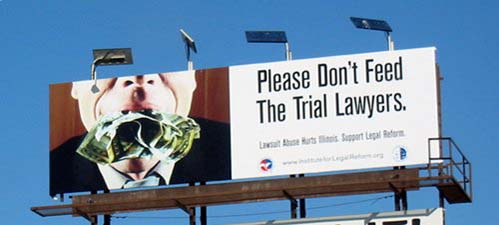
Just about anything advertised on a billboard is a raw deal - and that includes lawyers.

If you drive down the Interstate, particularly through a city, you'll see billboards, sometimes dozens of them, advertising the services of personal injury attorneys.  In Florida, these are so commonplace as to be unnoticeable.

Many offer services, including towing your car, finding a repair place, lining you up with a doctor, and of course, suing the other fellow's insurance company.

Other billboards are almost "how to" instruction manuals on how to fake a slip-and-fall accident.   A large Billboard near Miami shows a prostrate victim on a linoleum floor in a grocery store, with a spilled quart of orange juice nearby.  The tag line is, "It's Not Your Fault!  Sue!  Call the Offices of...." 

Are personal injury attorneys a good deal?  How can they afford to advertise on a billboard - and on television and the radio?

The answer to the second question is easy.   Attorneys can make a lot of money on personal injury claims - enough to pay for billboard advertising and television advertising - as well as big ads in the yellow pages and of course, online.

Now, note that I said the attorneys make a lot of money.   The plaintiffs (that's you) might not make out very well.

Why is this?  Should you hire a personal injury attorney?   That depends on a number of factors.   But it is worthwhile to understand ahead of time, how this "industry" works, and what is really going on.

First off, even though the lawyers on the billboards have rolled up their sleeves to show their scrawny lawyer-muscles and claim to "fight for you!",  lawyers are really only fighting for themselves.  If they can get a lot of money from the insurance company or some defendant, they make a lot of money for themselves - often the majority of what is recovered.

Lawyers are not running a charity - no matter whether it says they "fight for the little guy" or whatever on their billboard.  If you are dumb enough to think that a personal injury attorney is like Captain America, standing up for the downtrodden, with no expectation of making money in the deal, you are pretty darn stupid - and deserve to have some lawyer take away all your cash.

Can you make a lot of money as a personal injury plaintiff?   Well, that is the deal, ain't it?   You see these billboards, and you get into a fender-bender, and you think, "Gee, maybe I'll win the litigation lottery!  After all, that lady who spilled a cup of coffee in her lap got $5 million from McDonald's!  A real car accident should be worth more than that!  Right?"

Well, not exactly. 

First of all, yes, there are situations where maybe a personal injury attorney is necessary.  If you are really injured - and by that, I don't mean you have a sore neck for a few days - and the insurance company is being a real dick about it, then maybe you need to see a real lawyer.   The best, however, are the least likely to advertise on a billboard.  If you are in a car wreck and in a Coma and burned with broken legs, yea, you might need a lawyer.

But for the rest of us?   The P.I. Attorneys who advertise on the billboards are playing into the greed that most people have.   And most people think, "Gee, why hasn't my ship come in?  Why can't I get something-for-nothing like everyone else in this world!  My bruised knee is worth a million bucks, easily!"

And of course, this is classic weak thinking, which is very prevalent in America.   Too many today want wealth without work, and are more than willing to game the system, if not resort to outright theft, to get a few dollars.

And exaggerating an injury from a car accident or a slip-and-fall in the grocery store is what?  Stealing?  You betcha.

So, yea, if you think this is a good way to "get ahead" in life, then go for it.  Just remember that the Wheel of Karma catches up with people, rather quickly.    Ever seen someone who files on of these P.I. suits who ends up happy?  Hell, no.  They never feel they got enough, and in most cases, they don't get much.  They do bitch and moan about it, all the time, and become the friend with the perpetual problem.

I have never, in my lifetime, met someone who "got rich" from a personal injury lawsuit.  I have never, in my lifetime, met anyone who was happy with the way their personal injury lawsuit turned out.  I have never, in my lifetime, met anyone who files these sorts of suits who was really a happy person.  Have you?

There are actually people who intentionally "take a fall" in  retail store or other venue - or intentionally get into car wrecks - for the sole purpose of creating a personal injury case.   In some cases, these folks actually work in cahoots with seedy attorneys.  But again, you never see folks like this make a lot of money at this game.   At most, they get a few thousand here and there - enough to keep their head above water.

No one gets rich at this game.   Well, no one except the lawyers.

How does the game work?   Well, most of these attorneys work on a contingency-fee basis.  If you don't win, they don't collect.   But these contingency-fees can vary from 30% of amount recovered, to 60% and more.   And most attorneys also deduct "expenses" from the judgment award or settlement.

What sort of expenses?  Doctors fees, for one.  That friendly doctor he sent you to, that is not covered under your insurance plan, costs a lot of dough.  And since he is testifying at a deposition and possibly at trial, he gets paid for that as well.

Expert witnesses are also hired, and charge $300 an hour or more to review the accident files or medical files, testify at depositions, and testify at trial.  These may be medical experts, traffic control experts, accident reconstruction experts, automotive experts (if a part is alleged to have failed or was defective), and so on.  They may hire an animator to reconstruct the accident in a computer animation.   None of this is cheap.

And by the way, when I say $300 an hour, that includes travel time, meals, sitting around, waiting, whatever.  It adds up very quickly, into the tens of thousands of dollars - per expert witness. 

And then there are copying fees, court fees, courier fees, Federal Express charges, and so on, and so on, and so on.   "Expenses" can add up, fairly fast, and sometimes be as much as the attorney's contingency fee.

So, say for example, you get into an accident and damage your car.   You are only mildly injured, and like in most car wrecks, you are sore all over.   The other fellow was clearly at fault, and admits as much.   You could just call his insurance company and talk to them.   Granted, they may try to deny fault.  They may try to encourage you to get the car repaired at a place of their choosing.  They may try to get you to settle for less than you'd like to.

But on the other hand, if you are firm with them, they likely will try to settle the case quickly - and pay for your car repairs, medical bills, and the like - and even offer compensation for "soft tissue damage" if you are bruised or the like.  You might even recover "depreciated value" if your car is worth less, as a result of the accident.   And this payment is immediate, so you can move on with your life.   And since an attorney isn't taking 1/3 to 2/3 of the money, well, you are fully compensated.  You are "made whole" as we say in the law.

Now, on the other hand, suppose your wreck was right under a billboard for "Howe, Dewey, Screwem, Personal Injury Attorneys" who promise to "Fight for you!".   So you call their 800-number and they send out a tow-truck and hustle you off to the hospital in an ambulance, even though you are little more than shook up and bruised a bit.

The other fellow's insurance company, once they are aware you have hired a lawyer, will refuse to talk to you.   And likely, they won't have much to say to your lawyer, either.   You'd better be prepared to wait - and wait a good long time - to be made whole in this situation, if ever.

Why is this?   Well, in order to recover sufficient damages just to pay for your car repairs and hospital bills (generated in part, thanks to an unnecessary ambulance ride), the P.I. Attorney has to allege "pain and suffering" in addition to actual damages (car repairs, medical bills, etc.).   They might also go after "lost wages" and even "loss of consortium" - meaning the loss to your wife because you can't have sex with you (which she may actually perceive as a benefit, but let's not go there).

Now, in most States, the insurance company is only liable for damages up to the limit of the policy.  So if the guy who hit you only has $25,000 in insurance, that's all you're going to collect, unless you or a family member has uninsured motorists coverage which P.I. Attorneys just love, as it sweetens the pot.

But even then, that might add only another $25,000 to the pile.    In the greater scheme of things, we are not talking about a lot of money.   If the insurance company agrees to pay out a "claims limit" amount, that might be all that is collected.   And after the attorney's fees and expenses, it is possible you may end up collecting less than you would have, just negotiating with the insurance company.   It is possible you may end up collecting less than the damages you incurred.

Of course, in some situations, it is possible to collect more.  For example, if your attorney sends a demand letter for the limits of the policy - and the insurance company refuses - then the attorney can sue for any amount - at least here in Georgia.   So if you are hit by a schmuck with a $25,000 policy, and the insurance company refuses a demand letter for the claims limit of $25,000, your attorney could sue for a million bucks.  But of course, that does not mean he might necessarily win.

Another scenario is where a big corporation or other "deep pocket" is the defendant in the suit.  Slip-and-fall cases are very popular, as the grocery store or other establishment where the slip allegedly occurred, has a lot of insurance, as well as lot of assets, bank accounts, and other easily attachable stuff.  Similarly, if you are hit by a truck belonging to a big nationwide trucking company, the sky is the limit!

The only thing you don't want to do, is be hit by some poor person with little or no insurance.   That's not how the game is played!

I am being facetious, of course.

So why do people hire P.I. Attorneys?  Well, there are cases where people are burned horribly or paralyzed or whatever.   And in those cases, the amount of damages can be huge.   And if the defendant is a "deep pocket" the person injured may recover millions of dollars.

Of course, getting a million dollars isn't better than being paralyzed or burned.   Ask anyone in a wheelchair what they would pay to get their legs back.  Ask anyone in a burn ward what they would pay to avoid the agonizing pain of the daily wound scrubbing.

No one comes out ahead in these deals.   Except the attorneys, of course!

And those big jury awards are advertised all over the place.  I get a newsletter from a P.I. Firm in Florida, trumpeting their big wins (but never mentioning their losses or smaller wins).  A million-dollar jury award makes the news - and is free advertising for P.I. Attorneys everywhere.

Advertising - and for what?   What they are selling is the idea that you can make a lot of money in a personal injury suit.   And it is just an idea and most times, a myth.

You see, the coffee lady at McDonald's didn't win $5 million dollars.  The jury awarded about $3 million dollars.  But the judge reduced that to less than a Million.  They ended up settling the case for less than $600,000.  And can you guess who got the lion's share of that?   Well, with trial expenses as well as the attorney's contingency fee, I doubt the lady got even half.  (Some sources claim the law firm waived their fee in that case, I have no source on that, however).
"A twelve-person jury reached its verdict on August 18, 1994. Applying the principles of comparative negligence, the jury found that McDonald's was 80% responsible for the incident and Liebeck was 20% at fault. Though there was a warning on the coffee cup, the jury decided that the warning was neither large enough nor sufficient. They awarded Liebeck US$200,000 in compensatory damages, which was then reduced by 20% to $160,000. In addition, they awarded her $2.7 million in punitive damages. The jurors apparently arrived at this figure from Morgan's suggestion to penalize McDonald's for one or two days' worth of coffee revenues, which were about $1.35 million per day. The judge reduced punitive damages to $480,000, three times the compensatory amount, for a total of $640,000. The decision was appealed by both McDonald's and Liebeck in December 1994, but the parties settled out of court for an undisclosed amount less than $600,000."
And her experience is not atypical.  Gigantic jury awards generate sensational headlines.  Amounts reduced by a judge or reduced on appeal (or reduced in confidential settlements) are not mentioned in the press.   So the P.I. Attorney has a friend in the media, in that they report the sensational verdicts, but play down the reduced amounts actually awarded.   And of course, no one talks about how much the attorney got out of the deal.  And no one talks about whether the amount awarded really compensated the victim for all their pain and suffering (how much is having your vagina douched with boiling water worth to you?  A million bucks really isn't enough, I suspect).

So those "Whale" cases serve a very useful purpose - they convince the plebes that they too, can win at litigation lottery - even when they really don't have much of a case.  But there are an army of lawyers out there who are willing to take their cases on contingency, even if they are pretty basic car accident cases with a limited amount of damages at stake.

If you Google "Unhappy with Personal Injury Suit" or "Unhappy with Personal Injury Settlement" and you will see pages and pages of complaints from plaintiffs who are unhappy with their attorneys - sometimes even before the case goes to trial!  After settlement, well, you are pretty much stuck.   Consider this plea on the Internet:
"My mother had a slip and fall accident at Wal-Mart a few years back and she hired an attorney. After 2 years they finally settled the case. She at that time wrote a letter to this attorney and also to the head of his office about how disappointed she had been with his work ethics. She only settled because she simply got tired and frustrated with his lack of skills. My question to you now, is it possible to reopen a case like this after it has once been settled."
First, you can see there is a real brain-trust at work here.   For some reason, this Cletus doesn't quite understand what the word "settlement" means.   Can I go back and sue again and again?  Why not?   You see the mentality at work here.  He was hoping to win "Litigation Lottery" and had his new bass boat all picked out.   When the case finally settled, he doesn't have enough to pay the cable bill.

And you can see here, who the P.I. Attorneys are targeting as clients - the lower classes.   The very poor believe in Litigation Lottery - even if it really isn't real.   They believe in real lotteries as well - and that you can "get rich quick" if you know the "secrets" to investing.   In short, you can sell the poor anything at all.   They will buy shit-on-a-stick if you pitch it right.   And the P.I. Attorney is an excellent example of that.

But the question is telling.  After two years of waiting, they got tired of waiting around and settled the case.  And I am sure the question of  "work ethics" has more to do with the utter lack of work the attorney did on the case, the pitiful amount they settled for, and the huge chunk of fees and expenses the attorney took from that pie, than any real "ethical" violation.

It is a complaint I hear often from plaintiffs.  "My Attorney isn't doing anything to move the case forward!" they cry, not understanding that due to court backlogs, cases like this (which take back seat to criminal cases and more important things!) often take years to get to trial.   In the meantime, there is discovery, depositions, motion practice, and a whole host of activities.   And since the contingency-fee attorney is paid on the amount won and not on the hours he puts into the case, it often means it is in his best interest to do as little as possible, throw together a half-assed case (which it likely was, from the get-go, anyway) and then settle on the eve of trial for a token amount.

From the attorney point of view, that makes the most economic sense.   If you can get ten cases going at once, and do little or no work on any of them, and settle for $50,000 before trial on each of them, it is more profitable than one case that you actually have to take to trial and win $500,000.  Far less effort for just as much money.  The economic incentive is there.

So you see how the game is played.  Advertise on billboards, get a lot of cases, shake down the insurance company for a token amount, keep half of that, give a pittance to the client.   If the case was bogus to begin with, the client is happy - better to collect something than nothing.   But, if you are actually injured, well, it may be a less than desirable outcome.

And that is a predictable outcome for most P.I. cases where the actual injuries are not that severe.  Unless you can show some debilitating injury requiring lifetime care (paralysis, etc.) you are not going to win a million bucks at trial.   And if you have such a case, for God's sake, don't use some sleazy attorney who advertises on billboards!

But if you are not really injured - or not seriously injured - consider whether you need a Personal Injury Attorney at all.   Is what the insurance company is offering adequate?  Or were you hoping to win Litigation Lottery?  If the latter, I have no sympathy.

UPDATE December 18, 2013:   I attended a law conference in Savannah, and the litigating attorneys who spoke there were quite illuminating.   One mentioned that some firms here spend over a million dollars a year on television and billboard advertising.  There are a million people in the greater Chatham County area - that works out to a buck per person.

I mentioned to the speaker, during the break, that was a lot of money to spend, and he said, "Yea, and they make their money all on these shitty $3000 cases!"

Right there, you see how much "Litigation Lottery" pays - little to nothing, half the time.

What was interesting is that they described how the system worked before Lawyer advertising went into effect.   Back then, a referring attorney would get as much as 50% of the litigating attorney's fees.  If you were a litigating attorney, most of your business was by referral - and as a result, you paid out a lot, in terms of fee-splitting with other Attorneys.

So a Billboard or TV ad is a great way for a law firm to cut out the middle-man and avoid paying referral fees.

For all those shitty little $3000 cases.......

Sunday, December 15, 2013

Generational Warfare versus Class Warfare


When I was a kid, young people protested the materialism of their elders - and rejected it, at least for a time.  Kids today similarly protest the materialism of their elders - but want it handed to them, instead.


One thing I notice when perusing comments sections in news stories, as well as reading news stories themselves, is the emergence of a Generational Warfare between the very young (under 30) and those perceived as "Baby Boomers" and older.

The far-right misclassifies this as "Class Warfare" - pitting the poor against the rich.   But I think Generational Warfare is a more appropriate term.

What do I mean by this?  And is this anything new?   With regard to the latter, I think not.  Generations have always distrusted one another for, well, generations.   But unlike the Generational Warfare of yesteryear, today's young folks aren't rejecting the materialism of their elders so much as wanting it handed to them.  And I think this distinction has more to do with demographics, than anything else.

In the 1960's and early 1970's, many young people embraced a number of "movements" that alarmed their parents and elders.   The baby boom generation was huge - and out-populated their elders.   Riots, bombings, protests, sit-ins, and the like were scary to the WWII generation, who saw these unwashed hippies and radicals as a threat.

But the hippies didn't want to take away from their elders - at least not directly.   Granted, they had an agenda of social welfare programs that would be paid for by increased taxes.   But at least on the face of it, they eschewed materialism as "evil" - and didn't want so much as to take away, but to be left alone.

Today, we see a different scenario playing out.   The current crop of 20-somethings is a smaller generation than the one preceding it.   We have fewer young people today, in terms of percentage of overall population.   Our country is aging, and the average age in America is increasing.  And these older folks are also wealthier, by dint of age alone.   The kids to day look about them and see oldsters with defined benefit pensions, paid-for houses, and brand-new cars, and believe that they may never have such things.   And with regard to defined-benefit pensions, they probably are right.

But unlike the hippies, the young people of today are not so much rejecting materialism, but rather embracing it with a furor.   What pisses them off is not our society's obsession with material things, but the fact that they aren't getting enough of them.   Where's my new iPhone and Abercrombie shirt?   I want a new Toyota Scion - with a fart muffler and bling rims, if you please! 

And from their perspective, it is the older generation that has somehow "taken away" their toys, once they have graduated from college and have to pay back onerous student loans - often without a good-paying job, too.   Mom and Dad are no longer handing out money, as they have to save for their own retirement.  It all seems so unfair!

And I see this, all the time, in inquiries I get to this blog.   Google Blogger allows me to see some selected search terms from Google, Bing, and even Yahoo, that find this blog.   And many of the searches are somewhat disturbing.   Regularly, I see searches likes, "How do I get my Dad to stop being so stingy and buy me a new car?"    No, really, kids think this way - that Dad has plenty of dough and can cough up twenty grand on a whim to give them a new car, right out of college.  (And sadly, many middle-class parents spoil their children in this way).

The OWS protester sits-in on Wall Street, not to protest some war, but because they don't want to pay back their student loans.   They want a freebie - and many are up-front with the proposition that student loan debt should just be "forgiven" on a blanket and nation-wide basis.   And as I noted in an earlier post, many will text and tweet this from the new iPhone their parents bought them.


The revolution will not be televised.  Neither will it be tweeted or texted.


At least the stinking hippies could be said to be protesting for the rights of others - to eliminate poverty, racial hatred and discrimination, and to end the napalming of civilians on the other side of the planet.   It could be said that their cause had at least some nobility to it, in that they were championing the rights of others.

But the young people of today?  It's all gimmie, gimmie, gimmie

The latest gag - fueled by the Service Employees International Union (a name that just rings of Marxism) - is the idea that slacker jobs should be paid on a par with qualified professionals or skilled labor.   Kids are "fighting for a living wage" - arguing with a straight face that a crap job at McDonald's should pay $30,000 a year and come with health insurance as well.

They don't want to better themselves, acquire skills and talent, or try to climb the economic ladder.  No, rather, they would prefer to "work for the man" and get paid highly to do it.   The hippies of years past would have called that "selling out" and I think most would rather have starved before working for McDonald's.

I wonder how things would have been different at Alice's Restaurant if it were a McDonald's franchise?

Of course, we know how the hippie thing worked out.  Eventually, people get older and get tired of sleeping in unheated barns on the commune, and decide they want an espresso maker and a Volvo - as well as a home to raise a child in.   So they sell out - get a job - and start to accumulate wealth over time.  The leftist becomes a Republican, over time.  Jerry Rubin, the activist, becomes Jerry Rubin the Millionaire.  

It takes only time.   And a surprisingly short period of time.  30 years ago, I was a college dropout, living in my own squalor, smoking dope and hanging out with friends and drinking beer.  20 years ago, I had graduated from law school, and was making close to the vaunted six-figure salary.   10 years ago, I had my own law practice, as well as a thriving Real Estate business.   Today, I am semi-retired, fairly well off, and not really inclined to "share the wealth" with some 20-something who majored in Liberal Arts and can't figure out why the world doesn't owe him a living.   Time heals all wounds, unless of course, you keep smoking pot and, like a friend of mine, end up living with your parents at age 55.

Will the same thing that happened to the hippies happen to this current generation of young folks?   I think so, if they are not waylaid by these movements.  If the OWS protester keeps clinging to the idea that the way forward entails having debts forgiven and making a living from crappy service jobs, it is likely they will never progress very far.   Even if these unrealistic wishes were granted, (which would be a nightmare for the economy) they would still be stuck at the lower end of the income spectrum.  Engineers, Doctors, Lawyers, Businessmen, and Investors, would still be making more money - and lead more interesting and fulfilling lives.  Pining to make a living from a crappy job isn't the answer.  The answer lies in self-improvement.

Thursday, December 12, 2013

When Should You Sell Your Car? (When it is Still Running)


 While it is a good idea to hang on to a car for as long as you can, there comes a time when you will eventually have to sell it.   When should this be?

I recently sold my X5 on eBay.   In a way, I didn't really want to sell it.  But I took my reluctance to sell as a good sign.   Just as they say "the best time to look for a job is when you already have one" sometimes it is best to sell and move on while a car is running well, and maybe just a little bit before you are ready.  Why is this?

I loved the X5 and it was well-engineered.  But it was an expensive vehicle, and even doing the repairs myself, the costs were pretty high (and pretty frequent).   Throw in 93 octane gas, prescription motor oil (all 7 quarts of it) and mail-order oil filters, and well, it got old, real fast.  The $300 tires were not any fun, either.

We take a two-month trip North every summer, towing a camper, and after 150,000 miles, my partner was getting worried about getting stuck somewhere when the car broke down. And on every trip, something would break - which is normal on an older car.    It was an ignition coil last time around.  A radiator cooling tank the time before.  The alternator before that.  I was able to fix all of these within a day, but it meant delaying our trip and also caused stress.


We got back from the last trip, and after replacing the ignition coils, the window regulator, and the door handle (which is #3 for this car), everything was in working order.

So I decided to sell.   Why?  Because everything was in working order.   It is easier to sell a car when it is running, than wait until everything is broken.

Two friends of mine did the opposite.  It is human nature.   Why sell your car, when it is running fine?  Right?

The first one had a boat.   It was in running order, but he had stopped using it.  He said, "Why sell it?  It is a nice boat, and I might use it!  It's not costing me anything!"  (It is, actually, in depreciation, but that's another story - and another posting).   So he kept it two more years on the trailer, turning down an offer for $6000.  He took it out one year and the engine blew up.  The transom had rotted out and the motor was shot.  He gave it away for scrap.  If he has sold it when it was running, he would have gotten $6000 for it.   Once it stopped running, it was worth nothing.

My other friend has an old Mercedes that he paid $60,000 for.  It is worth maybe $6,000 now and he said, "I'm not selling that car for so little!  I paid $60,000 for it!"   But it is 20 years old.  He rarely drove it.   And eventually, the battery went dead, and he stopped driving it.   He tried to start it the other day and the gasoline in the tank is sludge and the fuel injection system clogged.   At this point, you can't give it away.
His widow will probably donate that car to charity for a pitiful tax write-off.

Better to sell when it is working, get a little money for it and have an easy sale, than to wait until it is shot and then try to donate it to charity.

At the other extreme, another friend of mine finally bought a car, after leasing a string of $35,000 pickup trucks.  Yea, they have a new smartphone, too. The car is now two years old, and they have four more years on the loan.   He says to me, "Time to trade it in on a new one".   When I explain that he is likely upside-down on the loan at this point, he says, "well, no big deal.  You'll always have a car payment, your whole life, right?"

I was ready to scream.

But it illustrates that there is a happy medium between "drive it into the ground" and "Let's trade cars every two-three years".   There is a "Sweet spot" of car ownership, between brand new and clapped out, when the cost of ownership is at the lowest point - in terms of the depreciation curve and theWeibull curve.

In general, most modern cars will easily go over 100,000 miles without difficulty or major breakdown.  Most will go to 150,000 miles.   This means 8-10 years of trouble-free driving.  So keeping a car for 8-10 years and 100,000 to 150,000 miles is a good basic target.   Yes, you can go longer and drive a car "into the ground" - but that requires a little more effort on your part.   And it means a car that you really can't take on long trips, as it might break down and leave you stranded in the middle of Oklahoma - and at the mercy of the nearest garage mechanic.

And yes, there is an insane logic to owning a clunker - but you have to be pretty clever and astute to make it work - economically.   For the rest of us, who might not be mechanically inclined, it pays to fish further upstream.  Of course, your old Honda or Toyota might make a good hand-me-down car for your kids.  Older cars are cheaper to insure, and odds are, a kid will trash the car in short order, anyway.   But don't expect your kids to be grateful.  Today, the average middle-class teen expects a brand-new car for their 16th birthday.   And if you don't buy them one, in a few short years, they'll convince Grandma to co-sign a loan so they can have a "reliable car to get to work."  Or maybe weekend Dad will buy them one - out of guilt.

Of course, getting rid of a clunker is problematic.   Once they go bust, all you can do is sell them for parts or scrap - or donate them to charity (which is akin to giving it away).  But at that point, a high-mileage clapped-out clunker isn't worth much.   If you are handy with tools and don't mind driving a piece of crap, the clunker thing could work for you.   But most Americans don't have the time and patience for this, so we won't leave it on the table as a realistic option for most people.

Trading in cars every 2-5 years, on the other hand, makes no economic sense whatsoever.   To begin with, as I noted in my Hidden Costs of Car Buying, you will have to pay sales tax on each one of those cars.  If you trade every five years, instead of every ten, you double your sales tax burden, which on a $25,000 car, can be about $1500 each time.   You also are taking the biggest hit in depreciation, in terms of dollars - whether you buy new or used - as the highest depreciation occurs when the car is the newest (as the value is greater).  Unless you are really rich and can really afford to squander huge sums of cash, this is not a realistic option, either.  And no, you can't "afford" to trade-in or lease new cars every few years, if you are at the same time complaining about being broke all the time or underfunding your 401(k).  Let me put it this way - if you are reading this blog, odds are, you can't afford it.  So we'll leave this option off the table as well.

So when should you unload a car?   Like I said, about 8-10 years and 100,000 to 150,000 miles are pretty good targets.  But here are some other criteria you should consider:

1.  Have you stopped using the car (boat, motorhome, etc.?)   If not, think as to why you are keeping a vehicle you don't ever use - or use rarely.   Many people make the mistake of buying a new car and then saying, "Gee, we'll keep the old one, as it still have some life left in it!"   But the battery goes dead, and the gasoline in the tank turns to sludge - and the cost of owning an extra car, while not readily apparent - starts to drain your finances.   If you have more cars than people in your house, something isn't right.  And I know this, as I used have six (cars, that is) and it was bankrupting me.   Cars are like fresh fruit - use 'em or lose 'em.   Better to have one car and drive it a lot than to have multiple cars and drive them rarely.

2.  What is your use of the car?  If you are commuting to work, and don't mind being late once in a while (if the car breaks down) then you can afford to have an older car and not worry so much about being stuck.   If you have AAA, the car can be towed to your trusty local mechanic (or your garage) for repair.   But if you travel long distances, an older car might not be such a smart choice.   Breakdowns in remote locations mean than you have less choice as to who is to repair your vehicle - if indeed anyone there is capable of repairing it.   For example, driving the X5 in Labrador was an interesting experience - we kept wondering what we would have done if it had broken.   AAA might not work in Canada - and spare parts would have to be flown in or take a week to arrive.

3.  How Old is the Car?  And by this, I mean age in years.   Cars rot, like fresh fruit, even if they have "low mileage" on them.   And lower mileage cars are not worth a lot more than high mileage cars, as a result.  While a garage-kept car might last 15 or 20 years with no difficulty, cars left outdoors after two decades start to look pretty ratty, and many parts start to degrade, just from time and the elements.  Things like oxygen sensors wear out over time, as well as mileage.  Rubber parts rot, fabrics fade and tear.  Very few cars look nice after 15 years.

4. How Many Miles on the Car?  Again, mileage is not necessarily indicative of age.   A lot of highway miles put little wear on a car, whereas city driving can wear out a car fairly quickly.  But again, the odds of you reaching the fabled 300,000 mile club are pretty slim.   Most people who drive a car this far, drive an awful lot every year - 25,000 to 35,000 miles, or about double the national average.   There are few 20-year-old cars that make it to 300,000 miles, but plenty of ten-year-old cars driven by fools who fail to grasp that they are driving their lives away, 30,000 miles a year.

5.  What Condition is the Car?   Is the headliner starting to sag in spots or have some tears?  Are there nagging issues with trim, accessories, and electronics?  Will it be due for tires, brakes, struts, oxygen sensors, fuel filter, spark plugs, or other maintenance and repair items?   As I noted in my Fright Pig article, once a car hits about 100,000 miles or so, it may need a lot of repair and maintenance work.  Cumulatively, these repairs and maintenance items could end up costing thousands of dollars, particularly if the work is done by a mechanic.   Is it worth throwing $5,000 at a car worth maybe $10,000 on a good day?

The point is, as with everything, moderation is the key.   Going to extremes trying to keep a car alive forever can be more expensive than buying a new one.   And yet many self-styled "frugal" people do this - throwing hundreds of dollars a month at a car for repairs, and ending up with a ride that is uncomfortable, unreliable, and worth very little.   A minor fender-bender is often enough to total the car.   Or after throwing thousands of dollars in maintenance and repairs, a "big ticket item" like the engine or transmission blows up, and the cost of repair exceeds the value of the car.

Yet many people do this - throwing more and more money at older cars, convinced that "this time, it will be fixed, for good!"   Usually, these folks are not car people or people with a background in science or Engineering. They assume that "but for" some worn-out part, the car would otherwise be in perfect condition.  They assume that if all the broken parts on an older car can be replaced, it will run like new.  They assume wrongly.

Cars, like computers, houses, buildings, appliances, and even people, have a design life.   They are engineered to run for a designed service life, and then to be scrapped.   Depending on care and the law of probability, some run longer, and some run less, than this designed service life.   And a few are taken out of service and become "collector's items" which are not really cars anymore, but talismans of cars.

So you have to know when to quit - at a reasonable time.   And one way to do this is to set a goal for yourself.  When we bought the BMW X5, it had 50,000 miles on it, and cost $25,900.   I figured if we could get about 100,000 miles out of it, that would bring the depreciation down to less than 25 cents a mile.  Since it sold for $5700 (about $250 over trade-in or private party sale) the actual depreciation was about 20 cents a mile.

We could have easily gotten an additional 50,000 miles out of it, without much maintenance, I think.   The only major component in question was how much longer the clutch would last.   Some owners reported getting over 180,000 miles out of a clutch (and still running).   But most of the major systems were in good repair, and all the maintenance items (oxygen sensors, spark plugs, ignition coils, fuel filter, fluids, etc.) had been changed out.

But two things gave me the impetus to sell.   First, the small repairs on our long trips (which are an annual occurrence) were getting annoying.   When a car breaks down in a strange town, it can be stressful.  Second, the car had some life left in it, and everything was working on it - so it was a good time to dispose of it.   For $5700, it represents a good piece of transportation for the new owner, who can probably put 50,000 miles on it with no difficulty other than putting a new set of tires on it, eventually.

And I am at a point in my life - with no debt and a net worth well over a million dollars - that I truly can afford to buy a car.   The insurance cost is negligible, and the dent to my net worth is less than it fluctuates on a monthly basis.   So maybe it was time to move on from the X5.

The car also had some practicality issues.   While an SUV is supposed to "haul things" you'd be surprised how little you can fit into these vehicles, compared to say, a minivan or pickup truck.  With four passengers aboard, there is barely room in the back for luggage for two.    So we ended up with a "rocket box" on the roof, which was cumbersome and awkward.

So, what to replace it with?    The following criteria had to be met:

1.  A Tow rating of at least 5,000 lbs (more than the weight of the trailer).

2.  Room for four adults (our other car is a 2-seater, and owning two 2-seaters is not practical)

3.  Something that can haul fairly large items (again, the roadster doesn't do this well).

4.  Reasonable gas mileage (this conflicts with 1-3).  At least 20 mpg for a truck.

5.  Simple and cheap.  No AWD or 4x4 or fancy gadgets.

6.  Has to fit in the garage.


The new medium sixed SUVs are all based on car chassis (the Taurus, Impala, Camry, etc.) and thus have AWD and FWD options.   The FWD models are usually a lot cheaper.  However, most have very little cargo space and since they are of unibody construction, their tow ratings are limited.   SUVs are also very expensive as well - with most topping $30,000 or more, even in base trim - and even with rebates, etc.   Used ones are not much more of a bargain.


We had been looking at these Nissan Frontier mini pickup trucks (4-door), as they have a decent tow rating (6,500 lbs) for our trailer and are cheap (maybe $25,000 new, a lot less used).   It also fit in our garage, which a larger truck would not do.  We put a Leer cap on it (painted to match), and it holds a lot of gear for camping.

Nissan has been reducing the price and adding features to their mini (more like midsized) trucks for several years now.


Like I said, we had been looking at them for three years.  And each year, Nissan has lowered the base price of the truck, and added more features to the option packages.   What really stopped us from buying one (and I know this sounds stupid) is that they were all either silver or white (neither of which is a color) and when I saw this graphite blue one, at a reasonable price, I decided maybe it was time.  Negotiated the price over the phone, checked all the online sources for a "reasonable" price for such a vehicle, and did the deal in about an hour.   Was it a smart move?   Not necessarily.  You never make out buying a car or truck - they are worth less than you paid for them the moment you buy them.

The only "gadget" it has on it was a backup camera and backup sensors.   And these are pretty practical gadgets to have (I installed one on the X5 as you can't see out the back of that thing, either).   The rest is fairly simple - power locks and windows, remote keyless entry, cruise control.   It does have bluetooth and a decent iPod interface on the stereo.   But other than that, it is pretty basic.

By the way, Hertz has a lot of these for sale for about $21,000 used, which is not a great price, but OK.  Most have 20,000 miles on them and are mid-range loaded SV models.   The only thing about buying a used rental car these days is CarFax, which brands your car with the red letter "R" on it.   I think they need to tweak their prices a bit, but supposedly, they do offer $1000 off.  If you are not concerned about resale value, it might be a good option, as well as looking in the late-model used market.

Sadly, these mini-trucks, like Jeeps, get "modded" a lot, as their primary audience, particularly for the 4x4 models, are young men.   They tend to beat on them and add questionable modifications.   Thus, it is hard to find a late-model used one (I found only two, 200 miles away, in Florida).   The 4x2 models are more "old men's trucks" - the type of ride favored by middle-class retirees.   So it is official, I am now an old man.

It burns 87 octane gas, and the oil and filters are available at Wal-Mart.  The 16" Goodrich tires are sold at the wholesale club for under $100 each.  Sometimes it is good to be one of the plebes.  Esoteric is nice and all, but expensive.

It certainly is no BMW, by a long shot, but it cost less to buy than the BMW did, used, 8 years ago.  And it hauls more cargo than the BMW did.   But, boy do I miss those leather seats!
And I intentionally bought below my income and wealth level.  I could have afforded to buy a more expensive car, but why bother?  Some of my neighbors think it is pretty funny.   But I really don't care what they think.  They have mortgages.  I don't need a car to impress them.

I bought the truck in RWD, as the 4x4 option was a lot more expensive, had worse gas mileage, and a lower tow and cargo rating.  And with age, comes service problems with four-wheel-drive.  We live in Georgia (no snow) and don't go off-road.  I don't need a 4x4 vehicle.  The 4x4 models do "look cool" though, all jacked up, which is why I think they sell a lot of them to young males.

And there are still station wagons out there - Volvos of course, and the Jetta and Passat Wagons, which are practical cars for hauling people and things.  Mercedes has nice ones, too.  But after working on my friend's Mercedes, I am not sure I want one.  They are a nightmare of complexity.
We went with the truck as it has the tow rating and a full-frame.  Not much is made anymore with a full frame.  If we didn't have the trailer, we would have looked at a wagon, I think - probably a VW.   Maybe an older 3-series wagon.   I look at this truck as an intermediate vehicle.  We will put 100,000 miles on it, maybe, and then move on to something else, once we stop RVing.    Again, have a plan, up front, on how long you want to keep a vehicle, and it will help you know when to sell.   So maybe in 2021, the Nissan will go on eBay with 120K on the clock.

But who knows?  Maybe we'll have this one longer.   We'll see.  I am not emotionally attached to it, but I guess that means I am getting older.

Wednesday, December 11, 2013

Conclusory Statements


What is a Conclusory Statement and why should you be on the lookout for them?


When I was in Law School and called on to recite, in the Socratic Method, I was routinely humiliated for my weak thinking, by the law school professors.   I was not alone, of course.  Most people in their 20's are weak thinkers, and confuse slogans and other people's ideas with real thought. 

And one comment a professor made, was, "That is a conclusory statement, Mr. Bell!"

As I sat down in abject humiliation and to the laughter of my fellow students, I thought, "what the heck is a conclusory statement?"

And when I learned what it was, I realized that much of my "thinking" up until that point, was not thinking at all.   And I realized, as I have noted here before, that Law School was about teaching you how to think like a lawyer, not how to be one - just as Engineering School taught you how to think like an Engineer, not how to design a bridge.

What is a Conclusory Statement?   Simply stated, it is a statement made in an argument that states a conclusion, without any foundation, underlying logic, or reasoning.  For example, someone says, "Hitler was bad" - that is a conclusory statement.  It states a conclusion, without any underlying reasoning or supporting facts.   If they said, "Hitler was bad because he slaughtered millions, enslaved nations, and started the largest war in history" - that is not a conclusory statement, as it provides supporting facts and arguments.

With these supporting facts and arguments, one can understand the reasoning and factual basis for the ultimate conclusion.   And you can research the facts or address the arguments, if you feel the conclusion is wrong.  You can debate a non-conclusory statement.  However, a conclusory statement is not even an argument to begin with.

Now with regard to the examples above, you might say, "Well, everyone knows Hitler was bad" and you might be right about that.   But to a child growing up, who is just learning history, they don't know all of that, and it bears explanation.   And in most instances, the things you are talking about or debating do not have a back-story based on common cultural or historical experiences.

And just because a statement uses the word, "because" does not mean the statement is not conclusory.   As this example illustrates
"Here's  an example  of a conclusory statement taken from an exam answer: "Because Adam's intent manifested the malice required for murder, he will be convicted." The problem here is that although the statement may be true, the writer has not told the reader (professor) precisely which of Adam's acts show he had the malice required to prove murder, what degree or variety of intent the law considers sufficient to prove malice, nor what type or variety of malice is required to obtain a murder conviction."
Similarly, statements made in the financial sector, which provide "reasons" but don't tie them to the underlying statement, are conclusory.  For example, "Leasing is a better deal, as it frees up your cash flow!" is a statement often made by salesmen and parroted by their victims.   It provides a "reason" (freeing up cash flow) for the argument (leasing is a better deal) but really fails to explain why freeing up cash flow is helping the consumer (it isn't, really) and how it relates to the overall cost of the transaction (the "deal").  And of course, the reason this isn't delineated, is that freeing up cash flow is a nonsense argument and the overall cost of the transaction (the deal) is higher than buying the car.

Why should you be wary of Conclusory Statements?  Because when someone makes a conclusory statement to you, they are engaging in weak thinking or lying to you, or both.  And in commerce, investing, and other financial subjects, conclusory statements abound.

For example, on the financial channels and online, you hear conclusory statements all the time, usually from self-proclaimed "stock analysts" who say things along the lines of, "Gold will hit $5000 an ounce!"  (which was an actual statement made by so-called experts, at one time - and yes, the price will eventually reach those values, the question is, of course, when).

The "logic" behind these statements is that "Well, I'm an expert at this, so my opinion means something.  Obviously I know about these things, so I don't have to explain why."   And this is an example of creeping credentialism and expertism in this country - where people assume that if someone is "expert" at something, they are right - or if they have a mountain of diplomas, their opinions are sacrosanct.

But experts are just jerks like you and me - and are often wrong.  And in the financial arena, the best example of this is the Shouting Guy - who screams "BUY!" and "SELL!" into the camera, touting one stock or investment after another - without explaining why these are good buys or stocks that should be dumped.   He's the expert, you're an idiot, and you're supposed to do what he says - or at least that is the idea they are selling you.

But, as others have noted, a monkey using a dartboard has a better track record of investment than the Shouting Guy, and his "expertise" is very suspect.  Actually, all "expertise" in the financial arena is pretty suspect.   A financial analyst makes a few good guesses, and he is touted as the Golden Boy - and people throw money at him.   When he flips a coin, it always comes up heads.   But eventually, he flips a tails and people scratch their heads and wonder why he "lost his touch" - when in fact, the law of probability just caught up with him.

The problem with these conclusory statements is that they cannot be analyzed.   When the gold bug says, "Gold will hit $5000 an ounce!" you cannot analyze that statement with any form of research, reasoning, logic, or analysis.   And not surprisingly, the people who make such arguments are usually in the business of selling gold, or some related business.

On the other hand, if I say that I think gold is overpriced because it costs only about $500 an ounce to mine, that people are mining more and more of it every day, and that historically sudden spikes the price of gold (or any other commodity) are usually followed by sudden drops, those are at least arguments and facts that you can research, refute, discuss, argue, or analyze.  You have something to attack, at least.  The conclusory statement, on the other hand, is irrefutable.

And in that regard, in political debates, conclusory statements (usually in the form of political slogans) are far more popular than reasoned analysis.   When you make a statement with reasoned analysis and factual basis, your opponent will attack the reasoning and facts, which to the public makes the original statement seem "weak".   The opponent, on the other hand, who merely makes a conclusory statement, seems stronger as there is no way to argue a conclusion.

Like I said, when someone makes a conclusory statement, they are usually lying to you.

In sales, we hear conclusory statements all the time.  "You'd be hard-pressed to find one of these chairs for less than $1,000" a salesman chirps.   This is a conclusory statement, with no underlying basis in facts or reasoning.  If she said, "You'd be hard-pressed to find one of these chairs for less than $1,000 because they wholesale for $900", that might make some sense.  At least there is logic and reasoning behind it.

Making conclusory statements in commerce is not illegal, and in fact, is protected.  In commercial law, we call such statements "puffery."  They are like ad slogans - not intended to set forth facts, but to give a consumer a warm and fuzzy feeling about a product.   So when the salesman says, "This is a fine car that gets good gas mileage and has plenty of power!" those are conclusory statements and also advertising puffery.  They are not enforceable as contract terms - even in a verbal contract - as they mean nothing.

On the other hand, if the salesman said, "This is a fine car, as consumer surveys place it in the top 5% of all cars sold.   It gets over 30 miles per gallon, and has 300 horsepower!" it is a different matter.  He is providing hard data here, which can be analyzed and refuted - and moreover the subject of a lawsuit, as some manufacturers have found out in the past when cars didn't meet their stated performance criteria.

Sadly, most people cannot distinguish between conclusory statements and logical thinking.   I know I couldn't, when I was in my 20's.   I tended to believe whatever pile of horseshit sounded good to me and sounded like something that would work to my advantage.   And this is why young people tend to be more liberal and tend to believe ideas like, "If we just gave everyone more money, no one would be poor!"

But sadly, many people go through life, never learning to think logically or to question the premise of arguments.  Many oldsters are just as naive as youngsters - listening to right-wing talk radio, which provides them with lots of slogans and conclusory statements - but little data or logic to back them up.

"Illegal immigrants are taking over our country and taking away good-paying jobs!" they cry.   But they can't point to one "good-paying job" that an illegal immigrant has taken away from anyone.  It is just a slogan touted on the radio, and part of an underlying political plan orchestrated years ago

People spend their whole lives making financial decisions based on conclusory statements.  "Leasing is a better deal!" they chirp, "I get more car!"   But they fail to do the math on the proposition - and salesmen don't provide this math.   And the simple reason is, if you did, you'd likely never lease a car.   Conclusory statements sell when logic and reasoning won't.

In the last few years, we've heard a lot of conclusory statements made by financial experts, salesmen, and politicians, and maybe even your family members.  Most, if not all of them have been outright lies:
"Better buy now, or be priced out of the Real Estate Market!"

"This payment-optional loan will make your home more affordable!"

"If rates go up, you can always refinance!"

"Housing prices in our area will always go up!

"Leasing a new car every three years frees up your cash-flow and you get more car!"

"These dot-com stocks are the next big thing! This is your chance to get in on the ground floor!"

"This credit card deal is great! You get Frequent Flyer Miles and Cash Back!"

"But Grandma, I need a reliable car to get to work and school!

"I just need $500 to tide me over.  You're lucky and have so much money!  Why not help me out?"
"Vote for me and I'll create jobs!"

"If you raise taxes on rich people, they will lay off employees!"

"Illegal Immigration is costing America too much money and taking away jobs!"

And so on....

Most of these statements are outright lies.   But even if one of them has a nugget of truth to it, you cannot tell - as there no underlying logic or reasoning presented as to why the statement is true.

You can blame these sort of people for making conclusory statements and lying to us.  But we chose to believe these sweet lies.   So who really is at fault?   The liar, or the person who believes the lies?  

When listening to the media, politicians, financial channels, salesmen, and even friends and family, be on the lookout for conclusory statements.   Chances are, when someone makes one, they are lying to you and trying to get at your money.   Such statements should set off an alarm bell in your head - and act like police tape to rope off a raw deal.   If you look at conclusory statements in this manner, you will be forewarned of bad things happening.

Sunday, December 8, 2013

If Something Doesn't Make Any Sense to You.....

If something doesn't make any sense to you, maybe that is because it is nonsense.


When I was younger, and someone tried to explain some financial transaction to me that made no sense to me, I figured that maybe I was just dense and didn't "get it."   After all, smarter people than I had investigated these things and must have found them sound.  I was just too young and naive to understand the complexities of finance.

Or so I thought.

As I got older, I started to see a pattern in these things.   People would try to sell me (often literally) on financial concepts that made no sense to me.   Later on, we discovered that they were flawed concepts - and a lot of people would lose their shirts in the process.

It began to dawn on me that perhaps I wasn't such an idiot after all, but rather my "gut instincts" were telling me that a snow job is a snow job.

For example, in 1989, I bought a house in Fairfax County, Virginia.   My boss told me at the time that property values in Fairfax County would always go up!   And everyone was buying and selling houses, which were appreciating, in some instances, by as much as 30% in a year.   I kept scratching my head about this, and thought, "This makes no sense!"

But "smarter" people than me explained, condescendingly, that I was just too dumb to understand.  "But," I said, "if housing prices keep going up this fast, who will be able to afford to buy them?   And if it costs far less to rent than to own, why bother owning?"

"Tut, tut," they replied, "You just don't see the bigger picture!"

Well, turns out, I was right and they were wrong.  The housing market in Fairfax County crashed and crashed hard, in the 1990's, with waves of foreclosures and short sales.  I bought some nice properties at that point - in foreclosure sales.

Twenty years later - nearly to the day - the exact same thing happened again - and the same people were telling me I was "dumb" to get out of the Real Estate market when so many people were "cleaning up".  This time around, I listened to my gut instincts, and not the "experts."  I made a million dollars, literally.

In retrospect, we all saw what happened.   Financial instruments that, on their face, made no sense, were being bought and sold, with no one bothering to ask whether they were sound or not.  Small investors were buying and flipping houses, and prices were climbing into the stratosphere.

This second time around, I was not so intimidated by the "experts" and sold out before the crash.  I began to realize that "experts" are just jerks like you and me.   And I realized this after taking the stand and testifying as an "expert witness" in a couple of cases.   Being "expert" in this country doesn't take a whole heck of a lot.  And experts are wrong - a lot of the time.

So I stopped listening to experts and listened to my gut instincts instead.   And when I was told some story that made no sense, I stopped thinking that maybe I was dumb and "didn't get it" but rather than people were trying to sell me horseshit.

And horseshit sales are booming.

Young people are still told these wild stories - and young people still believe them and not their own instincts.   Many a young person has tried to extoll the virtues of leasing to me, or explain why spending $100 a month on a smart phone is a "good deal".   Deep down, they know they are lying to themselves and these deals make no sense.  But they bought into "cash-flow" arguments or "opportunity cost" arguments that were peddled by retailers, and believed them, even if they made no sense.

The other day, I read this stupid story online about Bitcoin.   The tag line was "Man buys $100,000 Tesla with Bitcoins!" which sounds so trendy and cool, as it ties the trendy Tesla to the trendy Bitcoin.   But the reality is that this fellow cashed in his Bitcoins and then bought the Tesla with dollars. But that is not a very interesting story, is it?

I had heard about Bitcoins as some kind of online currency, but never really gave it much thought.    After all, if you want to shop online, everyone already takes credit cards or PayPal or whatever.   Why screw around with something else?

But the more I looked into Bitcoins, the more I felt I was being fed one of those "you're-too-dumb-to-understand-it" kind of deals.

How do you get Bitcoins?  What is the currency based on?    Well you can buy a Bitcoin, at current exchange rates - which vary wildly and have gone up dramatically over time.  Or you can "mine" them - which is what the currency is based on.

Mining?  How?  

Well, basically, they give away the bitcoins to people who can program their computers to solve algorithms - puzzles, if you will.   Solving these puzzles benefits nobody and creates no wealth.   We are not talking about decrypting documents or decoding DNA.   No, the bitcoin miners merely solve arbitrary puzzles and are awarded this imaginary currency as a result.  Over time, the puzzles get harder, and eventually, they will cease entirely when 21 million bitcoins are "minted".    So the currency has a fixed size, in terms of big "M" or the money supply.  This means that if an economy were based on bitcoins, it would have a hard time growing, as the currency would become more and more valuable over time.

It almost sounds like a practical joke being played on us by an Econ major.  Or the Mother of all pyramid schemes.   Think about it.  Each "puzzle" that these computers solve is harder than the last.  As a result, today, to "mine" a bitcoin, you need banks of computers solving these problems - the power needed to run them is staggering.   But the first guy who started it, mined the first Bitcoin in a few minutes, if that.  The first 100 in an hour.   The first million in a day.   He's sitting on a pile of dough and you ain't.   Sounds like a pyramid scheme to me!   And I suspect it will collapse when the last Bitcoin is "mined".

Well, who set up this deal?   That's where it gets really weird.  No one really knows.  The founder of bitcoin won't disclose his real name, and the enforcement and management of bitcoin depends on a distributed network of public keys and encryption.

In theory the system is secure, but there have been some thefts reported.   The "money" resides in your hard drive, unless you print out the code numbers representing your wealth.  As reported recently, one unlucky chap lost a fortune when he threw out his hard drive and lost a thousand bitcoins, reportedly worth a million bucks or so.  Back then, they were worth pennies apiece, so he didn't think much of throwing the hard drive away...

Which brings up an interesting point.   Bitcoins, like any currency, can be lost, stolen, or mutilated.  So, over time, the number of Bitcoins in circulation will decrease, since the maximum number is limited to 21 million.   If you take this to its logical conclusion, eventually, we will run out of Bitcoins.

The currency is not stable.  It has gone from 32 cents to 32 dollars, just in 2011 and then back down to two dollars.  It soared to nearly $1100 dollars and then back down to $600.  Some claim that this extreme volatility is irrelevant - as the bitcoin is just an exchange medium, and not a currency that one holds.  Yet the limited number of bitcoins encourages hoarding of the coins.   And if it is just an exchange medium, then it really isn't a currency, is it?

But taking all that aside, what is the real value of this money?   It is a perception-based currency,  and when people perceive it to be valuable then it has a value.   And today, people are perceiving it to be valuable, just as people perceive gold to be valuable.   And some would argue - again with the "you're-too-dumb-to-understand" argument, that all currencies are based on perception of value.

And while there is a nugget of truth to this, it reminds me of these relativists who argue that all truth and perception is relative, based on the person observing - and that "reality" is a myth.   But while that sounds find in the lecture hall on campus, in the real world (and there is one) it falls flat.   You may think you can fly if you jump off the Empire State Building - but mean old reality will tell you otherwise, in about 30 seconds.

And, oddly enough, the same has happened to Bitcoin, in fact, last week.   The value of bitcoins dropped by nearly half.  Far from being a stable currency, bitcoin has turned out to be, well, something else entirely.  It is hard to understand why someone would put "full faith and credit" in a currency based on the ability to solve meaningless and unproductive puzzles by computer.  No real work is being done - just make-work.   Nothing is being created.  No wealth is being created.   It is just a lot of people deciding that this arbitrary currency has value.

Now, you could say the same about the dollar - and indeed, all currencies, even gold (especially gold) are based on consumer perception of their value.  A currency is little more than a placeholder of wealth - an means of measuring the relative values of disparate items.  And in that regard, as I noted, money is the greatest invention of mankind.

But what makes the U.S. Dollar different from Bitcoin is that we know who controls the dollar and how.  It's value is not only determined by consumer perception, but by our interest rates, the amount in circulation, and the monetary policy of the Fed.   You may agree and disagree with the actions of the Fed, but the bottom line is, we know who is running the show, and they are answerable to the President, Congress, and by extension to the American people.

Yes, the dollar could also crash, but I am not so sure it will.  The economy is growing, inflation is down, and interest rates are low.   The rest of the world still cherishes U.S. Dollars and while China may hold a ton of our debt, we are paying them very little in interest for these loans (and despite what tea-baggers say, China cannot "call" this loan.  If you own a T-bill, you know how powerless you are as a creditor to the USA).

So, no, I don't buy the arguments that bitcoins are just like dollars and based on perception alone.  And no, it  is not because I'm too dumb to get it, but because the argument is bullshit.  And I'm old enough to detect bullshit when I see it.

Maybe down the road bitcoin will succeed.  I doubt it though.  For any "virtual currency" to succeed, it would have to be more widely used than bitcoin.  Only 1000 retailers worldwide accept it, only only a pitiful 10,000 online.  This is not enough to sustain a real currency for real trading.

It would also have to be controlled or monitored by some government agency or body of governments (like the Euro).   It would have to be backed by more than the ability to solve puzzles on your computer.   And we'd have to know who is actually running the show, too.

And I am not sure why people would bother with Bitcoins.   Granted, transaction fees for moving currency overseas are a pain in the ass, as I have noted before.   The banks, it seems, want a piece of every dollar you move from country to country, in wire transfer fees, credit card fees, or whatever.   Bitcoin promises to eliminate or reduce that - but you still have to find someone to convert Bitcoins to and from local currencies, and that is going to involve fees, as well as currency conversion rates.   Leaving money in bitcoin form runs the risk of sudden devaluation - as happened the other day when the value of bitcoins dropped in half.

In other words, I am not sure Bitcoins really have much of a use - or are a "cure" for anything in our existing system.   They may incur less banking fees, but they have far greater risks in valuation and liquidity.   And no, I'm not dumb for "not getting it" - it simply doesn't make any sense.   And certainly, the average citizen of any country will have little use for Bitcoins in their daily lives.

But the point is, never feel like an idiot when someone tries to explain some concept to you that sounds like a come-on.   In fact, if you feel "dumb" because you don't understand a lease agreement, or reverse interest-rate default swaps, or buying gold as an investment, you should take this as a warning sign that you are being fed a wagon-load of horseshit, and you are about to get ripped off.

Clever people always want to make you feel dumb - so they can take advantage of you.   When you feel this happening, treat it as an alarm going off - police tape roping off a bad deal - and just walk toward the door.

In the long run, you will be better off.    And no, you won't miss out on a "good deal".   There are plenty of other good deals out there, that are easy to understand for the simple reason that they make sense.