Saturday, November 26, 2016

The Post-Fact Era?


Is such a thing as a "post-fact era" or "post-truth era" even possible?   For a while, yes.  Not forever.


The pundits are at it again, claiming that the election of Trump is evidence of a scary new "post-truth era".   The reality is, the concept has been around for more than a decade, and it is a flawed concept, in some respects.

Yes, Trump used a lot of emotional arguments to get elected, mostly relying on fear to rally support.   As anyone with half a brain knows (or if you read my blog), fear is not an emotion to be trusted.   Throughout history, the powers-that-be have used fear to intimidate others and to mold public opinion.   If you can get people to believe that are in real danger, then they will act.  Otherwise, they are complacent and will not lobby for change.

And that is how Trump won.   By any logical analysis of our economy, the war on terror, the immigration situation, or whatever other metric you want to choose, we are doing pretty well.  The last eight years have been slow and steady recovery from the worst recession since 1929.   That's pretty good.

But you don't get elected if you tell people things are OK and you have no plans to change them.   And that was pretty much Hillary's platform, and pretty much the one she had to run on.   She could have articulated reforms to Obamacare, or maybe government reforms, but that would piss off the far-left of the Democratic party, who were already fleeing for third-party candidates or just not voting at all.   So Hillary had a conundrum - all she could do was attack Donald Trump as a dangerous psychopath, which he certainly appeared to be on the campaign trail (and still appears to be, although more muted and less tweety).

Trump's job, on the other hand, was a lot easier.  He didn't need to point out that things were rotten - they aren't.  Instead he had to make up lies about how bad things are.   So instead of Mexicans actually migrating back to Mexico (which is the truth) he tells us Mexicans are "flooding" across the border and raping and robbing and murdering.  None of them, it seems are the fellows mowing your lawn, cleaning your house, or picking your vegetables.

Similarly, in an era of 4.9% unemployment, he has to argue that unemployment is actually 32% or even 42% which is ludicrous on its face.   Or he just argues that "everything is bad" and getting worse, even if it isn't.   And people it seems, will believe what they are told.

Similarly, with ISIS and Islamic terror, he argues that this is an imminent threat to America, when in fact it is a real threat to Syria and Iraq.   A nuanced argument that our response to ISIS maybe could have been better orchestrated (Russia, of course, being the spoiler here) isn't going to work.   No, instead, he cranks up the fear that your local shopping mall is going to be bombed tomorrow.  And it doesn't help that some teenaged kid on the Internet decides that being "radicalized" is "rad".

But if you look back in history, you see the same pattern.   People don't vote for change unless they can be convinced - by real or imaginary evidence - that the system is "broken".  And that is why every candidate in the history of mankind tells you this.

Obama was elected only because there was a real economic crises.  People were losing their jobs and their houses and their life savings.   People voted for change, because Bush drove the economy off a cliff (well, maybe it wasn't all his fault, but when you are at the helm of the Exxon Valdez when it hits the reef, you are the one they blame).

And so forth down the line.

The problem with imaginary data is that eventually reality comes up to smack you in the face.   During the Bush years, we were told to borrow and spend - and lending rules were relaxed.   We all told ourselves that our houses could appreciate in value by 20% a year indefinitely which of course, is mathematically impossible unless inflation is running 20% annually as well - and it wasn't.  The balloon burst when mean old reality played his hand.  And suddenly the lies that Real Estate agents told ("buy as much house as you can afford!", "Real Estate values will always go up!", "You home is your best investment!", "I can get you a payment optional loan so you can afford this!") seemed pretty silly in the light of day.

You could argue the same about any major event in history.   The idea that we could bring "Democracy" to Iraq, and that it would spread across the middle east is now looked at as ludicrous.   But back in 2005, the President went on television and told us this was not only possible, but inevitable.   The run-up to the second Iraq war was indeed a denial of reality, and indeed, most of us were taken in by talk of yellow-cake uranium and how the Iraqis would welcome us as liberators.   Back then, most Americans couldn't tell a Sunni from a Shiite.   We've learned a lot of hard truths since then.

Or take Vietnam.   The harsh reality was, that unless we were willing to bomb Hanoi to rubble, massacre millions of civilians, and face the approbation of the world (and possibly trigger World War III), we could not win a "limited war" as each side poured more men and material into the fight.   What's more, the "democratic government" of South Vietnam that we were fighting for was largely a sham, installed by the CIA and not even supported by its own citizens.   The reality came crashing down in 1975 and the dreaded "domino effect" failed to materialize.  In fact, since then, both Russia and China have largely abandoned the Communist model.

World War II was the same deal.  Germany thought it had a "thousand year Reich" on its hands, but it lasted only a few short years.  People deluded themselves into believing a drug-addled madman had a secret plan to win, and that a small county in central Europe could take on every other country in the world and win.   In retrospect, it seems ludicrous.  At the time, a lot of people believed it.

And speaking of Communists, why exactly did Communism fail worldwide?   Because eventually the reality of economics trumps party slogans.   The Soviet Union collapsed from within, not from without, as it basically ran out of money and ideas.   China morphed into the greatest manufacturing country in the world by embracing capitalism and bowing the to realities of economics.  Venezuela is in the throes of chaos, simply because it embraces a failed ideology that cannot work in the real world.  Cuba is only somewhat better off in that they have partially embraced private enterprise.

I have talked about reality before in this blog and have a few mantras about it.   Act Rationally In An Irrational World is one of them.   Whoever perceives reality accurately will succeed in the marketplace.  In fact, the fellow who perceives it the best will end up a billionaire (which is why Donald Trump isn't one and why he has to whore himself on reality television shows).  If you want to succeed in life, you have to live in reality.

If you want to live in an emotionally-based fantasy world, you will fail.  It may take a month, a year, or even a decade for it all to come crashing down.   And the longer reality is denied, the greater the consequences.  Like a rubber-band being pulled tighter and tighter, the harder you pull, the more it will snap back when let go (or when it breaks).

So why do people engage in beliefs like this, even when they may know, deep-down, that they may be false?  The simple answer is that it's fun.  Indulging in weak thinking is lots of fun.   After all nothing you've ever done is wrong, but rather the fault of someone else - the opposing political party, immigrants, China, the "big corporations" or Wall Street, or whatever.

And it is a game anyone can play - right or left - and sadly enough, they do, a lot.   Some forms of weak thinking are just amusing pastimes - at least they seem to be.  Conspiracy theories are fun and all, but they fill the victim (and they are victims) with a sense of dread about life, their country, and their government.   If you really think the moon landing was faked and that 9-11 was an "inside job" your life must be depressing as hell.   How can anyone be happy when they believe there are dark sinister plots around every corner?

Right there is another reason people engage in weak thinking - depression.   If you are depressed, it is easy to think that everything and everyone is rotten and no good, so why not just wallow in self-pity and not even bother trying?  Everyone does it, on occasion.  Conspiracy theorists do it for a living.

For some of these folks, the rubber band will never snap back, per se.   They will never live in reality, but instead in a paranoid fantasy world.   And you've seen how people like that live - in the margins.   And often they get into legal trouble, which fuels their paranoid theories.

The snap-back of truth for Trump supporters appears to be happening already.   His most emotional and off-the-wall arguments and campaign promises are already being dampened or even revoked.   Hillary isn't going to jail, or at least not on the orders of a Special Prosecutor appointed by Donald Trump.   The wall probably won't be built, or if it is, it will be an ineffectual fence of some sort.    Huge import tariffs don't seem likely to get by Congress.  And Obamacare won't be repealed but replaced with something that looks suspiciously like it.

The Trump faithful are already in denial.  "He's just biding his time," they say, "trying to placate the insiders in Washington.   When they are complacent, well then BAM!  He'll drain the swamp!".

Denial is an awfully powerful force.

Whether they figure this out by the next election remains to be seen.   A lot of the blue-collar vote may see increased wages in any event as unemployment is at an all time low and wages are rising organically.  And as inflation rises, wages will too (or if they don't spending power will be eroded).

But eventually - eventually - they will figure out that a cabinet staffed by right-wing Republicans and billionaire businessmen (real ones) won't be the friend of the working man.   And when that happens, well, the rubber band will snap back and snap back hard.  

Maybe Hillary should have sat this one out and let Bernie get burned by Trump - and wait for the 2020 election.

I guess we'll never know.


Fake News and "Real" News


The problem with fake news is the same problem with real news - the temptation is to sell sensationalism as it captures eyeballs.

Fake news is all the rage these days.  The media has seized upon it as "evidence" that the election was rigged or that Russians are trying to mind-control us.   But the harsh reality is, a lot of fake news sites originate right here in the good old USA.   The fellow who runs nationalreport.net is in California - doesn't get more American than that.

The model for fake news is pretty simple.   First, put up a story that people want to believe or that plays to their pre-existing prejudices.   Obviously, targeting stupid people is a good move, but even smart folks will click on this nonsense.   Second, you set up ads on your site.   Third, profit.

What was interesting about the article on NPR was that the fellow tried to set up fake news sites about Hillary and left-wing issues, but few people bit on them.   A Russian interviewed in today's New York Times reported a similar result.   When both switched to Trump, all hell broke loose.   As the nationalreport guy noted, people want their "red meat".

Anything about Trump sells - the fake news sites found this out, as did the legitimate ones.   Since the election, the New York Times has become the New Trump Times, as nearly every article is about how awful it is that Trump was elected.   The New York Times and Breitbart are not so far apart - they know what "red meat" their readers want.

In Howard Stern's movie "Private Parts" there is a line that illustrates how this works. The station manager is reading the latest A.C. Nielsen ratings and says:

"50% of listeners LOVE Howard Stern and listen for an average of 1.5 hours. Reason given? They want to hear what he'll say next!"

"50% of listeners HATE Howard Stern and listen for an average of 2.5 hours. Reason given? They want to hear what he'll say next!"

Whether this survey was actually true, it illustrates the twisted genius of Stern and other "shock jock" and talk show hosts, as well as television programmers. Their goal is to get you to listen or watch, so they can sell you, like a pimp sells a whore, to advertisers.
The point is, it doesn't matter whether you hate Trump or you love Trump, they know you will click on articles that talk about him.  On Yahoo! I made the mistake of clicking on some Trump articles because I wanted to hear what outrageous thing he said today.   Yahoo! mistook my interest for support and then flooded me with right-wing diatribes about Trump.   Funny how that works.

And this is nothing new.   I decided recently to "monetize" this blog as an experiment (although I have not had any reports about ads appearing just yet).   One thing that occurred to me was that if there was any significant revenue from this that I would start writing more and more sensationalized posts (with clickbait titles), in order to make more money.   In other words, give people the red meat they crave.   It isn't hard to sell out, just ask "Sooze" Orman - on her new yacht.

But none of this is anything new.   Fake news is not some new product of clueless millennials (boo!  hiss!  Too bad you weren't lucky enough to be baby boomers!)  and online social media.  It has been with us since the dawn of time.

Cable television news made "fake" news stories long before the Internet took hold.  There's a contrail West of Los Angeles!  Let's spend 10 hours on the air speculating about it.   Or let's speculate about something happening on an airplane parked at a gate, for maybe five hours or so.  Oh, wait, it turned out to be nothing.   But we made you watch!

The format of "news shows" is not designed to inform but instead to keep you watching.   There is a huge filter in what is decided that you get to see, and what is not deemed important.   And what they decide you want to see is what is good for ratings - compelling videos and controversial stories.

"Legitimate" news shows caused riots across the country when they reported - often recklessly - that an "unarmed teen" or "unarmed black man" was killed by Police.   Now there are situations where Police have used deadly force in a capricious manner.   But most of the stories reported were cases where deadly force was justified.  The entire "Ferguson" thing, which spawned "Black Lives Matter" was based on an incident that the President of the United States (who is half-black himself) said was the justifiable use of deadly force.  A "strong-arm" robber runs from the police and then leaps into a squad car to wrest the pistol from the Policeman trapped inside.   It is a pretty clear-cut case of justifiable homicide.  But the news reports it as controversy as controversy sells.

If you want to find the "perp" who is responsible for the assassination of Police Officers across the country, look no further than your local newsroom - who puts dollars ahead of policemen's lives. 

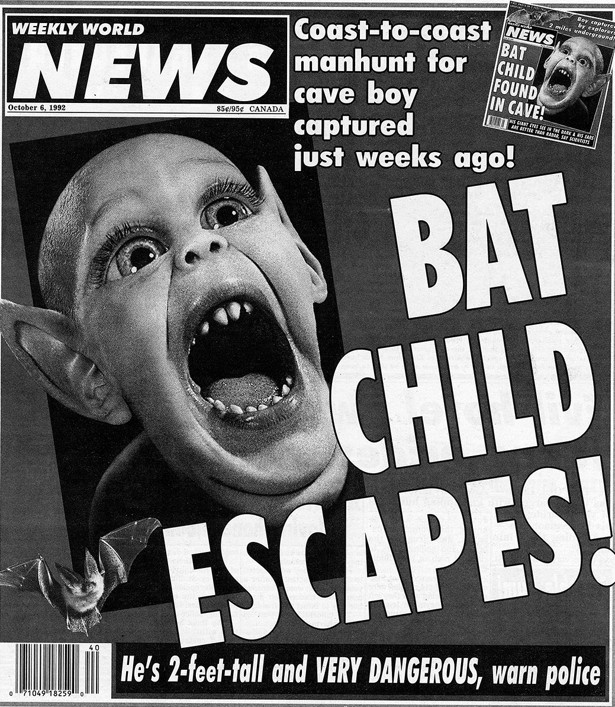
But none of this is new.  Tabloids were one of the early forms of "fake news" and still exist today.  The Daily News originated the "clickbait" title, only instead of "clicking" they got you to put 10 cents into the paper box to see what the rest of the story was.   British tabloids were - and are - the same way.  

Distorting the news for personal profit is nothing new.  WeeGee, the infamous "crime scene" photographer, would often stage crime scenes and move bodies to make a photo more compelling and salable to the newspapers.   This is fake news.
 
And this goes back decades or even centuries.  Remember WeeGee and his staged crime scene photos?   Sensationalism sold newspapers, even back then.   Especially back then.

And now the media acts shocked this had gone online?  What is really pissing them off is that some schmuck living in a tract home in the suburbs of L.A. is getting more hits on his fake news site than they are getting on their "real" one.

And then there are the off-the-wall tabloids like the National Enquirer  and the Weekly World News, the latter being a victim of even more outrageous stories online.  The Enquirer, as we know, was in Trump's pocket, and even today runs racy headlines about how Hillary is going to jail.   In the past, the Enquirer ran stories that the "mainstream media" refused to touch, but once ran, were now "legitimate" subjects for reporting, as in, "As reported in the disreputable tabloid, The National Enquirer, Bill Clinton was accused of...."

And the mainstream media "went there" because they knew their competitors would, and they wanted ratings or to sell newspapers.

This is nothing new, of course.  Tabloid journalism, yellow journalism - it is all the same thing.  You can draw a straight and direct line between Steve Bannon and William Randolph Hearst.

It has gotten to the point where many young people today find that satirical news sites are more reliable sources of information than legitimate ones.   The Daily Show or The Onion at least are up-front about their fakeness.   And you can read more into a story based on how it is mocked than with "straight" reporting.

I recently subscribed to The New York Times as they offered a good promotional deal for daily delivery (for three months only - they use a negative option subscription package!).   What alarmed me about the "Grey Lady" wasn't that it had become more left-wing over the years (which it has) as well as its pathetic attempts to be trendy and relevant, but that it pandered to its readers by offering "red meat" on a daily basis.

Every day, my inbox is now crowded with articles from the NYT about Trump - and three days a week, papers in my driveway with alarmist Trump stories.   Yes, there is plenty to be alarmed about with Donald Trump.   The articles vary from "can you believe he nominated.....?" to "Maybe it won't be so bad after all!"

But the main point is, they know that their readers have a lot of angst and will click on or read articles about Trump.   It is the same "red meat" that the fake news sites sell, only instead of just made-up crap, it is "news" by dint of speculation and conjecture.

Same shit, different day.

My only regret is that I didn't think of this first.   Rather than decrying fake news, I should have been profiting from it, right?

Stay tuned - did you know Hillary was actually a space alien?  I have pix to prove it!


Friday, November 25, 2016

Jill Stein is Batshit Crazy!

The person who caused Hillary to lose the election is calling for a recount.  WTF?


Jill Stein has raised enough money to demand a re-count in Wisconsin, which is ironic as the margin that Trump won Wisconsin by is so small that Stein's 1% voter tally would have easily put Hillary over the top.   Her demanding a recount would be as absurd as Ralph Nader demanding a recount in Florida in 2000.   You wreck the party and then say it is someone else's fault?

Stranger still, she says she is not doing this "to help Hillary."   If not, then pray tell, to help who?   Somehow, I don't think a recount in Wisconsin is going to put Stein over the top in the electoral college.

Weirder still, she claims she wants to raise 4.5 million overall to demand recounts in Michigan and Pennsylvania as well, an effort that would cost about $7 million in filing fees and expenses for all three States.   So even if she makes her financial goals, she will still be short of being able to demand recounts in those last two States.   And again, these are States where many people "protest voted" for Stein or Johnson, and whose votes would have put Hillary in the White House.

But again, we shouldn't expect logic from a lady who dog-whistles to anti-vaxxers and folks who think that your wireless router is causing brain damage.   In other words, she is part of the lunatic fringe.

But wait, the whole thing gets a whole lot weirder.   In addition to Stein, a lot of Democrats are saying that Hillary should demand a recount, something she does not appear to want to do (and the clock is quickly running out on that).   She saw how it worked out for Al Gore in Florida, and how that basically ended his political career - without changing the outcome.   Of course, Gore's problem was he wanted a partial recount of the counties he thought he could win in.   If he had gone for a straight recount of the whole state, that might have worked out - but still tossed the election to Bush.

The problem for Gore wasn't hanging chads, it was Nader.   The problem for Hillary wasn't "rigged" voting machines, it was Stein.  And any "statistical deviation" in voting by paper versus electronic machines has a very simple explanation - electronic voting machines tend to be used in more wealthy suburban and urban areas - the exact areas where voter turnout for Hillary was less than expected, as the core Democratic voters failed to rally to their candidate (and some idiots voted for Stein instead).

But wait, the weirdness gets even weirder.   Some folks are calling for the electoral college to change their votes.   Six "faithless electors" are already promising to do so - and encouraging others to do the same.   Wait!  This could be a perfectly legal way for the Electoral College to elect Hillary Clinton, and nothing could be done about it.

Well, it could be, except that the six faithless electors are all Democrats and are not changing any votes from Trump to Hillary, but rather from Hillary to some other candidate.   I am not sure how this will change the outcome of the election one iota.

And in our post-fact world, the news media gets this story all wrong and doesn't even bother to clean up the details.   Many outlets are reporting that the faithless electors were Republicans switching their votes from Trump to Clinton.   Still others are reporting that even if the electors switch votes, the House of Representatives could change the outcome (this would only happen in an electoral college tie).

It is just all a pile of bullshit.   It is the kind of crap that got Trump elected in the first place.

Speaking of which, the even more bizarre thing is people protesting the outcome of the election.   People are wasting time and energy with protests over an election that is over and done with as if a protest could actually change the outcome.   Again, this is one reason why Trump won - Democrats have become somewhat delusional over the last eight years, moving more and more to the Left and ignoring the real world as it is.

A lot of kids these days are brought up (on college campuses) to believe that if you don't like something, whether it is the "cultural appropriation" of the tacos in the dining hall, or the waterboarding of Gitmo detainees (which is the real crime here, right?) all you have to do is protest and the world will change and you will get your way.   It is far more effective that this stupid voting thing, right?   Unless, of course, you "protest vote".

There are a lot of folks chained to bulldozers in the snow North Dakota right now who are going to be for a rude surprise come January 21st.   Like the Bundy clan (Klan?) in Washington was routed out by the Obama administration, they will be routed out by a new Trump administration - and the GOP will push through the Keystone pipeline, whether anyone wants it or not.

This is the new reality, and it is what you get for voting for fringe candidates - or not voting at all, as many of these self-style "protesters" readily admit to.

Sorry, but the far-left can really fuck up a wet dream.   If Hillary lost, it was only because she tried to appeal to these far-left loonies, just as Trump appealed to the far-right loonies.   Like most politicians, neither had much intention on following through with these promises, and both would have moved closer to the middle-of-the-road once elected.

But the crazies want everything their way or not at all.   So today, they get their wish.

The "alt-right" didn't elect Donald Trump.   The green party and their ilk did.

Hope you enjoy the next four years, fuckers!

UPDATE:  More evidence of Batshit Craziness of Jill Stein:

1.  The "recount" in Wisconsin will only recount paper ballots, as you can't "recount" an electronic voting machine.   So what was the point again?

2.  She missed the deadline for a recount in Pennsylvania.   Not sure as to why she is saying she is going to pay for a recount there when she literally cannot, unless she is willing to go to court.

Completely insane.   And the folks who gave her money to do this are even more batshit crazy.

Here's a fucking clue:  If you didn't want Trump as President, then you shouldn't have run as a third party candidate!


Bull Market or Bullshit Market?

Why is the market bullish on a Trump Presidency instead of Bearish as it was?


During the last weeks of the election campaign, whenever Trump gained traction in the polls, the market panicked and sank.   When it looked like Hillary was winning, well, the market went up.   A lot of folks, including myself, thought that (and still think that) Trump's "economic policies" will be a disaster for America.   Protectionism, isolationism, tariffs and trade wars will only spell disaster for the economy.

But the day after the election, the market went up.   Certain stocks, such as Corrections Corporation of America (which runs controversial private prisons) shot up 60% overnight, which is a scary thing if you think about it (they are primarily in the business of housing illegal immigrants awaiting deportation, it seems).  But overall the market roared ahead, closing at record highs.

Is this a sign of a new Trump economic era?   Or something else?   

To begin with, I don't think it is a market endorsement of Trump's protectionist policies.  What the market (and many Republicans) realized was that while Trump says a lot of outrageous things he rarely acts on all of them.   And with Mike Pence in charge of the circus, a lot of conventional right-wing Republicans are being appointed to the cabinet and positions of real power.   This may not bode well for abortion rights, gay marriage, or global warming.   But it also means that the promises to the blue-collar union workers will likely be broken.

What we will see in a Trump Presidency is a lot of bluster and 3AM tweeting - sound and fury signifying nothing.   The real work will be done by Congress and the heads of various government agencies, as well as by appointees to the various courts - appointments that have been stalled through much of the Obama era (in addition to one glaring Supreme Court nomination).

Environmental regulations will be relaxed.   Labor regulations will be relaxed.  All this talk of increasing the minimum wage to $15 an hour will evaporate.  Subsidies for solar and wind power will go away.   Companies will be given more of a free hand to do business with less concern about regulations and labor trouble.  It will be harder to collect various forms of welfare or assistance, forcing people to take jobs at wages they might have previously rejected.   Health insurance costs for companies will decline as they will be able to drop coverage to go to high-deductible plans.   This won't necessarily be good for society as a whole, but it may help improve profitability of businesses.

But of course, after eight years of continual growth, the economy may already have been poised for a rapid expansion.   Unemployment is at record lows as is inflation and interest rates.  Wages are climbing, so people have more money to spend - but wages are still relatively low and attractive for employers.   It is a good time to borrow money to expand a business.   And maybe, this surge in stock prices is merely a reflection of that, as well as the removal of uncertainty from the equation.

The market doesn't like uncertainty.   If you are selling stocks in a solar power company or an electric car company (or both, sorry Mr. Musk!) you may find investors jittery if the subsidies that keep these companies afloat are in question.   If you have certainty that the regulatory environment and the market will be stable for 5-10 years, you may feel more comfortable investing.

And with the election over, investors may feel that now we have certainty - no matter which way the election went.   Maybe Trump isn't the certainty they wanted, but at least we have a road-map of where things are going.   And despite all the bizarre rhetoric of the campaign, he appears to be acting like a traditional Republican - not even in office yet, and repudiating most of his campaign promises.

There is also another factor as well.  The Dow has been closing with "record highs" for several years now.  Bear in mind that if the DJIA is up even a point over its last known high, that is a "new record high" but not really a significant indicator of a major gain in the market.

But leaves the question - which way is the market going and can anyone profit from this?   If you had a crystal ball or a time machine, you could have doubled your money overnight by investing in private prison stocks.   But you would have to know in advance that Trump would win, and to do that, you'd need that time machine, or be willing to gamble.   And gambling isn't investing.

Are we headed for the kind of economy that George W. Bush stuck us with?   You may recall the Bush era, when the President went on television and told us that consuming as much as possible was a patriotic duty and would help fight terrorism.   Lending rules were relaxed and everyone suddenly found gold in their home equity - and promptly went out and spent it.  The economy roared ahead - fueled by borrowed money.   Now Trump tells us he wants to borrow even more.

Inflation is due to increase, and the Fed is already hinting at higher interest rates.   We could be in the same situation we were in with the go-go 2000's where people sign up for variable-rate loans, only to see the rates go up over time and the loans "reset".   With the abolition of the consumer protection agency, a lot of people may end up being presented with poor choices - and taking them.

The problem with timing markets, though, it that it is hard to know when they will peak and valley.   If you saw the movie The Big Short you saw how some folks tried to profit from the collapsing mortgage market.   I made a lot of money when the housing market peaked, by selling out before it collapsed.   However, I sold out in 2005, not 2007, and thus left even more money lying on the table (literally half-again as much, if not double).   Timing is everything.

It is like when the stock market collapsed in early 2009.   We all saw this coming - all the news channels and financial channels said the same thing - hang on to your stocks, they will go up in value again.  And they did, recovering most of their value within a year, and exceeding their value within two.   But instead of the crazy double-digit growth of the 2000's, we saw slow incremental gains throughout the Obama era.   And most of us, including me, were happy with that, as opposed to the roller-coaster of the Bush era.

But figuring out when to buy and sell based on these trends is difficult.   For example, the guy in The Big Short could have lost it all if he missed the timing of the market collapse.   If the market kept going up another year, his "short" position may have backfired.   Making money on shorting is not as easy as it looks.  Timing the market is very, very hard to do.

So, while it is tempting to think that everything is going great, it is entirely possible we are on the brink of a new economic collapse - or that deficit spending, more government borrowing, and huge tax cuts will do the same thing they did in the 2000's - cause the market to soar, and then collapse.

I only wish this time, I could time the market!

Thursday, November 24, 2016

Poor Signage

This sign advertising the Jekyll Island museum is very fancy but poorly thought out.

Living in a tourist destination is fun and all, but it can be frustrating.   Tourists drive slowly, looking for places to go and often do dumb things like jam on their brakes in the middle of the road or try to drive on the sidewalk (I kid you not) or bike path.   Outdated GPS units are part of the problem - many of them show sidewalks as roads (which they used to be).

But part of the problem is signage.  No one wants to be in a place with screaming billboards or ugly signs, that is true.  So many "upscale" places try to use discreet signage or attractive signs to ease the blight.   The problem is, they are often useless signs that do not convey much in the way of useful information.

Case in point is the sign above, at the entrance to the soon-to-be remodeled Jekyll Island Museum.   We can only hope a new sign is part of the remodeling.   Nearly every day, I see someone with out-of-State tags drive by this sign and then lock on the brakes, realizing after the fact that they passed their destination.  They then try to turn into the tramway, which is blocked with a gate, but appears to be the natural entrance to the building.   This causes a lot of backups and dangerous situations.

Why is the sign bad?   Well, it is a victim of modern technology.   In the old days, you hired a drunken sign painter (and they were all drunks, back in the day) and he painted in clear, large letters a sign with an arrow.   He knew his business and the business was no-nonsense clear and easily readable signs.

(I am not picking on this sign in particular, only using it as an example.  No doubt the people who designed this thought it looked good in the conference room - and it did - but as a sign it doesn't function well.  There are millions of ineffectual signs like this in America alone.   Oddly enough, the Authority has a standardized sign format which is a simple listing of destinations and arrows, but for some reason, they felt compelled to go with graphics on this sign, instead of sticking to the standard format).

Today, we have computers and machines that will print color images, so we think we need to do this to be trendy and hip.   The problem is, images don't read well when you are 100 feet away driving 30 miles an hour.  The above image, from Google Earth (yes, I am too lazy to go take a picture myself) is blurred out to obfuscate facial features.   But that is about what you see when you drive by in your car.

The sign has a lot of images of the club hotel and the "lady in the hat" but the actual wording of the sign is obscured.   At the top of the sign in an olde timey distressed lettering is the name of the museum.   You cannot read this driving by at 25 mph, which is the speed limit.   At the bottom of the sign is some lettering, but far too small for the size of the sign.  The graphics, which are unnecessary and communicate nothing - other than a lady in a hat - offer no real information and distract from what little information is available.

Sadly, a lot of people fall into this trap - designing fancy logos that cannot be read from more than five feet away.  After the hurricane, a local tree service put up signs on lawns of homeowners whose trees they serviced.   They might as well not have bothered as the logo had a large stylized tree on it, which looked like a Rorschach ink blot.  Maybe it was a tree, maybe a Denver omelette.  Hard to tell.   Worse yet, the lettering took advantage of another computer-generated nightmare - the ability to stretch and shrink letters.  So instead of JOE BLOW'S TREE SERVICE we had JOE Blows tree serVICE with the key word being "TREE" and that word being the smallest on the sign.   I could not tell if he was a roofing repair guy, plumber, HVAC tech or what.  Worse yet, the phone number (the key ingredient) was in even smaller lettering.

These computer-generated signs are like so much that is computer-generated.   It looks good on the display at the store or at the company, but in the real-world, it falls down flat.   For example, HTML coders using state-of-the-art computers on high-speed fiber optic networks located less than 100 feet from the server, generate complicated pages with lots of video and graphics and photos, which are all slow-to-load on older computers and slower connections.   We don't need a fancy graphical page to log into our bank account, thank you.  This is not progress, it is regress.

Sure, we can put photos in our signs.  And sometimes a catchy photo or logo "catches the eye" and gets people to read the sign.   Other times, what looks like a neat photo looks like an ink blot when viewed from afar.   Another sign on the island has a horse's head on it, and for about a year I could not figure out why they chose the face of an alien for a logo, until I walked up to the sign one day and saw, at about 20 feet away, it resolved into a horse's head.

Lettering on images is also problematic, as the contrast will vary with the background of the image.  Some folks put green lettering on a photo that is mostly green (a Christmas Tree, for example) with the net result being you can't tell what the photo is and certainly can't read the lettering.  Thousands of dollars paid for graphics, thousands more to rent billboard space - the net result is, no one can read it.   You might as well just not bothered.

The best signs have simple lettering in high contrast and can be read from 100 feet away or more, from a vehicle traveling by at the posted speed limit.   The best signs convey the basic information - what you are advertising, where it is located, what time it is open, what your prices are, etc. - the exact choice depending on the nature of the business.  For example for a gas station, just "GAS $1.99 THIS EXIT!  OPEN 24 HOURS!" is about all you need to say.  A fancy image of the gas pump or children frolicking in a field of flowers is just confusing.

 The less information, the better.  Clear and concise.

And this goes for Garage Sale signs.   I have seen so many garage sale signs done in pastel markers on 8.5 x 11 paper, stapled to a utility pole so they blow in the wind and fold over.   The lettering is tiny - as if the author was too shy to advertise the sale.  Better off to print something on your computer (set the font to 75 point and make it fill the page - set the margins to zero and orientation to landscape).   Tape it to a piece of cardboard or some old political sign (which I paint with used house paint first) and "Wa-La!" you've got a simple, easy-to-read sign that someone in a car can comprehend in a nanosecond.

Sadly, bad signage is here to stay.  We have all this technology so we feel compelled to use it.  But I have lost count of how many "car wraps" I have seen where you can't figure out, for the life of you, what exactly it is they are trying to advertise and promote.

Technology is fine and all, but don't let the tail wag the dog (or the horse).   Fancy graphics capabilities are fine and all, but sometimes a simple black-and-white sign with huge letters is more effective and sometimes less of an eyesore!