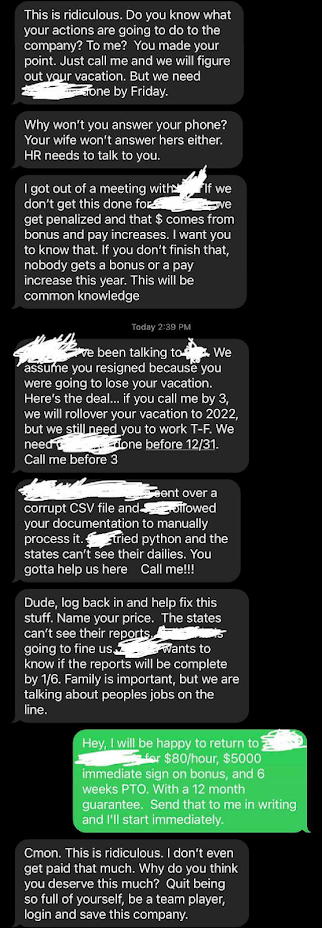
NOTE: This text thread below has been making the rounds on the internet. Like everything else on the internet you have to wonder whether it's true or not. But even assuming it is, there are legal issues with quitting this way. Here is a portion of it:
Tuesday, March 22, 2022
Why Rage-Quitting is a Bad Idea
Monday, March 21, 2022
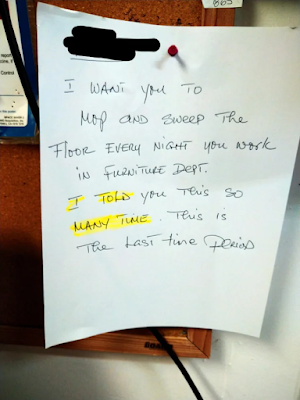
(Weak) Management by Sign or Memo
People who manage by sign are weak managers.
I wrote before about the popcorn memo war and how managing-by-memo is a bad idea. If, as a manger, you have a problem with one or more employees, you look them in the eye and talk about it. Leaving notes or memos is just passive-aggressive and no one respects that.
It also leaves a paper trail and odds are, someone will take a photo of your memo or note and post it on the Internet, where you will be mocked.
Such notes and memos are ineffective on a number of levels. Particularly if you put "this is the last time I remind you!" or some other ultimatum and then not follow through - they've called your bluff and you are toast. Nothing you say will have much impact anymore.
Not only that, it creates a bad vibe among employees - and customers, if they see the signs. I was at a restaurant the other day and there was a sign in the restroom, "No smoking or vaping in the restroom! If you work here and I catch you vaping I WILL confiscate your vaping device!" What was worse, was the sign was posted by the bar as well. Now bear in mind that this restaurant has like maybe six employees total - you can't go talk to them individually or before each shift starts? It just reeks of shitty, ineffective management. I bet he shouts a lot, too.
Memos are no better and perhaps worse. When you manage-by-memo you are admitting to everyone who receives the memo that you are a weak and ineffective manager who tries to avoid confrontation. You are, in effect, hiding behind the keyboard. It is like trolling the Internet. Again, it leaves a bad vibe with the other employees (who feel, rightfully so, that they are being castigated for something they didn't do). Got a problem with an employee? Talk to them about it. Don't broadcast your issue to the world.
In that regard, memos and signs can cause a lot of grief. There have been reports of people writing memos, or putting up signs, or publishing in the employment agreement - or even sending a text or e-mail - saying "It is against company rules to discuss your pay with others! You will be terminated if caught discussing pay!"
Problem is, that is illegal as hell. So now you just handed your "problem employee" a written confirmation that you have violated the law. It is so much better to just talk to people face-to-face, and not only that, more effective as well. Oh, and you don't leave a paper trail.
Written communication can be misunderstood. We've all had the situation where we responded to a text or e-mail or Facebook posting or Tweet or whatever with what we thought were witty comments or something friendly - only to be perceived the wrong way. The recipient of the message is insulted! How dare you make light of my grandma dying! And then a flame war erupts.
If you work at a place where they manage-by-memo or taped-up sign, think about moving on. Odds are, they will eventually make a sign or memo directed at you, and it won't be pleasant. In the meantime, you will labor under this litany of post-it notes and written warnings, and it will just suck. So cut to the chase and find a place to work where the boss will at least look you in the eye and say, "You were late for work.... again!" instead of posting some half-assed sign by the time clock.
Sunday, March 20, 2022
Rock Star Bosses?
In my last posting, I hinted that perhaps the problem with overpaid executives lies within us and not them. Just as we elevate sports stars and movie stars and rock stars on a pedestal, we elevate pop-star executives as well. Of course, in all four cases, these folks have promoters, agents, and public relations people who create the hype around these "celebrities" so that we don't question - too much - whether they are worth all that money.
It is cheap psychology. I mentioned before that while working at the law firm, the "Partnership Row" was a hushed hallway with large offices for the anointed few. Even the carpeting was plusher there. You felt the change in atmosphere the moment you stepped in - when summoned, of course - to talk to a partner in the firm. Even their secretaries were Godlike in their actions and reputation. You wanted to make sure you stayed on the good side of the partner's secretary - she was the acolyte who controlled access to the temple. Without her approval, you never got in.
Many bosses, even in small companies, play this game. I was reading complaints online from disgruntled workers, and one common theme is that they are denied a raise by the boss who says, "We can't afford raises this year" and in the same breath says, "You want to see my new Porsche?" It seems like a cognitive disconnect - to flaunt your wealth to your employees while at the same time crying poverty.
But it isn't.
You see, a lot of people want to work for someone who is above them. No one wants to work for a schmuck they think it equal to them, or worse, beneath them. And yes, this is a theme you see a lot in these "employee bitch" sites - that they are working for a boss they think it dumber than they are. It ain't fair!
And that is exactly why bosses play these games showing off wealth. Everyone admires the king with his purple robes and golden crown encrusted with jewels. You should admire it, you paid for it! It is a way of elevating one above us, and showing that the person is of a higher class and stature. Most of the job of "Boss" is just asserting this dominance - and forcing employees into submission. If you were in the military, you know how this works - the officers not only have fancy decorations on their uniforms, they have better quarters, offices, perks and so on and so forth. No one respects or obeys someone who is equal to them or is even perceived as equal. That's why officers go to military academies and not boot camp.
That is why Elon Musk tweets all the time. It is why Jeff Bezos bought the Washington Post. It is why Bill Gates has his famous charity advertised on NPR. These guys need the positive press to make it seem they are larger than life, better than us, and our superiors. Of course, celebrity has a downside, as I noted in my previous posting. Make a bad movie, sell a shitty record album, strike out enough at bat, and you are tossed in the gutter in no time. No one respects or loves a loser - so bank those salaries, celebrities! It could all come apart in no time.
The downside for today's superstar bosses is that perhaps they are making too much money for their level of celebrity. I guess people can swallow an athlete making $10 million a year, but it gets stuck in their craw when some CEO is worth a billion - he just isn't all that!
It is a funny thing, too - back in the day, maybe a few decades ago, you never heard about the CEOs of major corporations. Sure, you might know the names of a few corporate Presidents (we didn't have terms like CEO, CFO, COO, and the like) but that was about it. Most of them kept a low profile, by design. Since the "robber baron" era of the early 1900's, corporations learned it wasn't a good idea to flaunt wealth all that much. And salaries back then - even adjusted for inflation - were paltry compared to today. The IPO and stock option just weren't a thing back then. Buying back your company's own stock was, in fact, illegal. How can you make big bucks without stock options and the ability to manipulate the share price? That's no fun at all!
In a way, the superstar celebrity bosses of today are cheating at the game. Imagine how people would have felt about a sports star if was caught throwing games? Imagine how people would feel if their favorite music star was caught lip-syncing? We don't have to imagine - those things have happened in the past and people dropped those celebrities like a hot potato.
And maybe today, people are feeling the same way about superstar bosses. No one (well, not many people) begrudge someone making money from an enterprise they built up and nurtured. But when they make wild profits from stock manipulation - or people manipulation - then people feel cheated. And if they find out their celebrity boss is actually a schmuck like them?
Well, then, it's game over.
UPDATE: what is weird about our modern culture is that they actually make movies about these dot-com "geniuses." They made one about Zuckerberg and now they are hyping one about the guy who created wework which turned out to be little more than a scam. Even the people who cheat us out of our last dime are treated like gods. And yes they made a movie about Enron, Bernie Madoff, and the Meltdown of 2008 as well.
Of course, the billionaires they make these movies about also control the media.
Saturday, March 19, 2022
Income Inequality, Revisited
Some people make a lot more money than others. Why is this? In some instances people complain this is unfair but in others they claim it is entirely justified. Why is this?
Sir Elton John is worth tens hundreds of millions of dollars and gets paid millions a year to perform and record albums, not to mention the royalties from his existing records. Meanwhile, down at the local bar, the guy playing the piano maybe makes 50 bucks a night in tips. Is that fair?
John Travolta gets paid millions to make just one movie - and can afford to own his own 707 jet. Meanwhile, the guy down at the local community theater makes peanuts - and has to sweep up the auditorium after each performance. Is that fair?
Shaquille O'Neal was a star basketball player, and made millions of dollars playing a game. He also received millions more for endorsing products. Meanwhile, some kid down in the hood is shooting hoops with his buddies and not getting paid anything. Even if he is successful at the game, the best he can hope for perhaps is to get a scholarship to an NCAA college. The likelihood of him becoming a basketball superstar is slim. Is that fair?
At the multinational conglomerate, the CEO makes millions of dollars a year. Not only that, he has a golden parachute pension plan that would be invoked if he ever is fired. Plus, he has a company car and the use of a company jet. Meanwhile the guy at the assembly line barely makes enough to get by. Is that fair?
What's interesting about these four scenarios is that they largely have the same mechanism in common. They rely upon a stream of income from thousands, if not millions, of people who each pay a small amount to a company or organization which, in turn, rewards the person at the top with millions of dollars in salary.
What is interesting to me is that many on the left would argue that Sir Elton John and Shaquille O'Neal and even John Travolta deserve the millions of dollars they have earned over the years while the CEO of a corporation is merely a robber baron who is screwing the poor worker out of this last dime.
And maybe there is a nugget of truth to that, or maybe not. I noted before how the rise of recorded music created the musical superstar. Prior to the invention of the gramophone, if you wanted to hear music you had to go hear somebody play it. In every small town and hamlet, there was a local band or orchestra or somebody playing the fiddle and plucking out a tune. Every small town had a bandstand at the turn of the century, and Philip Sousa marches were quite popular.
But then came the record player, and suddenly everyone could listen to the same artist at the same time. Prior to that, there were very few superstar musical artists, except perhaps Jenny Lind the so-called "Swedish Nightingale." But even then you had to travel somewhere to see her on her American tour.
And most actors, back in the day, didn't make obscene amounts of money, mostly because they could only be seen by the audience in the theater during a live performance. We visited the former home of Joseph Jefferson near Avery Island, Louisiana. He became famous for playing Rip Van Winkle in the 1800's and became somewhat wealthy. But his example was few and far between. Today, one performance by an actor can be seen by millions - maybe billions - of people and they are paid commensurately.
The corporate structure of the music industry or the movie industry – and they are industries – is really no different than any other manufacturing industry for automobiles or smartphones or computers or whatever. You have one huge company that controls a big portion of the market and promotes and develops new products. Millions of people subscribe or pay money for these products which generates a lot of income - and a lot of profit for the few people at the very top of the pyramid. The sports industry is the exact same way. Millions for those on top, but the guy selling hot dogs at Shea Stadium isn't making jack.
Popular musicians, actors, and athletes can hold out for enormous sums of money if they can rightfully argue that the entire operation can't exist without their input. The law of supply-and-demand kicks in. There's a very small supply of superstars and celebrities and star athletes, and thus they can command high prices in the marketplace. Very few people argue this is unfair. After all, this is the fantasy everyone secretly has in life - to be the "little guy" who makes it big. But only a tiny fraction of a percentage of people ever become famous, despite what Andy Warhol said.
Sure, some people grouse that these athletes or coaches are overpaid, but they still cough up the ticket price for the big game or watch it on television. Similarly, music fans will cough up big prices for concert tickets and complain about the cost, but usually they end up blaming Ticketmaster rather than the artist in question. People whine that the latest "franchise" film of a comic book costs too much to see - but they go anyway, and dress up as the main character at a "Cosplay" event at Comicon or whatever. People willingly empty their wallets for sports, music, and movies, and never complain one bit.
But the guy running the company they work for? Fuck him. Yea.
Somehow we think that officers of a corporation are different. And maybe perhaps they are. Some have criticized the incestuous nature of the corporate world, where the board of directors meets in private to discuss the salary of the CEO after politely asking him to leave the room. The board then offers themselves a raise as well. Is the law of supply-and-demand kicking in here or is this just plain corruption?
It's an interesting question, because there is competition in the marketplace. There are a number of people who could qualify as CEOs or COOs or CFOs or serve as board members. And one would think that the shareholders of a company would seek out the lowest cost alternative rather than pay tens of millions of dollars for executive talent. Or perhaps, those shareholders are recognizing the value in that executive talent just as the music fan or the movie fan or the sports fan recognizes talent in their stars.
Prior to the invention of the phonograph record, there were a few musical superstars - and prior to the invention of the multinational corporation, they were few corporate superstars. When most commerce took place among small companies interacting with each other, the wages for top executives were fairly low because the income each business received was somewhat small. The rise of the mega-corporation created mega-salaries for people at the top, just as the rise of celebrity movie stars, music stars, and sports stars corresponded to the creation of the money-making machine (radio, movies, television) that allowed a selected few to demand very high salaries. It is, in a way, one and the same machine.
I'm not sure I have an answer to this conundrum, only that I am observing it. It is interesting to me that for some reason we feel we have the right to criticize the salaries of superstar corporate executives, but not criticize the salaries of superstar musicians, actors, or athletes. We all want to hate on Jeff Bezos or Mark Zuckerberg or Elon Musk or Bill Gates, and perhaps they deserve such reprobation. But on the other hand, we keep buying their products. You can't criticize Bezos while being a Prime member or reading the Washington Post. You can't criticize Musk while simultaneously admiring his rockets or lusting after one of his electric automobiles. And despite its multitude of flaws, Windows remains the most popular operating system in the world, at least for now.
But of course, things can change over time. Star athletes eventually lose their skills, often after just a few short years. Rock stars cut one or two good albums and then fade into obscurity - few stick around for the ages. Movie stars make just one or two box office bombs and their careers are over. Similarly, corporate executives make one or two missteps and they fade to oblivion. In all four cases, they claim to be "stepping back to spend more time with their family."
Perhaps I am somewhat strange, but that's one reason why I don't follow professional sports that closely nor do I idolize movie stars or rock stars that much. Those people are making scandalous amounts of money and some of their music or entertainment or athletic abilities are indeed spectacular. But on the other hand, I don't feel the need to throw tons of money in their direction. We recently received an invitation to buy concert tickets to see James Taylor in an arena in Jacksonville. The cheapest seats were $200 apiece and Mark and I just looked at each other and said, "Well he was good back in the day, but not worth $400 to see the fossilized leftover version."
And similarly, one reason I'm still using Windows 7 Ultimate is that I don't want to spend more money on shabby Microsoft products. And for the similar reason I'm not a Prime member with Amazon, and Amazon is usually my last choice of merchant when I'm shopping online – mostly because I find better bargains and better prices elsewhere. That's the problem with superstars - they command superstar prices. And maybe it is we who create these superstars - even executive superstars. But that is the subject for my next posting.
And no, I don't read The Washington Post, either. And while someday maybe I will buy an electric car, chances are it won't be at Tesla. By the time I'm ready for that market, they'll be a choice from a multitude of manufacturers offering electric vehicles, and I would prefer to have one that has an established network of service centers as well as lower prices. By that time a Tesla might be out of business – who knows?
But it seems funny to me that people complain about income inequality in certain situations, but not in others. In the corporate world, leftists argue that greedy executives are taking money away from low-level employees. But nobody complains about superstar athletes or musicians or movie stars taking money away from ordinary people in terms of higher ticket prices – do they?
And yet the net effect is the same.
Friday, March 18, 2022
Dowsing
Dowsing is another version of a poverty story. It never pays, however, to try to discredit poverty stories.
Early on in our relationship, Mark mentioned that his Father was a dowser. He had the "gift" for finding where to dig a well or how to find an underground pipe. All he needed was a y-shaped branch off an apple tree or even a t-shape metal rod, and he could find out where to dig! I tried to explain to Mark that it was superstitious nonsense, but I quickly backed away. This was his Father we were talking about, and he had a near God-like status in his mind (well, except the part where he abandoned him at age 14) so it wasn't worthwhile trying to "win" that argument - so I let it lie.
His brother told a similar story - a juicy "poverty story" about his Dad and dowsing:
Seems the DPW was trying to dig up a water pipe and they dug and dug but couldn't find it. The map showed it being ten feet from the road! Where was it? Bill (Mark's Dad) was driving by in his Rambler and stopped to chat with "the boys" doing the digging. They explained their plight. They had surveyors come out and even "scientists" (right?) with some sort of machine and no one could find the errant water line! So Bill knocked out his pipe on the digger and snapped a branch off a tree and started walking around in a spiral circle. Suddenly, the branch shot downward! It was vibrating as if charged with electricity!
"Dig here!" Bill said. The "scientists" and officials scoffed at this, but "the boys" running the digger intervened. "We tried it your way, all day long! Bill has the gift! We'll find your water line!" And sure enough, they dug down eight feet and there was the water line! They showed those eggheads what for!
The End.
Of course, the story has been embellished over the years. I doubt there were "scientists" with lab coats and elaborate machines looking for underground pipes back in 1965. Yes, today, they have such equipment, of course. But back then? You dug until you found it. How did Bill find the pipe? Well, for one thing, he told them to dig somewhere they hadn't been digging. It is not that he was a fraud, but he truly believed he had some kind of gift.
In other instances, he used his gift to tell people where to dig for a well. Again, there is a long-winded "story" about some well-digger who drills for hundreds of feet without finding water. Bill comes along and dowses and tells the skeptical well-digger to dig 100 feet away. Jackpot! They tap into an artesian spring of pure, soft water that tastes like honey and smells like flowers! Or something like that.
Did he have "the gift" or it is possible that if you dig anywhere in an area with a high water table you will find water? Or maybe telling someone who is digging a dry hole to stop digging there is just sound advice? Or maybe he is picking up on more subtle cues, such as the inclination of the land, wet spots on the ground, or an understanding of how water flows underground. It is hard to say - but there is no real "evidence" that dowsing works at all - the supernatural has never submitted to the rigors of science.
Poverty stories are, of course, a waste of your time - at best a mild entertainment, at worst, chock full of poor normative cues. And you can see where the stories about Mark's Dad fit right into the classic "poverty story" narrative - the "little guy" who never went to college and got those high-falutin' degrees (what is a "falutin" anyway?) shows up those science nerds with their science and technology and reason and whatnot. It gives the little guy a chance to win and maybe this is related to my previous posting about Populism. Why engage in rational thinking when fantasy is so much more fun?
And while it profits one not to believe these sort of stories, don't bother trying to "educate" your chums that they are false. Yes, there are no $50 Corvettes out there - but saying so isn't going to make you popular - in fact, it is the sort of thing that, in days gone by, got you burned at the stake. So just nod your head and go along with it and slowly back away.
And yes, sometimes, even friends and family believe in some of this nonsense, and you have to just let it go. While Mark is ordinarily a very rational person (and can be quite hard about it, the Maine way) he does indulge in some fantasies on occasion - but usually they are harmless ones that don't involve spending money. A friend of his believes in mystical stuff, and that's fine for her. She isn't trying to sell us essential oils or chakras or whatever. Therein lies the difference.
Of course, some people don't have a lot of willpower when it comes to this nonsense (and it is nonsense, but don't tell anyone that!). They get sucked into cults or evangelical religions (I am being redundant) or MLM schemes or timeshare sales. And yea, it is sad they get taken advantage of - we all do to some extent - but you can't save people from themselves. They will violently dispute your argument and tell you in no uncertain terms they know what they are talking about.
So keep your own counsel, move on, and learn from the experience - and maybe introspectively realize what nonsense you might be believing in, without even realizing it. Because we all believe in some sort of nonsense, at one time or another. It's a human thing, apparently.
-
Online discussion groups, like this Buddist group shown above, can be real time-bandits, if you let them. They also can be chock full of mi...
-
It may seem your parents had it "easy" but it wasn't. The Internet can be deceiving as the voices you hear most often are thos...
-
Comments like this are not helpful, and are deleted. I have enabled comments on this blog, which are moderated. Why? Because I write this ...