Friday, November 4, 2016

Referendum


The election Tuesday isn't about Jobs or Personalities or who is the more Honest.  It is about the issues.  Issues that affect you personally.


It sort of bugs me that some young folks are moving their vote from Bernie Sanders to Donald Trump.   They can't see a difference between the two candidates, they say, and they claim that Trump will "create more jobs" in an economy that already has record-low unemployment.

How could he create more jobs when unemployment is already below 5%?

But that is not the real point.   The real point is policy, and with one Supreme Court vacancy waiting to be filled, and several more looking to become vacant in the next 4-8 years, who in in charge at the White House and who will be appointed to the Supreme Court becomes the vital issue.

Because of gridlock in Washington, a lot of "law" has been made at the Court, much to the chagrin of Conservatives, who consider this "legislating from the bench" unless, of course, they legislate in their favor, in which case it is called "wise jurisprudence".

In addition to the Court, the President, as Chief Executive, has a lot of leeway in deciding policy issues.   How laws are enforced is often as important as what laws are enacted.

Thus, Tuesday's vote is a Referendum of sorts on the following issues.   If any of them are important to you, you might want to think about how you are going to vote.

1. ABORTION:   This may be the most obvious one, as Donald Trump has promised to appoint more conservative justices who will overturn Roe v. Wade while Hillary will appoint more liberal justices who will preserve it.   The anti-abortion league has pulled out all the stops this time around, pretending that third-term abortions are commonplace and inventing gruesome things that don't exist, like post-birth abortions. 

2. GAY MARRIAGE:   This is not talked about by either candidate, but if you want to "go back" to the "good old days" and you have very conservative justices in the majority, it is not hard to see that the legalization of gay marriage would likely be walked back.   What would happen to existing marriages would be anyone's guess.   But given the rising tide of anti-gay sentiment worldwide, things would likely get ugly if the Court decided that the States should regulate marriage.

3.  LEGALIZED MARIJUANA:  Despite being legal at the State level in a number of States, Marijuana is still illegal at the Federal level.   If President Obama decided to, he could shut down every marijuana dispensary (even medical ones) in the country overnight and jail the operators and employees for a very, very long time.   It is only the "hands off" approach of a Democratic President that has prevented this from happening.   A conservative Republican President would likely do otherwise.

4.  FREE TRADE:  If you still believe that your job was "taken away" due to free trade, I can't help you.   If you think you'll get it back through protectionism, you are even worse off.   The reality is, however, since so much of what we consume today is imported, the cost of all goods would skyrocket if we went back to a protectionist tariff scenario.   If you vote to abolish free trade, I suggest you buy that big-screen television and new smart phone shortly.

5.  IMMIGRATION:  If you think our country is being overrun by Mexicans, well, I guess we all know who you are voting for.   Of course, the net migration of Mexicans has been negative in recent years - as the Mexican economy starts to prosper through.... free trade.  But it is true that migrants from other Latin American countries do continue to seek a better life in the US.   And it is true that nearly every farmer relies on this source of cheap labor to harvest our crops.   And every suburbanite relies on them to mow their lawns and clean their bathrooms.   If you want to "build a wall" don't expect Mexico to pay for it, and moreover, expect the cost of goods to increase even further.   Myself, being the great-grandson of immigrants, I am less afraid of them and also more respectful.   The immigrants I know are hard-working people who have sacrificed a lot to obtain very little.   I am not sure why they are a punching-bag for the far-right.
  
6.  HEALTH CARE:   Granted, Obamacare has its problems.   I will find out shortly what the real cost is to me, once I do my taxes.   Although I pay over $1000 a month for coverage (and the cost will go to more than $1300 next year with the same plan) once I get my tax credit back, the cost may be more in line with what I paid before for a $10,000 deductible plan.   And the benefit of universal coverage and no pre-existing conditions limitations make it worthwhile.   On the other hand, if you want to see it abolished with no substitute plan put in its place, well, you know who to vote for.

7.  WORLD POLITICS:   Engaging the world is a messy business.  Countries jostle for influence and power.   You can play the game and get bloodied on occasion or go home and cry in your soup.   One candidate wants to continue to engage the world, as difficult as it is.  The other wants to fold up shop and stay home.


Those are the real issues.  Both parties want you to think the election is all about Hillary's e-mail server or Trump's shitty track record as a businessman.  They want you to think about "character" issues instead of real issues.   And let's face it, both Trump and Hillary have made some bad choices and maybe even done things that are illegal - but nothing like the hysteria that the extremes of both parties allege.   And no, some partisan movie (on either side) isn't going to change that fact.

There are real issues at stake this election.   Your vote does count, and it will change the course of this country.   Saying that the candidates are "both the same" or "it doesn't matter" is kind of dumb.

Thursday, November 3, 2016

Fix or Throw Away?

Is it better to repair or replace?

I was recently asked for my opinion about a new Swedish tax provision which provides tax breaks for people who fix things, as opposed to throwing them away and buying anew.

For some this is a validation of their beliefs that we can improve our environment and our economy and put people back to work by mending older things as opposed to tossing stuff away in our "throwaway culture".

The underlying premise, of course, is that we in the West are awful, decadent people who are wasteful and are destroying the world.   After all, that rotting meat in the dumpster behind the restaurant could feed five homeless people!   And France has recently enacted a law preventing restaurants from throwing away any food at all.   All I can say is, stay away from the Tuesday dinner special.

UPDATE:  The French found an end-run on this new law.  They simply wrap up leftovers and force you to take them home, American-style.  It is gross and unsafe, to be eating food that was in the trunk of your car, at room temperature, for hours.  That's the problem with these laws - unintended consequences!

Are we a wasteful, "throwaway" culture?  Perhaps.  But perhaps human beings have always been.   If you look in any museum or historical site, you will be amazed at the array of goods that archaeologists and historians found, simply by digging in the ground.  Our ancestors threw away broken dishes and whatnot, simply because it wasn't worthwhile or even possible to fix them.  Our ancestors literally lived on a pile of their garbage, which is one reason why ancient cities are buried beneath present-day ones.

But what about the Indians?  Native Americans were in touch with the land and never abused Mother Nature, right?   Well, it is a nice fantasy, but the reality is, they are pretty much like us evil Westerners. We visited one Indian site near Charleston where they had made a mound of oyster shells over 50 feet high.  The Indians pulled oysters out of the river, roasted them, and then threw the shells in a big pile, until it was a small mountain.  Today, we would "recycle" these shells to seed new oyster beds, particularly as the levels of calcium in the ocean declines.

Other "Native Americans" would settle in one area and then exploit the natural resources until they were exhausted - and then move on to more fertile territory.   The idea that certain peoples or races are more respectful of Mother Nature is something of a fraud.

But getting back to the main point, is it better to replace or repair?  A friend of mine harbors quaint notions in this regard.  "Mummy will send this to the man in town who will mend it!" she says.  Apparently the mending-man can fix anything, although usually the things he fixes are never quite the same as new.

And that is the problem with "mending" things.  Whenever you try to repair something, the end result is inevitably less than the item as-new.  Just taking things apart often breaks stuff.  You unscrew a bolt, and you've made the threads that much looser.  Odds are, you may strip out one bolt entirely.  For things like trim pieces, small clips and screws are always getting broken - and often left out of the reassembly, as the cost and labor of chasing down every last screw is atrocious.

You can weld to metal, but you affect the crystal structure of the material when you do so.  And you can only weld a piece of metal so many times until it is more weld than metal.

The big problem, of course, is that the incremental cost of repair far exceeds the cost of buying anew.   Let me explain what I mean.

When I was a kid back in the 1960's, we used to drive down route 81 in Pennsylvania as I recall.  There was a junkyard there that went on for more than a mile - covering two adjacent hillsides.  For as far as the eye could see, there were junked cars parked. Today, I think it is gone. Today, junked cars are quickly stripped of any usable parts and then crushed and recycled - as they should be.

As a kid, though, the junkyard fascinated me.  "Gee, Dad," I said, "There must be enough parts lying around there to build a whole bunch of cars!"  And indeed there was - there were enough junked 1965 Chevies there to assemble at least a few complete cars.   My Dad gently explained to me that the labor cost of taking all those parts and then reassembling them one at a time, by hand, would be far more than the cost of simply buying a car new at the dealer.  And the half-worn parts would not provide the service life of new ones.

And he was right.  Unless you are building a hobby car or restoring a classic, the cost of hand-building a car far exceeds the cost of building one on an assembly line.   Even then, with classic cars, the resale value when you are done is often "half what you have into it."   Only poor people think you can make money restoring older cars.   Well, yes, you can make money if someone pays you to restore a car, but the guy who pays ends up with 50 cents on the dollar most of the time.

Now of course, it is often "worthwhile" to repair an item if it still has some useful life left.  If your car needs new tires and it looks like it might go another 20,000-50,000 miles before it will be scrapped, then by all means, buy a new set.  But not a series of used ones, please!   But over time, the cost of repairs starts to add up and accelerate, and eventually you hit that point in the Weibull Curve where you are just throwing money away.

From an economic standpoint, as well as an environmental one, it makes sense at that point to junk the equipment and start over.  You'd spend more money, more energy, and waste more resources, trying to fix something old than simply buying anew - after a certain point.   Where that point is, of course, up for debate.

The short answer is, it is far more "efficient" to build something new on an assembly line than to repair it again and again, piecemeal, over time.  More efficient in terms of labor, materials, cost, and the environment.

Of course, the other real issue is obsolescence of technology. I sold one of my old BMWs not because it was entirely worn out but because it was obsolete. The navigation system relied on CDs and also had a cassette deck.  It barely had a cell phone interface, much less Bluetooth.  People today expect these sort of things in modern cars. With the advent of self-driving cars, I think you will see a lot of older vehicles leave the road, and this is not necessarily a bad thing. Also, older cars tend to pollute a lot more so it's better for the environment if people replace them with newer and more efficient and less polluting vehicles. The urge to save things is fine, but sometimes it is better to move on.

Other items simply cannot be repaired. While old-fashioned leather shoes could be taken to the "cobbler" to have new soles and heels installed (as I used to do when I worked at the Patent Office), modern sneakers and walking shoes are made of expanded polyurethane rubber, molded into one piece.  Not only can they not be repaired once they come unglued from the uppers, they largely are worn out at that point, as the polyurethane has compressed permanently and the shoes offer no support.

Of course for historic structures or vehicles, sometimes the cost-benefit analysis doesn't apply. And I'm sure Sweden has more historical structures than we do here in the United States.  Many of my European and Asian friends are amazed that in America we tend to throw things away or tear things down on a regular basis. When I went to visit Japan I noticed a lot of older buildings from the 1950's which were still standing which were kept in immaculate condition. In America usually an office building is torn down after 30 to 40 years. The cost of repair often exceeds the cost of replacement.  But in addition to wear and tear, sometimes a building outlives its usefulness and cannot be adapted to a new use.  In that case, it makes more economic sense to tear it down and start over.

Note that the law in Sweden addressed the VAT tax, which is less of an issue in the USA. The Value-Added Tax, or VAT is a huge tax slapped on the price of goods and services in most European countries. The proposed law in Sweden simply halves this tax for repair costs, and also allows the owner to deduct the income taxes paid by the repairman for labor incurred for the repair (how this is calculated is anyone's guess, it must be a bit of an accounting nightmare).

UPDATE:  My neighbor in Pompano worked with an SAS pilot rebuilding old SeaRay boats.  They would find a boat with a good hull, and tear out the gas engines and replace them with diesels from scrapped Navy landing craft.  They would reupholster the interiors and put new canvas on them and ship them to Sweden on container ships - and double their money.  The VAT tax made buying a rebuilt used boat from America cheaper than buying a new boat from Sweden.  Again, unintended consequences - which hurt the Swedish boat industry but helped a few lucky people in South Florida!

I'm guessing the Swedes feel that repairing older things is more environmentally correct than merely replacing. However I wonder if they are considering the overall cost in terms of dollars as well as the environment impact of  incremental repairing machinery and buildings. Eventually there reaches a point on the Weibull curve where is cheaper to replace than to repair. Sadly, laws like this are implemented by Politicians and not Engineers.

The wonderful thing is, of course, that we can see how such a tax strategy works out and whether it is advantageous. If it does provide some benefit to society, then maybe other countries will adopt it. If it turns out to be a boondoggle, maybe let it slide - sort of like this "guaranteed minimum income" craziness that is sweeping Europe at the moment.

Recently, one of my computers again crashed.  It appears the video card again went South.  I can buy a used video card on eBay for a few bucks and maybe get the machine to work again.   But the machine is almost a decade old, which is a lifetime in the computer world. Is it worth my time and effort to troubleshoot and repair a machine that might have a useful service life of only a year or two?   A machine that is already woefully obsolete?

That indeed, is the question.

UPDATE 2020:  I bought a used graphics card on eBay from some gamer who wanted to upgrade to a faster card.  Works for me!  But eventually the motherboard went South so into the trash it went.  Today, we have two hoard old Toshiba laptops (new hard drives, new memory, new keyboard) which seem to work fine with Windows 7 Ultimate.  But I can see a day - not too far in the future - when we will break down and buy a new Windows 10 machine for $300 at the wholesale club....

Wednesday, November 2, 2016

Laundry Detergent


What is the best deal on laundry detergent?

OK, enough political bullshit about Clinton and Trump.   You came here wanting to know the best price on a box of toothpicks or how to recycle pocket lint into an attractive sweater, right?  So enough about the election and whatnot and let's talk about cheap laundry detergent.

To begin with, laundry detergent - like all soaps - ain't cheap.   Early on in our country, a few folks realized that people would pay a LOT of money for brand-name detergents, if you told them they got clothes cleaner and whiter (interesting adjective) and what's more, all the smart set bought your brand.  Companies like Johnson & Johnson and Proctor & Gamble made their millions by selling soap, often door to door at first, to gullible housewives.

And speaking of gullible housewives, when I grew up, my Mother always bought TIDE detergent, which came in a cardboard box and promised to make your clothes cleaner.  The box was orange and yellow, which are two colors which test well with consumers (hence Burger King and McDonald's tend to use them).

The Tide box has changed over time, and it is now available in a liquid form.  It is not a bad detergent, but it is an expensive one.

Tide, of course, is a brand-name like Coca-Cola which has taken on a life of its own.   Some folks claim that the detergent is so popular that in the ghetto is it used as an informal currency.   I suspect that is likely bullshit, but it does illustrate how the poorest in our society are often the most brand-conscious.

Being a brand-name, the cost per load is not going to be the best value.  At 225 ounces, it claims to clean 160 loads of laundry.   And here is the key with "concentrated" detergents - you have to use the scoop they give you or get one and carefully measure the amount of detergent you use, in order to get full value out of a concentrated detergent.

At $26.49 per box, that comes out to 16.5 cents per load.   Again, you have to measure carefully, and like with my entry on coffee perhaps number of loads (or number of cups of coffee - at 6 oz. per cup!) are a bit overstated.

Arm & Hammer in this 2.5-gallon bucket seems like a good deal at the wholesale club, but is it?

We had been buying Arm & Hammer laundry detergent at BJ's Wholesale, as it seemed like a good deal.  After all, instead of some tiny cardboard box you are getting a huge plastic bucket with over 15 pounds of soap, right?

At $19.99 for 250 loads (again, be sure to measure, using the included scoop!), this is a better deal that Tide.  But this is like saying a Chevy is a better deal than a Cadillac.  Same car underneath, but a far lower price.

Cost per load is a staggeringly low 7.9 cents!   Again, this illustrates how "brand name" products are far overpriced in the marketplace.   Comparing the two soaps from a cleaning standpoint, I find no difference in the relative performance.

Does it make a difference in your budget?  Well if you average one load of laundry a day (as we do) the savings come out to about $31 a year.   Not a lot of money, to be sure.


Dollar Tree has good bargains on everything it seems, except laundry soap.

Dollar Tree sells only liquid laundry detergents, and the example above is typical.   For $1 you get 32 loads, allegedly, from one 64-ounce bottle.  Now granted that is a staggering 3-1/8ths cent per load, but my experience has been that even when you double the amount of soap suggested, it doesn't do a very good job of cleaning your clothes.

The only positive thing I have to say about it is that when we are in the camper, it is convenient to have such a small bottle, easily obtained (there is a Dollar Tree in nearly every town) so long as you double the amount recommended.

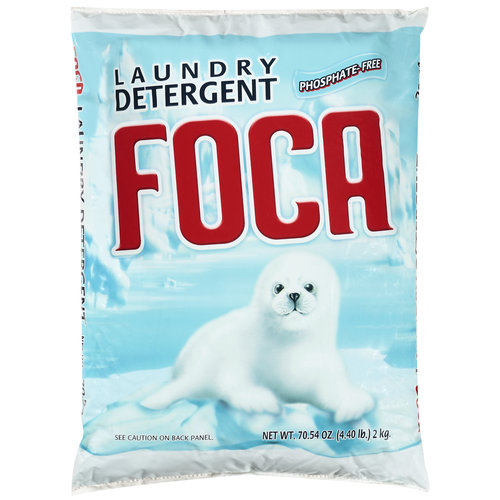
Recently, however, I was forced to shop for laundry soap, as our Arm & Hammer bucket was getting low.   On a whim, I bought a bag of Mexican-made "FOCA" soap which is a weird blue color, at Wal-Mart.


The soap is an astonishingly cheap $3.42 per bag   They also carry a second Mexican brand, which is a few pennies cheaper and is not the disturbing blue color.  They sell it in various sizes, including an 11 pound bag (for about $8) which seems to fill our Arm & Hammer plastic bucket.

Here is where it gets weird.  For some reason, Wal-Mart's website shows the 11-pound bag at over $60 - with the order fulfilled by "We the People" whatever that is.   But at the store it is less than $8.   Using it as with the Arm & Hammer (assuming an optimistic 200 loads) we get 3.2 cents per load.   That is on a par with Dollar Tree, but the soap works far more effectively.   Also, one bag would equal a shelf full of Dollar Tree bottles, so there is the convenience factor.

As you can see, there is not a huge savings in the laundry detergent department.  Even if we went with Tide (and used it at the rated "per load" rating) the annual cost would be less than $100.   Going to the cheapest detergent might, on paper, save us about $50 a year, if we use the detergent at the rated amount and do one load (on average) per day.

However, given the amount of detergent we buy per year, I suspect that few people use the properly measured amount per load (as with coffee, it is too weak if you used the measured amount) and that on average, we might be doing more than one load a day.

But is more convenient to find these bags in the grocery aisle at Wal-Mart than to lug home a plastic bucket from Price Club, 45 miles away.

And that brings us right back to politics.   I have no problem shopping at Wal-Mart, and indeed, I am a shareholder in the company.   When I started this blog, we shopped exclusively at Publix and Harris Teeter, the two most expensive grocery stores in our immediate area (we are not high-toning enough for a Whole Foods or indeed, even a Trader Joe's).

When I started this blog, we started going to Wal-Mart, which at the height of the recession was a popular place to go.  And yes, you will  see all sorts of people at Wal-Mart, some weird even.   But on the whole, their prices are a lot more attractive than the upscale grocery stores.

It took some doing to get Mark to go there.  After all, he used to work at Williams-Sonoma and what is now Balducci's.   But over time, he has come to appreciate that you can often buy the same stuff - sometimes the exact same stuff - at Wal-Mart for a lot less.   Wal-Mart has quite a selection of French cheeses, believe it or not, and they are the largest retailer of organic produce in the United States.

And some things that are more plebeian end up being better than "upscale."   We found out that cheap Tfal cookware actually works better than fancy "Calphalon" - and a lot of other people, such as the folks at Cook's Illustrated, are coming to the same conclusion.

But during our trip this summer, we ran into some real "true believers" who were aghast that we actually shopped at Wal-Mart.   They felt that by shopping in upscale supermarkets, they were being better people and that moreover, were not exploiting the "masses".

But of course, many of these tony supermarkets pay the same rates - or less - than Wal-Mart.   And decrying Wal-Mart for being evil is kind of stupid.   They are just a company like any other, that buys products and re-sells them.  The are just better at it than most folks are.

My liberal friends refused to believe it when we told them about some of the "upscale" products you can find at Wal-Mart.   The refused to believe that Wal-Mart was the largest retailer of organic produce.  They even refused to believe that Hillary Clinton used to be on the Board of Directors of Wal-Mart.

The point is, shopping is one area where maybe politics should be set aside.   Unless the company you are dealing with has severely odious policies, maybe it is time to put preconceived notions aside.

And the funny thing is, some folks will refuse to shop at Wal-Mart but will buy a sandwich at Jimmy Johns, who until recently forced its hourly workers to sign non-compete agreements and whose owner hunts endangers species in Africa.

Non-compete agreements for fast-food workers - even Wal-Mart doesn't stoop that low.   And don't get me started on Papa John's or Chik-Fil-A.   Oh, right, the franchisees just needed "a day off" and it just happens to always be a Sunday.

The nice thing about Wal-Mart is that is open on Sundays - in fact they rarely close.  And while they contribute to candidates that are pro-business and anti-regulation (as you might expect) they seem to steer away from social issues.

And those "underpaid" workers they hire?   Well, they are doing all right, when you factor in how much they get in subsidies.


Why People Don't Answer Surveys Anymore

Is it really a survey, or just a push-poll from Sirius XM?   And what did I say about entering into a business relationship predicated on a lie?   A fake survey is a lie.  Do the math.


Donald Trump may be right about one thing - surveys and polls are really unreliable indicia of public opinion.  Pollsters like to tout their scientific methodology and claim that their sampling techniques represent public opinion.  Oftentimes, however, this methodology is skewed.  For example, how useful it is it if you sample the opinions of the same people over and over again?    If your initial sample was skewed, your subsequent samples will also be skewed.

However, in this modern day and age, it is hard to gauge public opinion when so much of it is self-reported and moreover, so many people simply hang up on pollster calls assuming they are some sort of con artists - which they are most of the time.

Consider this SPAM message I received from "Mary Williams" the other day:
Dear ROBERT,

This is a followup to the invitation we sent you last week.  You are one of a very small number of car owners from around the country who have been selected to participate in an anonymous survey about audio entertainment options in your vehicle.
The answers you provide will help shape the future of audio entertainment in automobiles.
The vast majority of people complete the survey in less than 10 minutes.
 
PLEASE CLICK ON THE LINK BELOW TO TAKE THE SURVEY TODAY.

Odyssey, a leading customer research firm, is conducting this online survey on behalf of a major company with an interest in how vehicle owners are using the audio entertainment options in their cars, trucks, and SUVs.
This survey is for research purposes only, and is not intended to sell or market any products.
Our client values your opinion and wants to know what you think and how you feel.
Your opinions are very important to us and all information you provide will be kept STRICTLY confidential.  It will only be presented in aggregate.

We ask that you complete the survey as soon as possible to make sure that your opinion counts!  To take our online survey, please click on the link below, or copy the complete address into your browser:

CLICK BELOW TO TAKE THE SURVEY NOW!

This is not a sales effort.  This is strictly for research purposes.   Thank you in advance for your participation!
This message was sent by Odyssey, 2261 Market Street, Suite 1400, San Francisco, CA 94114. To unsubscribe, click below:

Of course, they are not interested in my "opinion" on anything.  If you click on the link, it takes you to a survey about Sirius XM radio and asks why you unsubscribed and then asks increasingly detailed "questions" which are more selling points for the Sirius streaming service and finally making the sales pitch - wouldn't you like to re-subscribe?

It is a desperate ploy from a company with a huge costly satellite infrastructure and a shrinking audience.  They are a dying business and are struggling to stay alive - finally realizing they need to join "the dark side" and go to a smart-phone streaming model, as no one in their right mind spend $17 a month to listen to Howard Stern unless they are particularly dense.

(One problem with Sirius XM radio is that you can't even get the news - only people talking about the news.  So while you can go to "NPR" on XM, all you'll get is canned talk show programs like Fresh Air but you won't get the hourly newscast.  The music content is predictable and lame - and repetitive.  It just isn't compelling at any price).

The point is, this isn't a survey or poll at all, but more of a "push-poll" - an advertisement designed to shape opinion rather than sample it.   Politicians use these as well, offering up "questions" such as "Would you still support Hillary Clinton if you knew that she had ordered the murder of our embassy staff and military guards in Benghazi?"   It is not so much a question as an argument.

Other "polls" or "surveys" are just come-ons for outright ripoffs.   Sirius XM is just a shitty bargain and shitty content - it is a "legitimate" business, although one that flirts with illegitimacy with its stubborn insistence on the use of "negative option" subscription models and flaky pricing schemes.   Outright crooks, on the other hand, use "surveys" as bait to lure their victims - which is why when Sirius starts using fake surveys, you know their time in the sun is fading fast.

The "free cruise" people use "surveys" as a gambit to get you to talk on the phone and then tell you that you've "won" a free cruise.   Of course, everybody "wins" the cruise - and then they ask for a credit card number to pay the port fees and other miscellaneous charges.   It is not free, just an inexpensive cruise on a shitty cruise line and you are forced to sit through a three-hour timeshare program before they let you board - and then you are pestered to buy once they have you trapped on board.

Online, almost all surveys are come-ons or frauds.   The self-reporting "surveys" that Trump likes to tout, are ones where people "vote" like with America's Idol.   Only those aware of the survey will vote, of course, and since they are advertised on Trump discussion groups, you can only guess who wins them (apparently Trump will win on November 28th, in a landslide).  But those are just shitty online contests, really.

Other survey come-ons promise the participant riches, promoting the idea that companies will pay money for your oh-so-precious opinions.   They won't, of course, and if you go down the click-bait rabbit-hole of the online survey, you will find your wallet a little (or a lot) lighter, as you will end up having to agree to buy magazine subscriptions or other products as part of this scheme.   Others simply steal money directly from you by claiming you need to pay "processing fees" up-front.

So people today are skeptical of surveys.   And it doesn't help when the survey taker outright lies from the get-go:
"This is not a sales effort.  This is strictly for research purposes."
Alas, it was exactly what they said it was not - a sales effort.   And as I have noted time and time again in this blog:

Any business relationship predicated on a lie, no matter how trivial, will inevitably go downhill from there.
Liars play their hand early.  When you answer the phone and someone says "how are YOU today?" they are lying to you, as they really don't care about how well you are doing.  When you get a piece of mail that says "urgent!" when it is just an ad, or is faked-up to look like a tax refund check or something important - to get you to open it - they are lying to you.  When a commercial says you can "lease a new car for $199 a month!" and you get down to the dealer and realize it will cost far more than that, they are lying to you.
People who lie to you at the get-go aren't going to become more honest over time.  Just walk away from deceptive advertising, practices, and come-ons.  Every time you send business to people to operate this way, you encourage more people to do it - and drive out of business the few honest people left.
 
And that's why people don't answer surveys anymore - and likely why they shouldn't.

Tuesday, November 1, 2016

What Does Putin Want?


Why would Vladimir Putin want to interfere in our elections?   For obvious reasons.

On neighboring St. Simon's island, there is a large photo at the Lighthouse museum of the G8 summit on nearby Sea Island.   What is interesting about the photo is that of all the world leaders pictured from 2004, only one remains on the world stage, Vladimir Putin.

Of all these world leaders from 2004, only on remains in power.

Arguably the richest person in the world, Putin rose to power simply by taking it (and his wealth) from others and from the Russian people.  Those who stood in his way were jailed or killed.   Russia is a Kleptocracy, and Putin is the head thief.    He is, however, the de facto leader for life of that country, and that is not about to change anytime soon.   In other words, we are back to where we started with Russian leaders, with despots anointed for life.

What Putin wants, of course, is to keep his wealth and expand it if possible.  He also wants to stay in power.  And to do these things, he needs to expand the power and influence of Russia, to recapture some of its former glory.   Along the way, the Russian people may benefit from this, as they nibble on the crumbs from Putin's feast.    Since they are used to starving, they support Putin wholeheartedly as he promises to bring back their former glory ("Make Russia Great Again!") and improve their standard of living.

World politics is a lot like chess.  There is a lot of gamesmanship involved.   And what weakens your opponent arguably empowers you.   So it is logically in Russia's best interests if the United States became weaker in terms of its economy, military, and influence in the world.   And it would be helpful if Europe was less united under the EU and more divisive and bickering.

This alone doesn't make Putin evil or anything (imprisoning, torturing, and killing his opponents does).  He is merely playing the world chess game and doing better at it than his predecessors.   And some would argue, better than we are.

Some in the United States would just assume walk away from the game.   After all, why do we need to interact and intervene in countries with value systems so opposed to ours, and as the experience in Iraq and Afghanistan illustrates, countries that will never accept our Western values.  The idea that Democracy would flourish in 3rd world countries now seems laughable, but at the time of the G8 summit, that was exactly Bush's plan.

From Putin's perspective, the strategy is simple.   Disruption, disinformation, disorganization.   Putin thus loves Trump as Trump is a "disrupter" of the existing system.   Trump also makes noises about leaving NATO and leaving Europe, Japan, and South Korea undefended.   Trump also is a divisive figure in the US.   People are actually talking about reverting to civil war if he doesn't win.   That certainly would weaken the US on the world stage.  His isolationist agenda would mean that the US would have a diminished impact on the world stage, leaving a path open to opportunists and dictators.

Economically, Trump is a disaster for the US and a windfall for Putin.   If Trump's protectionist ideas were enacted, our economy would suffer - if not crash - and our economic impact on the world would be diminished.  Russia and China would be the major players on the world stage, which of course is exactly what Putin wants.

Of course, it isn't just Putin who wants to see Trump elected.   North Korean Dictator Kim Jong Un has endorsed Trump (through his propaganda branch) as a "wise choice" for America.   Trump's promise to leave South Korea undefended from attacks from the North is, of course, the main reason why.

One of the most ruthless dictators in the world endorses Donald Trump and the world fails to take notice, because some e-mails were found which might have stuff or something.  Or not.

But I doubt it ends with Kim Jong Un.  Philippine Dictator Rodrigo Duarte isn't exactly endorsing Trump, although he seems to be playing a playful version of the Reality Television drama that both politicians seem to revel in.   Duarte wants to re-align his country with China and throw out the US, including any military presence.   Trump's isolationist stance would seem to dovetail with that dictator's goals admirably.

And the same could be said to be true with Venezuela as well - or Cuba for that matter.   Rather than engage the world - which is a messy process that often ends in setbacks and disasters - Trump would rather turn tail and ride home, hunkering down in his bunker and shutting out the rest of the world.

Isolationism is, of course, nothing new, and in fact it defines America for almost its entire existence.  "No foreign entanglements!" was the battle cry of the first Century of our existence, while "no more foreign wars!" was the mantra of the second.  America had to be drawn, kicking and screaming, into both World Wars, and emerged as a superpower not by design, but by default.

We can't blame Putin for being Putin.   He will do what he thinks is in the best interests of Russia and his own financial empire.   We would be foolish to expect him to do otherwise.   The reason he is intervening in Syria is simply to expand his influence in the region by re-installing Bashar al-Assad as the head of State there, and quashing any rebellion or dissent.   The result will be, of course, that Assad will be beholden to Russia, and Russia will have a strong ally in the region, much as we do with Saudi Arabia et al.

And yes, these can sometimes be odious allies.   Sadly, the world isn't divided into good guys and bad guys, and we don't always get to choose.   When it comes to the Middle East, we really are looking at a "basket of deplorables" in every corner - including even Israel.   (I have a friend who decries that Israel is a "terrorist country" but of course he fails to recognize exactly how odious the governments of all the neighboring countries are - including the Palestinians.    Israel may have its flaws, but relatively speaking, it is at the top of the middle-eastern dung heap, which of course, isn't saying much.  If you think Israel is a bastion of freedom in the Middle East, think again.   Like its Arab neighbors, it has its share of religious fundamentalists.  Same shit, different house).

It is, of course, comforting to sometimes think, "Hey, fuck the rest of the world.  Let them figure out things on their own.   Let's concentrate on our own prosperity here at home!"   It would be nice to retreat to our lair and be insular and safe.

The problem is, it is just a fantasy.   While we are retreating, others would be advancing.   And in short order, the safety of our insular lair would be at risk.  Isolationism, like protectionism, has never been shown to work, and both have resulted in disastrous consequences for the United States (or indeed, any country).

We need to think carefully about electing a candidate who is endorsed by our enemies.   There has to be a reason they like him.   And it is not a reason that is favorable to us.