Sunday, February 6, 2022

Denial - Part of Human Nature?

People live in denial up until the very last minute.  But not all people!

When I met Mr. See, I though the had his shit together more than I did.  After all, he had a new car, a nice apartment - which was nicely decorated and clean - and decent furniture.  But when I moved in, I realized that some of this was a facade.

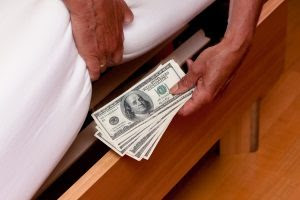
I went to get a bath towel one day and a $20 bill fell out of it.  "What's this?" I asked.  "Oh, when I get paid, I hide money around the apartment so I don't spend it all.  If I need money later on, I go on a treasure hunt to find it!"

This was the most insane thing I ever heard in my life.

Yet, a lot of people do this.  I had a great uncle who used to hide money in book (at page 99) or in old overcoats in closets.  When he died, his heirs swooped in and dove through his possessions, looking for that cash, letting out a whoop! whenever they found a $100 bill in an old jacket or pocket.

So I guess it is a "thing" but a stupid thing, on two counts.  First, it is like the guy who buries money in a coffee can in his back yard - you can lose that money if you forget where you buried it or someone sees you burying it and steals it from you.  Second, that money could be doing better things for you in the bank than under a mattress.

By default, I was put in charge of our finances, which was a case of the blind leading the blind.  I wasn't putting $20 bills in the towels, at least.  And I later discovered - to my horror - that Mark had not paid his car insurance (!!).   Sadly, he has become dependent on me balancing the books and figuring out financial things - even though he has an intuitive financial savvy.  He can spot financial shenanigans (such as that State Farm Agent proposed!) a mile way.  But I do worry that if I keeled over tomorrow, he would revert to hoarding money in the towels again.

I tried, at one time, to get him to balance the books on a regular basis, but he just flipped out over it. Worse yet, when it didn't balance out properly, he would click on "balance adjust" in Quickbooks (which should never, ever be used!) to make it come out even.  It took me a week to unravel that.

I blame his schooling for that. He was never a whiz at math, only because he felt that unless he gave the "right answer" to a math question, he would be laughed at.  Sadly, many math teachers, particularly in Elementary School, subscribe to this notion, as they themselves really don't understand mathematics - they just have the "teacher's edition" of the math text book with the answer key.  So when I ask Mark how much something cost, he says "I don't know" instead of "about thirty bucks" because it was beaten into his head, at an early age, that the correct answer was $29.99 plus tax and there are no other answers that are of any use.

But in finances, it really helps if you can envision numbers and estimate and round-off, as it allows you to see the big picture.  My fourth grade teacher thought that the "big picture" of mathematics was rote memorization of the multiplication tables.  Hell, even Jethro can do cipherin'.

But I digress....

It struck me, though, that Mark was living in denial about his finances when I met him.  It wasn't that he couldn't live on his income, but that he didn't want to be bothered thinking about whether he could afford this or that.  He spent - like we all tend to do - based on what he saw other people spending.  Problem is, those other people were making a lot more money than we were.

The "hiding money" thing was an attempt to limit spending.  If his friends from work asked him to go out to dinner or drinks, he could look in his wallet and say, "Uh, not tonight, guys!"   This was in the days before everyone had credit cards, believe it or not.

And yes, I did this too, in a manner of speaking, by squirreling away money into different accounts, so I would not be tempted to spend.  When I was younger, a dollar in my checking account was a dollar to be spent and most of it got spent on junk I really didn't need, in retrospect. I tired not to carry money in my wallet (back in the days when we paid cash for everything - credit cards were for airline tickets!) so that it would act as a limit to my spending.  In a way, it was like an alcoholic hiding booze or a smoker trying to stop smoking by not buying cigarettes but instead just borrowing them from other people.

As I got older, I consolidated a lot of my squirreled accounts. Funny thing, at my age, the idea of spending money fills me with dread.  I don't want to lose my financial security, and I realize now, that it can go away at any moment, particularly if I spend it.  When I was young, spending money was like 'Yahoo!" fun, but today it is like death itself.

Thanks to a roaring stock market (Companies are making record profits in a pandemic, but cannot afford to give anyone raises, even as inflation tops 7%!) and a goofy real estate market, our net worth continues to climb.  We made more money on our mutual funds than we spent last year - and the year before that.  The "bottomless purse" effect at last!  But I don't expect it to last - I still remember 2008 when everything tanked by 30% or more, sometimes a lot more (like 100%!).  But we're prepared for that contingency as well - because we spend so little.  Inflation is the one bugaboo that is hard to hedge against - and most things offered as "hedges against inflation" are just bogus come-ons.

But again, I digress.  Or maybe not?  A lot of people are enjoying the great returns on investment right now - and assuming they will go on forever.  Living in denial, again.

But getting back to personal finances...

Funny story - the first time I went to Japan, my boss told me to put the airplane ticket on my credit card and the firm would reimburse me before the payment was due.  He was shocked when I told him I didn't have a credit card.  I had to go out and get one.  Back then (the 1980's) you didn't need a credit card to get by, and indeed, few places outside of major retail stores and larger restaurants, took them.  Paying by credit card at McDonald's - or the convenience store?  Unheard of!  And no, they didn't have credit card swipe machines at the gas pumps back then.  It was not so long ago.

One reason I didn't have a credit card is that I knew it would get me into trouble - spending more money than I had.  I remember I had a Sears card when I was 21 and I spent a year paying off a set of tires for my car.  I didn't want to fall into that trap again!  So my not having a credit card was my way of stashing money in towels or old coats, I guess.

We all live in denial - denial of our most basic impulses.  I have friends who will drive 20 miles to the "upscale" grocery store to buy food - at 50% or more than what Walmart "Ghetto Gourmet" would charge.  It is funny, but at one time, I too fell into that trap - thinking that people of "my caliber" shopped at the upscale grocery store and never looked at prices - much less wrote down a shopping list! 

I stopped doing that.  And I stopped living in denial - or at least tried to do it a lot less (alas, it seems to be part of our primitive programming).   Maybe this isn't so much a matter of self-control but basic survival after a while.  When we are young, we figure there will always be more money, another paycheck, and a chance to recover from financial setbacks.  When you are older, you realize the amount of money you earn in a lifetime is a finite number - and one that is fairly easy to calculate.

When we realize that, it is harder to live in denial.
Friday, February 4, 2022

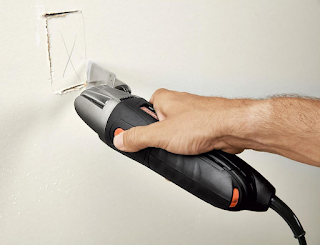
The Oscillating Saw

Cutting holes in sheetrock or even paneling, has never been easier.

One of the conundrums of modern home construction is how primitive and difficult our home systems are.  Wiring techniques haven't changed much in a Century - we still use the same primitive electrical outlet boxes, which for some reason are never straight or protrude from the wall at an odd angle, unless you fuss with them.  And then the archaic wire clamping mechanisms and grounding screws are an exercise in frustration.

Sheetrock is even worse.  Even "expert" sheetrock installers leave a hump or depression where the seams are, and they cast a shadow that can be seen no matter what.  It is an awkward way of finishing a wall - screwing this dusty plaster-board up and then "mudding" and taping it, sanding and sanding and hoping in vain to get it smooth (only to have it crack later on, as the house settles, or due to thermal expansion and contraction).

And cutting sheetrock - oy vae!  Sure, cutting a whole sheet is easy - you score it, you snap it.  But making a hole for an electrical outlet - a PITA of dust and frustration, if you are using a sheetrock knife.  Half the time, the knife punches through, leaving a starburst on the reverse side of the sheet.

Enter the oscillating saw.  This neat little toy has a variety of blade attachments, but the simplest one is just a 1.5" serrated blade.  When you turn it on, it oscillates a tiny bit, at a high rate of speed.  You touch it to the sheet rock and it cuts like a hot knife through butter - and leaves a clean, neat line as well.  Now you can make perfect cutouts in sheetrock without risking slicing upon your hand with a sheetrock knife, or creating an utter mess with a "sheetrock saw".

Plus, since it doesn't "ride" on the surface like a sawzall or a circular saw or a jigsaw, it doesn't leave marks all over the place, which require repainting later on.  Win-win!  You can make surgical cuts without making a mess (other than some dust to vacuum up).

Our house doesn't have return air ducts, instead relying on the hallway to return air to the central air handler.  As a result, when the blower comes on, it tends to suck doors shut - sometimes slamming them in fact - and the return airflow is limited to whatever comes through the crack at the bottom of the door. I ordered two 8x10 air registers and cut a 6x9 hole in the wall between the bedroom and the hallway.  Now, the air has somewhere to go!  No more doors slamming in the night!

The saw cut through the sheetrock just fine - and even the plywood wainscoting - leaving a neat, even line with no weird gashes or fubars.  I lucked out that there were studs on either side of the hole (A stud-finder is another nice, cheap tool to have as well!).  So the grills screw right into the wood.

I had been borrowing a friend of mine's oscillating saw, but I felt awkward asking to borrow it, time and again.  So I went out and bought one for myself.  They are only $22 or so for a consumer-grade model.  The joke is, of course, they want $7.99 apiece for the blades and even more for other attachments such as sanding triangles.

But if you are just cutting sheetrock, a blade should last a long time (they show them cutting through nails, but that dulls them pretty quickly).

Even if you are just a homeowner doing occasional sheetrock repairs, it is a nice tool to have!

I only wished they invented this darn thing a few decades ago!

Thursday, February 3, 2022

Mail Order

At one time in this country, ordering things through the mail was an ordeal. Half the time you never received your goods, either!

We take for granted today that you can click your mouse and order just about anything over the Internet and have it delivered in a matter of days.  I've bought everything from light bulbs to a hot tub online, and never once had an issue where I didn't receive what I ordered.  The only issue I ever had was when Amazon sent me the lower half of a toilet for some reason - and they told me to keep it, rather than send it back.

Before the Internet, however, mail-order was a real hassle.  You would get catalogs in the mail, and each one came with an order form which you had to laboriously fill out with the product name, the product number, price, shipping, and taxes.  You totaled it all up, wrote out a "check or money order" and mailed it off to Lands End or whatever.  Weeks later, your order would arrive (you would hope) in the mail, and sometimes you even got what you ordered.  If the item was wrong or didn't fit, well, sending it back was an even greater pain-in-the-ass.

There were always these cheesy catalogs like Carol Wright, which had a lot of stuff your grandma would buy, like little booties to put over her low-heel shoes.  Or a plastic cover to keep ice off the windshield of her Studebaker.  Or clamp-on ice grippers - again for those low-heel shoes - so she wouldn't slip on the ice.  A lot of grandmas apparently had anxiety about winter weather back then.  But then again, back then, half the population of the United States lived in the northeast.

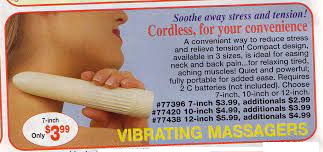
One of the funniest things they sold in the catalog was a "personal massager" which was obviously a sex toy vibrator.  But in the ad, it showed a lady massaging her face with it.  And this catalog was mailed out to every home in America back in the late 1960's and early 1970's.  Apparently the old ladies, besides being worried about winter storms, were also very lonely.

Every newspaper had a "consumer help" column, and almost every month, someone would write in to complain that they sent off a "check or money order" to some sketchy mail-order place they saw advertised in the back of a magazine - and got nothing in return.  The advice columnist would chastise them and say, "You should never mail off money to people you don't know!" and likely this was something the newspaper's advertisers were glad to hear.  They didn't want people buying things by mail order when they could be sold at a brick-and-mortar store.

Of course, mail order goes back long before that time.  Sears, Roebuck & Co. started out as a mail-order company, and you could buy everything from clothing to buggies to farm implements to actual houses (shipped in pieces by rail car) and later on, even cars.  Mark's grandfather build a "Sears House" in Old Greenwich, Connecticut back in the day.  Today, they are deemed historic.

Sears dropped the ball on mail order.  Over the years, they made more money with their downtown "department store" locations, and late on as anchors for suburban malls.  They let the catalog die on the vine - a catalog that its own soft-core porn like Carol Wright.  The sad thing is, they abandoned the catalog just at the dawn of online retailing.  "If only" they had gotten out in front on this, well, the world might be a different place.  And I am sure someone at Sears, back in the 1980's or 1990's tried to propose this, but was shot down by upper management at the time.  Recall that Sears sold home computers and even had a dial-up network called "Prodigy" for a while.

Mail order was handy, back then, for specialty items.  As kids, we ordered our model rockets from Estes, as the local "toy store" or hobby shop didn't sell them.  If you were into collector cars, well, chances are, there was a catalog or two for your make or model.  And of course, there was J.C. Whitney, which sold the cheapest parts available, and always had a section for Volkswagen Beetles and Model-T Fords.  There was also a two-page spread for light-up hood ornaments!

But that was back then.  Today, many of these catalogs are still around - but as online websites.  Apparently Carol Wright has gotten past its slap-and-tickle stage and has pages of vibrators for sale, which are not called "personal massagers" anymore.  They have dropped the pretense.  JC Whitney is still around, but quite frankly, I don't find their prices and selection to be so great anymore.  No more Model T or Beetle parts!  Those cars all went to the junkyard or became garage queens.

And ordering online has become reliable and trustworthy, for the most part - sites like Quibids, Woot!, and Wish.com notwithstanding.  You order something from Amazon or eBay or Walmart, you generally get it, unless the "3rd party merchant" is some sort of scam artist.  Even ordering stuff directly from China is reliable, if not a little bit slow.

So, what's the point of all this?  I dunno.  Perhaps just reflecting on how our world has changed dramatically within one lifetime.  Things that we thought were permanent parts of the landscape disappeared, a little bit at first, and then overnight, they were gone.  Or so it seems.

We worry about harmful things and trends, but they also disappear within a few years.  The thousand-year Reich lasted only a decade or so.   The pandemic will die down, eventually.  Three years is not a long time.  Talk of permanent pandemic is nonsense.  If nothing else, everyone who is susceptible to this virus will eventually die off.  Labor shortages turn to labor surpluses.  Bull markets to bears and back again.  Liberals become conservatives and vice-versa.  What seems like insurmountable problems look trivial after a decade or so - or they become a new norm, but not for long.

The 1%'ers, like their robber-baron forebears, will dissipate their wealth among their children, who will be far less likely to take risks and more likely to squander their wealth on pleasure-seeking.  Governments will change and opinions will change and tax rates will change.  Politicians will come and go, mostly because they age out.  How long can 70- and 80-year old politicians last, particularly if they are in poor health?  This too, shall pass.

We still get catalogs, of course.  But rather than a means of ordering merchandise, they are really just a form of junk mail - enticing us to order online.  No longer does the detachable "order form" come with the catalog, with its convoluted instructions on how to calculate sales tax and shipping.

It was kind of fun, in a way.  But I don't miss it all that much!

Wednesday, February 2, 2022

Plagues and Superstitions

Plagues and Epidemics have always brought out the worst in human beings.

People are freaked out today, not because of the pandemic or mask requirements or because of vaccine passports.  Yes, a few people are losing their minds over those things, claiming their "free-dums" are being trampled upon.   But the vast majority of the world is freaking out over the freaks.  The rest of us play by the rules, wear masks, get vaccinated, go to work, and pay our taxes.  We look on in horror at these idiots who disrupt society and even engage in violence over.... nothing.

But I got to thinking that this is nothing new.  The world is full of crazy and stupid people.  It is just stress that brings out the worst in people, and the Internet that allows us all to see it, firsthand.  And this isn't the first time this has happened.  In fact, in nearly every epidemic, plague, pandemic, or whatever, people have basically lost their minds.

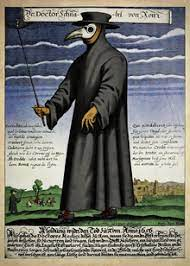
Now, granted, in the old days of the bubonic plague, you could understand why people might be superstitious.  After all, it seemed that people just started dying mysteriously. So they lashed out at witches or whatever - wanting someone to blame for their misfortune, even if the people being blamed were innocent.  It would take a long time before people understood how rats spread fleas, and fleas spread disease.  The ideas of bacteria, viruses, and inoculations were centuries in the future (although inoculations appeared before people even understood how they worked).

We saw the same thing as late as the 1800s in the old South, when the yellow fever struck.  No one knew what caused it - perhaps "vapours" from the swamps.  They were so close!  It was mosquitoes, of course, and draining swamps (or not living near stagnant water) was the real solution.  Instead, they shot off "Fever Cannons" to drive away the mysterious illness.  Yes, it was as stupid as using horse medicine.

But this same pattern emerges again and again, if you look throughout history at plagues and pandemics.  People revert to superstition, and often lash out at their neighbors and friends.  Human sacrifices were not uncommon - surely we somehow displeased the Gods, right?  And since every pandemic eventually peters out, the sacrifice seemed to "work" somehow.

Of course, back in those dark days, we didn't have the science we have today.  But even in the presence of science, people will ignore the results.  The Jekyll Island Club - winter home to the world's millionaires at the turn of the last century - had two episodes where members (or their spouses) died from typhoid fever.  The first time it occurred, the wealthy members of the club hired the best pathologist in America to find the source of the fever.  This expert noted that the club was dumping raw sewage into the Jekyll Creek, and at the same time, Club employees were harvesting oysters from near the sewage outlet - and serving them to the club members, raw.

The pathologist recommended that they stop eating those oysters and start treating the sewage or installing a septic system.   Of course, that would cost money.  Even though these folks represented one-sixth of the world's wealth and their own members were getting sick and dying, they refuted the suggestions of their own expert they hired. I mean, Republicans - why spend the money?  It was God's will they died, so be it.

Well, a decade later and another member's wife dies from typhoid from tainted oysters.  The whole thing is repeated all over again and once again, no action is taken, except perhaps not to eat the oysters or maybe steam them first (that probably doesn't help).  Maybe that is how Oysters Rockefeller were invented.  Just a guess.

Well, fast-forward a century and Mark and I drive our golf cart down to the boat ramp to see the sunset on nice days.  The boat ramp is downstream from the sewage treatment plant, which treats the sewage and then dumps the effluent in the creek.  And not surprisingly, the oysters are in abundance.  No one is eating them, though, even if the sewage is treated.

On the other hand, Joe Rogain hasn't visited here.  I am sure I could dare him to eat one or two!

Superstition never ends..... it just morphs.

But why does it even exist - in this era of science and technology? I have written about this before, and my theory is that superstition has expanded due to science and technology.  Few people today understand how any of this technology works.  They own cell phones that have more computing power than a Cray supercomputer did back in 1975.  As far as they know, it is all magick.  They feel helpless and like idiots and that they have no control over their lives - and what little control that had, they are losing.

But a conspiracy theory?  It is a chance for them to be in the know.  Now they are on top of things and have "done the research" (Googling things is not "research"!).  They are with a group of like-minded people who are ahead of the pack - not one of those "sheeple" who actually knows something.

The rest of us scratch our heads and wonder why anyone would follow these strange websites and conspiracy theorists.

But if you think about it, it makes perfect sense. Not the crazy theories, but that people believe in them.

It is simply plague superstition at work.

Tuesday, February 1, 2022

Therbligs

Hard to believe a guy with 12 kids pioneered the art of Industrial Engineering.

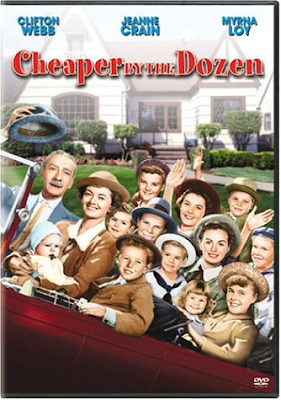
Years ago, my Grandmother taught English at the Ranney School, a private school in New Jersey.  Some of the students she taught were the children of Frank and Lillian Gilbreth, who were pioneers in the art of Industrial Engineering.  I inherited an autographed copy of the Gilbreths' book, Motion Study.   Years later, in 1950, a movie would be made of their lives based on the 1948 book written by two of their children.  The gag was that having twelve children and one bathroom, Dad had to use a stopwatch to time the children's bathroom use, and taught them how to be more efficient.  The era of the efficiency expert was born.

It was a thing, back in the early part of the last Century, and the Gilbreths were just one of many so-called "efficiency experts" who would sign lucrative consulting contracts with companies to improve their efficiency and productivity.  In the 1930's, the Japanese came over here to learn about these techniques, which they would use to great advantage long after America abandoned them.

The idea was simple.  In any task, such as on an assembly line, you would count the motions needed to do a job and try to simplify the job as much as possible.  Each motion is called a "Therblig" which is Gilbreth spelled backwards (so clever!).   For example, if a worker had to lift a part from a bin, why not eliminate that tiresome task and have the bin mounted a table height, so the parts would just fall into their hands?  To some extent, this made the worker's job easier.  But in other respects, it made it harder.


The three-stopwatch clipboard was more of an artifact of Taylorism than Therbligs.

By the time I went to work for GM, the three-stopwatch clipboard had fallen out of favor.  I walked out on the factory floor with one once, and the workers almost threw rocks at me.  The Union was not amused.  You see the problem was - and is - that when you make a job more efficient, you expect more work out of the worker.  And it never ends, either.  So Suzie on the assembly line does 150 parts per hour.  You reorganize her work space to be more efficient, and she can now do 250 parts per hour.   That becomes her new quota.   The faster she works, the faster she is expected to work, until she becomes like Charlie Chaplin in Modern Times, or poor Lucy Ricardo in the chocolate factory.

Modern times are here again.

Like I said, it fell from favor.  Treating people like machines only had short-term gains.  Just because you timed Suzie doing 250 parts per hour doesn't mean she can do that for eight hours straight.  And then there are things like repetitive stress injuries - which started to become a thing just about the same time the Gilbreths' techniques were applied.  People started to consider things like quality of work life and worker comfort.  Could a padded floor mat reduce back stress?  What about a comfortable chair?  Making work easier, not faster, was stressed more in later years.

That is, until recently.   For most of the history of this country, a lot of low-wage jobs were performed for fairly small companies.  Big companies, like Ford Motor Company, with its assembly lines, could afford to institute these "Industrial Engineering" techniques to increase productivity.  But there was a cost.  Ford saw his turnover rate skyrocket as workers quit in droves, unable to keep up with the hectic pace - or at least not for the wages offered.  He doubled wages overnight, and turnover plummeted.  And no, that wasn't because of the union - there was no union at that point!   He could afford to pay more in wages because of the increase in productivity - something union members should think about when asking for a raise.

Today, though, the world's largest employers are not manufacturers but retailers and warehouses.  Walmart and Amazon are the largest employers on the planet.  And today, we have computers which can measure every aspect of a person's work life.  It started with bar code scanners at checkout.  Checkout clerks are monitored for their "scan rate" and anything below a certain level will result in them being fired.  Amazon can track employees in the warehouse, determine how long they spent on break or in the restroom, and penalize them if they are not working hard enough.  Like the checkout clerks at Walmart, they are scored on their "pick rate" and fired if they don't meet standards.  Not surprisingly, they have a lot of turnover, just as Ford did.

The problem with Industrial Engineering is that, when taken to extremes, it becomes inhuman.  The Japanese pushed worker efficiency to the limit, and as a result, there was a rash of worker suicides in the 1980s and 1990s.  Today, we see this in China, where workers throw themselves from the dormitory windows of Foxconn and other factories.  We love having our cheap stuff, but at what price?

In America, we see rumblings about unionization, but it is tough sledding so far.  The rules have been changed over the years.  "Right to work" laws mean that "Closed Shops" are a thing of the past.  In the old days, if workers voted to unionize, everyone had to join the union, if they wanted to work there.  Today, workers can opt-out, and thus have the advantage of collective bargaining without having to pay union dues.  And union dues, particularly imitation fees, can be steep.  Companies such as Amazon, Walmart, and Target are aggressive about tamping down union talk.  Employees are forced to attend hour-long meetings where slick videos are presented that all but threaten employees with termination for even talking about a union.

John Oliver parodies the union-busting videos.

And since most of the modern jobs are in retail, service, restaurants, or warehouses, the workers can ill-afford to be on strike for more than a few days at a time.  Unions are so weakened that they cannot pay much, in terms of a strike fund.  People who work at such jobs are not sophisticated and are scared.  And they are often in debt, living "paycheck to paycheck" and the thought of losing their job terrifies them.

Of course, this could all change if this labor shortage goes on for much longer.   Fear of losing your job isn't such a big thing when everyone has "help wanted" signs posted.

But frankly, these companies have brought this on themselves.  They are making record profits by squeezing their employees more and more - expecting ever-increasing efficiency and production, while wages remain flat.  The problem is, human beings can only work so hard before they break down - quite literally.

Eventually, something has to give.