Wednesday, May 27, 2020

Would You Buy A Used Rocket From This Man?

Space travel is dangerous enough.   Riding in a rocket made by a company run by someone who acts crazy is.... well, adding to the risk.

Today is an exciting day - they are going to launch the Space-X rocket for the first time with people aboard.   This will be the first time in years that we have launched humans into space, and marks the end of our reliance on Russia for a ride to the International Space Station.   I hope it goes well, but growing up in the Apollo era, I appreciate how dangerous spaceflight can be, and I wish them all the best.

But this got me to thinking a bit.  Elon Musk doesn't seem like a really a stable person.  The only one who tweets weirder than him is, well, Donald Trump.   The guy regularly shoots his mouth off and gets in trouble with the SEC - for example, by saying he has a buyout lined up for his company for $420.  "420" - get it?  As in smoking dope.   He also got in hot water for calling some cave rescuer a "Pedo" which seems unnecessarily stupid.   And his empire of hole-digging, electric cars, solar shingles, and rockets to Mars looks more and more tenuous, as it requires a fire hose of money to keep running.

And the fire hose has a kink in it.  The "Boring Company" makes holes in the ground, but has yet to stuff them full of cash.  The solar shingle thing got caught in the collapse of home solar - due to cheap Chinese panels, Trump's tariffs, expiring tax credits, and the switch by utilities to paying wholesale rates for home-generated electricity, rather than retail.   Tesla is making and selling cars, but teeters on the brink of profitability.  With a two-month shutdown of his factory and $1.98 gas, well, we'll see how that works out.  They are offering discounts to move cars.   The whole move to electric cars, worldwide, may turn out to have been premature.   We'll see.

Space-X probably is profitable, given all the government contracts and satellite launches.  Whether it has earned back the staggering development costs is anyone's guess. Whether the overall Musk enterprise is profitable is another question entirely.  Musk says he's selling off his 20 mansions in Los Angeles (a rational purchase, if you are professional athlete, rock star, or lottery winner - is Musk just white trash?) because he wants to get away from materialism.  Or, he needs the money.   And sadly, selling multi-million-dollar mansions in the middle of a pandemic is problematic.  Such properties can languish on the market for years - even in good times.  Ask Michael Jordan.

An item in the news "gossip" column today gave me pause, though.   Maybe Musk's behavior is "LA Normal" but to the rest of the country, it seems an outlier.   Apparently he is married to an "elf" or "elven" or whatever, named "Grimes" - no word on whether this is a first name, last, or solo moniker like "Cher."  And they have apparently named their kid after the catalog part number of a rocket turbine pump sealing gasket:
"X Æ A-12" was always going to be a puzzling name, to say the least, but now it's officially an invalid one. Grimes confirmed on Instagram that she and her partner, Tesla CEO Elon Musk, changed the name of their son to "X Æ A-Xii" on his birth certificate, swapping the "12" out for the corresponding Roman numeral in order to satisfy California laws that prohibit anything other than "the 26" English-language letters. Of course, that still leaves a big question mark around "Æ," which Grimes has previously explained is her "elven spelling of Ai," and which is not one of the 26 more prosaic letters required by California. Baby X may very well have yet another name change in his near future.
Not since Frank Zappa named his kids "Moon Unit" and "Dweezle" has such a crime been committed, although the former wisely shortened her name to "Moon" which sounds sexy and feminine.  I mean, growing up as the child of a billionaire or celebrity - or both - is hard enough (yea, I know, all that money - so hard!) but to be tagged with a moniker like THX-1138 (There's an idea for you, Lucas - you can scar your kids for life, too!) is just icing on the cake.

You know, "Baby-X" might not be a bad choice.  Could be shortened to "Baby" later in life, which is cool and sexy, and the "X" is an homage to Space-X.   But for the love of God, could we just go back to normal, traditional names like Sam, and Mary, and Jim, and Fred?   Enough of the made-up names, whether black, white, or whatever.

Fortunately, names can be changed.  I wonder if years from now, Musk, Jr. will go to court to have his name changed to "Chuck" just to piss off Mom and Dad.  (Just a thought, can you imagine getting up in the morning and having breakfast with Elon Musk and calling him "Dad"?   "Pass the Cap'n Crunch, Elon!"   "Sure thing, X Æ A-Xii!" Surreal.)

I wish these astronauts Godspeed and hope the mission goes well - and is the precursor to many, many more.  And I hope Mr. Musk does well, too - because a world of solar-powered homes charging up electric cars, underground tubes wooshing people cross-country, and colonies on Mars sounds like - well, the dreams we were sold back in 1969.   I hope it comes true.

But the guy behind these dreams, well, he isn't the slide-rule geek we were all expecting to lead us to greatness.   Mr.Musk, if you will, can you please tone-down the bizarre?  Just a bit?  Thanks!

Would you buy a used rocket from this man?

Tuesday, May 26, 2020

Invasive Species, Revisited


The daily death rate and infection rates have been going down for nearly a month now.  Funny the news doesn't report that.

I check the daily death rate and infection rates for this virus, as it illustrates how the virus is flaring out.   The media, wanting a sensationalist headline, touts overall numbers of infections and deaths, which of course are always reaching "record highs" like anything else that accumulates over time. The media loves a "stock market at all-time highs!" report, but of course, since the stock market generally goes up over time, more often than not, this can be the headline.  Ditto for "American debts at all-time highs!"

Worse yet, as I noted before, the media doesn't report per capita death rates when comparing one country to another - apparently believing that each country in the world is identical in size and population.  Per capita rates are far more illuminating as to where the real "hot spots" are and aren't.  At first, I thought this error by omission was due to the fact that "journalists" are pretty much clueless dweebs who haven't taken a math class since the 9th grade, but now I realize it is an intentional error - that the news media selects whatever statistic or criteria that makes for the most alarming, and thus most click-worthy, headline.   And in turn, this means we are to blame for clicking on this nonsense.

We create the news these days, by clicking on what we think is interesting

The reality is, of course, that like every epidemic before it from the dawn of time, the virus is flaring out.  It may flare up again, as people congregate this summer - perhaps.   I look at the pictures in the news this weekend and think to myself, "Even without a virus, I would not want to be in that park, on that beach, or in that swimming pool!" as I don't like crowds in general (hence why I live on an island, literally and figuratively). 

Yes, the Memorial Day yahoos came to our island, but a "crowd" here means maybe 50-100 people on a beach that is seven miles long.   And most of the local residents don't go out on the weekends or holidays anyway.   Tuesday is "locals night" at the bars and restaurants, and when most do the pub crawl - or at least before the virus.  So to us, Memorial day was marked not by crowds but by noting the slight increase in traffic on the road, the few idiots who think it is OK to do 50 mph in a 35 zone, and the turkey buzzards who reaped the reward of this when the same idiots run over one of our many, many deer on the island (or raccoon or possum).  Amazing how quickly they can strip a carcass!  Now if they can only do this with tourists.

But getting back to the chart above, the first thing I note is that back in the "good old days" when you hit the pull-down menu to select "Country" the United States of God-Bless-America was top dead center on any list - the way it should be, of course!   We invented the Internet, and the modern computer, and the telephone.   There is a reason we are "Country Code" number uno - USA! USA! USA!   Whoops, I guess we let Canada and the Caribbean in on that deal.

Nowadays, what with political correctness and all, we're down there with "Uzbekistan" and just before "World".    Maybe this is what Trump meant by "Make America Great Again!"   These pull down lists should read 'Merica and Other and leave it at that.   Of course, Other isn't going to go along with that, so maybe as a compromise, we can put the list in reverse alphabetical order like our 3rd grade teacher did, so George Zimmer and Ted Ziff could be first in line for cafeteria (instead of Fred Able and Bob Bell) just once in a while, to be "fair".   Just a thought.

But getting back to the graph above, the death rate today was only 500 people, a number we haven't seen since March 31st.  That's a two-month low.  And the infection rate is also at a similar low and both have been trending down for a month now.  This is good news.  The world infection rate has largely been tracking the same, although today, it went up while the US went down.   What is interesting is that the death rate seems to be dropping faster than the infection rate, so one would think this means medical treatment is getting better.

Of course, there are caveats - and the news media loves to pile these on whenever good news is found. The actual death rate may be under-reported (or conversely, over-reported) as the methodology varies from country to country.   It is not an exact science - they are not doing Covid tests on the blood of the deceased and then filling out forms and checking off boxes.   In some cases, a death is counted as being related to the virus if it seems virus-like.  In others, no testing in being done.  In still others, if the person had the virus but died of other causes it is counted.   And yet in another method, the increase in death rate over statistical averages is attributed to the virus, whether or not there is a proven link between these deaths and the virus.   Statistics are not an exact science!

So while I follow these numbers, I don't try to get any false hopes up or think that the daily variations of up or down a few hundred deaths or a few thousand infections is relevant other than as noise on a signal.   The overall trend does seem downward, doesn't it, though?  Please?

But let's not get crazy here.   In a way, a virus is like an invasive species which I wrote about before.  Life doesn't view itself as invasive or non-invasive, good or evil.  Life just tries to survive and doesn't view that as a negative thing - even if others have to suffer as a result.  As humans, we eat other creatures - even plants - which have to die so we can live.  This morning, Mark made avocado toast again (the avocados are so cheap these days!) and I joked that it was a vegetarian meal and perhaps even vegan - if you don't count all the yeast that was murdered when we made the bread.

Life takes life - or lives parasitically off other life. We have a plethora of Cardinals on our feeders right now - broods of immature ones being guided by their parents as to how to alight to the feeders.  Worst pilots ever!  Cardinals must have invented the phrase, "Any landing you walk away from is a good one!"

We also have cowbirds.  Cowbirds are not as colorful and they are a bit menacing.  They lay their eggs in other birds' nests and then let those other birds incubate, hatch, feed, and raise their young. Sort of like how some humans have children.  Ornithologists worry that declines in other bird species are a result of this "nest parasitism".   But of course, if the numbers of other birds declines far enough, the cowbirds will have no place to drop their eggs - so the problem corrects itself.  Any parasite has to be smart enough not to kill off its host, as to do so is suicide.

A virus is, in a way, like an invasive species, although whether a virus qualifies as "life" is an interesting question.   They are not thinking beings of course, but from the virus' point of view - if it could have one - all it is doing is trying to survive.   If it kills off enough of its host, then it, too, will die out.   And if you make yourself too visible to your hosts - by killing off even a substantial number of them, or making them ill, then your hosts will take steps to stop your spread or stamp you out.  So, if you want to be a virus, you don't want to be like HIV, but more like the common cold or herpes - widespread, but not too deadly, annoying, but not so annoying your hosts take action to stop you.  The Corona Virus tipped its ugly hand by being too overt.

So what is causing this decrease in deaths and new infections?  And will this continue?   The answer to the second question is "no" as I think we will see the "infection rate" rise as testing becomes more commonplace.  Here on our island they are now offering free drive-through testing at the convention center. This will no doubt highlight some cases that were heretofore undiagnosed, thus raising the "infection rate" statistic, even as the actual infection rate hasn't changed. That and, well, these weekend warrior yahoos out there - thinking that "the crises is over" and instead of responsibly reopening the country, doing it in the most irresponsible way possible - and trying to shame anyone who takes even the slightest precaution.  Paging Charles Darwin!

But like keeping pythons out of the Everglades or snakefish out of streams in Maryland, it will be an uphill battle to eradicate this virus entirely, as the folks in China are finding out.  Even after a severe lockdown there cut the infection and death rates (again, uncertain reporting, this time with a politcal angle) once the country is reopened, new infections are seen - as the data shows.

So the lockdown has been somewhat effective, but might not be a long-term solution.  Eventually, like the snakefish or the pythons or the "invasive trees" the virus will find new paths, particularly as the infection rate slows and people want to "get back to normal."   Either we discover a vaccine, or develop this "herd immunity" assuming that if you get the virus and develop antibodies, you are immune.   Let's hope that is the case - it wasn't with HIV.

But I don't think this is the end of humanity quite yet.  Every plague and epidemic in history has followed the same pattern - flaring up suddenly, then fading out, only to flare up again, months or years later (hence, it is easy to make a prescient prediction of a plague or virus and sound like you are psychic).   But as we are seeing, there is a statistical distribution with regard to how the virus affects people. And again, we will know a year from now, a decade from now, more than we do today, and we know more today than we did yesterday or a month ago.

It seems that there are some who are severely affected by this virus - and a minority who die from it.  A vast majority - so far - who get it, don't even know they have it or had it.  Some have mild symptoms others have more severe ones.  Age and pre-existing conditions affect the death rate.   But the bottom line is that it appears a vast majority of humans have some sort of resistance or immunity to this virus, or let's hope that is the case and that the worst case scenario is that while a lot of people would die - millions in the US alone, mostly elderly - life will go on and our society will continue to function.

But let's hope it doesn't come to that.  Others have other opinions.  I am hearing from some folks who say this is the end of humanity as we know it.  That this virus will infect and re-infect everybody until everyone is dead, and there is no immunity to the virus once you have it.  So if you survive the virus (only a 99% chance, if you are under age 60!) you will get it again and again until you are dead, dead, dead, buster, so watch out!  Stop being so optimistic! You're just rooting for the virus!

I am not sure what the point of that thinking is - or whether it is supported by any sort of "science." My only observation is that if this re-infection scenario was the case, we would have seen thousands or hundreds of thousands of cases where people were re-infected by the virus, as millions of people have been infected, worldwide, and have survived the virus and are no longer infected, but have the antibodies.  Maybe such cases exist, and we haven't seen them yet.  But with each passing day, it seems less and less likely.

Again, I would hope that isn't the case - that there is no immunity to this virus - as it would eventually infect everyone and we would all die, unless a vaccine was developed.  But aren't vaccines designed to cause your body to develop antibodies?  If there is no natural immunity to this virus, I am not sure how you can create an artificial one.

But again, I suspect that it will not come to that.   In any population distribution, there are some sort of survival rates.  Yes, a comet or asteroid wiped out the dinosaurs.  Yet dinosaurs exist today - and not just in Jurassic Park.  They visit my bird feeder and they swim - as alligators - in our ponds.   It is just that not all the dinosaurs survived.  And meanwhile, those oddball furry mammals discovered they could prosper in this cold, new world.  This virus, of course, is hardly on the level of a comet or asteroid - it seems poised to let most of us survive.

We'll just have to wait and see what happens.  Myself, I guess I am an optimist - but then again, it is a lot easier to be an optimist when you don't watch television, particularly Fox News.   YouTube has been pushing "CoVid Reports" including snippets from "the evening news" and we had to laugh out loud at how useless and uninformative it was.  Some chesty blond starts off with some vague and unsupported alarming statements, who then cuts to a "reporter in the field" who is wearing an N-95 mask, even though he is at least a dozen yards away from any other living person (or dead one, for that matter).  The only thing we took away from it was a sense of dread

People say to me, "how can you stay informed, if you don't watch the news!"   And I reply to them, "How do you stay informed watching it?"   22-minutes of repetitive snippets isn't telling you much of anything, particularly when so much of it is biased and slanted left or rightward depending on which channel you watch.   I stay informed by reading my blog.  Genius stuff, there!

Lesson learned - never open Pandora's box of depression, a.k.a., the television.   The "depression box" I have called it, because television watchers are depressed people, and depressed people make excellent consumers.  The networks just have to figure out how to get you to lease a spanking-new SUV during the pandemic, or they are going to lose ad revenue.  What's the point of advertising on television if television isn't going to groom a generation of depressed customers for you?  Let's face it, these syrupy-sweet "we're all in this together" ads can only go on for so long.

Meanwhile, good news, such as it is, is ignored by the media, for the most part.  We'll see what happens in the next few weeks.  Eventually, if the death rate drops far enough, the media will have to notice - and of course, people will use this as an excuse for unwarranted euphoria and jump into a swimming pool together in the Ozarks.

Oh, well.  Protect yourself, do what you can, and hope Darwin takes out the idiots.   It could improve the breed.   It was either this, or another World War.  Mankind needs periodic pruning.
Monday, May 25, 2020

You've Got a Fast Car

Poor life choices lead to poor outcomes.  But you can change your mind about things.

I harp on mental health a lot in this blog, as it is essential to getting your financial house in order.  If you believe in MLM schemes, or timeshares or tithing to a church, you will always be behind the eight-ball financially, because you are substituting belief for logic, in places in your life where belief has no business.   It is sad, too, because the human brain is this amazingly powerful machine capable of analyzing and solving problems - yet so many choose to just shut it off and believe in pat answers instead.

That's why I don't give advice - among many other reasons.  Giving the answers to the test isn't learning, it is cheating.  No one learns anything from someone telling them what to do.  Besides, such answers are often wrong or don't apply to your life situation.  This isn't to say we can't learn from others - particularly the mistakes of others.  But just cutting-the-chase and asking for the outcome rarely ends up working out well.

I get inquiries from time to time from people who want the secret insider tips 'n tricks to becoming fabulously wealthy overnight.  Surely if you invest in the right stock or mineral or bitcoin or whatever, you can be heading off to Davos next week in your private jet!   But such tips 'n tricks don't exist, and believing in them instead of  believing in yourself ends up causing a world of woe.  The only people getting rich from these tips 'n tricks are the folks selling them to you.  The folks who make money on Bitcoin are not the small players on Reddit, but the folks who manipulate and control that market.  Since we can't be those people, we have to move to plan B, which is not to give those people your money.

I don't know what got me started on this, only that I was listening to Tracy Chapman's song, Fast Car, on Pandora the other day.  I still remember hearing this song for the first time, as an old high-school friend of Mark's played this for us (on an LP record no less) back in the late 1980's in his apartment in Boston.   That friend is now a high-flying lawyer living in London, no less.   How we all have changed in 30-plus years.

It is a catchy tune, and at first blush, sounds a little depressing.  But if you listen closely to the lyrics, it is a story of a young woman who makes some poor life choices (mostly involving men) but later on realizes things are not working out and tries a different direction.  It finishes as an anthem of survival and rebirth.  Well, that's what I get out of it, anyway.  I can be very wrong about these things.
You got a fast car
I want a ticket to anywhere
Maybe we make a deal
Maybe together we can get somewhere
Anyplace is better
Starting from zero got nothing to lose
Maybe we'll make something
But me myself I got nothing to prove
The song starts off pretty sad - a young woman hooking up with a young man, who has a fancy car to impress the ladies.   Right off the bat, we are given a normative cue here - one that resonates among the poor.   You may have nothing in your life, and have no direction or goals or promise or hope, but if you have a fancy set of wheels, you're set.  And we see this all the time in poor neighborhoods - the rent-to-own bling rim place, the car detailing shops.  Young and poor men, spending every last nickel they have to hop up some piece of junk so they can impress their peers - trading economic freedom for perceived status.
You got a fast car
And I got a plan to get us out of here
I been working at the convenience store
Managed to save just a little bit of money
We won't have to drive too far
Just across the border and into the city
You and I can both get jobs
And finally see what it means to be living
Moving away from depressed areas is always a good idea, but as I noted before, the poor don't find a job somewhere and then move there, they just move willy-nilly and hope there is a job waiting for them.   It is a poor choice, in both senses of the word.
You see my old man's got a problem
He live with the bottle that's the way it is
He says his body's too old for working
I say his body's too young to look like his
My mama went off and left him
She wanted more from life than he could give
I said somebody's got to take care of him
So I quit school and that's what I did
This is the poignant part, but illustrates that you can't save people from themselves.  Clearly her Dad is an abusive alcoholic, who doesn't work.  Mom had enough and left - but for some reason didn't taker her daughter with her.  Sadly, the daughter made the poor choice to "save" Dad by quitting school (another poor choice) sacrificing her own life and future for someone who refuses to take care of themselves - and why should they, when someone else will take care of them?

Sadly, young people do this sort of thing, thinking it is romantic or noble to sacrifice themselves (which is why we recruit them for the military - older people have no romantic notions about being shot to death).  And some no doubt would try damning and shaming me for saying this.  "It's in the Bible!   Honor thy Mother and Father!"  But the Bible is full of a lot of really bad advice, including how to enslave your neighbors.  The reality is, if you sacrifice your future and your life to "save" someone else, you won't end up "saving" them, and in addition, create an additional victim (you) and who is going to save your ass?   No one

Save yourself!

Besides, the Bible didn't say anything about quitting school.   "Honor" could mean a lot of things, but "sacrifice yourself" isn't necessarily one of them.
You got a fast car
We go cruising entertain ourselves
You still ain't got a job
And I work in the market as a checkout girl
I know things will get better
You'll find work and I'll get promoted
We'll move out of the shelter
Buy a bigger house and live in the suburbs
This lyric is particularly interesting to me, as it illustrates how people set up unrealistic expectations for themselves.  With no education, no skills, and working minimum-wage jobs, the best you can hope to do is support yourself in some modicum of comfort.   The idea of moving to the suburbs and buying a house is a fantasy - unless you can go back to school, get an education and find a better job.  And here, her boyfriend hasn't even found a job, and we are getting the hint he ain't trying too hard.

It also illustrates how people distract themselves with entertainments, which often drain their coffers and waste their energy.  Yes, when I was in my teens, we used to "go cruising" in cars to entertain ourselves, and by that, I meant riding around in cars, drinking and doing drugs.   Yes, it is illegal, and yes, you can get killed this way, pretty easily.   And of course, you can get arrested and go to jail as well.  And for what?  Entertainment?  Sadly, this happens to a lot of poor people, and once arrested, their lives go quickly downhill from there.  (Happens to middle-class kids, too, but their Dads hire lawyers and get them out of trouble.)

It also illustrates how we trade our future for trivial entertainments today - something that happens not just to the poor, but the middle-class as well.
You got a fast car
And I got a job that pays all our bills
You stay out drinking late at the bar
See more of your friends than you do of your kids
I'd always hoped for better
Thought maybe together you and me'd find it
I got no plans I ain't going nowhere
So take your fast car and keep on driving
Now the song makes a closed loop.   Turns out she married a guy just like her Dad - an irresponsible alcoholic.   Even if he isn't beating her, he is abusing her, emotionally and financially, just like dear old Dad.   And this happens a lot - I know people like this- even family members.  I mentioned before about about a husband who cashed his paychecks at a bar and then came home late, drunk, and broke, to an angry wife and crying kids.   Eventually - eventually - she tossed his ass out, realizing that living alone was better than living with him - and constantly bailing his ass out of jail.

This is an instructive song, because it describes a lot of human behavior, particularly among young people.  We are now just discovering that the human brain really doesn't finish developing until about age 25, and the decisions you make in life before that age can really divert your life path in negative ways - getting arrested, dropping out of school, marrying the wrong person, having kids you can't afford, and so on and so forth.

As sad and depressing the song seems, it does teach some valuable lessons - to those willing to listen to the lyrics and learn from them, as opposed to viewing it as a sad song to sing along to and be depressed, because - let's face it - being depressed is fun sometimes, as it gives you an excuse not to succeed.   Fun, you say?  Yes, fun - otherwise people wouldn't do it so much, would they?

Mental hygiene is like personal hygiene - you have to work at it.  Wallowing in self-pity and depression is never an answer to anything, yet there is a tendency in all of us to do just that.

The song ends on a positive note and becomes an anthem of empowerment.  She's got a job that pays all her bills and tosses her fast-car boyfriend, who she now realizes is worthless, out the door.  She's got no plans and going nowhere, but at least she is settled and has some hope for something better.

The early years are the hardest, and it is all-too-easy to make horrific life choices before age 25 - choices that might take a lifetime to reverse.  Myself, I was fortunate to dodge some bullets.   While I took on student loan debts (and stupid debts like car payments) I at least studied things that lead to good-paying jobs.  I dated people who were not mentally well-balanced, early on (and almost married one, or so I thought) because my Dad married a mentally-ill woman, and I thought this was some sort of pattern to follow.   We do what we know.  At least I didn't get anyone pregnant, that I know of.

One reason I got into Engineering was that my Dad was an Engineer - or so he told me.   I wanted, in part, to "follow in his footsteps" which is a really dumb idea.   Yet I know people who choose career paths that make them miserable, to appease their parents.   And when you're 20 years old, well, that seems like a good idea.   I was chagrined later on to find out that my Dad dropped out of Engineering school and got a degree in management which is a fluff degree.  And he sucked at it.  Fortunately for me, I had something of an aptitude for mechanical things and it has been a career I enjoyed.

But what turned my life around was making different life choices, which began around age 25 - again, when the brain becomes more developed.  It seemed I woke up one day and realized what follies I had been chasing - trading my future and well-being for mild entertainments and trivial distractions.  Yet so many people do this - back then, and today.  People spend countless hours watching television and claim there isn't enough time in the day.   Today, many young people, particularly young men, spend hours a day at video games - compulsively and obsessively - and complain that their life isn't working out the way they thought it would.  Unless you are like my friend's grandson, who won  $60k in a Fortnite tournament, playing video games isn't going to be much of a profitable enterprise.

It never ends, of course.  We all trade plans for tomorrow for entertainments today.   Why bother saving when you can have a fancy car today (and pay for it tomorrow?).   Why make the effort to improve yourself when you have enough to "get by"?   And for most of us, getting by is a major accomplishment, let's face it.

It took me about fifty years, but I'm kind of done with fast cars, both literally and as a metaphor.  Sometimes, it takes that long!

Sunday, May 24, 2020

How to Predict the Future - Simply Predict Everything!


If you make enough predictions, at least one of them will seem eerily prescient.   But that's only if you don't look at all the other predictions that went wrong.

I was looking at Wikipedia's List of Confidence Tricks, and this one entry jumped out at me:

Baltimore Stockbroker / Psychic Sports Picks[edit] 
The Baltimore stockbroker scam relies on mass-mailing or emailing. The scammer begins with a large pool of marks, numbering ideally a power of two such as 1024 (210). The scammer divides the pool into two halves, and sends all the members of each half a prediction about the future outcome of an event with a binary outcome (such as a stock price rising or falling, or the win/loss outcome of a sporting event). One half receives a prediction that the stock price will rise (or a team will win, etc.), and the other half receives the opposite prediction. After the event occurs, the scammer repeats the process with the group that received a correct prediction, again dividing the group in half and sending each half new predictions. After several iterations, the "surviving" group of marks has received a remarkable sequence of correct predictions, whereupon the scammer then offers these marks another prediction, this time for a fee. The next prediction is, of course, no better than a random guess, but the previous record of success makes it seem to the mark to be a prediction worth great value. 
For gambling propositions with more than two outcomes, for example in horse racing, the scammer begins with a pool of marks with number equal to a power of the number of outcomes, and divides the marks at each step into the corresponding number of groups, thus insuring that one group receives a correct prediction at each step. This requires a larger number of marks at the beginning, but fewer steps are required to gain the confidence of the marks who receive successful predictions, because the probability of a correct prediction is lower at each step, and thus it seems more remarkable. 
The scam relies on selection bias and survivorship bias and is similar to publication bias (the file-drawer effect) in scientific publishing (whereby successful experiments are more likely to be published, rather than failures). 
Several authors mention the scam: Daniel C. Dennett in Elbow Room (where he calls it the touting pyramid); David Hand in The Improbability Principle; and Jordan Ellenberg in How Not to Be Wrong.[45] 
Ellenberg reports often hearing of the scam told as an illustrative parable, but he could not find a real-world example of anyone carrying it out as an actual scam. The closest he found was when illusionist Derren Brown presented it in his television special The System in 2008. Brown's intent was merely to convince his mark that he had a foolproof horse race betting system rather than to scam the mark out of money. However, Ellenberg goes on to describe how investment firms do something similar by starting many in-house investment funds, and closing the funds that show the lowest returns before offering the surviving funds (with their record of high returns) for sale to the public. The selection bias inherent in the surviving funds makes them unlikely to sustain their previous high returns.

The last lines were interesting, and something along the lines of what I was thinking earlier - never confuse being lucky with being brilliant.   On Wall Street, there is always going to be a hot-shot trader who always makes the right picks - it is predictable in a sea of thousands of traders.   But eventually, he makes the wrong pick and people scratch their heads and say "he's lost his touch" when in fact he never had a "touch" but was just flipping a coin 100 times and coming up heads more often than not.   He is just a statistical outlier.

I mentioned this effect with regard to futurists such as Faith Popcorn - she makes hundreds of predictions and then cherry-picks which ones were "right" (or modifies them to fit the actual outcomes, hammering a square peg into a round hole) and then can say she "predicted" a trend.

They call it selection bias, and quite frankly I guess I didn't explicitly understand it until I read this.  It is like the Gambler's Fallacy - something I didn't fully appreciate even when I was taking a course in probability and statistics.   If you flip a coin 100 times and it comes up heads each time, then surely the probability the next flip is "tails" has to be greater than 50:50 - right?   Wrong.   (What it really means, is you need to examine that coin carefully!)    Each flip is independent of the other.  The odds are 50:50 for each flip, for a fair coin.

Investing without understanding selection bias and the gambler's fallacy is risky - and probably why I lost money on my early investments.

The part about investment funds was particularly interesting - every brokerage house is going to have one fund that does really well, and they will advertise that.  That doesn't mean it will continue to do well.   Meanwhile, they close the funds that lost money, and start new ones, hoping one of those will also strike gold.   Seems like the small investor can't win either way.

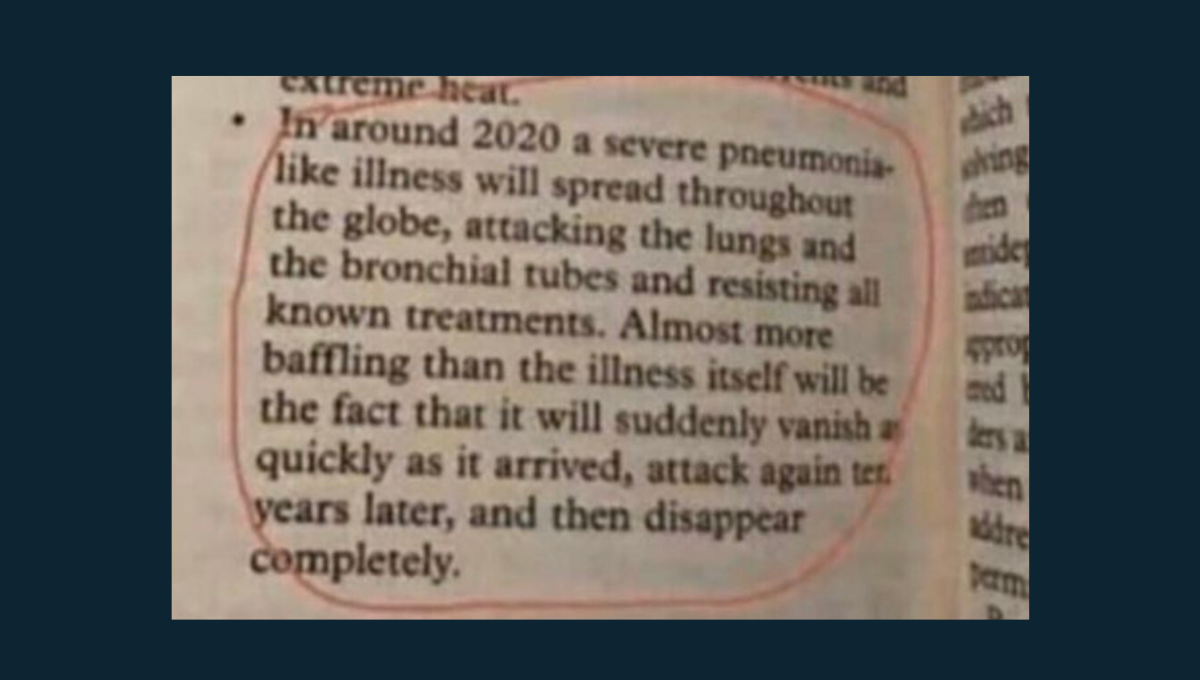
The quote above is from a prognosticator who claimed to have psychic powers.  It sounds really scary and accurate - how could she have known?   Well, not long before she made the prediction there was the SARS epidemic, and it was a pretty safe bet that epidemics would happen in the future. Epidemiologists, who use more than psychic powers, have been saying all along we were overdue for some sort of epidemic like the Spanish flu, as these things do strike periodically, and we still do not have a handle on controlling viruses.

Simpsons predicted it - or did they?

You might as well say The Simpsons predicted it, which they sort of did with their "house cat flu" episode. or South Park with their SARS episode.


South Park predicted it, too.


Or maybe Dustin Hoffman predicted it.

Even Hollywood is in on the act.

But of course, Hollywood predicted a mega-volcano, alien invasion, a new ice age and even six ravaging episodes of Sharknados.   None have come to pass - yet.  (Cue hoo-doo music).

Predicting the future is not an exact science - in fact, it is the hardest thing to do.   But if you predict everything, or at least make a whole lot of predictions, well some of them will come true, and you will be seen as a psychic genius or futurist.   Just don't talk about the things that didn't quite work out. 

In a way, it is like end-times theology, which in its current form is a relatively modern invention.  People have been taking one of the most obtuse books in the Bible - Revelations - which by all accounts was written by an insane ex-Rabbi, and then projecting the vague and weird predictions onto current events - for over a Century now.   The Anti-Christ?  Surely he has to be Hitler, or Stalin, or maybe Obama or Trump - right?  You fit the data to the theory, rather than the theory to the data, and like any good conspiracy theory, you can twist things around to show they match up, kinda sorta.

So what's the point of all this?   Nothing I guess.  I just thought it was interesting.   But maybe I can learn some things from this:
1.  Selection bias is a real thing - we tend to see people as "winners" in the marketplace when often they are little more than lucky.  They may have some insights, but also may be statistical outliers, too. 
2.   Prognosticators and futurists can always claim they were "right" about things, either by just lying about it (who is going to spend the time and effort to check?) or by selectively picking from among thousands of predictions, the few that came close to being true. 
3.  Spending money on a psychic reader is just stupid, even if just for "entertainment" purposes.   These folks are crooks and con artists - just stay away.  If you believe in that sort of thing, you life is going to be one difficult trial after another - which probably will send you back to the psychic for more "advice"!
Since we can't accurately predict the future (and thus buy the winning lottery numbers) the only realistic thing to do is diversify your portfolio, put aside money (instead of trying to leverage small investments in to big "wins") and pay down debt over time.

Not sexy, is it?   You could never sell an investment book or a futurist book with such boring advice.


UPDATE: see my posting about diecast racing. It's a classic example of selection bias. With a color commentary, the authors of those videos make it sound like there's actual drivers of the diminutive cars. But in reality the car that advances up through the ranks is the one lucky enough to win each race which is largely a probability event.

Nevertheless, you'll find yourself rooting for one driver over another.  Fun to watch!

Tired Old Tropes About Food

Penelope Pitstop - pepper sneeze - YouTube
We were raised with a lot of tired old tropes with regard to food.  Food, we were taught, was dangerous and scary, unless it was safe and bland.

I was chopping garlic this morning so Mark could make a meatloaf.  He puts ground beef, pork, Italian sausage,and even bacon in it - among other things, of course!  And I got to thinking - which is dangerous, I know - how when I was a kid, garlic was viewed as something humorous or perhaps even dangerous.  Only stinky-breath I-talians put garlic in anything, and even the tiniest amount was "too much!"  How times have changed, at least for me personally.  From what I can fathom, though, it seems most Americans are still on the bland diet.

It struck me there are a host of tired old tropes about food, and as kids, we were fed these in the cartoons of the day.  What am I talking about? Well, these kinds of things:
1.  Ground pepper makes you sneeze:  In the cartoons, when someone wants to make someone else sneeze for some reason, they place ground black pepper up their nose or somewhere where they inhale it.  The message was clear:  Don't mess with that black pepper!   Dangerous stuff!  Only to be taken in tiny doses! 
2.  Chopping Onions makes you cry:  Not just eye-watering, but when you chop onions, you'll become emotionally overwrought as well.  Sometimes, once in a great while, my eyes might water slightly when chopping onions.  As of yet, however, they have failed to make me reconsider my life choices. 
3. Garlic is bad:  It makes your breath bad and doesn't taste good.  Only those greasy I-talians would like it!  Stay away from garlic!  Maybe a pinch of garlic salt now and then, but don't go crazy
4.  Hot peppers are bad: In the cartoons, someone eats a hot pepper and they turn red or their body turns into a giant thermometer with the mercury zooming up to their head, where it explodes.  Spicy foods are just plain bad, bad, bad!  Stick with white bread and milk, kids!  Don't try those dangerous spices!
5. Hot sauce is dangerous:  The ladies auxiliary here on the island put together a cookbook in the 1970s, when the ladies-who-lunch did that sort of thing.  It is an interesting time capsule into what you could make with what little was sold at the IGA back in the day.  Back then, when you said "lettuce" you didn't have to specify what kind as there was only one - iceberg.  In some of the recipes, they call for hot sauce or Tabasco sauce - "two drops" in an entire casserole.  Way out there, I know!
There are many more, I am sure, and new ones are being coined every day.  One more recent trope on the Internet that I despise is the running joke about Hawaiian Pizza.   Only a apostate would put pineapple on a pizza!   It is sacrilege!   Well, calm down, bland-boy, and try something other than "meat lovers" pizza for a change.  Try a Hawaiian pizza with prosciutto ham and put some of those jalapeno slices on it.  Spicy and sweet go together (you have had American Chinese food, right?) and the result can be sublime.  But the gag has been going on for so long that I am sure a whole generation has never even tried a good Hawaiian pizza, but rather rejected it outright because of peer pressure.

They likely never had a good pizza for that matter.  The stuff the delivery guy brings to your door - it ain't pizza.  Loaded with cheese and meats, most have sodium content off the charts.  Maybe it is good in its own right, but whatever the heck cheese-stuffed crust is all about, it really ain't pizza.

So what's the harm in these old tropes?  Maybe nothing, but then again, stereotypes rarely are useful in real life.  They can prevent you from trying new and different and better things.   I know people, well into their 80's, who drink nothing but lite beer - and only a very specific brand.  I know people who think being a gourmand or as they call it, "foodie" is to express a preference and an insistence on Coke over Pepsi or vice-versa.   So sophisticated!

Of course, there is a little racism involved, too.  Like I said, those I-talians and their garlic - but also those Mexicans with their hot chili sauces.  Ouch!  They're too spicy!   Or those silly French with their soft cheeses!  Stick to good old American Orange Cheese or die!  Please give me a break.

I could go on and on.   Fear of Kimchi, the Korean staple.   Or Japanese sushi - referred to derisively as"bait" by know-nothings.  Or Indian food - again, "too spicy!"   Like I said, a lot of this is wrapped up in a delicious crunchy won-ton wrapper of racism and not-too-subtly, either.

I don't claim to be a sophisticate - my tastes are probably plebeian as well.  But I don't kid myself when I am having a corn dog that I am a sophisticate, even as I drown it in hot sauce.  The sad thing is, these tired old tropes prevent people from trying new things.  Even as some of these old tropes go away (I think the black pepper thing seems to have died a peaceful death) new ones, such as those about Hawaiian Pizza or French Cheese, seem to emerge.

Speaking of new tropes, there are two more I am not fond of. The first is the irrational idea that "real" chili can't have beans in it, and what's more, a chili made of nothing but ground beef is somehow better because it isn't "watered down" with pesky ingredients. If you just want to stuff your face with ground beef, be my guest, but don't call it chili.   Any idiot can brown a pound of hamburger and then pour ketchup on it.

The other one has to do with meatloaf or meatballs - the idea that putting breadcrumbs, rice or other "fillers" in a meatloaf is bad, because again, watering down the beef content.  Does the American beef industry actively promote these tropes?  Probably.   The reality is, like most of - if not all of - cuisine, these dishes were created out of necessity and poverty.  Chili was a way of taking some beef that was perhaps a wee bit past its prime, and adding spices and beans, and onions and peppers and whatever, to make it something more than ground beef.   Meat loaf wasn't just a way to bake a few pounds of ground beef to serve it, but to stretch the amount of meat with some fillers and to make it more flavorful with spices, onions, garlic and whatever.   Taking away those "fillers" doesn't make these things better, it makes them worse.

There is a trend in America to over-do things.   If 300 HP is good, then 700 HP is obviously better. Sometimes, though, it is more fun (and challenging) to drive a slow car fast, than a fast car slow.  If a quarter-pound cheeseburger is good, than a full pound of beef stacked so high that it would not fit in your mouth (and mostly end up on your shirt) has to be better.  The American tendency to "more of everything" sometimes means we end up with less.

There is hope, of course.   Since the days of my upbringing, the American diet has become more varied.  No longer is the lettuce section at the grocery store limited to one variety, but today has nearly a dozen or more.  We discovered Mustard comes in other colors than bright yellow.  Hot sauce, once viewed with suspicion, is embraced more fully - perhaps as a result of the explosion of chicken wings (I will go out on a limb here and decry "Teriyaki" wings as an abomination, or at least something other than real Buffalo-style wings, but again, could be good in their own right).  You even hear rednecks at Nascar talking about "summa that brie-cheese" or "that-there camel-bear".  Soft cheeses have made it to the trailer park!  What's next, tofu?

Let's not push it.  Although I tricked Mark's brother into liking smoked tofu by telling him it was a kind of smoked cheese.  And served sliced, on a cracker, it is pretty darn good.  His buddies who hang out at the local hardware store, told him that tofu was some sort of runny mess of white paste swimming its own juices, that only hairy lesbians and Hillary supporters would eat.  And he believed it.  People are so afraid - afraid to be different, afraid to try things.

Like I said, there is hope.  But please, for the love of God, let's put these tired old tropes to bed!