Monday, November 20, 2017

What If They Had An Economic Boom And Nobody Came?

How can a consumer-based economy work without consumers?

There is a lot of talk in the press about how great things are going and how even greater they are going to get next year and the year after.   Company after company talks about projected profits and how their sales are expected to rise in 2018, 2019, and 2020.

And the stock market is rewarding them for these projections, which seems to me to be a little bit premature.   We are told that the new tax bill will put more spending money in the hands of the average American, who will go out and buy more and the economy will expand further.   The problem, is, the tax bill largely favors the rich.  As one Senator put it, "My donors called and said to get this done or don't bother calling back!"   It is rich donors driving our government, not the people.

And already our economy is divided further and further in to two groups, the very rich and the very poor.  The middle class is disappearing to large extent.  As I noted in another posting, talk to any boat salesmen - they can sell mega-yachts or rowboats, but nothing in-between.  The days of a young married couple starting out with a 21-foot cuddy cabin and working their way up to a 55-footer are long gone.   Today you either buy big or go home.   There is no room for the middle class.

The working poor and what remains of the middle class (which are two groups that are rapidly combining) are taking on more and more debt and saving less and less.   How exactly are these folks going to benefit from their $700 a year tax cut?  Most would merely apply this money to their staggering debts, or it would merely offset inflation.

Republicans like to say that "a rising tide lifts all boats" but I think it is essential that the smaller boats be lifted first.   One reason marinas and other maritime facilities are shrinking is that there are fewer and fewer middle class people who can afford to own boats.   And while this may make more room for the mega-yachts, the very wealthy should bear in mind that what keeps the marina in business isn't one or two mega-yachts, but boats of all shapes and sizes filling every slip.

And the same is true for our economy.   Sure a tax cut for the very wealthy sounds great - if you are very wealthy.   You take that money and invest it - but in what?   Buy some GM stock - but who is left to buy the cars?   Your investments will tank if no one is left to buy the products that your company makes.  You need all these "little people" to buy cars, cell phones, cable TV, data plans, fast-food meals, consumer loans, and all the other things that American companies offer for sale to consumers.   Without customers, though, it all falls apart.

And I think that message gets lost sometimes.   Many on the right want to cut welfare programs - but not corporate welfare, of course!  But the two are intertwined.   Food stamps and other "government handouts" act as wage subsidies as well as a lifeline or safety net to the underemployed.   You can cut these programs, but it doesn't necessarily mean than the folks relying on them will spontaneously go out and get higher paying jobs.   They might just end up destitute - and spending money on nothing but basic sustenance.

The very wealthy also (should) realize that keeping "the masses" content is an act of self-interest.   When people become poor and destitute, they are more likely to riot and act out their aggression on the upper classes - and no amount of policing can keep that in check.

There is a lot of talk as to why crime rates have dropped dramatically since the 1960's.  An aging population, sentencing guidelines, and the war on drugs, are all offered as possible causes.   But a growing economy and greater economic security are also cited as reasons why people are less likely to engage in crime today than in decades past.

I don't know.  I just don't see it.   All this happy-talk about how the economy is going to take off like a rocket, when already we've been experiencing the greatest postwar bull market.   How much further can the market go?   These things go in cycles.   And I am not sure that a lot of folks feel that economically secure that they want to go out and spend and consume even more.

And without consumers, how can a consumer economy grow?

Sunday, November 19, 2017

The Myth of Amazon (And Walmart)

Are Amazon and Walmart going to "take over" retail as we know it?  Maybe not.

The media is still all agog about Amazon, which is probably because one of the largest media outlets in the country is owned by Amazon.   We are told that Amazon is causing "retail Armageddon" or that it is the "death star".   Amazon, we are told, will take over retail and put every brick-and-mortar store out of business.

We are told.

We are also told that the "last man standing" in brick and mortar is Wal-Mart, who like Amazon is "putting everyone out of business" with its low prices.   Once Wal-Mart comes to town, everyone else goes bankrupt!

We are told, anyway.

The reality is more complicated that that.   Retail is a business that anyone can get into, without a lot of capital investment.   There are no Patents or Copyrights involved in setting up shop and re-selling goods.   And this goes double for the Internet.

Recently, I made a number of purchases of parts and materials to do a makeover on our camper.  The 18-year-old carpet was kind of nasty, so I ripped it out and bought some vinyl flooring at Home Depot.  I hope to post a video of it soon.   At the same time, I replaced or upgraded a variety of items - adding lights inside the cabinets, installing new swivel chairs (the old ones were serviceable, but getting worn) and replacing a number of bits of hardware.   About half of this stuff was bought online, and half at the local Home Depot.   Wal-Mart doesn't carry RV parts, other than a small inventory of accessories.  And their "hardware" section is, well, as you know, kind of an afterthought joke.

But what about Amazon?   Certainly you can buy anything on Amazon, right?   Well, I ended up buying only one thing - a set of table bases - and that was a mistake.   Although they offered "free" shipping, making the price less than eBay, I ended up buying another $30 worth of travel guides (we are going to Alaska) to qualify.   Score:  Amazon 1, Chump 0.    By the way, used library books on Amazon can be a good deal - hardly used and usually coming with a plastic cover protector.

But the best prices for various RV parts wasn't on Amazon - often Amazon wasn't even close.   eBay was often the best place for really cheap stuff, or the website of an RV parts store.   I noted before how Amazon's prices are somewhat high - and this is not counting the bizarre listings for $100 jars of Mayonnaise.   Not only that, but the product Amazon delivered wasn't the actual item I ordered (which was made by Edelbrock - the header people) but rather a knock-off with "Made in China" on it (of course).   No big deal, it worked OK.  But it was not the thing advertised.

Amazon simply isn't a bargain anymore - compared to other online sites.   Or put more succinctly, if I am shopping for something, I check Amazon, to be sure, but more often than not, I buy the item on some other site (eBay, for example) for far less.   Amazon's complicated "gotcha" checkout procedures are not an inducement either.   No, I do not want Amazon Prime, Sam-I-Am.   Nor do I want green eggs and ham.

And therein lies the problem for Amazon.   People buy things online because of lower prices and convenience.  If you take away lower prices and make it a hassle to find things (after wading through pages of bizarrely priced items and then making checkout a hassle worse than a timeshare presentation) people will move elsewhere.   And on the Internet, there is an awful lot of "elsewhere" to find things for sale.   Being an online merchant isn't rocket science.


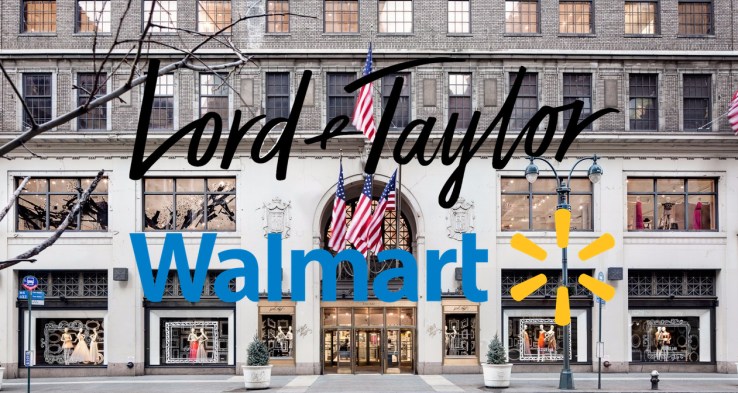
Wal-Mart is going upscale into the fashion industry, selling Lord and Taylor online.

But what about Wal-Mart?   As I noted before, Wal-Mart seems to be shedding its low price image and going upscale.  They are even now selling Lord and Taylor fashions online and have stated they want to become an "upscale" online fashion center.   This should be a shock to their regular customers.  And others have noted this as well.   Brand name products and high-priced items are slowly filtering into the store, displacing the cheap-but-good "Great Value" brands.   The other day, I could not find a 12-pack of seltzer at the store.   Winn-Dixie had it, though, at a very low price.   When Wal-Mart stops carrying the products I want and raises prices, I will shop elsewhere.   And I suspect a lot of other people feel the same way as well.

The "invisible hand" of the marketplace can be denied and skewed and diverted - but only for so long.  Eventually, people figure these things out.   I have a friend who cross-shops at every grocery store in town - and often has to make six stops to get all their groceries.   Maybe it isn't worth it to drive two miles to save 10 cents on a can of peas, but they do it.   And they report back to me (and to others) where the best deals are.   And increasingly, they are not at Wal-Mart.

Wal-Mart succeeded where others failed by offering staggeringly low prices and getting warm bodies into the store.   Many traditional grocery stores went by the wayside as a result, as their prices were far higher and selection less.   Sure, people will keep shopping at the old grocery store for years - out of habit.  But eventually, they will hear from friends and neighbors about the great deals at the "new" store and try it out for themselves.   And often, this converts them to the new store.

In 2009, this happened to us.  We shopped at Wal-Mart and were impressed by the variety of goods and the low prices.   We never went back to Publix after that.   So our loyalty is today to Wal-Mart.  But that loyalty could evaporate just as quickly, if they keep raising prices and concentrating on brand-names.   Something else will come along, and people will slowly figure out there are better bargains to be had elsewhere.

My recent experiences with Wal-Mart and Amazon are not an anomaly, I think.   Amazon is trying hard to make money, but with a P/E ratio of over 500, isn't making nearly enough to justify its stock price.  Their logic is that they are plowing money back into the business, so as to take over a larger and larger market share.   Eventually, after they put everyone else out of  business, they will make enough profits to justify their $1000+ share price.

Eventually.

But eventually could never come.   The idea that you can dominate a free-market in a monopoly fashion is a dream many a capitalist has had - a dream that eventually fails.   GM used to have 60% of the auto market.  Used to have, that is.   The problem, of course, was that others could and did take away that market share by offering better products at lower prices.   Back in the day, GM could afford to under-cut the likes of Studebaker or Kaiser by selling stripped versions of their cars for about the same prices.   You could buy a low-budget "Henry J" from Kaiser, or for a few dollars more, get a nice Chevy.   It is an old game - one that Wal-Mart played well back in the day, too.   Undercut your competitors and then run them out of business.  Profit.

The problem with this business model is that you never run out of competitors.  You end up playing whack-a-mole with each new entry into the marketplace, and cut your own margins - and your own throat - by lowering your prices in an attempt to not only compete, but run them out of town.  The vaunted "easy street" part of the plan when you have a total monopoly and can charge monopoly prices never happens as a result.

And the same is true for Amazon and Wal-Mart.   Yes, they are both huge retailers (Wal-Mart being substantially huger, though).   But neither has a monopoly in the marketplace and never will.   Neither will ever be able to dictate prices to consumers, so long as there is even one competitor in the market.  And for Amazon, that could be some kid re-selling junk he gets from China, using his own website.   The barriers to entry in online retailing are remarkably low.

So what is the takeaway on this?   I think the following:

1.  Amazon stock is horrifically overvalued.  They are not about to increase profitability by a factor of 10-20 in order to have a rational P/E ratio anytime soon.   Don't buy Amazon stock because you are familiar with the brand and use the service.  As I learned the hard way, that is the dumbest way to invest known to man.

2.  Wal-Mart could be vulnerable.   They have made mis-steps in the past, however, and recovered.  I think if we see recession in the future (and we will, eventually, we always do) the brand-name and high-price strategy will falter.  The big attraction for Wal-Mart is low prices.   Take that away, and all you have left is gawking at the other customers.

3.  Habit shopping is a bad idea.   We get into the habit of buying things on Amazon or eBay with "just one click" and don't bother cross-shopping on price.   It isn't hard, particularly online, to search for competing prices by typing in the product name or model number.   For brick-and-mortar, this is a little harder, but it can be done.   Going to the same store again and again out of habit is never a good idea, as prices can edge up over time and you might not notice it.

4.  The financial media's prognostication that Amazon or Wal-Mart (or both) are going to "take over" is a little overstated.   The mercantile business can't be protected with a Patent or Copyright.  There are other alternatives out there - and new ones being created all the time.  Don't listen to the financial press when they gush about things.  Usually that is a sign.

Friday, November 17, 2017

What a Fool Believes...

Note: This is a draft posting from 2015 that I just got around to finishing today! Hard to believe there are over 300 unpublished drafts....


Are we poised on the verge of a new age of enlightenment - or at the brink of a new dark ages?

Living in America, we often forget how horrific life is in the rest of the world.  In many, if not most, parts of the world, life is nasty, brutish, and short.

While we laud the legalization of Gay marriage in the USA, elsewhere in the world, Gays are still stoned, beaten, or burned to death - by a religion whose stated goal is to take over the planet.   We laud the advancement in women's rights here in the US - while in India, women are raped and in Africa, their genitals are mutilated.   We worry about racial inequality - and income inequality - in the United States, while in Africa, people are routinely slaughtered for being of the wrong tribe.   And in most parts of the world, there are the very, very rich, and the utterly destitute, with no "middle class" in-between.   Yet we whine about the minimum wage.

People are quick to point out that the sort of horrific things happening in the other parts of the world can't happen here or will never happen here.   But I disagree.  We are one crises or recession away from major social change.  Our country would never have engaged in torture, for example.   Even after the attack on Pearl Harbor and the internment of thousands of Japanese, the government did not resort to torture to extract information about spying or plots.   But after 9/11, well, for some reason, we almost expected it and then acted unconcerned when it happened.

And more than a decade later, we are learning what we should have known all along - that "confessions" obtained through torture are often worthless, as people will say anything they think you want to hear, if you torture them long enough.   All we did was give ourselves a black eye - well, and the people we tortured. 

Although we live in an age of high technology, it seems that superstition and primitive religions have become stronger than ever.   We've decoded the human genome, but we cannot teach evolution in school.  Fewer people are religious, but the few that are, believe that God literally wrote the Bible (on a celestial typewriter) and that every single word in it is God talking, and moreover that it is all incontrovertibly true - even the parts that contradict one another.   Even the Pope isn't that crazy.

We look back through history and see how people can lurch from rationality to insanity within a few years.   And people can commit atrocities in the name of freedom or nationalism - and the sweep it all conveniently under the rug later on.  During our own American Revolution - which was more of a civil war - people looted, sacked, and killed each other, based upon their loyalty to the crown or to the new State.  And after the war ended, many lost all their property and were forced to flee the country.   It was not the nice clean war we learned about in school - with plucky revolutionaries fighting paid Hessian soldiers.

Today, however, the "Founding Fathers" are viewed as religious figures.   And the reality of their lives - divorce, bigamy, adultery, and the like - is denied.  They were freedom-loving patriots, in an era where being "patriotic" meant swearing loyalty to the crown.   How can you be a patriot of a country that doesn't exist yet?

This isn't meant to take a shit on the "founding fathers" (a term coined in the last Century, not the 18th) but rather point out historical accuracy.   These were wealthy men fighting for the right to keep their money, and in some cases, their slaves.  And maybe when Britain abolished slavery in their own country and sought to stamp out the slave trade, it was less high-mindedness that was involved that a need to keep others from such rapid economic gain.  

Same reason they burned down the monasteries.

But I digress...

The point is - and I did have one - is that we have to stop feeling sorry for ourselves in this country and constantly positing that we are put-upon, over-taxed, and our "freedom" is at stake.   Compared to the rest of the world, we have a level of freedom that is dreamed of.  Not only that, we have more freedom and opportunity than any peoples in the history of mankind.

People from overseas get that.  And that is why, when many come here, they do remarkably well in a short period of time.  Despite urban legends and "fake news" rumors, immigrants do not get free furniture and wads of cash at secret government stores.  In fact, they don't get an awful lot and are expected to support themselves in short order.   And many succeed very quickly - unshackled from the limited potential of their home country, they rapidly flourish.

Others, well, they literally expected the streets to be "paved with gold" and wonder why life wasn't easy street when they got here.  In other words, they act like real Americans.

But again, I digress...

I think the real point is, we are poised at a precipice.   We have all this high technology and rapid communications, and yet people still cling to primitive beliefs - perhaps now more than ever.   Thomas Jefferson cut up his bible and pasted the parts he liked into a scrap book to make his own Bible.  Today, that would be considered heresy and he would not be deemed fit for public office.  There was arguably more religious freedom back then, than there was today.

Of course, today, he would be hounded out of Washington for sexually harassing his slave, Sally Hemings.  So maybe we are progressing, and not regressing.  It's so damn hard to tell.

It seems we have one group of people who want to go back to "the good old days" of white supremacy, sexual harassment, fundamentalist religion, dynastic wealth, racial discrimination, and religious superstition.   It is the year 2019 and we are still debating prayer in school and whether evolution can even be taught.

Worse yet, there are people saying they believe in a flat earth, and apparently they aren't kidding.

Of course, much of this is just baiting. We are being baited by many of these news stories about anti-vaxxers and flat-earthers and other nutjobs, positing that they represent some sort of new majority of thought, when in fact they represent an narrow outlier that is used by the news media to generate clicks.

But we've seen this pattern before. People throw away a perfectly good civilization or government because of perceived grievances that in retrospect were pretty trivial. The Weimar government in Germany was not overthrown during the height of the Great Depression, but many years afterwards when the economy was actually recovering.

Today, we are told that the country with the strongest economy in the world, with the lowest inflation rate, lowest interest rates, lowest gas prices, lowest unemployment rate, as well as the greatest amount of freedom offered to citizens anywhere, is somehow fundamentally flawed and needs to be overhauled with radical solutions from either the left or right.

Don't be a fool. Don't believe it.

Thursday, November 16, 2017

Rocket Jesus


Is the adulation of Elon Musk perhaps a little overstated?  Perhaps.

One aspect of the next tech crash will be Elon Musk and Tesla.  Musk has his share of supporters and detractors.  I am kind of neutral about him, personally.   Technology and investment should not be based on a cult of personality, but rather on the underlying fundamentals.

And coming from the car industry as a kid, I saw firsthand how ruthless a business it can be.   Margins can be razor-thin.  And capital costs can be staggering.  You invest billions of dollars in factories, equipment, and worker training, spend tens of thousands of dollars per car in labor, parts, overhead, and marketing, and sell a car worth $40,000 for a paltry profit of a thousand or two.   You'd be better off buying government bonds, in some cases.  Ask Henry J. Kaiser how simple it is to break into the car business.

Of course, for GM, Ford, and Chrysler, they can make up for this with $10,000 profit on a pickup truck or monster SUV - people pay a lot of money for empty steel boxes.   But even that strategy can backfire, as evidenced by the bankruptcies of GM and Chrysler in 2009.   What about Tesla?  Can they buck the trend of the last 70 years or so and become the independent carmaker who is not left in the dust behind the big-3 and foreign competition?

That is the conundrum.   There is no magic sauce in an electric car - Musk isn't selling something that other carmakers can't and aren't already copying.   Maybe he can sell the model S based on exclusivity and luxury - and indeed, in rich neighborhoods, you see them parked out front of the tony restaurant at the valet stand, next to the Porches, BMWs, and Mercedes.

But the model 3?  A car that looks and is priced like a Toyota Camry?   That is a car that has to compete on its economic merits, not on cache or perceived status.   And it is here that Musk may well fall down.  BMW is the most profitable car company on the planet as they are not just selling cars, but selling status and exclusivity.   Just as a befinned Cadillac in your driveway in 1959 showed everyone you had "made it", a trim 5-series sedan today says the same thing - that you have money to spend and are (allegedly) smart about how you spend it.

Take away that status and exclusivity and the BMW or Mercedes is as pedestrian as a police car or taxicab - indeed, what they are often used for in the rest of the world.  And that is not the only problem for Musk.   If he really attempts to "mass market" an electric car, he will need dealers and service centers to service them.  They just opened a Tesla service center in Jacksonville.  I drove by it the other day on the way to the wholesale club.   Maybe it was the hurricane, but it now says "ESLA" on the front, which is not a good sign.

When I drove by one Tuesday, it said "ESLA"

Mass-marketing cars is a whole different ballgame.  Sure, you can sell "boutique" cars with dealers only in limited areas.   Rich folks don't mind having their Ferrari flat-bedded to the dealer for an oil change - in fact, they get off on that sort of shit.   But for the rest of us?   There is a Chevy dealer in nearly every damn town we drive through.   You'd better be prepared for that kind of infrastructure, if you want to sell hundreds of thousands of cars.  GM, Ford, Chrysler, Toyota, Nissan, et al., already have this infrastructure in place.   When they get in the electric car game, it is game over for Tesla.

Of course, the big problem for Rocket Jesus is money - or the lack thereof.  He isn't making any, but rather has been hemorrhaging cash since the get-go.  Tesla was poised to make money there for a while, but then the model-3 came out, along with the purchase of solar city.   Both could be smart moves, I guess, if they made money for the company.   And in order to make money, you have to sell product.   And they aren't selling many model-3's because they aren't making many of them.  And solar city seems to have gone dark, other than some grandstanding operations in Puerto Rico.

And as I noted before, we have an administration who would rather see cars powered by coal.   It is not going to be a friendly regulatory environment for electric cars or solar panels.  The new tax bill could roll back or eliminate many tax credits and other incentives.   The ITC has found that Chinese companies are "dumping" solar panels on the marketplace, and now it is up to President Trump (I throw up in my mouth a little bit every time I say "President Trump") to decide what tariffs should be applied to solar panels.   If he goes along with the complainant's suggested import duties, many suggest that solar installs, which are already slowing in the United States, will grind to a halt.   The purchase of Solar City will start to look like a bad bet for Tesla.

And questions will be asked - pointed questions - as to why Tesla bought Solar City when Musk and other insiders had investments in Solar City.  The specter of self-dealing will be raised and shareholders might be more than a little miffed.   A shareholder derivative suit may ensue - well, it already has ensued.

But what about Space-X?  Is that making a profit?  Bloomberg claims so, back in 2015.  Others are guessing at the answer - using "scenarios" to calculate potential profits, as Space-X keeps financial information pretty close to the vest.  The folks at Motley Fool can't figure it out, either - guessing at profits based on scant information the company provides.  As a privately held company, they don't have to disclose their finances.

Frankly, I think these "analyses" are rather optimistic.   Space travel is staggeringly expensive.  Space-X has been stealing launch business by undercutting industry giants like Boeing.   In other words, they are likely losing money on each launch, just to get their foot in the door - hoping later to bring costs down through re-usability of the components and eventually make a profit.

A nice theory, but it won't work - or work as well as they'd like.   In space travel, every system is mission critical.  We stopped flying to the Moon, even though we had several Saturn-V rockets and Apollo space capsules laying in wait (which were later used for Soyuz and our first ill-fated Space Station, Skylab).   Why?  It was incredibly fucking dangerous and we nearly lost two crews.    People forget that Neil Armstrong took manual control of the LEM at the last minute, and landed the craft with seconds of fuel to spare.   It could have turned out very, very badly if circumstances were different or if he had hesitated a moment longer or his landing skills weren't up to snuff.   And then there was Apollo 13, which illustrated dramatically how one tiny flaw in a wiring harness can cause all sorts of trouble.

So, if you want to re-use a rocket component, that is fine and all - the Space Shuttles did it for decades.  But  you end up inspecting, adjusting, fixing, and replacing every damn millimetre of the thing, in order to insure it is safe.   And as we learned from the Space Shuttle, twice, sometimes that's not even enough.   The end result is, re-usability or not, the costs of going into space are pretty staggering.   And you can only sell launches for below cost for so long.

Now don't get me wrong, I am not anti-Musk or anti-Tesla.   I think the entire concept of electric cars recharged by the sun is a great idea.   And eventually, I think it will happen.   But first to market is often last in the marketplace, and Musk is basically being the sacrificial lamb here - prodding more mainstream manufacturers to move forward into this electric and solar era.   And once Trump and his cronies are out of office, maybe this idea will have legs.   In the next few years, however, it will be tough sledding.  As a personal investment, I don't think Tesla stock is a good buy for the small investor.  If you buy this stock, it is for emotional reasons not logical ones.  Even Musk is embarrassed by the stock price!

I think also that I am not fond of the idea of these "Tech Messiahs" who the press puts forward as the mythical gatekeepers of the future.  We are told that Bill Gates, who once said the Internet was a fad, has some special insight into technology and futurism.   He doesn't.   But if you want to sign a licensing agreement, you might want to run it by him.  The deal he made with IBM was what made him rich.   He is not a "tech guy".

It is sort of like how the press hangs on every word Stephen Hawking (whose personal life was a bit of a train wreck) says about futurism - as if every scientist knows everything about every technology.   Granted, the guy is a genius in the physics business.  Ask him about quantum gravity.   I am less sure he is an expert in "AI" (whatever the hell that is - it seems to be a catch-all phrase these days, like "block chain" - repeat it often enough and you will sound smart).   But the press reports breathlessly that Hawking is warning us about "AI" or global warming or whatever - things outside of his purview.   It is sort of like these Einstein "memes" that are bandied about, where poor old Albert is said to give his views on everything from economics to your sex life.   Most of these are things he never said, but even if he said them, what does a theoretical physicist bring to the table here?

Worse yet are the mere business-people who are hailed as "tech geniuses" such as Zuckerberg, Bezos, or that crazy guy who started Uber.  These are mere merchants in the marketplace, but we are told they are "tech" people and have special insight into everything from robotics, to "AI" (again) to politics, economics, futurism, global warming, or whatever.  And I guess you could argue that Musk, who made his money with PayPal (a mercantile endeavor if there ever was one) is part and parcel of this group - but at least he has earned his chops in the space and electric car business by actually doing things in these areas.

Put not your faith in Rocket Jesus - or any of his modern-day disciples.  Worshiping famous people or rich people is to worship a false God.  This is not to say these are bad people or that they have bad ideas, only that we should not place them so much on a pedestal.

Because unlike Gods, humans have a tendency to fall off.


UPDATE:  Some people like to hero-worship too much, and apparently my blog entry upsets their world view.  Surely these great men of our era are Ayn Rand style gods, right?   A reader writes that he read a book by Bill Gates, and in it, he says he foresaw the importance of the Internet.  Bullshit.  Sorry, but I was there, as were a number of other people.  Microsoft dropped the ball on the Internet, but of course, later on, put Netscape Navigator out of business by making IE part of Windows (just as the put WordPerfect out of business by bundling Word with Windows, originally).

Of course, maybe our reader read the revised edition of Bill Gates' book - where he suddenly has a road-to-Damascus experience and decides the Internet is the next big thing.


Tuesday, November 14, 2017

Dinner For Eight

Restaurant meals with more than 4 people can be problematic.

A reader writes, in response to my previous posting, that he dreads going out to large group dinners. And it's something that I wholeheartedly agree with.

Don't get me wrong, I enjoy going out for meal with another couple - maybe as many as six people in a group.  But beyond that, it just becomes cumbersome and difficult.  Of course, it is even better to have dinner at someone's house or have someone over for dinner at your house then to eat out in a restaurant.  Not only is it a lot more intimate and fun, it is a lot less expensive.

But here on retirement island, we have a number of friends who say things like "let's all go out for dinner together!" - wanting to get together a group as many as 8 or 10 or even 12 people to eat at a restaurant.  The problem with this is multi-fold.  First of all, when you come into the restaurant and ask for a table for 10, the waitress is going to give you the evil eye, and for good reason.

Look around any restaurant the next time you go on into one.  There are tables for two - the so-called "two-top" - as well as a number of four-tops and maybe even a six-top.   But there are not very many 8, 10 or 12 seat tables in most restaurants.  Moreover, most restaurants don't really like to see large parties for a number of reasons.  And there was a reason why they usually tack on a mandatory gratuity of 18% or more for parties of 6 or more.

Simply stated, from the restaurant's point of view, as well as that of the server, big tables are a big pain in the ass.   It's very hard to cook a large number of entrees and have them all come out at once - and have them all come out well.  If you're cooking for a party of 2 or 4 or even 6, this isn't too difficult.  But with much larger tables, it's very hard to make each entree come out so it is served at the perfect temperature and perfect doneness for each person in the party.  And oftentimes, one set of entrees comes out at one time, and another set ten minutes later.  As a result, either half the party has to start eating, or face dishes of cold food.

And large tables are often at disruption to the restaurant.  The servers have to scramble to assemble smaller tables into one larger one.  And if the party doesn't show, they've tied up an awful lot of their tables which could have been given to other diners - which is why a lot of restaurants refuse to seat people until the entire party has arrived, particularly large parties.  Not only that, but large parties tend to be loud and boisterous which is often disturbing to the other patrons.

But aside from the difficulties the restaurateur has, dining in large parties is often not very fun for the diner either.  In a large group, you can hope to maybe talk with the person on either side of you or perhaps somebody across the table.  But it is impossible to carry on a conversation with everybody else at the table, particularly in a noisy restaurant.  Thus, instead of being a party of 8, 10, or 12, you're really just a group of two or four tops dining together at adjoining tables.  Why bother?

I've been to some of these nightmares and it is very interesting.  Even though I am dining with people for an hour or two, if they are at the other end of the table I never get a chance to have more than a word or two with them.  It is almost as if we were not dining together at all, in fact we were not.  And if that is the case, then why bother going out to eat together in an unwieldy group?

This is less of a problem when dining at home, as it is quieter and is possible to have conversations across the table or down the table.  But in the noisy restaurant, you have to shout to hear yourself heard, which is probably one reason why large groups are often so loud and noisy.

And there is the issue of the check. As I noted before, restaurants routinely add on an 18% gratuity for large groups, apparently because some groups don't tip very well.  How to divide up the check becomes problematic.  Some people insist on separate checks, which some waitresses are very adept at handling.  Here in the South, asking for separate checks is quite common, but in other areas of the country, it is not only uncommon, but restaurants will refuse to do it.

When I worked at my first law firm, I used to go out to lunch with a number of other associates, which was a really bad idea career-wise.  We would spend an hour and a half at some Chinese restaurant in Chinatown, and come back to work bloated with food and sleepy.  However we always brought along one of the associates whose name was Bruce, as he could mentally divide a check in his head, accounting for what each person at the table ate, and how much it cost.  He had a genius knack for this, that made it worthwhile to take him along on these outings of 8 to 10 people.

But like I said that was a bad idea from a career perspective.  Partners seeing you come back to the office late from lunch are not very impressed with your work attitude.  And usually the conversation at such luncheons turns to how awful work is and what a rotten place the law firm is - things that are not necessarily good for your psyche.   But I digress.

Worse than these group dinner outings, here on retirement island we have a number of supper club type organizations which get together on a monthly basis to have group dinners.  These are taking the group dinner nightmare to the next level.  Rather than just a group of 10 or 12 people, they get together with five or six tables of 10 to 12 people each.

One of the supper clubs actually expects members to invite as many as 10 people to a table and pay for their dinner, which is a rather expensive proposition.  I'm sure it started out as an interesting social experiment, but it is sort of kept going with a life of its own.

And unlike a cocktail party, these dinner meetings are not necessarily a means of socialization and mingling.  At a cocktail party you can walk around and talk to different people and introduce yourself and have brief conversations with a number of folks.  At a sit-down dinner party, you can only talk to the person on either side of you, particularly at a circular table of 12.

And rather than mix up people so that each attendee sits next to somebody they haven't met before - something a good hostess knows to do - they instead tend to stay within their particular groupings so that each person at a table already knows everybody else at the table.  As a result, newcomers are often shunted off to the "newcomers table" which is akin to the rickety card table that children are forced to sit at at Thanksgiving.

I recounted in earlier posting how we were invited to a party on nearby rich people's island. The hostess made an attempt to mix up the table seating as there were probably 30 people in attendance - far too many for a reasonable dinner party.  Nevertheless, she tried to make it fun and came up with table ornaments and name cards using a beach theme.  She intentionally mixed up the seating arrangements so that each person would be seated next to at least one person they had not met before and thus generate conversation and socialization.

Unfortunately a boorish group came in and saw the table settings and swept them all aside and said "we're all going to sit here" and just disrupted the hostesses plan.  This is an astonishing breach of etiquette on their part.  As a result, everybody ended up grouping into the same cliques that they were in before the party and no one really interacted with anybody else other than their existing friends.

We ended up sitting in a table in the kitchen with some friends we had come with, and decided quickly to leave.  There was really no point in going to a party where you don't meet anybody other than the people you already know.

Some friends of mine were invited to one of these supper clubs here on the island.  They reported that they when they went there, all of the tables were filled and they didn't have a chance to meet anyone else at the dinner.  Then end up sitting at a half-filled table with a number of other newcomers.  The people who had invited them did not even sit with them.

A friend of mine tried to invite us to one of these supper club nightmares but we politely declined. When she asked me why I didn't want to go, I replied "I already lived through high school once, I don't need to go through that again."

I think perhaps that some people believe in the old adage, "the more the merrier," and feel uncomfortable in small groups, as small groups are very intimate and in-your-face.  When you're sitting down in a group of two or three or four people, it is a much more intimate experience than being in a table of 6, 8, 10, or 12.  And many people are uncomfortable with intimacy.

In fact, I guess most people prefer to be superficial.  They want to put on a "face" to society - an image of who they believe themselves to be.  People do not like to discuss the more intimate aspects and details of their lives with others.  And I guess this ties into this obsession people have today with so-called privacy - this idea that they have this private life that is so, so top-secret, while at the same time spilling their guts out on Facebook.

So they prefer the group gathering to the intimate dinner, because it is less threatening to them.  In these group dinners, the conversation is superficial and there's a lot of guffawing and laughing going on, but not a lot of serious or deep conversation, the latter of which makes most people uncomfortable.  Again, the large group in the restaurant tends to be the loudest, and not merely because of their numbers.

Smaller groups are more interesting, I think, because people tend to say more interesting things.  It is hard to be glib and superficial when you are sitting face-to-face with another person in a more quieter environment.  More interesting and profound things get said.

I guess, in a way, this is why some people like to go to noisy and crowded bars - something I never really understood.  When I was younger, I used to go out with my friends to the bars and discos but was never really happy going there.  My friends all wanted to go and they said it was a lot of fun, and I guess I went along with the crowd because everyone said this is what you're supposed to do.

But at the end of the night, I find myself an awful lot poorer having paid for a cover charge and expensive watered-down drinks.  And of course I'd be half deaf with my ears ringing from the loud music and even louder conversation.  People had to nearly scream at each other to be heard over the sound of the music in the crowd.  And of course, back then, they allowed smoking in bars, so basically had to set fire to your clothes when you got home because they stank so badly of cigarettes. Going clubbing - what's not to like?

This is not to say I always had a bad time. I remember we went to see the Squirrel Nut Zippers at Club 9:30 in Washington DC back in the late 1990's, and it was an awful lot of fun with a group of friends.  Back then they have a cigar bar in a martini bar and we had a great seat on the balcony overlooking the stage. Of course, they weren't really a overly loud band and the crowd was pretty laid-back.

We were turned with a different group of friends a few months later to see a Hootie and the Blowfish (remember them?), and the audience was mostly middle-aged drunken white people.  It was not nearly as enjoyable experience as the place was packed shoulder-to-shoulder and the music was deafeningly loud.  The contrast between the two experiences was interesting.

Maybe this is another aspect of the madness of crowds.  That group-think is really not thinking at all, but merely cheerleading for each other.  And that can be fun perhaps once in a while.  But I think overall I prefer more contemplative and intimate experiences.