Monday, December 24, 2018

History Repeats, But Never Quite the Same Way

We are heading for recession, but this time will be different, but yet the same.

There are a number of ways to predict when a recession is coming, when you are in it, and when you are out of it. A recent interview on Marketplace with a member of the government agency responsible for monitoring such things illustrates how difficult it is to predict such things.  Their judgement on recession or lack of recession takes months to process.  By the time they indicated the recession of 2009 had started, it was already several months underway.   Backward-looking statistics are fine and all, but without a time machine, kind of useless, except to historians.

One interesting way to predict a recession, I think, would be to count the number of articles online about recession, using online analytics.   You could even use social media data to see how many people are discussing recession as well.  I think such a system could be predictive, as prior to the meltdown of 2008, there were plenty of articles discussing the "froth" of the overheated housing market.  The signs were there for everyone to see - yet most of us refused to see them.

Markets go in cycles, this much is undisputed.  And the longer a boom cycle goes, the harder the bust will be.   Without Trump's tax cuts (and the goosing of the economy over the last two years) we might already have entered recession territory - a mild recession perhaps.  But over the last two years, companies have been using this windfall money to buy back stocks and do other things that really do not bode well for future productivity, but spell huge short-term gains for people who live and die by share price - such as top executives who are paid in stock options.

Unemployment is at an all-time low, but it was also during the Clinton years in the 1990's.   I remember those times - business was booming and we hired more help to dig our way out of the backlog of work.  Every business was doing just that.  But these last to be hired were the least productive employees for a number of reasons. They had the least amount of training, for starters.  And since unemployment was so low, we were scraping the bottom of the barrel to find people - and paying the highest possible salaries to attract them.

When the economy cooled down, we laid those folks off first.  We realized then that they were the least productive people and in fact, probably cost more in salary and benefits than they generated in additional income for the company.   And I suspect a similar thing is happening today.  There are stories abounding about new hires "ghosting" companies as they take other job offers and don't want to be bothered give any sort of notice.   We saw the same thing in the 1990's, but the term "ghosting" wasn't in the lexicon back then.

The housing market today is overheated - in selected markets.  This is less like the market of 2008 and more like the market in 1989.   In 1989, we saw a lot of overbuilding of office space in some metropolitan markets, along with speculative overbuilding of residential properties in select metropolitan markets.   2008 was a different deal, where everyone, it seemed, refinanced their house and was convinced that they lived above a gold mine that could be mined perpetually for more equity to spend.   Again, in selected markets, such as Florida and Nevada, builders overbuilt, particularly condos, which tended to zoom up in price the fastest, and fall just as quickly.

This time around, it will be the same, yet different.   In addition to a general slowdown in the economy, we have rising interest rates.   I have hammered time and time again in this blog that the price of houses isn't determined by some inherent metric, or the cost of land plus the cost of construction (plus a "reasonable profit" tacked on), but rather by the laws of supply and demand - and how much people can afford in terms of monthly payments - as most folks buy using mortgages.   Today, we are seeing a lot of older, cash buyers, and they are skewing the marketplace.

But even those prices track what the mortgaged buyers can afford in monthly payments.  And when interest rates rise, even 1%, it decreases the amount the borrower can afford to pay.  Assume that Joe Blow can afford to pay $1000 a month for a house in a hypothetical town.   If interest rates are 4%, he can afford to pay about $209,500 for his hypothetical house.  If rates rise to 5%, the amount he can afford to pay - at $1000 per month - drops to $186,300 - a drop of $23,200. 

In the olden days, when we had to put down a 10% down payment (or more) this meant that you maybe lost your down payment amount (at least temporarily) in terms of your equity.   But in 2008 - and indeed, today, this means you may be "upside down" on your loan, for some time.   In 1989, when we bought our first house (at the height of the market) this is exactly what happened to us - but we had put down 10% as a down payment, and at worst, if we had to sell, we would have walked away with nothing, as opposed to walking away owing money to the bank.

And I guess, like a college education, buying a house with borrowed money can be like trading in derivatives - you can end up owing more than you paid!   But this only occurs when you leverage yourself too far or buy in an overheated market.

But getting back to the monthly payment mentality, it is a pretty inflexible rule that people cannot simply afford to pay more money for something, just because prices go up.   Unless wages go up accordingly, Joe Blow is stuck.  If he wants to pay more per month for the house, he has to cut his budget somewhere else.  Maybe this means he doesn't buy that new car he was thinking about, or he cuts back on his cable bill, or cell phone, or buys fewer designer coffee drinks or eats out less.  Regardless of what he chooses to do, each one of these activities (including not buying the house) means that the economy slows further, as Joe consumes less.

And it isn't just interest rates.  As we saw in South Florida, exploding property taxes (in the five figures) and insurance bills (often close to that as well) meant that the amount people could afford to pay to service a mortgage declined.  For condos, increased condo fees and special assessments are also factored in.    Condos topped out in South Florida in 2005 with only half the units sold - sometimes none.   After the first year, the property taxes - based on actual sales prices - skyrocketed.   Condo fees went up after the builder turns over the Condo Association to the owners, who realize the builder was keeping fees artificially low.  Throw in a hurricane or two and rising insurance rates, and suddenly the "affordable" vacation condo costs twice as much per month as what you thought it would.

So you put it on the market - along with half of your fellow owners.   By 2008 you can't give these things away, and a foreclosure crises ensues.

This time around, it will be the same, yet different.   In many parts of this country, housing prices are still somewhat affordable.   There are still people today sitting on houses and condos that are worth less than what they paid for them in 2007.   Still others owe more money than their properties are worth.   How they survived the last decade in these underwater homes is beyond me - just as how Sears survived this long is bewildering.  But another recession and declining housing prices could be the nail in their coffin.

Speaking of Sears, there is a lot of chatter on financial pages about how mall owners are being creative in coming up with new uses for old malls - everything from pop-up stores, to retirement communities (Mall Walkers!) to even homeless shelters.  This sounds like good news, but it actually is the last dying gasp of these properties, many of which are decades old.  And most of these types of buildings have a design life of 20-30 years or so, and are very hard to adapt to other uses.  Most will be torn down, I expect.    If you have a lot of money tied up in REITs (Real Estate Investment Trusts), I hope it isn't too highly leveraged in malls.

Rising interest rates will harm other industries.  Ford had banner years in 2015 and 2016.  But lately, as interest rates rise, sales are slowing down.   Prices are also edging up, as the cost of materials (thanks, Trump tariffs!) jumps dramatically.  The new F150 has a body made entirely of aluminum, and the cost of aluminum has jumped.   It is not like you can switch to alternative metals on a whim, either - you have to redesign the whole truck.   But rising interest rates mean, once again, that monthly payments go up.  So Joe Blow can't afford to pay more for a new car or truck.   He either buys a cheaper model, or decides not to buy at all.

These are not gloom-and-doom predictions, just ordinary cycles in the marketplace.   And just like in 2008, or 1989, or indeed, 1929, the market will turn around again, and people will go back to work, and industries will recover over time.   In fact, a remarkably short period of time.   Most share prices recovered from the nadir of March 2009 within a year or so.   Granted, this meant some companies that were leveraged too far went bust.  It also meant that some individuals who were leveraged too far, went bust as well.

And sadly, the last time around, a lot of people made foolish decisions which only made things worse.  One retiree I met here on our island told me he sold all of his investments in March of 2009 and invested in Gold and government bonds, essentially locking-in a 50% loss in his portfolio.    Others did stupid things like cashing in a 401(k) and paying huge taxes and tax penalties, in order to "hang on" to an underwater house.  They sold off their retirement account - which is and asset protected in bankruptcy, to make monthly mortgage payments on a house, which usually is not.  And the house never recovered in value, and when they were done frittering away their life's savings on interest payments to a bank, the bank foreclosed anyway, leaving them with nothing.

Panic is not the answer.  Trying to "hang on" to bad deals is not the answer, either.  Cashing in your retirement is the dumbest answer of all.

A reader writes that the net result of the last recession was that those who had money made a whole lot more.  Those who had less, usually lost it all, or a substantial portion, anyway.   That does seem to be a pattern in these things, and some folks argue that folks on the Right like to see these volatile market swings (which are increasing in frequency and intensity) as it allows a few select people to make a whole lot of money in a short period of time.   Stable markets are not profitable markets, which was the major gripe of Republicans during the slow-but-stable growth era of the Obama administration.

But again, these larger forces at work do not entirely negate free will or the individual actions of the actors in the marketplace.   In other words, what you do in your own life has far more of an impact on your life than these nefarious actors and world events.

If a house seems unaffordable, maybe that is a good sign that it is.  Maybe the market is overheated, if you are spending a huge portion of your income on housing.   And maybe waiting for a better market - or searching elsewhere - is a better idea.  Or maybe just not buying into such a market at all is a good idea.   Rents are high, but you can't lose your shirt on renting an apartment, in most cases.

Whatever the outcome of the next recession will be, the person with the least amount of debt and the most amount of savings will likely do better than the opposite.   Of course, there are always the folks who are leveraged in debt up to their eyeballs and have no savings whatsoever - and who are crafty enough to walk away from the over-leveraged house two hours before the Sheriff shows up to evict them.   Or worse yet, somehow manage to convince the government to "bail them out" of an underwater mortgage (although history has shown that most people who get a "mortgage adjustment" usually end up losing their houses, just at a later time).

Myself, I have not done anything dramatic to prepare for this next recession.  I have sold off a lot of stocks and bonds over the last year or so, and thus have a lot of cash on hand.   But since I am retired, I need this cash to live on, so it makes sense to have it in the bank, and not tied up in stocks.  Later on, when I need the cash, I don't have to make the painful decision to sell at a loss at a time not of my choosing.

And a funny thing, too.  If I had left that money in stocks and bonds, today it would be worth exactly the same as a year ago, as the euphoria over the "Trump Bump" has worn off.   I managed to ride the first part of this bump in 2017, but got off the ride before it peaked in 2018.   Better to get off before the peak than to try to time it and get off too late - a lesson I learned back in 2005 when I sold out of the real estate market before it went South.

In March of 2019, I had no cash to invest (and still had a lot of debt).  I had $750 in my trading account and bough Avis stock for 74 cents a share.  It went up several thousand percent in price since then, and that $750 investment made me well over $10,000 in capital gains.   Sadly, I was not able to buy more stock (and other bets, such as Fannie Mae, didn't pan out).   This time around, I hope to be the guy with cash-in-hand, when it all goes South.

Well, I can hope, anyway.  Trying to time markets is nearly impossible to do, even when all the warning signs are there.

UPDATE:  A reader provides this helpful link to a Washington Post (our motto:  "Trump is a sad and lonely man, and we consider that a news story!") article that talks about google searches on "recession".

I am guessing that someone far smarter than you and I has already figured this out and is trading stocks based on social media data and google analytics.   If enough people are searching on "should I sell my stocks?" and "Is a recession coming?" or "should I buy gold?" you can make trades based on that data and make a fortune.

Or worse yet, you can use a troll farm to "prime the pump" and get people to panic or act against their own self interest.  Sort of like how Russia nudged us in the 2016 election.

Sunday, December 23, 2018

A Tale of Two Lawyers


An education is an investment, but more like a derivative investment.  Not only can you lose the money you invested, you can lose more!

A recent article on CNBC and MSN talks about how student loan debt can "balloon" to two or even three times the base amount borrowed.  I thought the article was going to be another whiny piece about how shitty millennials have it these days, but it quickly morphed into some common-sense advice on how to avoid this trap.

The article missed two salient points, however.  First, go to a cheaper school, if you are borrowing money.  Second, borrow as little as you can.  Live more frugally, get a part-time job - whatever you have to do (I did it, you can too!).   Major in something that will lead to a job, not something that sounds like fun.

The latter is important.  In another MSN money article, one of these financial "gurus" actually offered some good advice - learn something useful instead of "following your dream".   Dreams are fine and all, but often they remain just that - a fantasy.  And sometimes it is useful to have salable skills in this world.   Long before I became a lawyer and before that, and engineer, I learned to type, to weld, to plumb, to wire, and to fix cars and program computers.   These skills served me well, even today.

The problem with education today is that we encourage 18-year-olds to "follow their dream" and for a lot of them, this dream involves joining a frat, drinking a lot of beer, smoking a lot of pot, and playing a lot of video games, while majoring in "sociology" or "liberal arts" or even "general studies" - while racking up tons of "private" student loans to pay for their living expenses in addition to tuition.

If you are getting private student loans, that is a sure sign you are living too lavishly in college.

They say an education is an "investment" and that may be true.   Having an engineering degree and a law degree has paid off for me - allowing me to be self-employed for nearly 20 years and make more money and control my own life in a way that I would not have been able to do as a technician in the labs at Carrier.

But not all degrees pay off, and some can cost you more than your "investment".   I bought GM stock before it went bankrupt, and I lost the $5000 I invested in that stock.   I lost money, but I didn't have to pay back more than I invested in GM.   With a college degree, you can spend tens of thousands of dollars and pay back hundreds of thousands, if it doesn't work out.   If you don't get that job after graduation, and you stop making payments on your loans, well, the interest can be added to the balance and eventually the amount balloons out of control.

Now before you try to tell me how "lucky" I am to have lived in an earlier era where college cost $5 a year and how Bernie Sanders is going to make college free (good luck with that) consider the poster-boy the above article uses to illustrate the pitfalls of investing in a college education:

For example, law school graduate Rick Tallini borrowed around $55,000 in the 1990s. He's since struggled to find employment and pay the bills, and today his student loan balance has ballooned to well over $300,000.

Wait a minute.  I went to law school in the 1990's and ended up with about $38,000 in student loan debt.  But for some reason, mine never ballooned to $300,000.  Instead, I paid it off.  In order for this $300,000 scenario to play out, you'd have to never make a payment on the balance of your loans or refinance the balance again and again.

How was it that I was able to succeed as a Lawyer and this poor fellow is so hopelessly in debt?  Well, when I went to law school I already had the job I wanted when I graduated.  And I was working in a field where there was a high demand for attorneys.   I knew a lot of other people who were in law school who had never worked at all, and were borrowing huge sums to attend law school, and also to live a lifestyle they would never approach after graduation.

Like the undergraduate studying "Sociology" I ran into a lot of people studying "International Law" in law school - without any real understanding of what that meant, or what jobs that lead to.   I guess they envisioned themselves as these mythical "international lawyers" jet-setting across the globe, raking in six-figure salaries and solving tricky international legal issues.   Sadly, such jobs largely don't exist - they are a fantasy.

Yes, there are high-paying jobs with "white shoe" law firms, but only for a select few people from name-brand law schools who are in the top 10% or 1% of their class, who edited Law Review and participated in Moot Court competitions and otherwise distinguished themselves.  These students were groomed with law clerk positions while in school and then transitioned to six-figure salary jobs upon graduation.   They were the few and far between.

When I graduated, in 1992, a funny thing happened.  Some of the students I knew during school - who had cushy law clerking positions and implied promises of big-paying jobs after graduation - found their offers being rescinded.  Suddenly, they had all this debt and no where to go to work - and little or no real work experience.  A similar thing happened on a larger scale in 2008What happened?  The law of supply and demand kicked in.  Everyone saw that lawyers were making money, so everyone decided to go to law school.  In 1992, when I took the bar exam, I was part of the largest graduating class of my law school and the largest bar exam class in the Commonwealth of Virginia.

But I was lucky - or smart - in that I had a unique skill that kept me in business for years to come.  But even then, as you get older, your skills are less and less in demand.  I get letters from headhunters all the time with listings for jobs in the Patent field.  Most are for chemical or biotech engineers - or people with computer software experience - with "3-5 years experience".   They don't want someone with less experience or someone with more.  They want someone who needs to pay back student loans and will work for a smaller paycheck.

There are senior positions, but again, I am usually not qualified as the technology is biotech or computer science (meaning, Internet) and my skills in these fields are nonexistent or obsolete.  But again, they want someone with "In-house counsel experience of 5-10 years" - no less and certainly not more.   You get put out to pasture after a while, and you have to plan for this.

I made regular payments on my Federal student loans - and never took out any private ones.  I borrowed as little as I could, although in retrospect, I could have borrowed even less.  I worked while going through law school (and undergraduate) so I didn't have to borrow for living expenses.   And I paid off my loans over ten years without refinancing them.  The payments weren't all that onerous, at the time, or in retrospect.

What happened to the fellow above is hard to parse - his story is repeated time and again on the Internet, from a search I did on his name (and I believe that ironically, today he is a bankruptcy attorney, if Linked-in is showing me the correct profile).  But you have to take one-sided stories with a grain of salt.  People want you to be outraged, but only because they want to sell you a narrative.  Whether that narrative is "law school is a ripoff!" or "feel sorry for me!" is hard to tell.  And you don't know whether the story is an outrage, unless you could go through this guy's personal budget for the last 30 years.

In order to sextuple your student loan debt, you have to seriously make an effort to not pay it back - and allow interest to compound over decades.  Compound interest is a bitch - when you are paying interest.  It is your friend, when it is being paid to you.   But I have to wonder, over the three decades since law school, did this guy buy any new cars?  A house?  Have a fancy cell phone?  Cable TV?  Coffee drinks once a day?   These sound like trivial things, until you realize that any one of them could pay a big chunk if not all of a student loan payment.

I did without cable TV for years - the $100 a month they wanted for it was a big chunk of my monthly debt payments.  Ditto for fancy smart phones, which I did without until very recently (and even then, I bought a used phone on eBay for $99).   I scrimped and saved and did without and paid off those damn loans.   And I gave up a lot of things - toys mostly - to get out of debt and stay out of there.

But we'll never know what the real story was.   Did he graduate at the bottom of his class?  Have no specialty that was in demand?  Were there personal issues?  What?   His story is a cautionary tale, though, that "investing" in an education can go horribly wrong, if you don't think these things through.

But again, I am not sure that making college free or subsidizing education further is the answer.  One reason that college tuition has gone up exponentially in recent years is that it can.  With so much "funny money" loans available, students can borrow more - and their parents can borrow as well.   People see an education as the ticket to the middle-class, and thus put all their money on this one "bet" on the roulette wheel.  If they win, great.  If they lose - they lose it all.

And it is odd, that people smart enough to go to law school, or engineering school, or college in general, can make such poor financial choices.   I was perusing Reddit the other day, and there was something /r/beggarschoosers where someone mentioned that a student in Calculus II class was thrown out for selling MLM products during class time.  Smart enough to study calculus, but not smart enough to understand the math (or lack thereof) behind a pyramid scheme.

It is almost as scary as a pilot selling "cake shakes" as part of an MLM scheme.  Smart enough to pilot a plane, not smart enough to see through a scam.

And that, to me, is the interesting thing.   People can be absolutely brilliant in one narrow area of specialty, and utter idiots in others.   And I am not leaving myself out of this equation, either.  I had three semesters of Calculus, Differential Equations, and even Number Theory - and yet I still could not balance a checkbook or figure my way out of intractable credit card debt, at more than one point in my life.

But it wasn't just luck, though.   Even when I was a spendthrift, I did cringe at the thought of debt and at the cost of things.  And we did start investing early and regularly.   We may all be prone to weakness, but this does not negate free choice in the equation.

Selling Narratives

Are we worse off than we were 10, 20, or 30 years ago? Or are these the best of times?

In response my previous posting, which touched on the issue of things being made in China, another reader notes that we are, in many ways, far better off today than when were in the past, thanks in part to the Chinese.  The Chinese are not taking away from us but rather giving to us - taking our worthless American dollars and giving us high-quality merchandise in return.  As I've noted before, even if you buy products made in America, chances are they're full of Chinese components.  Your American-made car has a lot of Chinese electronics and other parts in it.  Without these, American car companies could not compete with their foreign counterparts - and without these, American cars would easily cost double what they do today.

Speaking of cars, over 20 years ago I bought a fully loaded Ford F-150. I spent the princely sum of $22,500 on that truck, and its fully loaded features include air conditioning, cruise control, power door locks, and power windows.  It still came with cloth seats which were mechanically adjustable, and a cassette deck.  What is considered fully loaded back then would be considered below stripper today.

20 years later, I bought a new F-150 - or at least one is slightly used.  For about the same amount of money, taking into account inflation over the previous 20 years, the truck I have now is ten times the truck of 20 years ago.  Not only is it a fully loaded King Ranch Edition with a leather interior, a panoramic sunroof, an amazing sound system, and a whole host of electronic toys and gadgets, it has a body that's made entirely of aluminum - something that would be unheard of 20 years ago.  Not only that it, it has a very high tech engine and transmission - gets far better gas mileage as well.

For the same price - or perhaps even far less - I end up with an awful lot more truck.  And for what I paid for my truck back in 1995 you can go out and buy what is today considered a "stripped" truck that would still have more options - such as a backup camera - that my 1995 model would never have.

Or consider televisions. My father was a fairly well-off executive but he didn't buy his first color TV until 1975.  It was a 25 inch RCA Colortrak we got three channels plus sometimes UHF.  He paid the princely sum of $500 for the television which was an awful lot of money at the time - enough to buy a pretty decent used car.

Fast forward 40 years and I have a flat panel television hanging on my wall which is twice as big as Dad's old colortrak and has a host of amazing features including stereo sound and the ability to receive signals from multiple sources, including the internet.  For the same dollar price as that RCA Colortrak it is a hundred times more television.  And if you factor in inflation, the cost of that television in 1975 dollars would be like 25 bucks or so.

I grew up in a fairly affluent household.  We were upper middle class at the very least.  However my father felt it was unaffordable to purchase things like a Weber kettle or a Coleman steel-belted cooler because they cost $99 a piece at the time, and that was an obscene amount of money to him.  Again, fast forward 40 or 50 years and these items can be had for the same dollar price, which taking into account inflation means they're about one-quarter to one-tenth the amount of money we would have paid back then.

Not only have such products have gotten a lot better and cheaper, there's some more choices in the market than we ever had before.  And it cuts across every single product line and commodity that you use in daily life.  Mark and I are like to joke about the old days when we would go grocery shopping with our mothers.  Back then, there was one kind of lettuce - Iceberg.  You went to the IGA or the A&P and you basically had to buy what they had in stock at the store.

Maybe if mom felt like having an exotic meal she might buy some of that Chow Mein in a can that came with a little can of noodles attached to it.   We'd have "Chinese food" that night.  Or we get the Old El Paso taco kit with stale crunchy tacos that crumbled in your hands as you tried to eat them. From a culinary standpoint, things are pretty primitive back then.

While the price of food has gone up in terms of dollar amounts since then, if you factor in inflation, the price of food is markedly consistent over the decades - if not in fact, dropping.  We are awash in a sea of cheap food these days - so cheap that the farmers are going out of business.  Not only that, we have a enormous selection and quality available to us today that simply didn't exist before.  There was not a single piece of organic produce in the IGA back in 1975.  Today, Walmart is the world's largest purveyor of organic foods.

If you wanted a cup of coffee, you either went to the diner or you made some at home using Folgers crystals.  Things like coffee shops and Starbucks simply didn't exist.  Even going to McDonald's was considered a special treat and reserved for special occasions, perhaps the weekend or something.  

Maybe that's where we've changed, for the worse.  We now expect to spend $5 to $10 a day on coffee drinks, just during our break time.  We also expect to eat at restaurants four to five nights a week, not including lunches and breakfasts, and wonder where all our money went.

The other day I was cleaning out my desk I found my old Power Video card.  I still remember those days - and it wasn't that long ago when I would drive down to the video store to rent a VHS cassette -  first dropping off my film at the Fotomat booth to get developed.

Back then having a camera was a big deal - even some piece of junk.  If you want to get a really nice camera, it cost you a lot of money - hundreds of dollars.   Similarly, stereo systems were outrageously expensive - even a basic hi-fi set could run into the hundreds, more serious stuff in the thousands. Today everybody has a surround-sound system with their wall screen TV.  Digital music storage means audiophile quality is now at an everyman price (although this also means that the definition of "audiophile" has become far more esoteric).

Jay Leno said it best, when reviewing an old Ferrari from the 1960's.   At the time, that was a state-of-the-art sports car.  Today, a Ford Focus with the sport package can out-handle, out-accelerate, and out-brake that old Ferrari, and also provide a more comfortable, safer, quieter ride, while getting better gas mileage, to boot.   Oh, and it costs a lot less as well!

Sadly, though, we're no longer content to have just basic things in life.  We want to have the deluxe items since these seem so affordable these days.  Our lifestyle has become much richer and, in a way, more expensive, only because we choose to make it soWe are a wealthier nation than in the past, but we squander this wealth at a much faster rate than in the past.

But to say this out loud is considered heresy by some people.  There are many people who want to sell you a narrative that our country is going down the drain.  And it's not just the Russians or other outsiders, but Republicans and Democrats, the far left and the far-right - even your neighbors and friends.

They want to tell you how they're put upon and how they're living paycheck-to-paycheck and how rotten they've got it (and by extension, how awful you've got it) and how awful their lives are and how awful politics are.  But mostly they're just repeating things they've heard on television or on the Internet and not really thinking for themselves.  People don't look around them and see how lucky they are or think about how things have changed over the years - how much better off they are today than they were 20 or 30 years ago.

Politicians and opinion-makers want to influence the national thought process by selling people various narratives.  Consider, for example, this blow-up over this Trump wall nonsense.  This long ago stopped being about the wall itself but rather about winning and losingAccording to some sources if the government shuts down for a week it'll cost over six and a half billion dollars and even affect our national GDP.

If you've been paying attention, you realize this is a billion dollars more than Trump actually asked for his stupid wall.  One wonders why they don't just give the baby his bottle and get him to shut up about it.  Because in the greater scheme of things - in an era of trillion-dollar deficits - 5 billion dollars for some stupid wall is really nothing.

But that's not what it's about - it's not actually about the wall.  It's about winning and losing.  It's about demonstrating to the voters that you've succeeded in getting your wall or the you've succeeded in blocking the wall.  The actual merits of these political positions really mean nothing to the politicians.  Democrats can't let the President win.  Republicans can't let the President lose.

A logical person might say, "Why not just fund a billion dollars a year for the stupid wall?"  After all, it'll take several years to build a wall all the way across the southern border United States.  Why not fund it in installments?  That, of course, would be common sense, and neither side wants to hear that sort of thing.

Both sides of the political spectrum are guilty of selling us these narratives.  The people on the far left want to tell you about how everyone's put upon and how awful the world is becoming.  Homeless people are victims of the Trump economy!  They are not just mentally ill drug addicts who try to steal your money and then stab you in the chest when you give it to them.  No, no, they are victims of Republican heartlessness.   A man and a woman who are raising three children in a shack in the desert are not irresponsible parents, they're just homeless and we should feel sorry for them!  Sorry, but no sale.  Bad enough that homeless people have pets - it's even worse they are raising children.  I feel sorry for the children.  The parents should be in jail.

(Funny thing - people on the Left like to use this spurious quote about "a society should be judged on how it treats its least members" - but apparently "least members" doesn't apply to children).

But the left has this narrative that homeless people are saints and they like to use them as props in their agenda against the right. In a way it's no different than the dispute between Israelis and Palestinians.  There's no real good guy in that debate.  The Palestinians keep their people as perpetual refugees and play passive-aggressive games, launching rocks and rockets at the Israelis and then acting dumb and innocent when the Israelis retaliate.  Who me? I didn't throw the rock!  I didn't launch the rocket! The whole idea is to sell the narrative that the Israelis are bloodthirsty bastards. And the Israelis sell a similar narrative about the Palestinians.  It's all about winning, not about reaching a real consensus.  Because neither side wants the whole thing to end as their power base is based on perpetual violence and antagonism.

As I noted before, both sides of the abortion debate are the same way.  Both the right to life and the right to choose people don't want the abortion debate to ever end because it generates votes and donations for their causes and their organizations.  The worst thing that could happen to either side would be for abortion to be made fully legal or to be fully outlawed.

It's like the problems the National Rifle Association has had in recent years.  They basically legalized everything but howitzers - and I'm not even sure those are illegal - and the NRA has really lost its raison d'etre.  They have to resort to further and further obscure arguments about gun rights in Australia or the United Nations taking over, in order to fire up their base.  You don't want to win too much in these deals - it is better to have a festering issue to fire up your supporters with.

So what does this all mean?  What it means is that you can make yourself miserable listening to these people and thinking that you're put upon and the world is a miserable place, when actually it's a very beautiful world - and if you just stop spending so much goddamn money on stupid junk you'd probably be a lot happier.

If you stop believing in something or nothing or get out of debt for free - as a friend of mine just fell for - you'll end up happier and healthier and wealthier in the long run.   If you stop obsessing about politics as the solution to your personal problems, you might have a better shot at solving those problems - or realizing they aren't problems at all.  Maybe you won't become a billionaire overnight - in fact it's likely that you'll never become one at all, much less a millionaire.   But you'll worry an awful lot less about money and where your next meal is coming from.

Friday, December 21, 2018

The Best Socks!

Socks that fit - without losing their elasticity!

Note:  In response to my previous posting on stainless steel tumblers from WalMart, a reader asks if they are "made in China" - as if it were possible to buy things only made in America or Canada these days.  Of course they are made in China - which is why they are $5 apiece ($20 for a set of four) instead of $20 apiece.  I didn't realize until I perused their entire line of products, but the Ozark Trail line of products is basically a low-cost ripoff of the overpriced "Yeti" brand of coolers and outdoor gear.  And by ripoff I don't mean they stole anything, only that they sell for less and are based on the same product ideas (which do not appear to be Patentable).  Of course, you don't get a cool "Yeti" sticker to put on the back of your pickup truck or on the windshield of your boat (stickers sold separately - $4.99 apiece!) but we all have to make sacrifices.

You can bash China all you want to, I myself prefer to get my products for 1/4 to 1/10th the cost of "American" made products.  And after actually having worked in American factories and seen how overpaid and underworked American workers are (and what whiny bitches they are) I have little sympathy for them when they lose their overpaid jobs.  I mean, going on strike for months when you are overpaid compared to local talent by at least a factor of four is just insane.  And yes, I was in the union once - it suckedUnions suck.  Organized crime sucks.  I am being redundant.

So, if you want to spend $20 on ONE drinking glass so the 'murican worker can buy a new monster truck, you go right ahead - I'll buy four for the same price.  And that 'murican worker - he's buying all the crap made in China, too.  Why?  He's no fool - he wants his money to go further.  And yes, with layoffs and salary stagnation, it pays to buy things that are less expensive - your dollar goes further.  So in reality, the 'murican worker of today may make the same amount of money (in terms of dollars) but his dollar goes a lot further than it did 10, 20, or even 30 years ago - thanks to cheap crap from China.   The "American Made" Coleman cooler of 1975 was $99 at the local hardware store.  Today, you can buy it for about the same price - in dollar terms.  In terms of inflation, you can buy six today for the price of one back then.   I've said it before and I'll say it again - although it is unpopular to say this in America today - we are a far wealthier nation today in real terms than in the not-too-distant past.

But I digress...

Socks have been the bane of my existence since as long as I can remember.  They were always falling down, or stretching out of shape after only one or two uses.  In the 1970's, striped athletic socks became a thing - socks that extended past your calves.  These actually stood up well, as they didn't tend to fall down to my ankles, like other kinds of socks.  By my large feet (13EEE) and large calves meant that they elastic would stretch out after a few uses, and once again, I had socks around my ankles.

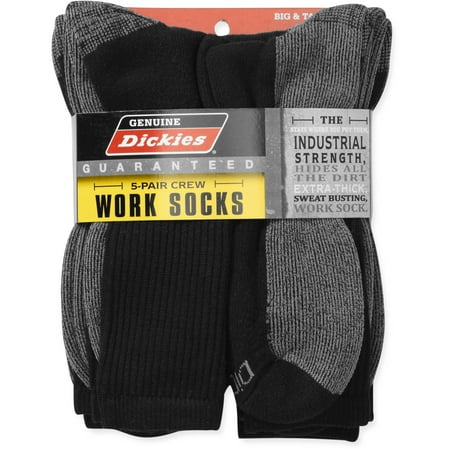
But while traveling, we found a set of socks that fit both of us, are warm and comfortable without overheating your feet (like LL Bean socks do) and are nice enough to wear to "nice places" - they are Dickies work socks.   We bought a set of these somewhere along the way - perhaps at WalMart, I do not know.  But geez, they fit well, they breath, they are warm, they come in different colors, and they don't bunch up around your ankles or wad up under your big toe.

Oh, and they are reasonably priced - likely because they are made in bad old evil China, or as WalMart calls it, "Country of Origin:  Imported"  You don't have to be a detective to read between the lines there.

But unlike really cheap socks, such as they sell at Dollar Tree, these actually fit well and last a good long time.   And when I find something that works well and sells for a reasonable price, I am quite ecstatic.

Makes a great Christmas gift!

NOTE: These come in different weights. There are heavy duty insulated socks which are too hot for warm climates. The ones I prefer are the lighter weight socks.

Tuesday, December 18, 2018

Everything Old is New Again


Pyramid scams have been around for decades.  Why do they still exist, if people know they are scams?

When I was a kid, we watched Dragnet, which was sort of the Blue Bloods of its day, although ironically less jingoistic.   While Sergeant Friday was all "Law and Order" he did tend to see different sides to various social issues.  And the actor and producer behind it all (as well as Adam-12 and Emergency!), Jack Webb, was very progressive with regard to racial views, as he himself was part native American.

He used a regular roster of repertory actors in the series, including the great Virginia Gregg who played a con artist running a pyramid scheme in the episode linked above.   I learned at an early age that pyramid schemes were just a dead-end and a con, and they played upon the naivete of the Mark, as well as the Mark's own desire for riches, to succeed.

So, they went away, right?  I mean, after we all saw this on the TeeVee, who would fall for such nonsense?  And yet today, pyramid schemes have gone mainstream.  They call it "Multi-Level Marketing" or "MLM" to give it respectability, just as the gambling people cloak their nonsense as "gaming."  Some of these companies are even listed on the stock exchange.  And they all use the same old gag - you sign up, buy the "starter kit" and then try to get other people to become distributors and salespeople as well.   Sales of the actual products are, of course, secondary.

Why didn't pyramid scams go away?  Well, if you watch the episode above to the very end, you'll understand why.   The character played by Virginia Gregg is fined $500 and given six months probation.   Consider the cost of the investigation and the time involved as well as the court time, and you can see why the Police have better things to do, particularly in Los Angeles, what with gangs, drive-by shootings and drugs and whatnot.

Dragnet  was considered "square" at the time, and eventually it went off the air.   The hippies were calling the Police "Pigs" and not many of the younger viewers (the most desired demographic) connected with old Joe Friday.  They might want to watch something more contemporary and hip, instead. It didn't help that some episodes, such as the infamous "Blue Boy" episode, which discussed the spread of LSD, were almost laughable in their naivete.  The episode depicted a young man painting his face blue and shoving his head in a hole in the ground while on LSD, because that's what you do on acid, right?

But we knew back then that drugs were a dead-end, and potentially fatal.   While pot seemed harmless enough, we knew that methamphetamine (which we called "speed" or "crank" back then) was really bad for your health, both mental and physical.  And since you felt invincible once you took it, taking more of it seemed like a swell idea - so it was highly addictive.   Heroin and other opioids were also well-known as bad news.  Cocaine wasn't really yet on the radar, but by the 1970's and the disco era, we knew the score on that as well.  Sadly, a whole generation after that was lost to crack.

People died back then - often famous people.  We lost Janis Joplin and Jimi Hendrix to drug overdoses.  Decades later, we'd lose "Prince" in a similar fashion (not as great a loss as Hendrix, in my opinion - Prince was highly over-rated).   But it begs the question, don't people ever learn?

Today, we have a new epidemic of opioids, and this time around, they are legally prescribed.   Methamphetamine became a "thing" in the last few years, and not only did Joe Friday not preach against it this time, the television actually celebrated Meth with its own TeeVee show.

We declared a war on drugs - and lost.   We tried to go after the con artists - and still do - and slap them with trivial fines.   A guy who represents an Invention Broker isn't sent off to jail, he's appointed acting Attorney General.   So you see where we are today - and how we got here.   The police, and the courts can't really stop us from doing stupid things if we are bound and determined to do them.

So what does that leave?   Well, it leaves you and me.  We can decide that buying a timeshare is a shitty idea, and not something that should be defended.  Ditto for leasing cars and other crappy bargains offered out there.  And no, you can't make money on an MLM scheme, so be sure to mention this to your "friend" who tries to sell you a distributorship - and then find new friends.

Welcome to the United States of Go Fuck Yourself - and it isn't changing anytime soon.   Oh sure, some Democrats may try to enact laws to curb these sort of abuses.  But like drug laws, they rarely result in a real reduction in crime, even if they could fill up all the jails with scammers and con artists.  Someone else is always there to take their place - these are lucrative businesses.

Today, thanks to the Internet, the con artist who takes your money might not even live in this country - making them nearly impossible to track down and prosecute.   Yet more and more of these cons exist, and more and more people fall for them, every day.  It seems we never learn.

And while the cop shows on television today depict scientific investigations of all sorts of heinous murders, they don't go after the sort of street-level scams that Joe Friday did - and in the process, educated us on how to avoid being ripped off.   People won't sit still for that old-school stuff anymore.  Besides, the sponsor of "CSI" or whatever is probably a timeshare company, a car company offering scam leases, or some MLM scheme - or someone selling "gov't gold" - or whatever.

I said it before and I'll say it again - we've gone from a manufacturing-based economy to an information-based economy, to a fraud-based economy.   A lot of these folks wearing MAGA hats and attending these Nuremberg rallies are probably the folks who have been ripped off by one scam or another.   And they hope their "Law and Order" President will fix all of this, not realizing that he is in on the deal - running a "for profit college" of his own and scamming everyone he's ever met with one sort of raw deal or another.

For-profit colleges - we didn't really have those back then, or did we?   There were what we called "matchbook schools" which advertised on the back of matchbooks.   Go back to school and become an electrician!  Or a truck driver!   The catch was, they charged a lot of money and didn't teach you much.   So I guess it was the same old thing, even back then - only on a much smaller scale.  Today, the Federal Government is in on the deal - guaranteeing loans for sketchy colleges.  Loans that cannot be absolved in bankruptcy, thanks to that same Federal Government.

Joe Friday - where are you when we need you?