Thursday, April 25, 2019

Selling Your Car (or Boat, or RV) on eBay

eBay can be a good venue for selling vehicles.

I have not posted in a while, as we are in the middle of selling the Casita on eBay.

A lot of people ask me, "how do you sell a car on eBay?" as if it was some sort of magical process that required a PhD to complete.    I have sold a number of vehicles on eBay, including five BMWs, a 1948 Willys Jeep, three Bayliner boats (21, 27, and 29), three (now four) RVs, a Russian motorcycle, and several other vehicles (SHO, Fiat Spider, Mercedes W123, etc.).  It wasn't really all that hard.

And in most cases, I ended up getting more money for the vehicle than I thought I would and also more than I would have had selling "locally".  Oh, yea, in as little as seven days, the vehicle is SOLD and goes away.   None of this perpetual "for sale" nonsense like you see in Central New York.

It is a great way to dispose of vehicles.  I listed the Nissan on eBay but sold it to someone local.  This was a mistake as I did not get as much for the vehicle as I could have, and since a local now owns it, if something goes wrong with it, no doubt I will hear of it.  So far, though, he seems happy with the truck, and should be, as I sold it for thousands less than what I would have gotten on eBay.

The process isn't hard.  Be honest.  Be detailed.  Put in lots of photos.  Create videos to accompany the listing.   Some folks think they can be "clever" and hide defects and issues with a vehicle when selling it online.  This is stupid.   The buyer will spot these when they pick up the vehicle and either opt not to buy it, or leave negative feedback, or just sue you.   People who are too clever by half always end up in trouble.  Point out all the flaws, scratches, and problems.  This actually gives bidder comfort in bidding, knowing you are telling the whole story.

The auction typically follows a pattern.  Early on, you get lots of eager bidders who think they will get your vehicle for nothing.  They pepper you with questions - some inane - and fantasize about winning the auction.  Of course, they don't want to pay much, so in the early days they are outbid and you never hear from them again.

You also get the folks who want you to provide esoteric information that is hard for you to obtain.  What is the bore diameter of the cylinders?  That sort of thing.  Nonsense information that is hard for you to find.  I suspect these are trolls.  Others will try to run down your vehicle and then say they will stoop to buy it, if you "end the auction early" and sell it to them for a low price.   These sort of people never bid and are likely trying to perpetrate a con.

Then there are others who try to power-shift.   "I'll buy your car if you end the auction early, but I want to inspect it first.  So if you end the auction now, I will come and look at it and decide whether I want to buy it!"  You know how that works out.  If you went along with this cockamamie scheme, they would show up, allege the vehicle is loaded with "defects" (which you disclosed, of course) but as a favor to you, they will give you $500 for it.    Apparently some people fall for this, as curbstoners do this to people all the time.

Then there are the trolls and time-wasters.  People e-mail you with questions that are clearly answered in the listing if they bothered to read it.   I think some of these are overtures from Nigerian scammers.  Others are just lazy people who can't read.   Maybe others are trolls.   One lady asks me, "does the unit have air conditioning?" and another "does it have a bathroom?"   Both are answered by the text of the listing - and shown in the videos - but they can't be bothered to read or watch.

Who ends up buying?   In almost all cases, in the declining seconds of the auction, someone snipes the bid and buys the vehicle - someone you never heard from and who never bid before.   And in those last minutes and seconds, the price of the vehicle can rise by hundreds or even thousands of dollars.   So don't worry too much about answering questions early on in the auction - the folks asking those questions either never bid, or are outbid rather quickly.   I try to answer them, to be transparent.   But when someone asks a question that is clearly answered in the text, I can be somewhat curt.

It isn't hard to sell things on eBay.  And the best part is, they sell.  If you park your car at the end of the driveway, you have to hope that, of the ten people driving by during the day, one of them wants to buy your car.  With eBay, you have a national audience of millions of people.   In seven (or ten) days, the item will sell, unless you are an idiot and put some outrageous "reserve" price on it.

I tend to start the auctions at a dollar and let the market determine the market value.  Believe me, the market will do just that.  I have yet to sell a car for a dollar on eBay.  In fact, I usually end up getting far more than I would selling locally.

Saturday, April 20, 2019

Sanity Is In Short Supply

This summary is not available. Please click here to view the post.

Thursday, April 18, 2019

Vol. 2, Page 8, Last Paragraph

This is all you need to read in the 448 pages of the Mueller Report:

"Because we determined not to make a traditional prosecutorial judgment, we did not draw ultimate conclusions about the President 's conduct. The evidence we obtained about the President's actions and intent presents difficult issues that would need to be resolved if we were making a traditional prosecutorial judgment. At the same time, if we had confidence after a thorough investigation of the facts that the President clearly did not commit obstruction of justice, we would so state.  Based on the facts and the applicable legal standards, we are unable to reach that judgment. Accordingly, while this report does not conclude that the President committed a crime, it also does not exonerate him."

Anatomy of a Real Estate Meltdown


It's happening.... again.

A recent article in Bloomberg, and reprinted elsewhere, says that college kids are "living like kings" in unoccupied mansions in Vancouver, BC.   In case you are not Canadian or were late for class, there has been a huge housing bubble in parts of Canada, mostly in Vancouver and to a lesser extent, in Toronto and elsewhere.

The Vancouver bubble is driven by Chinese sales.  During our trip there last year, we were chagrined to see billboards - all in Chinese - advertising chirpy young Real Estate Agents, who were young Chinese women.  What the billboards said, I do not know, as they were not bilingual but entirely in Chinese.  They weren't interested in my money, apparently. Chinese millionaires are buying up properties in Canada and having "anchor babies" in Canada and the USA to provide themselves with a "Plan B" in case China decides that its experiment with capitalism was just a fad - a scenario that is looking more and more likely every day.   You can't blame them for looking out for their own interests.

Problem is, or was, it was driving up housing prices in that city by double-digits every year.  Ordinary Canadians found themselves priced out of the market - if they were lucky.  Unlucky Canadians bought at these high prices and may end up bankrupted if the bubble bursts.   Since most of these mini-mansions and luxury condos were owned by out-of-towners, they were unoccupied most of the time.  To stem the wild speculation in housing prices and to trigger a "soft landing" the Canadian government instituted a 3% property tax on unoccupied properties.   They also made it a little harder to get mortgages for these properties.

One solution, of course, was to occupy the properties.  So wily Chinese are renting out at least part of these mini-mansions to students and others, to avoid the 3% unoccupancy tax.

This is a chilling echo to me.   You see, back in the 1980's, Mark was a college student in Boca Raton, and there was a real estate bubble that burst there.   It is the same old pattern - a market takes off, and each builder tries to build the most houses or condos before it all goes bust, convinced the "other guy" will be the one holding the bag when the music stops.   So they overbuilt the market, and luxury condominium developments sat empty.  So they rented them out to college students.  Sounds familiar, eh?

Fast-forward two decades and yet another housing bubble is taking place in South Florida, and this time Mark and I are back there, owning two condominiums.   We would drive down A1A in the cool of the evening in our secondhand BMW convertible and marvel at all the high-rise luxury condos all "topping out" at once.  What would happen to the Florida real estate market when these hundreds of units in one building hit the market?  What would happen when the thousands from all the buildings hit the market?  Well, rather than type this all out, I can just cut-and-paste from the Bloomberg article, because what is happening in Vancouver is the exact same damn thing that happened in Florida in 2006:
One flyer offers a 368-square-foot unit at C$515,000. “Transfer at original price,” it reads in Chinese. Last year, it would’ve fetched as much as C$800,000, says Jerry Huang, a realtor with Nu Stream Realty Inc., which specializes in presale developments.
“That’s an insane deal,” he said.  Presales were once seen as a slam dunk—put down a 20 percent deposit, flip the contract at a premium before completion, and pocket the gains.

Westbank said in an email that in the five years since some investors purchased, values have appreciated from 25 percent to 100 percent depending on the unit. The number of so-called assignment sales is less than 10 percent of total units in the building and “in-line with expectation.” But the broader downturn is beginning to catch some out across various developments. Those who bought at the peak need to find a buyer fast or come up with the full amount to pay the developer. 
With banks in some cases assessing units lower than the contract price, buyers hoping for a loan may face a shortfall. 
 "There are no assurances right now," says Adil Dinani, a realtor with Royal LePage—some sellers may be lucky just to break even. 
There have always been buyers who overextended and needed to sell quickly.
We saw the same damn thing in Fort Lauderdale back in the early 2000's.   You could sign a contract on a new luxury condo and put down a token amount as a down payment.   A year or so later, the building is finished.  You sell the condo and make a huge profit.  Say you "paid" $250,000 for the condo.   You put down $25,000 as a deposit.  Once completed, you sell it for $500,000 and make a $250,000 profit on your $25,000 investment.   Not a bad deal, eh?

Of course, it is an example of leveraging yourself, by speculating on the price of a commodity, in this case, the price of a condo.  If it goes well, you make ten times your "investment".    But if it doesn't go well, you owe tens times as much as your investment, and bankruptcy is almost a foregone conclusion.   If the condos are worth only $125,000 upon completion, you can't get a loan, and your contract with the builder obligates you to buy at the contract price.   If they sued you for "specific performance" you'd be screwed.   Luckily, most "investors" ended up just losing their down payments, as builders themselves went bust, and realized that suing their buyers was not likely to accomplish much.

As the bubble in South Florida expanded, it got so that you could sell the contract before the building was even built.   Some folks would flip a contract within days - to some other chump who felt that the condo might go up to $750,000 or more!  Sometimes a contract would be bought and sold a half-dozen times or more, with none of the buyers having any intent on actually living in these units or even owning them.   The contact itself became a talisman of investment - it was a tulip bulb.

The problem is, of course, eventually someone who actually wants to live there has to buy the unit, and in order to do that, the price has to be reasonable.   Empty condos, like the swapped contracts to buy them, are just a talisman of value - they are like the tulip bulbs of yesteryear.   You can't just keep swapping and selling them forever.   Like Bitcoin or gold, there has to be a "there" there.   And unlike Bitcoin or gold, condos are taxed - and taxed heavily in South Florida - and with condo fees and hurricane insurance, the carrying cost of owning such a place can be quite steep - to the point where rents barely cover carrying costs, if that.

The problem is, of course, the bubble wasn't nicely limited to these new condo developments or mini-mansions in the Everglades.  Once people get the idea that real estate is taking off, the broader market accelerates as well, which happened in Florida, and has happened in Vancouver.   Fast riches attracts all sorts of shady characters.  In Florida and Georgia, it was mortgage fraud - buying and selling the same house over and over again, to straw buyers, inflating the price with each transaction, and mortgaging the place to the hilt - leaving the banks (and by extension you and me) on the hook when the last straw buyer defaults.

But that is hard to explain to people.  Most of the television-watching idiots in the USA think "mortgage fraud" was something the banks perpetrated on the home buyers, not vice-versa.   As if lending too much money on a home was somehow profitable and that banks made money in foreclosures instead of hemorrhaging cash.  The banks weren't bailed out because they made money foreclosing on properties or writing liar's loans.    The fraudsters, on the other hand, made out.

But that is just an example of the sort of dregs that follow bubbles.   The industry itself will wallow in the gutter, putting out articles that "you'd better buy now, before you're priced out of the market!"    Banks start offering funnier and funnier loans to make overpriced houses "affordable."  Ordinary people see prices skyrocketing and think, "I need to get in on this and make money!" or they think, "I need to buy before I am priced out of the market - the real estate agent said so!"   And people who already own homes start to believe they are sitting on a gold mine, and either refuse to sell at these attractive prices, or worse yet, take out second mortgages to "cash-in" on their newfound phantom equity.  These are all pretty predictable things that happened in the bubble of 1989 and again in 2009.

But the worst is yet to come.  Housing prices in Vancouver seem to be making a soft landing so far.  Price are off by 8-10% this year, and many houses for sale are slashing asking prices and are waiting on the market for weeks for buyers.  The old days of multiple offers over-asking (which again, we saw in Florida and Virginia back in 2005) are fading fast.


To begin with, understanding how prices are affected by demand is important. Even a small drop in demand or a small increase can cause prices to fluctuate wildly. 
For example, suppose in a small town there are 100 homes for sale and 99 buyers. Well, clearly, someone's home is not going to sell. So that homeowner will drop his price. As a result, perhaps one of the buyers will buy his house instead. This in turn will cause another homeowner to drop his price. Perhaps if prices drop enough, another buyer will appear to snatch up a bargain. 
Conversely, if there are 99 homes for sale and 100 buyers, one buyer is not going to get a house. He might bid up the prices in an attempt to buy a home, which in turn can cause a bidding war. 
If the median home price in our mythical town is $100,000, it is not hard to see how a small bidding war, between even a few buyers, can increase home prices by as much as 5-10%, as the incremental monthly cost of ownership is not that great. Similarly, it is not hard to see how even a small discrepancy between the number of sellers and buyers can drop prices dramatically - again by as much as 5-10% without effort. And all this because of a ONE PERCENT difference between buyers and sellers! 
So you see, our "housing bubble" was not due to huge demand and the collapse was not due to a huge drop in demand.  People still want houses, just not as much as before. If demand drops 5-10%, housing prices can drop 20-30% easily.
Once prices start to rise, they can rise dramatically, even if the ratio of buyers to sellers is only 1.1 to 1.   Similarly, once a "bear" market starts, prices can collapse, even if the ratio drops only to 0.9 to 1.

The guy who is making "lowball" offers - as illustrated in the article - and finding them accepted, starts to get nervous.  He is elated to "score" a mini-mansion or luxury condo at an attractive price.  But he has this nagging worry, has he in fact overpaid for the property?  After all, there were no other bidders!  If he tried to sell the property today, he might not get what he paid for it.  So the psychology of buyer's remorse kicks in, and prices drop even further. 

The folks in Vancouver can hope for a "soft landing" and I hope for one as well, for their sake.   The Chinese aren't yet abandoning the city, I think, given the political situation in China.   But perhaps many who were merely speculators are realizing the party is over.  And the Chinese do love to speculate - and gamble - which does not bode well for the Chinese economy in the long-term.

And it is not all bad news, either, if the market does crash.  Housing in Vancouver was obscenely priced, and lower prices are good news for working class people looking to buy a home.  Bad news, perhaps, for folks who just got a second mortgage to pay off credit card debt, or the unlucky (unwise) person who bought in at the height of the market, convinced it was going to go higher.

I've been on both ends of the equation - buying houses at the height of the market (1989, 2008) and also snatching up bargains at the bust (1994-2002).   The properties I bought at the valley sold for nearly double their purchase price - often to buyers who approached me unsolicited - while the properties that I bought at the peak merely failed to inflate in value much over time.  Although if you wait long enough, as I did, eventually the house you buy at the peak (1989) can be sold at the next peak (2005) for a hefty profit.

Over time, bulls outweigh bears, even in real estate.

Again, the simple way to tell if you are in a bubble is to compare the carrying cost of a home, including taxes, insurance, reasonable mortgage payments, and upkeep, with the cost of renting the same property.  If it costs more to own than rent, the prices are head of the market.  If it costs two or three times as much to own than rent (which happened in South Florida) you are in for a big, huge, bubble burst.

Right now in Florida, the bubble is in luxury apartments.   Builders rushed to build these in the last few years, convinced that Seniors didn't want to own homes anymore and that they would all pay sky-high rents (with their Social Security checks, apparently) on luxury apartments.   So they all overbuilt, convinced that the other builder would be the one to go bust.   It is a perverse logic and a flaw in capitalism.   If the builder doesn't build, he makes no money, and the other guy does.  So in these hot markets, it quickly becomes a race to the bottom, as everyone tries to meet perceived need, and oversupplies the market as a result.   Raising beets or building houses, it is the same deal.

And markets in Silicon Valley, Austin, DC, and elsewhere, are showing signs of bubbly-like froth, although perhaps these are not as dramatic as the rise in prices in Vancouver.  Nevertheless, when no one can afford to actually buy and live in houses or condos, the prices will eventually "correct" over time.   You can't have a real estate market dominated by unoccupied properties that serve only as talismans of investment and no real homes.

It is a pattern we have seen time and time again, and no, this time it isn't different, and no, there are no special unicorn markets where the laws of supply and demand (and profit and loss) are suspended.

Wednesday, April 17, 2019

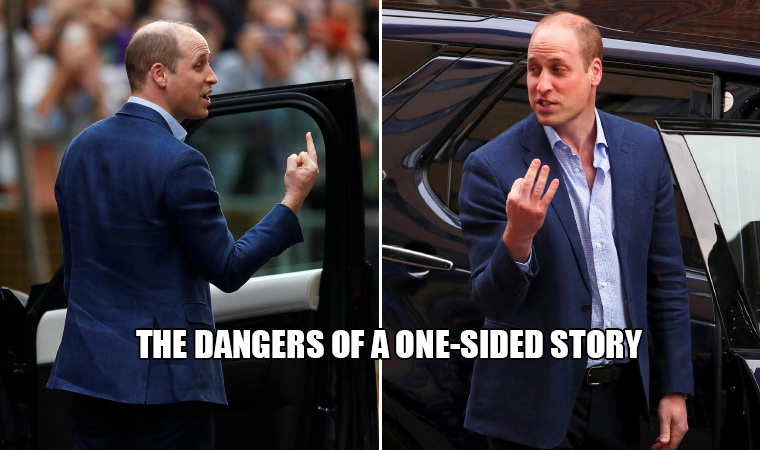
One Sided Stories, Yet Again

Image result for one-sided story
People love one-sided stories.

One way to get people to believe a lie is to embellish the lie with incredible details. This has long been known as a technique that liars used to convince people of their lies. The more you can embroider the fabric of your lie, the more people tend to believe it.

If you're going to tell someone a lie, you never want to come right out and just say it. You want to build up to it slowly, feeding in all sorts of background information - which is really irrelevant - in order so that the lie goes by unnoticed.

The media loves a good story, particularly one-sided stories. And the latest trend with streaming services is to put up a made-for-streaming series arguing that some prisoner is innocent and was wrongly convicted. You may recall the Netflix series, "Making of a Murderer," which convinced a huge portion of the population that a guy who was convicted of murder actually was railroaded.

When, your uncle shows up with a dead body in the back of his pickup truck and asked you to help bury the corpse, you're kind of complicit in the deal whether or not they made a TV series about you. People seem to forget that salient fact - along with others.

Since that series came out, a number of other series have come out (or are coming out), giving prisoners everywhere hope that maybe, they too, will be profiled on television and found not guilty after murdering dozens of people. I think the people who put on the series get off on convincing people that guilty murderers are actually innocent.  It's like they enjoy pulling the wool over people's eyes, having that power to manipulate public opinion. It's kind of sick really.  It has taken trolling to a whole new level.   It is one reason I am less enamored of Netflix.

A recent article in the New York Times is sort of a case in point. The article essentially is about a young man in high school who was "unjustly deported" after it was alleged he was a member of the MS - 13 gang.  But we know he wasn't a member of the gang because he told us he wasn't, and also his mother said he wasn't a member of the gang.  So that sort of settles the issue right there, doesn't it?

No need to investigate further, right?

As I was reading the article, I could tell I was being bullshitted from the get-go.  These type of articles don't just set forth the facts - the who, how, where, when, and so forth.  Rather, they set off to embroider and embellish the story to get you to feel sympathetic and sorry for the person profiled.  Then, in the middle of story, they drop the bomb on you.  But by then, you've identified so much with the subject of the story, you tend to let those details go.

So instead of a story that begins "Little Joey was wrongly convicted!" we get something along the lines of "It was cold that day as little Joey pedaled his bicycle 10 miles to school, hoping that he would be in time for his Algebra test, so he could make his mother proud!"

Articles like this go on for paragraphs before they finally get around to the main point. I don't know if it's just poor writing or if it's by intent.  But I suspect it is the latter. They want to build up a sympathetic profile of the subject of the article before they start bringing in nasty little details like accusations of gang affiliation.

It is sort of like how you can spot a raw deal in the marketplace - by how it is presented.   Raw deals have loud ads and lots of fine print and too-good-to-be-true terms.   One-sided stories are easy to spot as they pad the front-end of the story with lots of weepy details before they get down to the facts, and then present facts only from one perspective.   You can spot this sort of shit from a mile away, once you know the pattern.

The young man of the article is actually not a young man but an adult.  At age 19 he enrolled in high school as a freshman.  If you ever been to high school, which I assume you have, you know that it's awkward when somebody is several years older than the other students.  Having adult students in the high school is not a good influence on the other children.  It can be downright scary to have a 19-year-old in the same classes as 14-year-old girls.

So right off the bat they slip lie number one in on us. The kid in question is hardly a kid but old enough to be in the military or even be married and have children. He's old enough to be working, and one wonders why he would be in high school, much less a freshman at age 19.

At that point you move on to a GED certificate and move on with life, rather than trying to walk around in high school with people five years your junior.   At that rate, he would have graduated by age 23.   Is that even allowed?  (I had a friend who finally had to quit high school at age 21.  He was set back several years as a result of mental health issues.   I think they finally had to let him go, as it wasn't helping him - or the school - to have adults in classes with children).

The young man was accused of defacing school property by drawing gang symbols. He claims this was when he doodled on a calculator - which seems like a very odd thing to do. I can't imagine where on a calculator you would actually draw things, as it's mostly buttons and display. Maybe they have huge calculators there that have big blank spots on them you can draw things on, but I kind of doubt it. And why the hell would you draw on a calculator?

But of course, we don't see or hear the other side of the story. It could be that he drew gang symbols in the wall, but the school isn't saying - they can't comment on these cases.  It could be he was a hardcore gang banger, but of course his mother said otherwise so obviously he isn't.  We have no way of knowing as we only hear one side of the story.

Myself, I'm skeptical of the story.  Why?  Because of the way the story is presented.  Rather than giving us a straightforward recitation of the facts and also presenting evidence from both sides of the case, we are given a lopsided, one-sided story it starts off with a lot of emotional garbage about poor little Gomez and his attempts to become a U.S. citizen and make it big in America.

This isn't journalism, it's propaganda. They're trying to tug at my heartstrings and get me feel sorry for this kid before they are willing to even tell me the facts of the case.  When the facts of the case are finally told, they are either muted or qualified.  For example, the young man in question signs his own deportation order, saying that staying in detention for a year forced him to do so. But on the other hand, one would think that someone who is innocent would want to appeal the order, which they were entitled to do, rather than just acquiesce to being deported to their home country.

And then there's a lot of other details of the story which are not addressed.  Once back in Honduras, he goes to live with his aunt.  But he doesn't actually live with his aunt, she rents him a room in town. That to me seems rather odd.  Why wouldn't she want her own nephew to live with her?

The possibility that the government perhaps got this one right is not even discussed.  Maybe this guy is in fact a gang member and the reason why his aunt doesn't want him living with her is that she doesn't want a gang member in her house.  And maybe that's why his aunt rented him a room in town, because she was too afraid of him.  It does seem like an odd situation and one that was not addressed in the article.

The article also sort of skims over the horror of these MS-13 gangs.  People are being bludgeoned and hacked to death, and by people, I mean children. These are teenagers killing teenagers.  But the way the New York Times puts it, it is sort of like, "Oh yea, there's gangs and people hacked to death, blah, blah, blah, but whatever."

From the way they describe it, MS-13 is some sort of social club.

The idea that you have to have a strict and zero tolerance policy towards a sort of thing is played down by the New York Times. But the reality is a huge number of people have migrated into our country, particularly to places like Long Island, and most of them are here illegally, claiming amnesty.   And it is not a problem limited to the United States.   Europe and even Australia are seeing migration of thousands of desperate people trying to get to their shores, often after fucking up their own home countries by pledging loyalty to extremist religions or corrupt governments.  Ask anyone in France how its working out with a permanent underclass of Algerians in public housing, ringing Paris.   It isn't.  And this is the future of "migration" for the rest of us.

The point of the story is that Trump is bad and mean, and the New York Times went looking for a story to support that theory.   Granted, Trump is a jerk.   But this isn't reporting, it is propaganda, as I said before.   Reporting is going out and finding out the who, what, where, when, why, and how and then reporting these facts and then, perhaps, drawing a conclusion from them.    Propaganda is setting forth with a conclusion and then bending the facts of the story to suit the preordained conclusion.

The New York Times and Netflix are not alone in this, of course.  The right-wing press, particularly Fox News, does this all the time.  And we are even seeing this in terms of "science" or should I say, "Social Science" where people set out to prove a point and then do surveys to create data to prove the point they set out to prove.   Real science gathers data and then uses it to validate or invalidate a theory.  Junk science bends the data to the theory.   Both junk science and junk reporting are rampant today.

This nonsense has been going on a long time, too.  But in the past, such one-sided stories were largely limited to conspiracy theories and the like.  I recounted before how my brother, in Junior High School, became infatuated with Erich von Däniken, who wrote a book claiming that all the great wonders of the world were made by aliens, not mankind.  If you read only that book, and you were an impressionable Junior High student, you might believe it.   But what the author did is what any good conspiracy theorist does - tells a one-sided story.

To make a conspiracy theory, all you need to do is to make up some facts, disregard any facts that don't fit your theory, or if you address them at all, claim they are "unproven" or "controversial."   The Making of a Murder people do this, perfectly, claiming the blood evidence was planted, because blood in a sample vial was treated with a preservative, and if such a preservative was found at the crime scene, then the blood was planted!   Neat theory - but no such preservative was found at the crime scene.   By repeating this theory over and over again, most viewers, however, think otherwise.  And by not bringing up any incriminating evidence used at trial, well, as a viewer you might think this guy was innocent and the victim in the case just vanished mysteriously.

What is the danger in all of this?   Well, the danger is, one-sided stories and conspiracy theories are no longer marginal things in our society, believed only by kooks and other outliers.  They have gone mainstream.  And while you might expect Fox News to distort or slant the truth, it seems that the New York Times and the Washington Post are now in on the game as well.   Both have set out to destroy Trump - which may or may not be a good thing, but something a newspaper shouldn't be involved in.   Report the facts, let the public decide.   Doing otherwise is, well, what we used to run down Fox News for.

On a personal level, this abdication of truthiness is damaging as well.   We live in an era of prosperity, but signs of cracks in the facade are showing.   But no one wants to talk about them.   Once again, a decade after the largest real-estate crash in 100 years, we are hearing the happy talk about how "this time it's different!" and that housing prices will just keep going up and up and up (Folks in Vancouver, it seems, are learning a different story as of late, but that is the subject for another posting).

We all hear what we want to hear, and yes, I like to hear that my net worth went up by ten thousand dollars, even as I spent thousands on a vacation in Florida.    What isn't said, is that when a recession comes, all that phantom gain will evaporate and it will get scary, although there isn't much I can do about that, other that what I have already done - diversify my portfolio, divest of riskier stocks, and stay calm.

When truth becomes subjective, bad things happen in the marketplace.   Fraud occurs, on a small level and a large one.   Once again, we are seeing a slew of "tech" IPOs hitting the market, where most of these "tech" companies are just apps on your phone, doing things you used to do before you had a smart phone (like hail a cab) while hemorrhaging millions a week in cash.  People seem to forget the five previous tech IPO meltdowns, convinced that this time, it must be different!

Meanwhile, the time-share seminars and check-cashing stores are doing a banging business - denial of reality being so ingrained in people today that these things seem "normal" to them.   When it all goes horribly wrong, they wail that the rich "took their money away" when in fact, they willingly handed it over to them in these schemes.

One-sided stories won't go away, of course, unless people stop believing in them, clicking on them, reading them, and watching them.   The boffo ratings of  "Making of a Murderer" have insured that copycat series will proliferate until no one is left in jail.   And maybe these one-sided stories about migrants will result in a new era of "open borders" which some Democratic candidates for President appear to actually endorse.

But maybe, if people stop believing in fairy tales, and stop clicking, reading, and watching this shit, it might go away - or at least retreat to the kooks and conspiracy theorists of years gone by.   Because like raw financial deals, these things are supply-side driven.  So long as people are willing to believe just about any sort of nonsense, folks will provide them with the media kibble they crave.

In any war, truth is the first casualty.   And it seems truth died quite a few years ago.