Wednesday, August 12, 2020

Public Space, Part II

Owning a slice of paradise is nice and all - if you want to spend a pile of money and all your spare time maintaining it - but public lands are often nicer than some million-dollar vacation homes, and are often free.   Maintenance-free, too!

We are staying near Robert Wehle State Park, which is a free day-park on Lake Ontario.  Wehle was the son and grandson of the owners of the Genesee Brewing Company and when his Dad sold the place, Robert decided to spend his time raising pointer dogs and hunting on his 1067-acre tract.  In the decision matrix of inherited wealth, he made the right choice.   When he died, the land was left to the State, which has maintained it as a State Park.

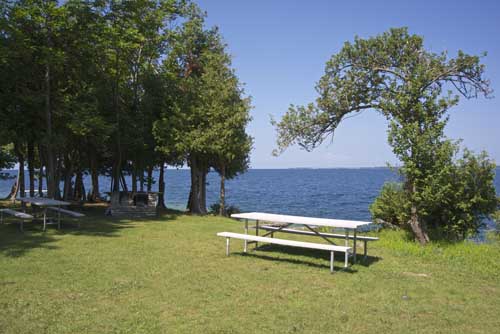
You can rent out Mr. Wehle's house and grounds - for a considerable sum, I am sure, but far less than the cost of paying taxes on 1000+ acres of waterfront (I am sure the local county misses that money!).   But the rest of the park is free to visit, to hike and bike.   About a mile or so from the parking area, down a gravel road, is a nice picnic area, complete with grills, tables, a pavilion, and a bathroom.   Since it can only be reached by foot or on bicycle, not many visit it.

We rode the yellow "snakefoot" trail all the way around, several years ago, returning with our bikes covered with mud and feeling exhausted but exhilarated.   We returned a few days ago and now the trail has been improved - no more knee-deep swampy areas, and we were again exhausted and exhilarated, but not covered so much with mud.   We stopped at the picnic area and had a picnic, and Mark suggested returning in a few days with hammocks, as there were many cedar trees near the water's edge.  It turned out to be a good idea.   This time, of course, we didn't do the yellow "Snakefoot" trail, but took the well-groomed gravel road.

A few days before, we had visited our old haunt on Cayuga lake and saw one of our old neighbors, who invited us down to his lake rights for a cold glass of wine.  He had put in a new picnic pavilion and a cabana, as well as improved his dock and bought a brand-new party barge.  It was all very nice but we didn't miss it a bit.   You see, all that costs a lot of money, plus you have to maintain it or pay someone to maintain it.  And all that, for just a few dozen feet of lakefront, right next to someone else's few dozen feet of lakefront.  And you can rent a party barge for a lot less money than owning one.

When we bought our condos in Florida, Mark's Dad said it was a big mistake (he said the same thing about all our Real Estate investments, even though most of them made us fantastic amounts of money and even though he made his small fortune in Real Estate as well).  His argument was that a vacation home forced you to go to the same place every year, much as a timeshare does.   But unlike a timeshare, you can sell a vacation home, after a few years (as we did) sometimes even for a profit.  Real Estate is not forever - the average home changes hands every five to ten years or so, so "owning" something is not some sort of permanent thing.  And even if paid-for, any property costs a lot of money just to keep.

On the other hand, at Robert Wehle State Park, we lazily spent the afternoon in our hammocks, on over 17,000 feet of pristine shoreline, sipping Mumm Napa pink Champaign and basically living like millionaires, for a lot less cost.  When we were done, we packed up everything and rode back to the truck, leaving our cares behind.   We didn't pay for a damn thing - and certainly not New York State's onerous property taxes (imagine what they would be on such a property!).

Don't get me wrong, my friend's lakefront cabana was nice - as was our old one (which the new owner wisely rents out on AirBnB and VRBO to pay for the onerous property taxes), but what we had the other day was nicer - including the ability to just walk away when done.

Public space is a great value - often free - and a lot less hassle.   Plus, you can visit a different public space nearly every day, particularly when RVing.  When we travel, we often look for city or county parks to visit to have lunch.   We start looking around 11:00 AM, checking the GPS for nearby parks, or looking on Google, or at a paper map.  Often we find these places deserted, other than maybe one or two other intrepid explorers.   Beautiful pavilions on the water, complete with barbecue grills, and spotless restrooms to boot.   Often, a lonely park ranger will stop by to chat, as there are so few visitors to these places - and that's a shame.

The urge to "own it all" often means you end up with less - or even nothing.   Because when you own things, they can be a trap.  And quite frankly, you'll never own hundreds of acres, much less thousands, of waterfront property in your lifetime, nor would you want to.

But if you want to, you can visit such places, often for free or for very little money ($5 or so) and pretend you are as rich as a Rockefeller, if only for a few hours or maybe a few days.

Tuesday, August 11, 2020

Cities In Flight


For a brief time in the early 21st Century, American cities became a desirable place to live.   Then, 2020 happened.

You read all the "news" stories a few years ago, "surveys say" that millenials want to live in cities, to be close to where all the action is.   We were told that retirees wanted to retire to cities, so they could walk to the grocery store and experience cultural activities like museums and symphonies.   Major cities were being "gentrified" - turning ghettos and slums into nice neighborhoods where families might want to live.

There was, of course, a backlash.  Some claimed that gentrification destroyed the "grittiness" of the city, and that this grittiness was a desirable social value or even part of the "culture" of some "communities".  But it was true - cities like New York had changed and changed dramatically.  Times Square was no longer a collection of seedy porn theaters, sex shops, and live sex shows - as well as prostitution.   It was now a place you'd take your kids to see a Disney Broadway production or have lunch at a outdoor cafe table, while being entertained by street performers dressed as your kids' favorite action heroes.

Places like Brooklyn, which were on the borderline of turning into a slum, were now commanding top prices.  My hippie brother lived in Park Slope, decades ago, before gentrification pushed him out.  A fellow at the campground here reports his Mother bought a brownstone for $95,000 back in the 1980's, and recently sold it for $3M.   Yes, gentrification was real.   Emphasis on the word "was".

Oddly enough, some of the gentrifiers were the loudest voices for change.   The same liberal whites who moved to these neighborhoods and drove prices through the ceiling, were now calling for the very things that made these neighborhoods attractive to be eliminated. So-called "broken window" policing was abolished, and graffiti and garbage proliferated.  The anti-graffiti task force of the Transit Authority was abolished, and the pristine subway cars are now reverting to their 1970's look.

Homeless bums now had "rights" to sleep on your stoop and shit on your sidewalk, because it was "unfair" and "cruel" to make them move along and find a shelter to sleep in (or maybe even get a job, get off drugs, and stop being a drag on society?  Nah!).   And of course, criminals were all innocent - we all saw that on television!   Bail was unfair to the poor, and long prison sentences for career criminals who just didn't give a shit about anyone else but themselves were of course, unjust.

Criminals noticed the change, and slowly, crime rates have gone up, once nice neighborhoods got getting "grittier" and people started to trickle out of the cities. Come 2020 and a pandemic and senseless riots and looting, and the trickle becomes a flood.   White Flight, once a phenomenon of the postwar era, has once again blossomed, as a new generation of white folks realize that quiet, secure towns, with nice houses and manicured lawns, are not as "boring" as they might first appear.

Or more precisely, maybe "boring" seems nice after you've been mugged at gunpoint on the way home from work, and your wife or daughter was raped and your house was broken into - along with your car.   Suddenly, the idea of all this "culture" - that, let's face it, you never really took advantage of - doesn't seem worthwhile.   And when a pandemic closes all the trendy restaurants, Broadway shows, the symphony, the ballet, and the museums, what does that leave you with?

When we first looked at buying a house on Jekyll Island, Mark wasn't so sure he was ready to leave the DC area.  "I don't know about Jekyll," he said, "It's kind of creepy and quiet."

"Yea," I replied,, "Isn't that great?"

It took 9/11 and an airplane crashing into the Pentagon, the beltway sniper and the anthrax scare, for Mark to appreciate "Creepy and Quiet" and today, many folks from Atlanta are discovering the benefits of quietness as well.    Houses are going on the market and selling within days - sometimes with multiple offers.

The same is true for other suburban or even rural areas.  Houses on Long Island are going under contract left and right as people flee the once-trendy boroughs of New York for safer and more relaxing digs.   And so on across the country.   A new real-estate boom, or mini-boom is taking place, and what happens next is sort of scary.

Cities may collapse and go into bankruptcy again - as New York did in the 1970's.    When people work from home and companies realize they don't need a trendy office at a fancy address in an expensive city, the value of real estate - both commercial and residential - in major cities could go into free-fall.

I recounted before how one of my clients abandoned a suburban office park near Austin, Texas, and built a high-rise on troubled 6th Street.   The employees raved about the new digs, at first loving their expensive condos nearby -within walking distance of the new office!  So much to see and do - so much culture!  No more being stuck in rush-hour traffic!

Buy now, before the lofts at SoDoSoPa are sold out!

Today, there are riots in that city, and I wonder if the company is re-thinking its move downtown.

So, what is causing White Flight, Volume II?   In a way, it is the same things that caused white flight from cities back in the day.   People get older and raise families and they want their children to have good, safe schools to go to.  Yea, people are so darn selfish!  After all, you should be more than willing to sacrifice your children's future in order to be part of some sort of educational and social experiment, right?

Well, when push comes to shove, white liberals in the city make noises about diversity and equality and all that, and then will draw blood to get their children into the right Montessori nursery school or the right "gifted and talented" high school.  And you can't blame them for this.   Any parent who isn't looking out for their child's best interests is really being a rotten parent.   You know, like the one who had five kids out of wedlock with five different fathers - and doesn't give a shit about their kids education or future?  Yea, that.  And this is not a racial thing - shitty parents come in all colors.  They all tend to live in shitty neighborhoods, though, whether trailer park or public housing.

So no, it isn't selfish that a parent doesn't want their kids hanging out with the meth-head trailer park kids or the gang-banger teens from the ghetto.  This is just basic self-preservation. And what I suspect is happening - in addition to the 2020 madness - is that a lot of the "yuppies" who started to raise a family in Park Slope, are realizing that a big city isn't really a great place to raise kids.  Maybe ten years ago, you could take them to the park to play.  But today, it is full of homeless bums who have a "right" to sleep and defecate there, along with the drug dealers - you know, the same sort of shit that forced people out of cities decades ago.

Of course, suburbs can be hellish nightmares as well, with spoiled and bored middle-class kids with nothing to do all day long, getting into one form of trouble or another.

Will our cities come back? Eventually, yes. A lot of the nonsense being spouted today about "defunding the Police" and replacing them with "community intervention" or some such nonsense, will quickly fade from the scene, as the crime rates and murder rates soar - as they have in the past few months alone.  A new generation will learn that many criminals are not just "misunderstood" or had "difficult childhoods" but are little more than feral humans - psychopaths and sociopaths who just take from society what they want, and don't care about the consequences to others.

As I have said time and time again, today's Antifart or OWS or whatever protester is one stolen bicycle from becoming a law-and-order Republican.  When you become a victim of a crime, suddenly your empathy for criminals evaporates.  My epiphany was when I was delivering pizzas - struggling to get by - being chased by four thugs with steel pipes, bent on caving my skull in and taking my wallet.   Fortunately, I escaped.   Others are not so fortunate.   And 2/3rds of all violent crimes are usually unsolved, as the Police can usually only catch the perpetrator when they are known to the victim.   Stranger-on-stranger crime is nearly impossible to solve.

And so-called "property crimes"?   The Police have no resources to even go after those.   So yea, we need to cut their funding, right?   Makes sense to me!  /s

But eventually, the pendulum will turn against this sort of nonsense.   I will likely be dead by then, as the last time around, it took several decades before people realized that the "rights" of criminals can only go so far, before none of us have any rights - to safety and prosperity, the pursuit of happiness.

So, if you want to play the long game, snap up one of these city properties that might hit the market pretty soon.  In three our four decades, it will re-gentrify and you'll make out like a bandit!

Or maybe not...

Monday, August 10, 2020

Kodak - Just A Pump 'N Dump Scheme?

When someone can't tell you what their business model is in ten words or less, watch out.

In the last few months, I have received a number of emails from readers asking me about Kodak stock. This tells me that somewhere on the internet, someone is hyping Kodak stock as some sort of get rich quick scheme.

I was born in Rochester New York, the hometown of Kodak. My Dad was an executive at a company called ITEK, which some wags said stood for "I Took Eastman Kodak" because of some disputes over intellectual property.  I think they made high speed cameras for U2 spyplanes or spy satellites or something along those lines.

Back then, Rochester was a company town, and the company was Kodak. They were the six hundred pound gorilla in the camera business and film business. It wasn't until the 1970s that Fujifilm started to take hold and take over a larger and larger share of the market. Kodak's misadventure into instant cameras ended up with one of the largest patent infringement lawsuits in history, and really set in motion the modern patent era.

But digital cameras were the downfall of Kodak, even though Kodak offered its own line of digital cameras (which apparently were not very reliable, although I had two of them).  Smartphone cameras were the nail in the coffin.  It seemed to happen almost overnight. Suddenly the Fotomat booth disappeared from the strip malls, and the local drug Store stopped selling and developing film. Film cameras went away rather quickly as digital cameras became easier to use and had longer-lasting batteries and higher resolution.  Kodak declared bankruptcy.

The company reorganized and today they are doing... I'm not sure what they're doing. In fact, when some people tried to explain to me what Kodak does for a living, and they couldn't explain it to me in ten words or less, I knew something was up.

Kodak provides packaging, functional printing, graphic communications and professional services for businesses around the world. Its main business segments are Print Systems, Enterprise Inkjet Systems, Micro 3D Printing and Packaging, Software and Solutions, and Consumer and Film.
I am not sure what any of that means, only that it sounds like a pretty competitive number of businesses they are in, that don't seem poised to take off like a rocket, in terms of profitability or everyone having to have their product.  Film is dead.  Printing is dead. Paper is dead. These are dead and dying businesses with no spectacular future in them.  About as exciting as selling PC's these days.

This isn't the next Microsoft or Apple, but rather a rather typical commodity business.  The P/E ratio and earnings per share are nothing to write home aboutWhy on Earth would anyone hype this stock? It is about as exciting as General Motors.  They make things - commodity items that other people make as well, at very competitive prices, with very narrow profit margins. There is no secret sauce here, no "moats" as Warren Buffet would like to have, no.... nothing.

A couple of years ago at the height of the Bitcoin madness, Kodak announced they're going to get into cryptocurrency.  I never heard anything more about that, but it did cause the stock price to spike. One wonders whether or not the announcement about getting into cryptocurrency was strictly for the purpose of jazzing up the stock price at the time.  One wonders....

Today, Kodak is a subject up some controversy as they supposedly got a huge loan from the government to produce "drug ingredients" whatever those are, which seems like an interesting thing for a former film company to be doing. But apparently, prior to the announcement of this government largess, the stock started trading rapidly which totally reeks of insider trading.

Now it remains to be seen whether they get this government loan or not, or whether they intended to get it all along, and perhaps the whole purpose of the thing was just merely to manipulate the stock price.

Like I said, when several readers asked me about Kodak stock and whether it's a good investment, I get suspicious that something was up - and that something may be stock manipulation and a pump-n-dump scheme.  I don't give stock tips here and I don't suggest that people invest into things that are hyped on the Internet or on a financial channel. Usually, after something's gone up in value, it's too late to invest in it. Also, the people who are hyping these stocks are the ones who are buying them before you do and making a lot of money off of you.  If you hear about some investment on television or the Internet, chances are, it is too late to invest in it.

UPDATE 2021:  Here is the stock price from 2020 (when I wrote this blog entry) until today.  As you can see, on July 29th, the stock price peaked at $33 a share, and then went back to languish in the sub-$10 range, where it remains today.  Clearly somehow this stock price was manipulated, and it was no coincidence that several readers (or "readers") asked me about this stock at that time.  Someone was hyping this stock!

* * *

One thing is clear:  In recent days, someone made an awful lot of money selling Kodak stock for as much as $33 a share, when it was trading days before at $5 a share.   And the people who bought at $33 a share, are now looking at a 70% loss on their holdings.  This has all the hallmarks of a classic pump-and-dump.

These recent events make me wonder whether Kodak exists simply as a placeholder for other people's fantasies.  In other words, it's just a pump-and-dump company whose stock price can be hyped with the announcement of some new product or new government contract, regardless of whether they follow through with any of this.  Or it is possible outsiders are using the company as part of their own schemes.   Maybe someone in the Trump administration leaked out this loan information - Eric!

If that's the case, then it is the perfect modern company for Trumpian America - a company with no substantial business plan whatsoever other than to make money for the insiders by manipulating the stock price.

It's sort of like Enron, only without the energy.

UPDATE 2023:  There is money to be made in these old rust-belt companies in Central New York and the midwest - in manipulating their stocks!  Kodak isn't about to come roaring back to life with some new "must-have" product - that rarely happens ever, in the marketplace, but it doesn't stop the stock manipulators from selling "The Next Big Thing!™" to the plebes.  If you look at the history of Kodak, post-bankruptcy, you can see there isn't a lot of "there" there.  In fact, they are losing money and a second bankruptcy (and maybe liquidation this time) might be in the cards.


Stop believing in "The Next Big Thing!™"

If you read the Wikipedia entry for the company, it seems in post-bankruptcy their only real business is in supplying film stock to the motion picture industry.  How long that will last in this digital age remains to be seen - digital imaging is far cheaper and more flexible than film - and most "film" is reduced to digital images when shown in movie theaters.

The other "businesses?"  Mostly licensing the trademarks or their stupid venture into "crytpo" which rightfully went nowhere (and sounds scammy to me!).   Before going backrupt, Kodak "borrowed" millions from KKR, so I presume in Chapter 11 bankruptcy, they became major shareholders.  If you are looking to see who might be manipulating the share price.... there's a place to look!
Post-bankruptcy

On March 12, 2014, Kodak announced that Jeffrey J. Clarke had been named as chief executive officer and a member of its board of directors.[143][144][145] At the end of 2016, Kodak reported its first annual profit since bankruptcy.[146]

In recent years, Kodak has licensed its brand to a number of other companies. The California-based company JK Imaging has manufactured Micro Four-Thirds cameras under the Kodak brand since 2013.[23][147] The Kodak Ektra, a smartphone, was designed by the Bullitt Group and launched in 2016.[148] Digital tablets were announced with Archos in 2017.[149] In 2018, Kodak announced two failed cryptocurrency products; the cryptocurrency KodakCoin, which was developed by RYDE Holding, Inc.,[150] and the Kodak Kashminer, a Bitcoin-mining computer which was developed by Spotlite.[151]

In 2016, the Kodak spinoff company eApeiron was founded with assets acquired from Kodak and an investment by Alibaba. The company's mission is to eliminate “knock offs” and promote authenticity.[152]

Despite the pivot to digital technology, film remains a major component of Kodak's business. The company continues to supply film to the motion picture industry after signing new agreements with major studios in 2015 and 2020.[20] In 2022, Kodak announced it would hire new film technicians after film photography experienced a revival among hobbyists.[21][153]

Just Say No to Podcasts!

The printed word is slowly dying.

I mentioned before in a 1951 edition of Galaxy magazine, Ray Bradbury published the short story called The Fireman. This later on became the novel Fahrenheit 451 which was later made into a movie.

In that dystopian future, books would be outlawed, and since houses were all fireproof, fireman would have the job of burning books if they were found in someone's home.

Printed words were deemed seditious and dangerous. People absorbed information through audio and visual means only. The only printed documents were basically comic books, or as they call them today, graphic novels.

By the way, those early editions of Galaxy magazine were pretty fantastic. Authors like Isaac Asimov, Ray Bradbury, and others contributed to the magazine, as they only requested first publication rights and allowed the authors to retain subsequent publication rights for their works. You can read and download these documents for free at the links I have provided above. Classic science fiction - for free on your phone - itself science fiction, when I was a kid.  Handheld computers - amazing!

But getting back to our topic, it seems frightening to me that the predictions made by Mr Bradbury in 1951 seem to be coming true today. Newspapers and magazines are going out of business one after the other. The book business is struggling as bookstore after bookstore goes under. The few books that are published are sensational tones by celebrities or someone who landed a plane in the water.  Or there are books written by  people willing to do an exposé on political figures. Or the political figures themselves writing a book which is a thinly-veiled grab for money. Conservative think-tanks buy 500,000 copies of some politician's book and liberal think-tanks do likewise for their people. It's just a way of legitimately(!) transferring money from one person to another.  No one actually reads this crap, anymore than they read Healthy Holly.

Most people get their news from CNN or MSNBC or Fox News via cable television or online.  Few people read newspapers anymore, and more and more newspapers are resorting to video features on their online feeds.  They know from what we click on, what we like, and what we like is simple narratives, even if false, fed to us by spoon.

The few books that are left are sold as audio books to listen to while driving your car. People no longer blog, but rather v-log, where they stare into the camera on their laptop and drone on for hours about topics.  If they become successful enough, they can do a podcast, where you download some audio feed where the person again drones on and you listen to him.

What's wrong with this, and why is it different than print media? The thing about the printed word is so you can stop and analyze things, one idea at a time. You can re-read a sentence to see what the meaning of it is. And if you don't understand something, you can stop reading and do research either through the encyclopedia, the dictionary, or online.  It is much easier to critically evaluate things as you read them, and a lot easier to spot bullshit.

If you try to push a one-sided story, for example on Dateline NBC, it is a lot easier to do.  You can snooker people by doing long-winded introductions to induce sympathy for a murderer or other criminal, before they drop the bomb on you.   In a printed story, you can spot the bullshit much more easily - because the basic facts of the story are buried.   Well, at least astute people can spot it more easily.

I don't know how many people I've met who've told me they think some murderer is "innocent" because they saw some show on the Internet or Cable TV.  He had fetal alcohol syndrome!  His Father beat him!  He had a rough life!  Lost in the shuffle is the victims of these gruesome crimes, who are tried in absentia and found guilty of their own deaths.  These stories have great ratings and sell eyeballs, so producers keep producing them.  They are little more than propaganda pieces.

With a printed story, you can just stop and digest what you read, and think about whether it makes any sense. But when you listen to something or watch it on the television, it's jammed down your throat at the speed dictated by the author.  You have no time for reflection or analysis of what was being said. Moreover, you can't fast-forward through the boring parts and skim over what you don't want to read or what you think is superficial.  You have to accept what they say at the rate they say it.

The audio word and the video word are much better suited to propaganda and indoctrination. The printed word is far less so. I mentioned before that after the invention of radio, or more specifically broad-casting as envisioned by David Sarnoff, the world became enthralled with various dictators and strong-men.

It was not by accident. Benito Mussolini, Hitler, and Tojo came to power around the same time.  They could reach a mass audience through radio.  Even President Roosevelt, who was elected four  times to office, knew that his fireside chats could reach a mass audience more effectively than the printed word.

Today, we see the same sort of pattern - people are abandoning the printed word for video and audio and coincidentally, we are seeing a rise of a new generation of petty dictators, worldwide, who use these new video and audio media to project their crazy ideas.

The only time they stoop to communicating by the written word, is to send out slogan-like phrases via Twitter. Twitter, while technically the printed word, doesn't allow for any analysis or in-depth parsing. Instead, cheap phrases and cheap shots are flowing out at lightning speed to be digested instantly without any critique.  Tweets are little more than T-shirt slogans, bumper stickers, or sound-bites, and such slogans were also the favorite of dictators in the past, from Fascists to Communists.  Workers of the world, unite!

Long-form articles are falling from favor, simply because people refuse to read them.  The most popular phrase on Reddit is "TL;DR" - itself a shorthand for "Too Long, Didn't Read".  Since everything is online today, publishers know exactly what people are reading and not reading, and long-form articles don't get read, which means they don't get click-through revenue. Thus, long-format is slowly disappearing.

More and more, I see news articles that are only available as videos which I have to download on my phone. And often these videos won't download on my phone if my connection is kind of iffy. So there becomes this digital divide between those who have high-speed internet and those who do not.  The most well-connected in our society are often the least well-informed.  500 Channels of cable, the latest smartphones, the best data plan, and high-speed internet, and yet they are voting for Trump.  The worst sort of hovels and trailer homes have three or four satellite dishes screwed into the sides of them.

As I have noted before, we've been cutting cords one by one.  Cable TV was the first to go.   Internet service - via cable, fiber, or phone line, was next.   We still have service through our phones, but increasingly, we are downloading less and less.  It seems just last month, YouTube decided to up their advertising content by a factor of five.  It is painful to watch YouTube anymore, which is why I stopped watching it.   Others have a higher threshold of pain.

On the whole, I don't think I'm missing much. Most of these news videos are very superficial, along the lines of a nightly news story. As I noted before in The Nightly Nooze, the 22 minute format of your typical news program provides for a little information. The news anchor reads the entire story and then cuts away to a local reporter who is maybe three countries away from the incident. They basically repeat everything the anchor said, and then says, "Back to you!"

Again, there's very little time for reflection or analysis. The information is flowing at you at the speed of light - you either have to accept it or reject it. And there's very little room for embellishment or nuance either.

Some readers have sent me articles that they thought might be of interest to me . And it's interesting to read some of these articles. But some of these articles are V-logs or podcasts or YouTube videos which are tedious and take a long time to watch - some a half-hour or more!  I can read a lot faster than that!  Oftentimes, the producer of these videos spends 20 minutes saying something that could be said in five. And it gets very frustrating, waiting for someone to get to the point. It's sort of like listening to a Rush Limbaugh broadcast, where he keeps saying he's going to come up with all this devastating information about Hillary, but first he has to cut to a commercial to sell some of his neckties. By the time he comes back, he's forgotten all about Hillary and moved on to something else. All you're left with is a feeling that Hillary is somehow a bad person but you're not exactly sure why because Rush never told you.  Perhaps this is by design.

A lot of these video bloggers and podcasters are the same way. For example with regard to our little home island, people drone on and on in long videos about how the Federal Reserve was founded at Jekyll Island and this is a horrible thing. But they never say explicitly why it is such a bad thing only imply it over and over again.

It's the old Hitler technique of, if I say it three times it is true.  Create a background Greek chorus of voices saying things are bad or people are bad, and pretty soon, folks believe it - it is a baseline belief.   Jews are causing all the trouble in the world!   How, exactly?   Well, I can't explain it, you have to listen to Hitler's podcasts, though!  He makes it very clear!

To be sure, there are still a few print periodicals out there - although most people read them online.  But the few that remain have become far more slanted in their coverage - propaganda pieces for the Left or Right.  And although I have no scientific data, it seems that the length of the articles is shrinking over time - while advertising space is increasing.  And as I noted before, even staid old-line newspapers have videos on their websites these days.

Video, one would think, would be compelling. After all, it provides eyewitness views of an incident. The Vietnam War was the first really televised war, and yet, most Americans had polarized views about that war.  If you watched Walter Cronkite every evening, and saw the videos from the war zone - as well as the nightly "body counts" - you would think we were winning that war.  Yet a whole generation was convinced otherwise, and of course, we weren't in fact winning, and it doesn't look like we would have - failing extreme measures.  And the side we were fighting for (the Catholic Church, essentially) wasn't even popular with their own citizens.

Video can be incomplete or hard to figure out.  The Ahmaud Aubery video, for example, goes out of frame at critical moments, and starts at a time long after the men involved started chasing him around the development in pickup trucks. Depending upon your preconceived notions, you can read whatever you want into the video - that Aubery struggled to take the gun away (as the initial encounter occurs out-of-frame) or a lynch mob set out to murder a black man.   The video doesn't solve much, although without it, perhaps no one would be charged.

But video can be edited and modified to suit the ends of the publisher.   These "deep fake" videos are a more modern example, and very concerning.  What is concerning is that people believe them, even after they are exposed as fake.  But even before this sort of electronic trickery was invented, there were simpler ways of manipulating video - by editing start and stop times, camera angles, and what is and isn't viewed. Or, as with the "Collateral Murder" video put up by the Russian-backed Wikileaks organization, you can edit the video into segments, combine it with audio from other segments, and then put captions on each scene to tell people what they are seeing so as to frame a narrative.

Video, as it turns out, doesn't solve much.  In some cases, it is no better than "eyewitness" testimony.  I think that if there was security camera video of OJ Simpson murdering his wife, he still would not have been convicted.   People see what they want to see.  I watch (or used to watch, before all the ads) dash-cam videos on YouTube.   Some young kid races along through city streets doing 50 mph in a 30 zone, and when someone pulls out in front of him, he laments that it was "the other guy's fault" for the inevitable accident and the video "proves" it - after all, causation!

In short, video will show you want you are predisposed to want to see - and can be easily manipulated to make you see what they want you to see.

The other problem with audio and video versus print is that it takes time and money to make compelling video and audio presentations.  A professionally produced video takes about 10-50 minutes of time, in shooting, editing, and post-production, for every minute of resulting video.  And that's being conservative.   Unless you just point-and-shoot with your cell phone and upload "raw" video to YouTube, it can take hours to create just one five-minute video and do it well.

So video and audio channels favor deep pockets.  The more money you have to spend on a video or audio production, the better and more compelling you can make it (and the better it is for propaganda). The written word, on the other hand, is far more egalitarian.  It is a lot harder to respond to a piece on the "evening news" - particularly after the FCC got rid of "equal time".    But anyone can write a "Letter to the Editor" and in fact, newspapers encourage this, as it is cheaper than hiring their own staff to write.

Of course, I am ranting against what undoubtedly is the future.  We will become a more and more video and audio society as time goes on.  Already many products you buy don't come with instruction manuals, but rather a bar code that links you to an unboxing video (what the ever-loving..?).  Pretty soon, documentation may be entirely obsolete.   Perhaps.

In the meantime, I will fight the trend, if only because I don't have a half-hour of my time to waste, waiting for some podcaster to get to the ever-loving point.  It is like listening to these "Zoo" guys on "morning drive time" - they talk an awful lot, but never seem to say anything - of merit, anyway.

TL;DR - Podcasts suck!
Sunday, August 9, 2020

Apologists for Communism

A man walks past a mosaic depicting late Venezuelan President Hugo Chavez (left) and Venezuelan president Nicolas Maduro in Caracas, Venezuela, on January 30, 2019.

Yes, the crash of the Venezuelan economy was not 100% due to its Communist government.   But does 99% make it any better?  Thank God we don't have murals like this of Trump!

An interesting article argues that "socialism" is not to blame entirely for the predicament Venezuela is in.  Once one of the richest countries in the world, today it is one of the poorest.   And yes, you have to calculate these things on a per capita basis.  The authors of that article use overall GDP to argue that Venezuela wasn't that well off during its heyday.  That's a small lie - and you know about how liars work.

But the big lie is in boldface in the article.  The author admits that the Maduro and Chavez governments basically destroyed the Veenzualan oil industry through utter ineptness. Since the country was a single-industry economy - oil - destroying the oil industry destroyed the economy.  Yes, the collapse of oil prices over the years has been a huge factor as well, but even with such a decline, an efficiently run oil business would have supported the economy in that country.
But further, according to Foreign Policy magazine, Chávez, and those he appointed to run Venezuela's oil monopoly, knew little about the nation's biggest industry.
“He was ignorant about everything to do with oil, everything to do with geology, engineering, the economics of oil,” Pedro Burelli, a former Petróleos de Venezuela board member, told the magazine. “His was a completely encyclopedic ignorance.”

In 2010, ahead of an upcoming election and as the global price of oil fell, Chávez announced he was decreasing the value of the bolivar, the nation's currency. It was worth more than the U.S. dollar but dropped after Chávez's decision, then continued to plummet. 
They have more oil than Saudi Arabia - and you don't see people starving there, do you?  Devaluing the currency and having "official" prices for food (and a thriving black market) are common tactics that Communist countries use - tactics that economists (and history) have shown are always doomed to failure.  Again, the marketplace is not an artificial construct of man, but our default mode of operation.   You cannot decree what prices are in the market, without distorting the marketplace.

What irks me is that the author of the article is going out of his way to minimize the excesses of the Communist regime and maximize other influences. It is, in short, a propaganda piece.  I was shocked that he didn't blame Yankee Imperialism - after all, that is a common tactic of South American dictators of all bents.

If this was something on the opinion page, fine.  But MSN is calling it a "fact check" which sort of puts fact-checking in a bad light.