Wednesday, August 2, 2017

Why You Should Have A Passport


We live in a paranoid era of documentation and identification.   Not having documentation can be problematic.

In the news the other day, a sad story about a young man locked up by ICE for over three years, facing deportation.   The problem was, he was a U.S. Citizen, and it is illegal for ICE to detain a U.S. Citizen.  He sued for false imprisonment and won $82,000 (that's worth three years' detention, right?) but it was overturned on appeal on a technicality - the statute of limitations for suing had run while he was in prison.

And you wonder why I no longer practice law.

The problem he had was he kept insisting he was a U.S. Citizen but had no real documentation to readily prove this.   All he had was a copy of his Father's naturalization papers, which, since he was77 17 at the time, automatically made him a citizen as well.   Problem is, you are asking ICE agents to do mathematics which is a stretch.   We see ICE folks training here all the time at the Federal Law Enforcement Training center, and let me just say that, compared to Park Police, Homeland Security, and TSA, they don't look too bad, but then again that ain't saying much.

Relying on a copy of your Father's immigration papers is sort of a weak form of identification and proof of residency.   Getting a passport is a better idea.

If you are going to reside in the United States these days, you'd best get your documents in order.  And before you decry this as a sign of a "fascist state" let me remind you that in most European countries and Japan, having your documents in order is sort of a given.   The USA has a history of lax documentation, mostly because our freedom-loving populace is antagonistic to the idea of a national identity card or serial number (although they are quick to line up for their Social Security benefits, of course!).

In many States today, you can be thrown in jail if you "look foreign" and don't have proof of citizenship.   Mercedes-Benz found this out the hard way, when one of their executives was jailed in Alabama when he could not provide proof he was in the country legally.

But this applies in areas other than immigration.   The ACLU has made a big deal about using a 92-year-old woman in Michigan as their poster-child for overturning voter-ID laws.  They claim she has no ID and has difficulty getting one, and thus cannot vote.   I suspect she would also have trouble collecting Social Security, getting a driver's license, a credit card, cashing a check and a host of other things you need to do to survive in society.

This is a crazy idea, I know, but it would be a lot more cost-effective if the ACLU helped this lady get a proper ID rather than fight this law.   In fact, why not set up a fund to help people get proper ID?   I am sure many attorneys would help with pro-bono representation or whatever else is needed.   When you argue for no-ID voting, you are basically arguing to allow for voter fraud.   I am not saying voter fraud happens very much, but it is a concern not just for one party, but both (this is particularly true for mail-in ballots).

The change in ID laws came pretty suddenly in 2001.   When I moved to Washington DC in 1987, I had two pieces of ID.  The first was a paper driver's license issued by the State of New York.  It was dog-eared and had been through the laundry at least once.  It was not a photo ID.   The second piece of ID I had was a "birth registration" to "Unnamed Male Bell", which I think was done because I was not expected to survive my birth.  I was a bitter disappointment to my parents from the get-go, it seems.

When I sat for the Virginia bar, I had to order a copy of my birth certificate from Rochester.  That allowed me to get a passport as well.   And very quickly after 9/11, you had to have three forms of "primary ID" to renew a driver's license or other government ID.  It was (and is), in a way, Catch-22.  You need ID to get ID, and if you don't have ID, you can't get ID.

I also finally ordered a Social Security card, which I never had in my life, but was easy to get online.  So today, I have three primary forms of ID - a driver's license, a passport, and a Birth Certificate, as well as a Social Security card.   Only the passport shows that I am a citizen of the US and is a photo ID. 

And sometimes that is not even enough in this day and age.  As I noted in an earlier posting:
A few years back, a friend of mine, who came here as a Cuban refugee in 1968, was pulled over by the Georgia State Patrol.  This was before the onerous Nuremburg laws were passed in Georgia, allowing the Police - nay, requiring the Police to investigate the immigration status of anyone deemed "suspect".

The Officer who did the traffic stop was a young fellow - pink of skin, with folds of fat around his neck, his head a burr of close-cut hair.  If you live in Georgia, you know what I am talking about.  A well-fed boy.  He was apparently fairly new to the force, as he was accompanied by an older Officer - a female - who held back and watched the traffic stop. Perhaps he was in training.  We do not know.

Anyway, after asking my friend for his license and registration, he asks, "Do you have any proof of residency?"  Of course, at the time, he didn't even have the legal right to ask this, as these new onerous laws had not been passed.  But he asked anyway, no doubt because he listened to talk radio all day long and the vile hatred spewed by the anti-immigrant forces had seeped into his brain. And here was his chance to catch an illegal "Spic" and send him back to Mexico!

Why was he suspicious of my friend?  Was he riding in the back of a pickup truck with a load of lawn care equipment?  Hardly.  He was wearing a suit and tie and driving a Mercedes-Benz.  He hardly looked "Hispanic" in any sense.  But he does have a charming (to me, anyway) thick Cuban accent.  "Oh, Looooocy!  I'm Hooooome!"

Now my friend actually had his U.S. Passport with him, which was lucky for him, and today would be a requirement if anyone with any sort of accent wants to leave the house. So he pulled it out and gave it to the Officer.  No doubt, this boy of a Policeman had never even seen a U.S. Passport, having never left his home town in rural Georgia, other than to attend Police Academy.  He riffled through the Passport, mystified.  "Where in here does it say you are here legally?" he intoned, shining his flashlight in my friend's face.

"It is a U.S. Passport!" my friend cried.

"Yea, I see that, but where is it stamped that you got here legally?"

At this point, the other Officer got out of the car, sensing something wasn't right.  "What's going on here, Clem?" she asked.

"This fellow has no proof of residency!  All he has is a U.S. Passport!"

The second Officer quickly sized up the situation, gabbed the passport from Clem and handed it back to my friend.  "Thank you sir, you're free to go!" she said, taking Clem by the elbow.

As he started up the Mercedes, he could hear them arguing.  No doubt, she was trying to explain to him that a U.S. Passport was indeed, proof of Citizenship and that moreover, under the law (at the time) he had no right to even ask about such things.

For my friend, there was a tinge of irony in all of this.  His family had escaped Cuba, at a time when a simple drive down the street would take them through roadblocks where "revolutionary guards" would ask them for their "identification papers, please" and then scrutinize them with skepticism.  They lived in fear and uncertainty - and prayed that the whims of one official or guard would not land them in jail, or beaten and left for dead by the side of the road.
So you see, in this paranoid era, even having all your documentation might not be enough.   But if you have a passport, at least the Judge will let you go, even if some cop brings you in, in error.

The other side of the coin is, if you are a legal resident and have the chance to become a U.S. Citizen, do it.  Do it now, don't delay.   If you have some qualms about being a U.S. Citizen because you don't like the United States, then please leave.   No, seriously.  I have no truck if you hate our country, but don't come here and live and work, then.  It is blatant hypocrisy.

You may recall also a recent case in Texas, where a judge was suspended from office when it was discovered she was not a U.S. Citizen.   Fortunately, others intervened to speed up the application process, as she was qualified to become a U.S. Citizen once she married.  For some weird reason, she wanted to keep one foot in Korea, which like the US, does not recognize dual-citizenship.   I have little sympathy for her - you want to be a judge here, you have to go all-in on your commitment to this country.  I'm glad it worked out for her, but it again makes me wonder why some people get our sympathy and have the rules bent for them, whereas others are told to go fuck themselves.   And I say this, as I tend to be the one told to go fuck himself more often than not.

Then there is the weird case of the guy let of out jail early - who was a legal resident and married a US National.  He could have applied for citizenship once he got married, but didn't do so.  Now he is rotting in an ICE jail awaiting deportation to Cuba.  In the six years he was free, he could have applied and obtained citizenship, and it would have made all the difference in his life.

If you can become a citizen, do it.   Millions of people would love to have the opportunity to live in the US and be a citizen of this country.   While being a "legal resident" may seem like the same thing, you have far less rights.  If you are convicted of a felony, for example, you can (and will) be deported.  Something as simple as drunk driving can land you back in a "home country" that is alien to you.

If you are already a U.S. Citizen, get a passport.  Maybe you will never leave the USA, but it still comes in handy as a "primary" form of identification.   Even traveling to Canada these days can be difficult if you don't have a passport - particularly when you are returning to the new, paranoid, USA.

A passport makes your life a whole lot easier in other ways.  To renew your driver's license, for example, you need those three forms of "primary" ID, and a passport fills one of those roles neatly.  As I noted in an earlier posting:
I recounted before about how a man at the Virginia DMV in Arlington held up the line while he went through a meltdown, screaming at the entry clerk that he "didn't have time" to go back home to get these documents.
I finally tapped him on the shoulder and he turned and shouted, "WHAT?"
I then calmly explained to him that three of the 9/11 hijackers got their fake IDs standing in line right where he is standing right now, and that the clerk behind the kiosk was not authorized - nor was anyone in the building authorized - to make an exception for him, and that he might as well spend the 15 minutes of screaming and arguing, pulling out hair and rending garments, just driving back to his condo in Foreclosure Mews Estates and getting the damn documents.
The clerk mouthed the words, "thank you" as he left.
Yea, it is a "hassle" to assemble all the necessary documents, get a bad photo taken, and either mail in all the stuff (and the application form) or appear in-person at a designated office.   But in retrospect, not that much of a hassle, really, as you send the stuff in and just wait in the mail.  And once you have a passport, it is easy to renew by mail.

So just do it.

Phantom Profits, Paper Losses

What do we mean by phantom profits or profits and losses "on paper"?

The news media is breathless today.  "Apple stock is going through the roof!  The Dow will hit 22,000!!"

This is all very well and fine.  Apple has a rational P/E ratio today of about 17 and actually pays a dividend of about 1.8%.   I am not invested in Apple, directly.  Likely one or more mutual funds I am in has some Apple stock, and unfortunately, Facebook as well.  But I am not running out to buy it because the financial press collectively came in its pants today.

The financial press harps on share price and "market cap" as if it was the only game in town.   What they fail to realize is that making money is the name of the game, not watching numbers go up and down on a computer.   And you don't make money until you have a realization event, and until then, any profits or losses are purely conjecture.

What is a realization event?  I've talked about this before.   It is when you cash out of something and realize the profits.   And the term has definite meaning in tax law, as when a realization event occurs, you pay taxes. 

For example, you buy a collectable Ferrari in the early 1990's before the dot-com boom.   You pay $100,000 for the car.   A bunch of zit-faced 20-somethings in a tech company strike it rich and decide that a Ferrari will finally get them laid (this is the only thing that drives tech - sex).   So they start buying up Ferraris and the market value of your car zooms up to $250,000.

You've made $150,000, right?   No, wrong.   Unless you actually sell your car to the zit-faced dot-com wunderkind, all you have is a paper gain. 

You think you're a genius for buying this car and decide to keep it.  After all, it can only go up in value from here, right?

Well, it's the year 2000 and the dot-com bubble has collapsed, and your car is only worth $150,000.   Have you gained $50,000 or lost $100,000?   Answer:  Neither, until you actually sell the car and have a realization event.   If you sell the car then, you'd have a gain of $50,000.   There are no "losses" just because at one point in time you could have sold it for a lot more.

Now, the zit-faced dot-com kid who paid $250,000 and is now forced to sell it for $100,000 as he is facing bankruptcy, he actually lost $150,000 on the deal, as he actually sold the car and had a realization event.

It seems like a pretty simple concept, but it eludes many people.  And by many people I don't mean the man-on-the-street who doesn't understand the basics of accounting or taxes, but even high-flying financiers and corporate CEOs. 

Take Enron for example.   One way they were able to inflate their balance sheet was to use an accouting technique called "Mark to market" - they listed assets at market prices and counted as "sold" deals that hadn't already gone through.   And of course, market evaluations of assets are always tricky things and easy to over-estimate.   So it wasn't hard to make the company look far more profitable than it was.

Another technique that is considered quite legitimate is to use "accrual" accounting methods as opposed to cash methods.   In my small business, I use cash accounting - counting only income actually received and expenses actually paid.   It is a lot easier to do, particularly when you have clients that don't pay or you have to write-off some bills.

In accrual accounting, you count invoices as paid (essentially) the moment you generate them.  And you count bills as paid when they arrive - even if they are not paid until weeks or months later.   The problem with this technique is that if a client doesn't pay an invoice or challenges it and you have to reduce or adjust it, then you have to later adjust your books to show this money, already counted as income, isn't coming in.

So, for example, you bill a client $100,000 for services.  Under the accrual method, this is counted as income before the invoice is paid.   You end the year with $100,000 shown as income and pay taxes on that amount.   The next year, however, the client declares bankruptcy, and you end up getting paid $10,000 in bankruptcy court as an unsecured creditor.   You now have a $90,000 loss on the books, which you can apply against gains for that year.

It gets complicated - far too complicated for a small businessman.   And it gets confusing for investors as well, as a company one year shows huge gains from a sale that never went through, and then huge "one time" losses the next year, when the loss from that broken sale are accounted for.   You may think a company is doing well, but the real health is hard to determine.

As you might imagine, I am a bigger fan of cash accounting that the accrual method.

In stocks, bonds, and houses, the same is true.  I recounted again, the story told during the recession of the man in California who cried that he "lost" $250,000 on his house, because in 2006 it was appraised for $500,000 and today it is worth only  $250,000.   But he paid less than $250,000 for the house, so he lost nothing.   He only lost a phantom gain that he could have had, had he sold out in time.   But at the time, it seems like everything is going up, up, up - so why sell out now?  Might as well hang on to a winner - whether it is a stock, bond, house, or Ferrari.

It is counter-intuitive to say, "Gee, this has gone up in value, I'd better sell!" just as it is counter-intuitive to say, "Gee, this has gone down in value, I'd better hang on to it!"   And yet both sentiments are better than their opposites.

I have a basic philosophy that whenever a stock goes up in value by 50% or more, I often sell out a portion of that stock to realize my gains and then invest that money elsewhere.   For example, my Berkshire-Hathaway stock went up by over 100%, so I sold half of it.   I still have have the same amount of money invested originally in that stock and I made my money back.   I've done the same with other stocks as well.

On the contrary, when I bought Bank of America stock, it tanked and stayed low for a long time.   I hung on to it.  Why?  Well, if I had sold it because I "lost money" on the stock (which I hadn't as I hadn't realized the loss yet) I would have had to do something with the money I got from realizing that loss.   Hmmmm..... Where to invest?  What should I put my money into that will increase in value.   Hey, what about Bank of America stock?   Oh, right, I just sold that.

My philosophy is that if the thing I would buy if I sold a "losing" stock is the exact same thing, I might as well hang on to it.

There are, of course, exceptions to this rule.   Say it is December 30th and I realize, estimating my income for the year, that I may have a tax problem some April 15th.   So I sell the stock, take the loss (because now we have a realization event) on my taxes - which offsets income - and then go back and buy the same stock - or something else.

The phantom profit phenomenon manifests itself when you hear about "market cap" or how so-and-so is the "richest man in the world".    That person has a lot of money - on paper.   But to say their net worth is X dollars is often a flawed statement.   If Bill Gates decided to "cash out" of Microsoft stock - sell every last share - he would not get market price for a number of reasons.  First, the market would panic that the founder was selling out.  Second, the market could not absorb that many shares at once, and prices would be depressed.   We saw this when someone tried to sell a boatload of Bitcoins all at once - the price plummeted in a manner of seconds.

This illustrates that share price is often a function of supply and demand not actual value.   People read about a stock in the paper and bid up the price, thinking that since the company was mentioned in the newspaper, it should be a good buy (no, really, people do this - and yes, I used to as well!).   Since the people who hold shares also read the same paper, they are reluctant to sell.  As a result, share prices go up.  It has nothing to do with the fundamentals of the company or its profitability.   It is just a commodity being traded, like Elvis collectible plates, when people buy and sell stocks based on popularity and trendiness.

Now, I've noted in the past that calculating your net worth is very important in understanding where your financial life is headed.   And in view of what I just said about phantom gains, you realize that a calculated net worth can be deceptive, as it is calculating phantom "paper" gains that have not been realized.   The share price of your stocks, the appraised value of your home, these are just numbers on pieces of paper, opinions on what something is worth, not the actual deal, which is what you realize when you get a buyer willing and able to consummate the transaction and pay you "cash-money" (as we say here in Georgia) for your stocks or house or whatever.

Your net worth calculation is a useful tool to see where your financial life is headed, but it should be viewed with the caveat that it is just a number on paper and not "real money" until you sell every last damn thing.   And often it will be your heirs that do that.  As we saw in January of 2009, stock values can plummet by 50%, houses can drop in value by even more than that (in some areas).   Your net worth can take a nosedive on occasion, and that is nothing to be alarmed about.

But it is a funny thing, in 2009, when my assets dropped by 50% in value, my debts stayed exactly the same, and in fact went higher.   Interesting thing about net worth, ain't it?   Market values of assets can and will go up and down.   Debts, on the other hand, have values that are as solid as concrete.   And this realization made me start paying down debts as part of increasing my net worth.   A wildly performing stock is a fine thing, and a house that has doubled in value surely is sweet.  But both types of gains can turn to vapor in a heartbeat, leaving you stuck with the debt part of your balance sheet, which stubbornly refuses to evaporate as readily.

The recession of 2008 was exacerbated by debt, at least for many people.   Stocks went up, housing prices went up, so people started borrowing more and more money.   When stocks and housing prices went down, people were stuck with debts - often more debt than they had assets.  In the boom times, they had a positive net worth.   It went negative in a real hurry once the bubble burst.

Today, it is nearly a decade later, and I am already running into people who say, "What recession?  We've never had recessions!" or they say, "Oh, you mean how Obama ruined the economy, right?"

It seems that people never learn.

And today, the stock market is at all-time highs.  Housing is at all-time highs across the country and particularly in Canada.  It all sounds so familiar to me.   We are riding a "high" of phantom gains, spending money and borrowing even more, because the market is up, and on paper we are all rich.

Meanwhile, some nagging stories about consumer debt, sub-prime loan defaults, underfunded pension plans, and insolvencies of some cities, and even States, as well as territories.   But it is all hushed away, because the party is going on at Wall Street, and no one wants to ruin a good party, right?

Tuesday, August 1, 2017

Restaurant Vacation Contests


When you see these contest cards near the entrance to a restaurant, just leave them on the rack.   At best they are just a crappy come-on, at worst, an utter rip-off or scam.  Click to enlarge.

I saw this card in a restaurant the other day, next to a plexiglass fishbowl that was half-full of completed cards.  Apparently, a lot of people think they are going to "win" a vacation to the Bahamas.   They aren't.

This card is at least up-front, with no fine print on the back.   In the old days, many of these cards would have fine print on the back saying you consented to signing up for a long-distance service or other telephone add-on plan, by filling out the card.   You think you were entering a contest, when in fact, you were being "slammed" with a long-distance service - an expensive one, too.

This one didn't have "fine print" on the back, but pretty large print on the front, and it was pretty humorous to me.  If you fill out this card, you are automatically a "winner" and you "won" a "Free Bahamas Vacation" (in quotes) and all you have to do is pay for the airfare, transportation, hotels, and resort fees and taxes.  The "vacation" is free, just the getting and staying there you have to pay for.

In other words, you have to pay for the whole damn vacation.

It is a pretty funny come-on promotion, to be sure.  They are just harvesting names and later on will call you (and call you) and offer to sell you a vacation.

Is the vacation a good bargain?   Well, I don't need to call them to find out, because the way it is marketed tells me all I need to know.   They are implying (but not saying) that you are entering a contest and if you win, you will get a free vacation.   But it is not free, you have to pay for it, period.

I find it also humorous that they have, at the top, "THIS IS NOT A TIMESHARE - Your Name will NOT BE SOLD!" as people are already wise to the "free cruise" scam which is just a cheap cruise to the Bahamas, that you pay the "port fees" for (and thus pay for the cruise, basically) and they force you to sit through a three-hour timeshare sales presentation before you leave, or worse, while on the boat. 

At least it isn't that!

But I think that any of these deals offered in the vestibule of a restaurant are likely to be shitty deals.  Even putting your business card in a bowl for a drawing for a "free meal" probably will never result in said free meal, but rather your name being added to a mailing list or sold to someone.

Contests are usually a waste of time to begin with.   Contest cards at a restaurant?  Just walk away!

Another Reason for Income Disparity?


The smarter you are, generally the more money you make in life.  Are smarter people reproducing at a rate less than the dumb?   Is income disparity more a result of lower classes having more kids?  Perhaps.


We stopped that the WalMart near the airport in Jacksonville.  When it first opened, it was a ghost town - a beautiful store and no one in it.   Well, it has been "discovered" and it is mobbed these days.  And today, well, it seems they let the zoo out, it was a total freak show.   It got me to thinking, though, there are a lot of dumb people in the world, and dumb people do dumb things like gamble, use check-cashing stores, buy cars from used car dealers, rent-to-own furniture (or even bling rims) and other shitty deals such as payday loans, which quickly take away what little they have.

And maybe, the reason why we (allegedly) have increasing income disparity in this country is that there are more and more dumb people giving their money away to a smaller and smaller group of smarter, wealthier people.

And then I thought about it.   Perhaps it is a stereotype, but in the ghetto and the rural trailer park, people have a number of children, starting when they are children themselves.   Wealthier folks, particularly professionals, tend to have one or two children - if they have any at all.   The days of the wealthy patriarchal family with a brood of children have gone by the wayside, it seems.

Of course if you say that, you are accused of being racist, classist, or some other sort of -ist.  But the numbers don't lie - the richer you are, the fewer kids you are likely to have.  Of course, there is an inverse explanation as well - if you have children at an early age, the less likely you are to be wealthy later on in life, as you will be spending your formative years raising kids, instead of finishing high school, going to college, or establishing a career.  But this relationship between income and fertility is inverse - across the board, not only in the USA but in other countries as well.  And the poorer the country, the more likely they are to have more kids.

Does having more children cause poverty or does poverty cause you to have more children?   And can we make the connection between wealth and intellectual ability and say that the smarter you are, the fewer children you are likely to have, and the dumber you are, the more likely you are to have a brood?

If so, it might explain income disparity.   There are fewer and fewer smart people in the world, as a percentage of the population and a whole lot of dumb folks.   Read the paper.  Honor killings in Pakistan, and "Florida Man" always up to something.  There are a lot of people in the world dumb as posts and usually they are poor as dirt as well, and yes, there is a connection.

Maybe in the past, when your typical young executive would have a family of four or six children, this gap was not as large.   Today, young professionals have far fewer children - because of the expense, concerns for world overpopulation, because of career duties, and maybe because of social pressures (when all your neighbors have only two kids, you'd feel weird being the guy with 10).

Of course, this presupposes intelligence is hereditary.   It may be, to some extent.  But in terms of nature versus nurture, the kid growing up in the poor household, such as Cletus Spuckler's shown above, are not going to be intellectually stimulated as a child in a wealthier, more affluent home.   His kids are not reading books or going to computer camp, to say the least.

It struck me, in WalMart, that it seems we are becoming a dumbed-down society more and more.   Ignorance is valued over intellect.  People are more willing that ever before to embrace "Rebel Pride" or "Ebonics" - and posit that ignorance is a better deal that being "smart".   And a lot of people feel this way, across America.   This is how Donald Trump got elected.

And maybe that is one reason I am not so concerned about the 1%'ers or whatever.   Actually, I fear for them, as the mob, once in power, will do stupid things like vote themselves a pay raise, which you can only do to a certain point, when you run out of other people's money.

Sadly, I am not sure how this trend could be reversed, either.

Your Water Bill and You

Most of us don't think about our water bill very often.  However it is an expense than can add up.


I never much thought about my water bill until I retired.   It was just another bill you had to pay, and compared to the mortgage and the light bill, it seemed pretty trivial.   And we used a lot of water when we lived in Virginia - having a swimming pool, sprinkler system, and drip irrigation.   We used a lot of water and never gave the bill much thought.

But $10 here, $100 there, it can add up.   And in recent years, water "shortages" (which are often artificial, due to policies more than actual drought) have driven water bills up.   In the Atlanta area during the last "drought" (which was caused in part by diverting a huge portion of water to Florida and Alabama) some homeowners were shocked to discover their water bills topped $1000 a month or more.  Suddenly, water is a thing.

In the old days, you paid a few dollars a month for your water, and never gave it much thought.  Today, things are a little different.   And a few dollars turns into hundreds and thousands over a lifetime.

What exactly is in your water bill?  Do you ever read it and really understand it?   Do you even know when it is due?   Back in the day, I used to throw the water bill in a pile of bills and pay it "whenever" often incurring late fees.   I was pretty stupid.

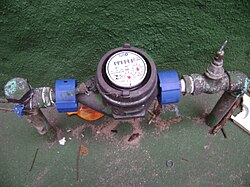
Our water bill today has three parts.  There is a bill for the water, which is read by a meter in our back yard.  The second part is the sewer bill, which is based on the water bill, with the assumption that every drop of water that comes through the meter ends up going out into the sewer.   More on that later.  The third part is our trash bill, which pays for our trash and recycling pickup via Waste Management.   And we'll address recycling in another posting.   Needless to say, we pay for this service, and very little of what goes into the can other than aluminum and cardboard, gets recycled.  Yes, you can carefully wash and rinse all the bottles you want, they often end up getting thrown away at the recycling center.

As an example, our water bill last month was for 10,090 gallons of water which cost $30.59 or about 1/3 cent per gallon.  If we have an older toilet of, say 3.5 gallons, then each flush is costing me about a penny a flush.  Not too bad.  But considering the minimum charge for just being connected is $9.33 (for 0 gallons) the cost may actually be less.  On the sewer side, we paid $44.96 or about .4 cents per gallon.  The total cost is about 3/4 cents per gallon, which means each toilet flush is sending three pennies down the drain.  There is, of course, a minimum sewer fee of 7.83 even if you use zero gallons, so that affects the calculation somewhat.

If you figure you use the toilet five times a day, for two people, you are talking 37 cents a day just for flushing toilets or about $136 a year (didn't see that coming).   But of course, the big-ticket items are the washing machine, watering, car washing, and showering, which make up the bulk of our water usage.

This site provides some round numbers on water usage for various tasks and appliances:


Bath40 gallons
5-minute shower 10 gallons
5-minute power shower 20 gallons
Brushing teeth with tap running 2 gallons/min
Brushing teeth with tap off .25 gallon
One toilet flush 3 gallons
Other water use (drinking, cooking, etc.) 7 gallons
Washing machine 40 gallons
Dishwasher 10 gallons
Washing car with bucket 3 gallons
Hose/sprinkler 140 gallons/hour

Assuming we run one load of laundry every day and take one shower each, that's 120 gallons of water a day or $327 a year in water usage.  It certainly adds up!
 
As I noted above, there is also a minimum monthly charge for water in sewer, at least in our district.  I found this out when I shut the water off when we went away.   The meter reading for that month was zero, but we still got a bill for about $50 - half of which was garbage pickup (which you pay for even if you have no garbage) and half for the baseline fee for being connected to water and sewer.  So even if you don't use any water at all, you have to pay.  And in most jurisdictions, you have to have the water and electric hooked up in order to occupy a dwelling.

The sewer charge, on our bill, is actually higher than the water charge.  And one reason for this is we have plenty of water (wells pump from an aquifer that extends far into mainland Georgia) but running a sewage treatment plant is an expensive proposition.   For this reason, it is advantageous not to pay sewer tax on water that isn't going into the sewer, and there are a number of ways to go about this.

In Virginia, we were sent a form every year asking us how much water we put into the pool.   I could never figure out exactly how much, of course, but would guesstimate so many gallons, and they would deduct that from the sewer bill.   Here on the island, there are two alternatives.   You can have a separate meter installed for "water only" for things like garden hoses and sprinkler systems.   You pay for the water from this meter, but don't pay a corresponding sewer bill.   The standard meter for your house is used to meter water that ends up going down the sewer.

Many homeowners here dig shallow water wells for sprinkling, which can be expensive, but pays for itself within a year or two, in reduced sewer and water bills.   The only problem is these shallow water wells are very hard, and the sprinklers will turn your driveway or the wall of your house brown over time.   My neighbor complained to me that the wall of my house was an "eyesore" because of all the brown staining.   I pointed out to him that the staining was from his sprinkler system, and he re-aimed his sprinklers accordingly.   $10 of Lime-A-Way liquid from the Dollar Tree and some scrubbing removed the brown staining.

Of course, another alternative is to water less.   I found that watering only about five minutes a day, twice a day, is more than enough to keep your grass alive.   And even inexpensive battery-powered sprinkler timers can be had with rain sensors, to shut off watering when it is raining.   It is funny to me, but many folks here will water for a half-hour to an hour, even in the rain.   Most of that water is merely carried off or soaks into the ground, often taking nutrients with it.

We might consider the shallow-water well thing down the road, but I am in no hurry to add complexity and cost to my life right now.   The ice maker, now 12 years old, (close to the design life of most appliances) seems to have given up the ghost, so my next project is to fix it or find a new one, and I am finding out that new ones are staggeringly expensive.

A house is just a place to live - and a thing that costs money.  A lot of money, over time.