Tuesday, February 12, 2019

Payback Schemes

Electric cars won't dominate the market until they make economic sense for the lower classes.

There are a lot of things you can do to save money, but chances are, you don't do a lot of them because the payback is measured in years, not months, and they might require a high capital investment.   Some things you might do because over time, they save you money, but also they provide you with some immediate benefit.

For example, we replaced our aging wooden-framed single-pane windows (circa 1970) with vinyl-famed energy-efficient double-paned insulated windows.   Yes, there were energy savings, and within about two or three years, we saved enough on our heating and cooling bill to pay back the $3000 cost of the windows (which we installed ourselves - windows installed by a "window store" would easily have been two to four times as much, stretching out the energy payback to a decade or more).

But the main reason we made the switch was we were tired of windows that were painted shut or swelled with the seasons, or let dust in the house or had broken screens.  We were also tired of the noise - we used to hear every car that went by the house.  Today, you don't even hear a car in the driveway.   The reasons we replaced it were more than mere energy savings - in fact, the energy savings were secondary.

Other "energy-saving" ideas we have not implemented because the payback is too long and the increased complexity isn't worth the hassle.  I looked into solar hot water, but the amount of money people want for these systems means the payback would take close to a decade, which means we'd have five years of actual savings before the design life of the system was reached.   In the meantime, we'd have to deal with balky pumps to maintain, along with controllers and valves, and of course, holes in the roof for all that plumbing.  And we'd have to hope a tree branch didn't take the whole thing out over its lifetime.

Hybrid cars fall along similar lines.   The payback is measured in years not months, and it can take the better part of a decade to recover the increased purchase price in terms of gas savings.  At $2 a gallon, it could take well over a decade.  And that's the problem - you buy something with a seven-year efficiency payback, and then the price of fuel drops in the interim, foiling your carefully laid plans.  And of course, if you buy a hybrid and then drive it like a jerk, you won't get better gas mileage than someone in a similarly sized non-hybrid.

One problem with these sorts of things is that they provide tax subsidies for them.   I am exhorted to buy a solar hot water heater as I might get a 30% tax credit (which I think has expired anyway) or a $7500 credit for buying a hybrid or electric car (ditto for some makes).  These are attractive to wealthy people who have high tax bills, which is why Musk was a genius for marketing $100,000 electric cars to the rich and Elio was an idiot for marketing $7500 three-wheeled cars to the poor.  At least the rich ended up getting their cars.

But the tax subsidy thing illustrated why these long-payback propositions are a no-sale for the poor.  My friend with the solar panels on his roof got some sort of tax deduction and was paid-back at retail rates for surplus electricity.   The poor person, living in an apartment, can't take that tax break or install such solar panels.

Oh, and by the way, the change in utility buy-back pricing illustrates again the pitfall of long-term planning when prices can change in the short-term.  Those solar panels would have paid for themselves in five years.   Now that the law has changed, it may be ten or twenty years before they pay back their installed cost - and that may be longer than they actually last.

The very poor don't have access to capital.  Moreover, they tend to make poor decisions, hence they are poor.  Things like buying in bulk or long-term paybacks are just not on their radar.   Hence why you see convenience stores and stores selling pints of liquor in poor neighborhoods.  That's why rent-to-own furniture stores proliferate in poor neighborhoods. Their time-horizon for investments and purchases is measured in days, weeks, and maybe months at most.   Years?  Out of the question.

The proposition of paying $5000 more for a car because in seven years, it will pay back the increased cost in gas savings is just a non-starter with the poor.   And this is not to bash the poor, only to state a fact of life.  And from their perspective, it may even be viewed as a logical choice.

In order to sell an electric car to the poor or even the lower-middle-class, it has to be a value proposition that is readily apparent.   The idea that the increased cost represents an equivalent quantity of gasoline isn't going to be obvious to them.    The only way to sell these vehicles to the poor would be if gasoline prices skyrocketed.  In the past, when gas prices hit the ceiling, people groused and complained and then went out and bought Japanese cars, or Chevettes, or whatever economy car got good gas mileage.

The problem is, of course, that if electric cars become popular with the upper classes, then the demand for gasoline will drop - and the price will drop accordingly.  Cheap gas ends up as a disincentive to the electric car - and could kill the electric car before it has a chance to kill itself.

There are also logistical problems to selling electric cars to the poor.    You already see well-used hybrid cars, on occasion in the ghetto, where some astute buyer did the math and realized that even a ten-year-old Prius was a good buy and good on gas.   For the most part, though, you see a lot of gas hogs in the poor neighborhoods - where we live, it is large SUVs and pickups.

But electrics require a charging station, and charging stations are not cheap and the price is the same for the rich as it is for the poor.  The rich guy with his $100,000 Tesla Model S can afford to hire an electrician and install a 220V sub-panel in his garage complete with Tesla charging station.  The poor cannot.   And unlike a used Prius, there are no used charging stations (or damn few of them) available to the poor - and there is still the labor to install them - assuming their electrical service is sufficient for the load (when I was poor, I lived in a house with 60 Amp service, I kid you not!   No, we did not have air conditioning or a heat pump or even an electric dryer!).

Either these things will have to charge from a 110V socket, or the government will have to subsidize the installation of charging stations on streets across the country.  Maybe some free-market entrepreneur will have to install them, along with a card-reader to charge customers for their juice.   Oh, right, a lot of the poor don't have credit cards and pay cash for gas at the convenience store.  How will that work for charging stations?

It gets me to thinking, how will that work for convenience stores?   Sure, some will still exist in the inner city.  But the vast majority make their money from coffee, donuts, beer, and lottery tickets that people buy when they stop off for gas.   The move to electric vehicles will be a game-changer.   Or will it have the opposite effect?  If people have to sit for an hour to "rapid-charge" their electric car, maybe they will sit down and eat lunch or buy even more coffee and donuts or whatever.   It is an interesting thought.

Whatever the outcome, I don't see electric cars being a value proposition to the poor and even the lower-middle-class, unless gas prices skyrocket to the point where going electric is the only realistic option.  And if the previous gas crises of the last 45 years are any indication, it seems people will cling to their gas guzzlers as long as possible before they give up and buy a smaller car.   And a smaller gas-powered car may be more of a immediate value-proposition to a poor person than a used electric car.

We'll see.  It is interesting to think about.
Monday, February 11, 2019

Is Diesel Dead?


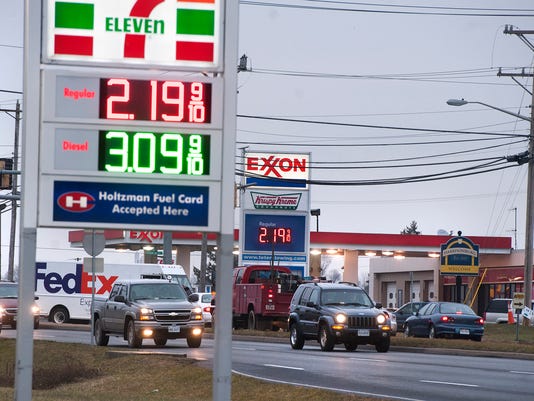
In at least the near-term, with the price of Diesel fuel as high as it is, the use of Diesels for consumer vehicles makes little economic sense.

The debate of gas versus diesel raged on for years in the RV and Boating communities.   And granted, once you get up to a certain size engine, there is no real choice - you have to go with a diesel.   The real "bus" motorhomes and large yachts are all going to be diesels.  But these are vehicles costing in the hundreds of thousands of dollars.

What about smaller rigs and boats?  What about cars and pickup trucks?  In the past, diesel proponents would argue that the increased lifespan and decreased maintenance of a diesel was the big selling point - with increase fuel mileage being the gravy.   But these arguments are flawed on two grounds.

First, while it is true that commercial diesel engines can go over 300,000 miles without a rebuild, the reality today is that consumer-grade diesel engines don't last nearly as long.  Light truck and car engines are not designed like old-time Mercedes diesels or the Caterpillar tuck engine on an over-the-road truck.   The little four-banger in your Golf just isn't the same deal.

And while diesels rarely break, when they do break, they break expensive.  It is harder - in America - to find a diesel mechanic who will work on light-duty consumer-grade engines.   So you break down in the middle of nowhere, you may be out of luck.

The second problem with the longevity argument is that most people don't keep vehicles that long.  Motorhomes don't generally go 300,000 miles - at least not within a few years as over-the-road truckers do.  Maybe after a couple of decades, they might approach this, but even then.  We've seen a lot of 10 and 20-year-old motorhomes with less than 100,000 miles on the odometer.   And the same is true with boats - they end up sitting parked at the dock for long periods of time.  Such recreational vehicles don't get exercised like your daily driver.

But of course, gas mileage is the other argument - and one that made sense back in 1980 when cars were getting horrible mileage and diesels were getting great mileage. Diesel fuel was actually cheaper back then as well which was an added bonus.   Plus, you were exempt from emissions testing back then, simply because they didn't have the necessary equipment to test diesels.    The diesel was an end-run then, but today less so.

Today, diesel fuel is more expensive than gas - by nearly 50%!   Gas locally here is $2.14 today, while diesel is over $3.    Yes, maybe you might get 50% better gas mileage with a diesel, but you pay 50% more for the fuel - it is a wash.   Lately, gasoline engines are being wrung out for every last mpg - with turbocharging becoming very commonplace.  As a result, the vaunted fuel mileage gap is closing quickly.    A F150 diesel might be rated for 22 city, 30 highway while the gas counterpart is rated for "only" 17 city and 22 highway.    In city traffic, the gas model costs less per mile in fuel, and on the highway, the cost is about even (with the gas model still being slightly cheaper) due to the high cost of diesel fuel versus gasoline.

Then there is the purchase cost.  Diesels can cost up to ten grand more than their gasoline counterparts.  Even "consumer grade" diesels, like Ford's 3.0 powerstroke cost four grand more than a gas model.    I would say that four grand buys a lot of gas, but since gas is cheaper than diesel fuel, it really isn't relevant.   You end up spending more for the engine and the fuel.   You can only hope to make it back in repair costs, over time, which might take a decade or more of high-mileage driving to show.

If you drive for a living, towing heavy trailers, the answer is diesel.  If you are Joe Consumer, pulling a boat or a travel trailer for recreation, the answer is less clear - and gas is probably a less expensive and easier choice to live with.  If you are commuting to work in a small car, diesel no longer makes sense and may no longer be available.

Yes, the emissions thing.  Diesels pollute like mad.  Even if you are not "blowing coal" diesels make a lot of soot.  Some vehicles actually filter this and have a vibrator on the filter so you can empty out the dust pan of pure carbon powder.  Most diesels today use "exhaust fluid" which used to be a snipe-hunt type of joke turned into reality.  To reduce pollution, a fluid which contains uric acid is used to scrub emissions.  Yes, you are essentially pissing in your exhaust pipe.

All these complications mean the engines are more complicated, have more electronic controls, and as a result are not the bulletproof machines of yore.  My old Mercedes W123 was totally mechanical, down to the fuel injection.  Once started, it required no electrical system to run and in fact, there was no real way to shut it off, other than to cut off the air supply, which was achieved by a butterfly valve actuated by a vacuum line.  If that line came undone (as it did once) the engine could not be shut off.  Such was the nature of diesels back then.  Today, less so.

Since the VW emissions scandal, which seems to be encompassing more and more manufacturers (such as BMW) it seems that diesels are falling from favor.  VW is promising to go all-electric, or at least mostly electric - and other manufacturers are following suit.  Diesels for small cars are simply disappearing from the roadways as, economically, they make less and less sense.

Of course, some people are "diesel faithful" such as my neighbor from Ithaca, New York, who thought having a Diesel Jetta was not only cool, but a political statement - which spells trouble right there.   Never mind that diesels pollute more than gas engines - he was convinced that somehow his "eco-diesel" was saving the environment.  Hey, you can burn fryer oil!   But of course, he didn't, as converting fryer oil to diesel fuel is a messy and time-consuming process and, oh-by-the-way, there aren't enough fryers in the world to power even a tenth of a percent of the world's fleet.

Diesels turned out to be a lot about posturing and less about practicality.  The leftist drives his diesel VW convinced he is saving the world.  The motorhome owner buys a diesel so he can play pretend bus-driver.   The pickup truck buyer wants to pay pretend trucker - and scratch his balls while he makes lots of smoke and noise.   Outta da way!  Diesel trucker coming through!

But the rest of us simply find diesel pickups - particularly ones modified with ridiculous garbage-can sized exhaust pipes that are even louder than normal - to be just annoying and slow.

If you like to read old-time car literature (and who doesn't?) it is interesting to see how many over-the-road trucks back in the day had tiny engines - often gas engines.   They didn't go very fast, of course, but they did get the job done.

Many of the diesel drivers of today are driving diesel simply for status reasons.   That, and they have issues about their masculinity and need to overcompensate - itself a form of status-seeking.   It is also a form of the "professional grade" trap - where people buy overpriced "professional grade" appliances and items, thinking that their experience will be improved, when in fact, it is just made more expensive.

Will diesels go away?  Not in the short-term or even the long-term.  Odds are, they will continue to dominate heavy-duty trucks and even heavier-duty light trucks.  But for passenger cars and light trucks, they will shrink in market share if not disappear entirely, in the case of cars.   Certifying diesel emissions will get harder and harder to do, and manufacturers may drop them from even light trucks, if demand doesn't warrant the cost of certification.

I suppose if a manufacturer came up with a high-mileage diesel with low emissions (without cheating) AND the price of diesel fuel dropped precipitously, things might change. And the latter could change, as in America, the high cost of diesel fuel has more to do with refinery design and capacity than anything else.  The flood of fracking oil hitting the market is a light, sweet crude, well-suited to making gasoline.  But our refineries are set up to crack diesel from heavier, high-sulfur crudes, such as from the middle-east or Venezuela.  Changes in politics could change the price of diesel - one way or the other.  I am not sure change in technology will occur to overcome the technical problems.

For myself, buying a diesel was not even an option.   I simply don't drive enough to warrant the extra cost (and even if I drove a lot, the fuel costs would wash) or haul heavy enough loads to warrant the horsepower.   Maybe, someday, if we bought a boat, it might have a diesel engine.  But the more I look at the cost of owing boats, the more I think renting them is a nice option.

Birds and Squirrels

When you throw food out in the wild, animals will start to gather.

When we traveled to Alaska, there were warnings aplenty in nearly every park we visited - long before we arrived in that State - noting that if you left food out, animals would come and take it.   Maybe in most of the lower 48 and Canada, this is limited to wild raccoons and the like - spreading trash across your campsite.  But the further into the wild you go, and the further North you go, the more likely it is bears you will have to deal with.

And the authorities are pretty strict about this.   Back in the day, people used to feed bears - I recall when we visited Yellowstone back in '68 people would hand food out the car windows to "friendly" bears.   Occasionally, someone would lose a finger.  Even back then, they tried to damp down this behavior, as the bears became too tame, then a nuisance, and then had to be relocated.

We ran into a similar problem when we started feeding the birds.   We put up one tiny feeder and filled it with grocery-store birdfeed mix.  After a week, birds started showing up.  Encouraged, we bought books about birds and bird-feeding.   The bird-feeding book was literally for the birds and written by a lady who was literally a bird-brain.  She had birds on the brain.

Some of her suggestions - all of them, in fact - were nuts.   And not just the suggestions we feed nuts - and fruit, and bread, and peanut butter and suet - to the birds, but ideas like making a "feeding platform" out of an old board and some cinder blocks and then just scattering random food items on it.  Or using a pile of old branches as a feeding area - with food just dumped onto it.

The problem is, of course, that every other animal in the area would appreciate this as well, including squirrels, raccoons, possums, deer, and even mice and rats.   If you throw food into the wild, the animals will come.

You can try building elaborate mechanisms to keep the "unwanted" animals out - such as squirrel shields, or hanging the feeders from trees.   Usually, the animals figure a way around these things over time.

You can try trapping the squirrels and relocating them, much as wildlife officers try to relocate bears.  Relocation sometimes works, but in other cases, does not.   It seems for every squirrel you trap, ten more come to take its place - they reproduce prodigiously, particularly when there is free food laying about.   If you put out seed for birds, in an area with squirrels, you will find one squirrel under the feeder one day.  Then two.  Four.  Eight.  Twelve.  And eventually, one of them will climb down to or jump up to the feeder and start helping himself.  One enterprising fellow gnawed through steel wire to cause a big feeder to fall to the ground, creating an instant buffet for him and his friends.

Actually, that isn't right.   Squirrels have no friends.  They fight with one another constantly and are selfish as they come.  If one is eating, and another approached, he will attack that other squirrel, viciously.   Maybe this is because they have this largess and thus no reason to cooperate.  Perhaps.   I wonder, sometimes how they even breed, as they are so mean to each other.  I suspect that all squirrel sex is basically rape - and this after seeing squirrels mate.   "No means no!" doesn't carry much currency in the squirrel world.  And I suspect that all squirrel Moms are single Moms.

Sea lions, all along the Northwestern coast of America, are a protected species - or were, anyway.   It seems they found where the salmon run and lately have been depleting the salmon stocks by basically eating every damn salmon that comes upstream to spawn (we are the other half of the salmon problem, of course).   They tried screens and nets and even relocating the sea lions (a tedious and expensive process).  Moved a hundred miles up the coast, they returned in a matter of days.

This year, they finally authorized shooting sea lions. Relocation doesn't work. 

The other problem with feeding the birds was the birds themselves.  Presented with a huge feeder full of seed - that was constantly refilled - they had no incentive to conserve seed. Some birds, particularly wrens, would fling their bills back and forth, scattering seed from the feeder to grateful squirrels and doves on the ground below. They would dig through an "assortment" seed mix to get the black oilseed they wanted.   We tried going to just black oilseed, but for some reason, they fling that out as well.   Birds do not appreciate things when they are free, and have no incentive to conserve food when it is freely available in bulk.

The only solution, of course, was to cut back on feeding or just stop feeding entirely.  Once the food source was removed, the squirrels, possums, raccoons, and deer dissipated.   Of course, the birds did, as well.  But maybe that is for the best - they need to forage on their own, and an artificial supply of food would cause them to reproduce at a rate that would be unsustainable if the food supply were removed.

This is debated among those in the bird community - not the birds themselves, but the bird-lovers.  Some argue that feeders encourage dependency and that they create an artificial environment for the birds.  If the food is provided, the birds learn to depend on it.  Remove the food, and the birds would starve, as they are not used to foraging on their own - and moreover, the amount of forage-able food available isn't sufficient to support the population inflated through seed provided by feeders.  I think this is a valid argument in many regards.  We alter how the natural environment works and we end up creating havoc.

What got me thinking about this - other than yet another fat squirrel riding the "rotunda" feeder with a self-satisfied smirk on his face - was an article recently in the right-wing National Review. A Christian couple, through their church's youth outreach program tried to help troubled youth.  They had initial success with one troubled lad from a broken home - finding him a place to live, getting him enrolled in a trade school and finding him a job.  He settled down, bought a home, got married, had kids, lived happily ever after.

Encouraged by this success, they tried to help others, only to find their initial experience something of a fluke.  Other "troubled youth" were less responsive, deciding instead to steal from this Christian couple, break into their home, blow off community college classes (and jobs offered) and even assaulting them.

You want to be nice - you want to help people.  It's the Christian thing to do, right?  But some folks view Christians as the ultimate patsies (and perhaps they are, turning the other cheek and all).  And some folks will take advantage of charities - plundering them for their own benefit, either as recipients of the charity or as the people running it.  Friends of mine who volunteered for the local food bank and food kitchen quit in disgust when they discovered that many of the clients were hardly "needy" but just willing to take free stuff and free meals.  When you are loading boxes of food into someone's car - a car nicer than yours - and they won't even get out of the car to help, you have to ask yourself why you are doing this.

Many folks use the phrase "bug light" to describe how giving away money (or houses, or food, or whatever) acts as an attractant.   If you make being homeless comfortable by allowing people to beg on the streets, do drugs, get drunk, and sleep wherever they want to, you do tend to end up with more homeless people.  There are more homeless in tourist towns and resorts than there are, say, in a small town in rural Iowa.  The simple reason is, you can make a lot of money begging from tourists and support a hefty drug habit.  In Iowa, you'd freeze to death.

So the "bug light" analogy is inapt.   Bug lights actually kill the bugs who are attracted to them.  Then again, allowing people to live on the street eventually kills them, or at the very least, shortens their life expectancy considerably.  I would say the bird-feeder analogy was more apt.  But of course, if you are a fan of the new Democratic-Socialist shaming far-left, you would find this all appalling!   How dare you compare people to animals!   But of course, we are animals, too, and despite our high-minded principles, we tend to act like animals.  And the behavior of animals is illuminating in studying our own behavior - which is why Psychologists put rats in Skinner boxes (that, and maybe they like to torture small animals).

Look around the world and see how the human animal behaves.  We, like birds and squirrels, reproduce until we have exhausted our habitats.  We destroy the natural world so that a few more mouths can be fed and a few more of us can get fat in the process.   We fight and kill and maim each other, just like our squirrel friends do.   We are not so much different, nor are we very much high-minded.   We are animals and our behavior is proof of that.

In my previous posting, I included some links to some sites which questioned the worth of Habitat  for Humanity, which like most charities, is held out as some sort of Mother Theresa type deal which is beyond reproach and how dare you even question their mission and credentials!    Most of the blog postings and articles I cited to were poorly worded rants on how somehow Habitat screwed them over by not giving them a free house.  One article was about a Veteran who claims the house he was sold was defective.  Beggars can indeed be choosers.

But one article was illuminating. An older MarketWatch article from 1999, claims that "scams" are targeting Habitat home buyers by offering to refinance their homes on balloon notes.  I am not sure whether the scammers are the people who were offering the balloon notes, or the people who were being "helped" by Habitat.   

The scam is pretty simple.  Habitat sells a home to a "poor" person for about half its market value.  Right off the bat, you see the problem - they are giving away a huge chunk of equity to a person with no financial common sense.   For a $160,000 home (a number that seems to be common at Habitat) they might sell it for $80,000, effectively giving away 80 grand to a poor person.  There are restrictions on the resale of the home to prevent people from immediately "cashing out" so instead they do a "cash out" refi and walk away with tens of thousands of dollars in cash.  They stay in the home for free until it is foreclosed upon or the balloon note is due, and then walk away.

For a homeowner, this is not necessarily a bad outcome.  They have a free place to stay and a wad of cash out of the deal.   The fact they don't see the long-term gains they are losing out on is irrelevant.  We're talking people who think a payday loan is a long-term financial instrument (which indeed, it can devolve into).   Moreover, if they have a drug habit, well, 20 grand in the hand is worth home equity in the bush.  Or maybe it is just the prospect of buying a fancy car.   People are people, and are often (if not usually) illogical.

It is not the homeowner being scammed here, it is Habitat being scammec by selling homes for half market value - with predictable results.   Some of the other blogs and articles I linked to had complaints from homeowners arguing that the structure of the sale of their home prevented them from refinancing or selling it.   Perhaps the Habitat people have wised up and used a land-contract kind of deal to keep the buyer in the home and prevent them from refinancing or selling for a certain period of time.   This would explain why these people complained they could not sell or refinance - and that's probably a good thing, too.

But of course, this places Habitat in the position of being perpetual lender and landlord, and having to control people's lives because they can't control their own.   And right there is the root reason for poverty - poor people making poor choices.

Like with our Christian couple, there are no doubt a lot of people helped by these Habitat handouts - and make no mistake, "sweat equity" or not, they are handouts.   Some folks are actually grateful for a chance to improve their life and will take this windfall and put it to good use.   Others, I suspect less so.  It is human nature to squander a windfall - stories abound of people who tear through an inheritance in a year or so, or lottery winners who end up bankrupt.   When you don't earn something - when you don't have to pay for something - you don't value it.

Or more precisely, you assign the correct value to it, which is zero.   When a home is "free" - as is the case for many Section-8 tenants who never pay their pitiful share of rent - they have no respect for it. They trash it, knowing full well that the government will find them a new Section-8 house or apartment once the one they live in is uninhabitable.

When food is free, (or cheap) you have no incentive not to waste it.   When gas is cheap, you have no incentive not to buy an SUV or Truck.  And so on down the line.    People - particularly on the Left - seem to think we can overcome this fundamental problem with our human nature.  That we will "recycle" things on our own initiative, even as there is no market for much of what we recycle today, particularly with regard to glass.  Some even think - as they do in Paris - that no food should be thrown away ever, even though food is ridiculously cheap these days (ask your local bankrupt farmer) and that saving "leftovers" is as sure-fire recipe for food poisoning.

They even have a name for these crazy folks (thanks to a faithful reader) "Freegans" - who basically eat out of dumpsters.  We live in a country awash in a sea of cheap food, and these folks have to eat garbage.   It makes no freaking sense, whatsoever.   It is, of course, just an affectation, a form of status-seeking among their own twisted peers.  "I'm better than you because I don't waste food".

Neither do I.  I eat it.  Unless it has gone bad, then it goes in the trash where it belongs.  But I digress.

We don't put out as much birdfood as we used to.   We cut the number of feeders in half and may reduce even the few we have left.  When the birds empty one feeder, I am in no hurry to refill it, as I was in the past.   The net result is maybe a few less birds and a lot less squirrels.

And what I take away from this is a lesson in human nature - including my own.  We like to think that as humans, we are better than animals - that we can invent and think our way out of troubles.   That we will solve the world's problems by using birth control and not overpopulating the planet.  That we can invent solar-powered batteries and electric cars and eliminate fossil fuels.   But I suspect we are deluding ourselves a lot with this sort of thinking.   Birth control hasn't reduced the headlong rush into world overpopulation - and in fact, the poorest among us are populating the fastest.   Electric cars powered by solar batteries won't "solve" our problems, they will just make it possible for even a greater number of us to overpopulate the planet.

Look at photos of Los Angeles in the 1930's, 1950's and today.   In every photo, the place is covered with smog.  People stopped burning coal for power and heat by the 1950's.   But car pollution took its place.  California emissions cut back on the amount of pollution from each car - we responded by doubling, tripling, and quadrupling the number of cars on the road.   Our technology didn't make L.A. better - it just kept it habitable, for more and more people.

Maybe I am wrong.  Maybe we are smarter than squirrels and birds.  Maybe we can think our way out of our problems.   But the more I see human nature at work, the more I doubt it.

Cheerful thoughts!

Sunday, February 10, 2019

How Much Does It Cost To Live In A Paid-For House?

How much does it cost to live in a house?

In my last posting, I mused that it costs me about $1000 a month to live in the house I live in.   But quantifying this is a little hard to do, even though I have been tracking expenses on Quickbooks for the last decade.  With a click of a mouse, I can generate a report that tells me to the penny what my housing expenses are.

But what are they?   For example, to get on our island, you have to pay a $6 toll, or pay $45 a year for a parking pass (I think it is $50 now).   Does that count as a living expense here?  After all, if I didn't live here, I wouldn't be paying it, right?

Or what about personal property taxes?   In some jurisdictions they would actually tax your sofa (I kid you not, back in the day, they did this in Virginia).   So if I moved to a no-personal-property-tax State, this would not be an expense I would be paying.  Here in Georgia, we only have (or had) personal property tax on cars - is that an automobile expense or a cost of living here?   Hard to tell.

The main categories are easy to figure out - property taxes, insurance, electric, water, sewer, trash - all broken out in monthly checks or credit card charges and logged neatly.   We also have our lot lease ($250 a year - not much!) and fire fee (nearly double that) which clearly are a cost of living here.

But what about "maintenance"?  This is where it gets tricky to determine and tricky to log.   I go to Lowes to buy a bunch of junk - half of it I don't need.   Paint to paint the bathroom.  Is that a housing expense or just a waste of money?  What about the plants for the front yard?   Or house plants?  Or furniture?   It gets a little tricky.   What about cleaning supplies and vacuum cleaner bags?  Arguably these are things I would buy in any event.

It is not an exact science, unless you can determine hard-and-fast rules for these things and itemize each receipt in Quickbooks, item by item, which would take forever to do.

There are other things that seem pretty straightforward - the pest control people (necessary in the South) and the HVAC contract.   And we have a guy mow the lawn when we are not home.   Those seem like legitimate expenses.  And I have included "maintenance" expenses from Lowes and Home Depot, except for "projects" which I have broken out separately.

Averaging the last six years' worth of expenses, I come up with $10,891.67 a year for housing expenses - an attractive $907.64 a month in costs.   But this is only because we have no mortgage and that raises some other thorny accounting issues.

Opportunity Cost arguments, as I noted before, are often specious when applied to consumer spending.  The real estate agent and the car dealer makes these arguments when trying to sell you more house or get you to lease a car - reasons alone why they should be suspect.  After all, when was the last time a real estate agent or a car dealer lied to you?   Oh, right, all the time.

The argument goes that you could "invest" that money and make lots of bucks in the stock market - in excess of what you were paying in interest on a mortgage or car loan.   However, this is a classic case of comparing apples to oranges.   Interest not paid is the safest "investment" you can make - safer than gold, bitcoin, stocks, and even government-backed bonds.   You can lose every penny you invest in stocks.  But a dollar in interest not paid is a guaranteed sure-thing.

So let's toss the "opportunity cost" arguments for the time being at least.  By not having a mortgage, I am saving over ten thousand dollars in annual interest payments, assuming I would be borrowing $400,000 at 4% interest, and the loan is fairly young.   I would have to consistently beat 4% in the stock market to make more money than this - it can be done, of course, just not consistently or reliably.

You can't compare investments with different rates of return and different risk factors.  It is apples and oranges.  If this comparison was indeed valid, then the most "sensible" investment would be ultra-high-yield absolute junk bonds or hugely speculative stock investments.   They might yield returns well into the double-digits - or lose every damn penny you have.   But if you take the "logic" of "opportunity cost" arguments to its ridiculous extreme, that's where it gets you.

And as we learned in 2008, leveraging yourself into debt to invest (which is what you are doing - borrowing money to invest) can go horribly wrong and leave you destitute and literally homeless.  Debt sucks.

But getting back to monthly home costs, as I note before, a house is just an expensive machine with a lot of parts that break about every 15 years.   Every so often, you have to pony up thousands of dollars to repair or rebuild things - something Condo owners don't understand, which results in them freaking out when a special assessment is due.   Roofs may only last 15 years, and ditto for air conditioners, hot water heaters, and home appliances.   Driveways crack and fall apart and need to be resurfaced or replaced.   Kitchens and Baths can become woefully outdated and need remodeling.  Plumbing and sewer lines can age and require replacement.  Electrical wiring can even age and electrical boxes can become outdated as well.

All of these things are expensive.   And these are just things you need to do to keep the house from falling down.  We're not even talking about add-ons you might want to plow money into - a swimming pool, a new addition, a screen room, a sun porch, a deck, a garage, a garden - and so on.  A house can be as much of a money pit as you want to make of it.  Oh, and ask me how I know this - Mr. Swimming Pool!   Oh, well, we had fun with it, at least.

Last year, we did a garage makeover - epoxy speckle paint on the floor, replacing the outdated and leaking plumbing, new washer and dryer, new sheetrock, lighting, wall treatments, cabinets - even a new garage door seal.  It didn't sound like much, but I logged every purchase and every expense and it came to over $8000.   Just to remodel a garage.  And that's not counting the two grand I threw at it a few years before by installing a split system air conditioner and insulating the garage door.

I do have a nice garage now - the envy of the neighborhood!   Well, not exactly, but a nice place to do laundry and work on cars or projects.  It is something we enjoy and something that had to be done (leaking plumbing and peeling paint were non-starters).   Maybe we could have done it for a few thousand less - but not for free.

This year, it is a new electrical panel.  Our Pacific-Electric panel is well-known to start house fires - what's not to like?   Eventually it would have to be replaced, just to sell the house.  A local electrician can replace it for about $1000, which is pretty reasonable.  I could do it for a little less, but not much less!

We had two trees taken down this year - at $1000 a tree.   Oh boy, does that add up!  The driveway is cracked and will have to be replaced.  The appliances, the roof, the hot water heater, the HVAC system- all about 13 years old and destined for replacement within the next few years.

I can see where these sort of expenses could easily equal half the "annual cost" of owning home (sans mortgage) if spread out over time.  In other words, I should budget another $5000 a year for these sorts of long-term repairs, or about $500 a month or so.  Owning a home isn't cheap.

Of course, you can let a house fall down around you and not spend a dime.   Eventually, you sell it for a pittance and someone comes in and tears it all apart and starts over with new everything. The problem with that approach is twofold:  First, you are living in a festering shithole, and that's not exactly fun.  Second, you end up losing a lot of equity in your home.   For example, a house recently sold here on the island for $250,000 as it needed a complete overhaul.  It is now on the market for $450,000 after being remodeled.   If the previous owner had kept the place up and up-to-date, they might have realized two hundred grand more when they sold it.

It is like the "logic" of never changing your oil.   And yes, I know people who have done this - even to brand-new cars.  They save all that money on oil changes, right?  But they end up driving an oil-burner and putting a quart in every time they fill up (so they don't necessarily save on oil changes, they just buy them one quart at a time).  And in about 50-70K miles, tops, the engine gives out and the car is worth little more than scrap - a car that could have gone 150K miles without effort.

Of course, there are junker cars that cost only $100 and maybe aren't worth even an oil change.  Similarly, there are houses in places like Gary, Indiana or Flint, Michigan, which aren't worth fixing, and as a result, they aren't fixed and quickly turn into ghetto homes, until they become inhabitable and condemned.  And at that point, the city tries to sell them for back taxes - with no takers.  Gary, Indiana is trying to sell homes for a dollar with no takers.   Location trumps condition, and when location and condition are both bad, you can't give real estate away.

Please tell this to the people at Lowes and Home Depot!

I guess that is why it sort of irks me when people talk about housing as a "right" and not as physical thing that requires maintenance and expenses.   You can talk all day about how you have a "right" to a house, but even if someone gave you the house outright (hello Oprah?) there are still significant expenses that need to be paid in order to just live there - well over $1000 a month, I would estimate, even for the cheapest of homes.  But of course, many people don't realize these expenses exist, as their roof isn't leaking yet and the refrigerator hasn't broken down yet.

I wonder, in these situations such as Habitat for Humanity how it works out for the buyers of those homes?   Do they understand that their remodeled or new home will require a lot of expensive repairs  in 10-15 years?  Or that even neglecting simple maintenance, such as cleaning gutters, can result in expensive repairs down the road?  Do they understand that as owners they are responsible for these things? (Can they even afford the homes in the first place?)

I say this as I sold a house to a renter once, and he called me two years later asking me to make repairs to the house.  When I refused, he said, "I don't see what the problem is, my landlord used to make repairs all the time!"   I explained to him I was not his landlord and he did not have a landlord.  He was the landlord.

"I put in a new HVAC system, new wiring, new carpet, new roof, new driveway, and new windows," I told him, "now it's your turn!"  Apparently he thought a house was a thing that never needed repairs, maintenance or replacements.  I tried to explain to him about cleaning the gutters regularly, but apparently that never took with him - with predictable results.

He got very agitated and I offered to buy the house back from him at the same price.  The house was worth $100,000 more now than it was when I sold it to him, of course.   He should have sold the place and gone back to renting.   Some people are not cut out to own homes.  Some people are not cut out to even own cars.  Or be parents.  Or even feed themselves.   But, sadly, that doesn't stop them!

Maybe I should just wait for Ms. Alexandra Casio-Sportwatch to become President, and then get on the wait-list for an apartment in some brutalist soviet-style housing block.  There's always that option!

House Trap, Mouse Trap

Is it possible to be stuck in a house?

A reader writes suggesting a potential blog entry. I'm always suspicious of people suggesting blog entries as outside forces in this world are always trying to influence the way we think.  I get a lot of suggestions from companies wanting me to promote their products, for example. And I have promoted some products on this blog that I like, but only because I like them and think they're outstanding values.  No money changes hands, and no one suggested that I write about those products.

For example, you can go out and buy a Yeti drinking cup for $20 each, or by the Chinese knockoff at Walmart for $5 a piece. You can guess which one I bought.  And damn, those socks are great.  I am wearing them now.  The don't slide down my ankles like the brand-X I used to buy.  And they are warm, too.   It's like an orgasm for your feet.  But I digress.

The reader wasn't pushing a product.  Rather, he pointed out that downsizing from a larger home to a smaller one as you get older can be very difficult to do.  And in that regard, he has a point.

While we enjoy our present home, I can envision a time when it will be too much for us to keep up. And I say this because I see that my neighbors, as they get older, let their house sort of slip away from them, until they reach a point where they are forced into a retirement community or have to move back home to be near their children.

There seem to be phases in one's retirement, and I will write a blog entry about that later.  One of the early phases is what I call "house polishing" - which I am finding myself subject to at the present time.  Some people have written to me saying that once I retire I'll go crazy not having enough to do with my time.  But actually the opposite is true - you wonder where the day goes, and it seems there is more than enough things to keep you busy every day.  In fact, you wonder how you were able to get anything done at all when you were working full-time.

I noted before that anxiety is like a gas.  It expands to fill the container it is placed into.  And when you retire, your level of anxiety doesn't necessarily go down, it just expands in other areas.  Maybe you no longer have to worry about getting to work on time or whether the boss likes you, but now smaller and more trivial things seem to fill up your day.  And this is one reason why the ladies in the Parcheesi Club are always causing trouble for each other - stirring up a shitstorm over trivial nonsense because they had nothing else to do.

Others engage in volunteer work, still others obsess about a hobby or sport such as golf which is particularly popular with the elderly set.  And many people, particularly men, start to obsess about their houses - polishing them up to make them perfect, now that they have the time and money. Maintaining the perfect lawn becomes an obsession for many men, such as my recently deceased neighbor who built an almost flawless lawn from property line to property line and even beyond.

He got very distressed that the lawn looked ratty on my side of the property line, and he started mowing, fertilizing, and watering the narrow section between the property line and my driveway.  Of course, I didn't object to this.  If somebody wants to mow my lawn that's fine with me.  I did have issues when his sprinkler system sprayed the side of my house and turned it brown from the brackish water.  But some re-aimed sprinkler heads solve that problem, and a little lime-away and a scrub brush took away the brown stains.

But getting back to our topic, sometimes it can be hard to leave a larger house, not only because you're comfortable in it, but because changing to a different location could actually cost you more money.  For example, back in the day in Florida, many older people were stuck in their homes due to the homestead law.  So long as they stayed in their home, their property taxes remained low.  For example, Mark's mother-in-law passed away a couple years back and we inherited her house, along with Mark's siblings.

She only paid $3,000 a year in property taxes on that house.  The new owner would have to paid close to $10,000 a year in property taxes once it was reassessed.  That along with the staggering cost of hurricane insurance forced us to sell the property, as nobody in the family could afford to live there.  And that is a story being repeated time and time again in this country.  People are inheriting property from their parents that they can't afford, even if there is no mortgage on the property.

But getting back to the homestead exemption, before they changed the law about a decade ago, you couldn't transfer your homestead exemption to a new property.  Thus, if you lived in a half-million dollar home on the water in Pompano Beach and were paying $2,000 a year in property taxes, and decided you needed to downsize, the property taxes on your new condominium would be double or triple that easily.  As a result, many older people stayed in large homes they could not maintain rather than downsizing to a condo.  Fortunately, Florida changed that law, making it possible to transfer your homestead exemption to a smaller property and us unchaining you from the house you had bought decades ago.

But there are other factors that make moving to a newer property more expensive.  For example, here on our island they are building some new townhomes and condominiums which would cost less to purchase then our current house.  Theoretically, we could sell our home and buy one of these condominiums or townhomes - before the prices went up - and pocket $100,000 or more in the process.  The problem is, those properties being condominiums and townhomes have a monthly condo fee or homeowners association fee that needs to be paid.

As a result, our monthly carrying costs would be a few hundred dollars higher than what we are paying now to live on this property.   We will be going to a smaller and less expensive property, but paying more in monthly carrying cost in order to live there.

There are also duplexes on the island, which were built as beach rentals or housing for island employees.   They can cost about half of what our house is worth, and theoretically, we could downsize to one of those (and just might) and cash out $200,000 from our current house.   Of course, the neighborhood isn't as nice.  Being closer to the beach, you get more transient people - weekend warriors and whatnot, renting out places and stuffing four families in them for a yee-haw vacation.   So there are tradeoffs.

And that was the point our reader was making.  If you live in a neighborhood of $500,000 homes, if you move to a neighborhood of $250,000 homes, odds are, it isn't going to be as nice a neighborhood.  The crime rate may be higher.  There may be more eyesores like cars parked on the lawn and whatnot.  It may be noisier and less attractive.   The schools might not be as nice.

And while that is true, there are often, in the same areas, dwellings in different price ranges.   There may be an apartment or condominium nearby the house you live in.   It all depends on where you live.

The real savings, though, often occur when you move somewhere else instead of just moving across town.   In days gone by, moving to Florida was seen as the ultimate way to cash-out of an expensive home in the Northeast.   You could sell your overpriced tract home in New Jersey, New York, or Connecticut, and buy a place in Florida for less than half of what you sold your house "up North" for.  And the taxes - back then - were very low.   So not only are you cashing out and moving to where the weather is nicer, your monthly carrying costs were lower.

A lot of that has changed as more and more people move to Florida.   Houses which were cheap to buy are once again being speculated into the stratosphere.   The boom and bust of 2008 flipped the whole Florida narrative - suddenly a retirement home in the South cost more than a home up North, and the property taxes were staggering, thanks to a homestead exemption that kept taxes artificially low for people who had been there a long time, but socked it to newcomers.

There are still places to live in Florida that are fairly cheap.  You can buy a two-bedroom home in The Villages for under $200,000 and the taxes there are fairly low (not many kids in that school district!).  but places like Miami and Ft. Lauderdale are often far too expensive to downsize to.  Or if the places are inexpensive, you really don't want to live there.

Oddly enough, there are cheaper places to live "up North" these days, and if you don't mind the crappy weather, they could be affordable.   In fact, I suspect we may see a reverse-migration from the South as housing prices here become excessive.   One reason we are in Georgia is that it was less expensive (and less crowded and less crime-ridden) than Florida.  They call people like us "half-backs" - people who moved to Florida and then moved halfway back - to Georgia or the Carolinas.

One friend of ours moved back to Elmira, New York.  Elmira is a depressed former factory town where they used to make typewriters.  But that went away a long time ago, and today, the best that could be said about Elmira was that it is nicer than Utica.   Elmira boasts that it is the soaring capital of the world, a title it used to have in the early days of gliding.  Today, not so much.  They also tout that Mark Twain once lived there - at least in the summer months - but I am not sure that is really a claim to fame.  Chittenango, New York, where I lived briefly, touts itself as the home of L. Fank Baum, the author of the Oz books.   They even put in yellow brick sidewalks and have an Oz-themed casino and events.   But I think he only lived there from age two to five - hardly an imprint on the community.

The point is, and I did have one, they bought a sturdy two-bedroom house only a few blocks from the hospital (and their grandchildren) for under $100,000.   Granted, the weather sucks for about 8 months of the year, but it is cheap living, particularly for the elderly, who do get some tax breaks.

For us, our search to downsize is continuous.  One reason we like to travel to different parts of the country is to see different places and wonder whether they would make good "next step" places to live.   So far nothing has jumped out at us.  We are fortunate to live in a low-cost area that is relatively crime-free and quiet.   There is not a lot of support for elderly living here, nor are there a lot of cultural attractions or good restaurants.    Life is about trade-offs, I'm afraid.

But all that could change.  Sadly or fortunately, our little island is being "discovered" after being overlooked for so many years.   Not everyone likes "creepy and quiet" as Mark described it nearly two decades ago, but with new construction of new homes (replacing hotels that were torn down nearly a decade ago) the fixed population of the island may increase.   This could lead to horrific things like traffic and maybe even a stop light!   The horror!

It may also mean some good restaurants, but I am not holding my breath about that.   Getting good service in rural areas is hard - the locals seem to have no idea how the tipping system works.  But that's neither here nor there.

But again, I digress.

There is one other point to be made about downsizing and that is transaction costs.    Don't be in a hurry to dump your current home and downsize to a smaller one, unless you truly cannot afford the home you are living in.   Expect to pay at least 5% in real estate agent fees, as well as other closing costs (closing company or attorney's fees, recording fees, document fees, and so forth).   If you are selling a $500,000 home, it could easily cost you $25,000 in transaction fees.   And this is why it doesn't pay to "churn" houses.

When we lived in Northern Virginia, we knew people who moved from house to house more often than they traded-in cars.   We're talking moving every three to five years.  It made no sense, really, as the transaction costs ate up whatever equity they were building in their home.

Probably the best way to avoid this problem is to not buy a monster house to begin with.   The huge mini-mansion or oversized house (for your needs) is something than younger people buy into, based on status alone.   I know childless couples living in four-bedroom homes - some rooms blocked off and never used.    I know other folks with children, who buy monster homes with six bedrooms or more - most unfurnished or furnished with crap furniture and milk crates.   They are paying huge taxes, utilities, insurance, and maintenance and space they aren't using.

Often such folks are sold oversized houses like these on status - and promises by the real estate agent that they will "make more money" on their home by "buying as much home as you can afford!"    A better plan, in my opinion, is to buy the home you need, and if you have money left over, then invest this in something - maybe a rental property (with a positive cash-flow) or a mutual fund.   Because a house you live in is not an investment, even if it may be an asset.

Maybe downsizing is just a daydream.   The idea of having an inexpensive apartment or condo with little maintenance and upkeep, only "steps away" from shopping and restaurants and cultural attractions is, well, perhaps overstated.   Sure, there are such places - but not inexpensive places.  They might be easier to keep clean, but the monthly condo fees and taxes (or rent) are likely to be more than we are paying right now (about $1000 a month for taxes, insurance, utilities and basic maintenance).  Maybe the best place of all is where we already are.

Of course, that doesn't factor in other costs - like roof replacement, HVAC replacement, appliance replacement, routine painting, new driveway, new flooring, new windows - all things we will have to do (or have already done) on the house, over time.   These sort of things can double the cost of owning a home for any one given year.   But more about that in another posting.