People take politics too seriously. When you wish ill-will on a sick old woman, it is time to step back and take stock of where you are going.
In two recent items in the news, news celebrities were taken to task for insulting comments they made about a young man from Parkland High School who is advocating for gun control. These celebrity newscasters, among others, have gone beyond really debating the pros and cons of gun control, but have made it their job to personally attack this young man and say horrible and sometimes vicious things about him - suggesting violence or even death.
Sadly, this is the level of discourse in our country today with regard to politics. People on both sides of the political spectrum take politics far too seriously. And oddly enough, their political viewpoints are rather shallow - the "hooray for our side, too bad for the other guy!" kind of mentality that is only ankle-deep in thought.
It was reported in the news that Barbara Bush is seriously ill and is refusing further treatment. It is likely that she will pass away soon. A friend of mine who is on the far left said, when she heard this news, "Good! She deserves to die!" I was a bit taken aback by this as it seems rather harsh. Whatever the faults of her husband or her son as Presidents were, I'm not sure that they are transferable to the elder Mrs. Bush.
Indeed, I don't think it would be proper to be wishing ill-health or death upon even either of the Bush Presidents. Regardless of how you feel about their political views in their actions in office, I don't think wishing death upon them is appropriate.
But it is not a Left or Right thing. Ted Nugent made headlines (and got a visit from the Secret Service) after he went on a rant and threatened to machine-gun President Obama and Hillary Clinton to death. This is not deep political thought - just partisan nonsense. Dangerous partisan nonsense.
Today, however, it seems this is the new norm. Politics has become a contact sport. And in contact sports it is an all-out effort to win at all cost, regardless of the damage to your opponents.
There was a time in this country when people had political opinions but didn't take them so seriously. People would talk about politics and they would vote and there was about the extent of it. They wouldn't hate their neighbor for having different political views, much less wanting to cause them harm or taking joy in their misfortunes.
Somewhere along the line - by design - we have been coached into this mentality where we not only disagree with our fellow citizens, but wish them ill will if they disagree with our political opinions. It's not enough that we want them to lose elections, but we want them to crawl into the grave and die.
And sadly, a few deranged minds act upon this mentality and take potshots at elected officials, sometimes scoring direct hits. When we create an environment where politics are so highly charged and we view our opponents not as human beings but as mere objects, this is the inevitable outcome.
I'm quite certain that if I were to sit down with Barbara Bush, I would have a nice conversation with her, provided we didn't talk too much about politics. But even then, I think we could have a civil discussion and I could respect her viewpoints and she likely would respect mine. I may disagree with her, but I don't hate her for being who she is or having the experiences that she's had in her life that lead her to have the opinions that she does have.
Because that's all political opinions are - a result of our experiences and values that we develop as human beings. And often these are based on our upbringing, our education, where we live, and who we interact with. We may think our political opinions are deeply held personal values, but it is quite startling how people can change their mind about politics - often 180 degree turns, and often on more than one occasion.
The hippie that wants to burn down the system in 1968 and says "stick it to the man!" ends up becoming a yuppie in 1980 and votes for Ronald Reagan. It is the same person with two diametrically opposed views. And neither their views nor the person are abhorrent but rather quite normal. Does the hippie of 1968 really want to murder the yuppie he becomes in 1980 or vice-versa? I think not. Yet today, people think nothing of wishing death on those who disagree with them - even if they may have disagreed with the themselves of a few short years ago.
We should debate the views, but not the person. We need to stop turning politics into a series of personal attacks. Because personal attacks don't address the underlying issues. And if the issues stand on their own, they don't need to rely on personal attacks. One sure way to tell if someone is wrong in a political debate is if they resort to personal attacks. Because that means they have nothing really to say to defend their viewpoint.
From a personal perspective, taking such extreme political views and obsessing about politics in general does absolutely nothing for your own personal bottom line. It does not make you wealthier, or happier, or more productive. On the contrary, it distracts you (again, by design) from your own life and your own business. It alienates you from co-workers, friends, spouses, and potential clients and employers. And such simmering anger can make you unhappy, mentally imbalanced, and even affect your physical health.
It's just bad for you, so don't do it. All you are doing is giving up your own life to be a pawn in someone else's game.
* * *
HINT: If you are talking with someone who has rabid political views diametrically opposed to your own, don't try to argue with them - it simply won't work, and you will just make an enemy out of a friend. What I try to do is say, "Well, you might be right about that!" and change the subject. They think you are agreeing with them, when in fact, you aren't. Trying to "convert" people to your political point-of-view, I have learned, the hard way, is pointless.
The only thing more pointless, is getting into a political discussion with someone who agrees with you.
The devil came down to Georgia in the form of ICE raids.
We drove into town today to get a massage. As I noted in an earlier posting a massage can be very good for your health and helping straighten out your joints and bones and relaxing your muscles.
Afterwards we thought we drop by our favorite Mexican restaurant, La Salsa, to have some tacos al pastore and maybe a couple of cold Dos Equis beers. But when we got there, the parking lot was empty. I went to the restaurant and pulled on the door handle and founded firmly locked. I went next door to the Tienda - the small Mexican market that does wire transfers and sells various sundries - but that was also locked. What was really strange was that the park benches normally up in front of both businesses were placed inside, on their sides. Apparently they were going to be closed for some time but also apparently closed in a real hurry.
I asked the neighboring businesspeople what happened to the restaurant, but they had no idea what was going on. I had a sneaking suspicion - and an increasing dread - as to what was happening. If I want to find out anything that's going on in the Mexican community in our town, I knew who to call - Pope Juan.
Our friend Juan works for the local Catholic Diocese. He has his hand on the pulse of everything that's going on in the Latino community in Southeast Georgia. We texted him and he responded that there's been a major ICE raid on our town and that things are "pretty bad."
I got to thinking about our favorite waiter at the restaurant. We called him Clark Kent because he wore thick glasses like Superman's alter ego. He was a handsome young lad who came here as a child - one of those "dreamers" that you hear about. He hardly spoke any Spanish as he was raised in America. And in fact our attempts at Spanglish fell on deaf ears as he was more proficient in English.
I worried about him and the other employees of the restaurant. Would they be sent back to their own country? Where was that Home Country exactly? If they were sent back to El Salvador or some other crime-ridden country, it could be a death sentence. Not only that, with all of their contacts and family in the United States, what would they do in a country that was foreign to them? Our friend Clark barely spoke Spanish - how would he survive in a country where he had no family, no contacts, and could barely speak the lingo?
The irony, to me, was that we have a training center here in Brunswick call the Federal Law Enforcement Training Center, which people refer to as "Flea-tech" or "Fletsie." And every day, during the lunch hour, the FLETC trainees would come to this Mexican restaurant for lunch - many of them wearing ICE uniforms. I wonder how many of the same people were involved in this roundup were arresting the very same people who are serving them tacos the day before.
Now granted, some of the folks they're rounding up came to United States illegally. They did not have their proper citizenship papers or residency permits. And under the law, they have no recourse other than to be sent back to their home country. But it seems like there's something wrong when somebody is here for 10, 15, or 20 years only to be sent back at that later date. Why, suddenly, do we feel these folks are a threat and need to be deported?
Under the law (actually, equity), we have concepts known as laches and estoppel as well as in real estate law something called "squatter's rights." Basically, if you have legal rights to something and you "sit on your hands" for a decade or more, you are deemed to have voided your rights.
For example, if you get into a contract dispute with someone and you write them a letter telling them they are in violation of the contract and they need to cease and desist at once, and then you fail to follow up on that for a decade or more, your rights to sue might be voided. The opponent could argue that your silence was an asset to their breach of the contract and your failure to take action over a long period of time voided their right to sue later on. People have a right to rely on things being settled.
Similarly, if you occupy a dwelling or property openly and notoriously for a decade or more, in many states you may end up owning that property. I wrote a blog entry on this before and noted that it's very hard to do. If you occupy a house, pay the property taxes, and put your name on the mailbox make everybody aware that you live there, after 20 years the homeowner can't come back and say, "Hey, you have to leave! I own this place!" He had 20 years to throw you out and he can't claim ignorance of the matter if your occupancy was open and notorious.
It seems to me that these legal concepts are analogous to the immigration situation. We have allowed people to cross the border with a wink and a nod and have hired them in our economy to do essential jobs that no one else will take. We haven't deported these people or in fact made any effort to track them down until now. They have lived here openly and notoriously, often paying taxes at the jobs they work at. And they have acted in reliance on the silence of the government as an asset to their living here.
Now, decades later, we say, "Gee, you're breaking the law! You have to leave!" even though we've known about this for years and years and taken no action - and in fact benefited from their hard work in our society.
There's something else that disturbs me about this, at an emotional level as well. The idea of policemen rounding up people and hauling them off to detention camps - for-profit prisons run by friends of the President in fact - and holding them there for months at a time before shipping them off to these foreign countries seems somewhat Orwellian. Or perhaps even Naziesque.
When we have raids like this where the police swoop down and start hauling people away en mass, it makes me wonder how long it will be before they start hauling me away as well.
The devil has come down to Georgia. And he walks the Earth in an ICE uniform.
I wonder if the folks from the Federal Law Enforcement Training Center will have the balls to show up at this restaurant ever again.
Many people misunderstand Attorney-Client privilege - even attorneys - and Presidents!
What is Attorney-Client privilege? Simply stated, it is a right that may be asserted by a client to exclude evidence at trial, on the grounds that the evidence comprises confidential information communicated between a client and his attorney. It is not the ability to keep things "secret" but rather to have them held inadmissible in court as evidence. It cannot be used to further a criminal enterprise, nor can it be asserted by an attorney to shield himself from criminal liability.
Thus, for example, the FBI can raid the offices of your lawyer, if they suspect he is a corrupt lawyer or doing something illegal. If attorney-client privilege prevented this, being a lawyer would be a license to unlimited criminality - or at least more than it is already. You can't break the law and hide behind "privilege". Oh, yea, I know, they do this all the time on television. That's television, not reality. Stop watching television! It is rotting your mind!
Now, in some matters, it may be possible to keep documents "secret" up to a point, by claiming attorney-client privilege. For example, in a civil suit, maybe there are some documents that include letters or memos to and from your attorney, that you claim privilege to. During the "discovery" phase, your opponent makes a document request for a certain document. You demur, claiming attorney-client privilege. Your opponent challenges this in a hearing in court. The judge may ask to see the document and review it in camera to determine whether it truly is privileged or not. If he does not believe so, then the document may be provided to your opponent and perhaps admitted as evidence.
For example, during a patent case I was working on, we found a memo from the opponent's attorney saying that the Patent may be invalid because they filed it too late. A disgruntled former employee of the company had a carbon copy of the memo. For some reason, it was not on the opponent's privilege list - they claimed not to have a copy in their files! We were aware of the document and it could have torpedoed their case as it was an admission that the patent was filed too late. But, the opponent claimed the memo was protected by attorney-client privilege, and thus was inadmissible as evidence. We had a hearing, and the judge reviewed the memo and agreed with our opponent. If we were to prove the patent was invalid, we would have to do so through other means. This did not mean the memo was kept secret from us or that we instantly forgot that it existed. Of course, we could not disclose the contents to others.
On the other hand, if our opponent sued somebody else on the same patent, they would have to list this document on their privileged list. They were well aware of it now, and could not claim and did not exist.
The idea that you can keep things "secret" using privilege is thus flawed. At the very least, a judge can review these documents, and your grounds for claiming privilege has to be pretty strong. It is not a blanket proscription - you can't just take all the corporate records of your criminal enterprise, ship them to your attorney's office and claim "privilege."
My criminal law professor, Professor Starrs, used to tell us this, with regard to privilege. "I tell my client, 'before you say anything, that if you tell me you are guilty, I will then fight to get you the most lenient sentence. But if you don't tell me one way or another, then I will fight to make the prosecution prove its case. Now, is there anything you want to tell me?'" And usually, his clients would shut up at that point, rather than confess to him their crime. As a lawyer, he could not argue his client was "innocent" when he knew him to be guilty. But if he didn't know.... such is the fine line of legal ethics - at least for some lawyers. Others simply don't care.
In other words, he can't be an accomplice to the crime, if he knows that a crime has been committed or an ongoing criminal enterprise is functioning. Obviously, other lawyers have different ethical standards than Professor Starrs.
But the idea that you can use a lawyer as a means of shielding your activities from public view or from the view of the police or the courts, is flawed. You cannot avoid prosecution from crimes simply by claiming attorney-client privilege, if you and your attorney are in fact, partners in crime.
Pollen season is just starting to wind down here in Georgia. This year was really bad. First the pine trees, which wasn't so bad, but then the oak trees, which laid me out for several days. After a while, I was so angry about it, I wanted to murder an oak tree - take a chainsaw to the neighbor's oak and chop it into itty, bitty pieces. But that would be illegal on our island, so I have to grin and bear it.
Pollen is an interesting beast. It is basically the trees performing Bukakke on you (if you don't know what that means, Google it. On second thought, better not!). It is breeding season for the trees (and other plants) and they need to spread some DNA - all over you and your car. Speaking of which, I use my car as a pollen level detector. Since the truck has been outside during the garage makeover, it gets covered with yellow pollen. Every day, I blast it with the hose, to clean it off. The next day, I can see how much pollen fell in 24 hours. Some days, it's like snow!
Pollen is basically tree sperm. Your body reacts to it, thinking it is being invaded by foreign DNA (which, in a way, it is) and your immune system goes berserk, and you end up with a runny nose, clogged nasal passages, clogged ears, and post-nasal drip, and a nasty cough. Throw in watery eyes and a feeling like you've been hit by a truck - what's not to like?
Some are more susceptible than others. I never had a problem until I move to Washington - it is worse in the South. And your reaction can change when you get older. The use of antibiotics, some say, can make you more sensitive to allergens.
Of course, maybe I was sensitive to it before, but just didn't realize it. Many people get a "spring cold" and a "fall cold" and think it is a virus - when it could be pollen or other allergens clogging you up. I take an antihistamine to tamp down the allergic reaction, and if I get clogged up, a decongestant. It can be serious stuff. When I moved to Virginia, I got a series of nasal infections and ear infections (the latter of which damaged my hearing). You let that fester long enough, and it could kill you.
Every year, too late into the game, we realize we should be running our HEPA filters. We have three of them, and they do really help get rid of dust in the air. If you have a forced-air furnace or A/C, then you have such a filter built-in to your house. Instead of those lame fiberglass filters, you can install a HEPA type filter in your furnace and it will take out an amazing amount of particulates from the air. Just set the unit to "Fan: ON" so the fan runs all the time, until pollen season is over. You should change the filter at least monthly, if you are using the fan a lot.
It reduces dust and pollen throughout the house. And that's why I get a laugh when the shills on the "Hydronic Heating is a Gift from God" discussion group, gripe about forced air systems. "It blows around all that dust!" they say. But it does just the opposite - it sucks it all up. I never had such a dusty house as we did when we had a hydronic heating system - there was no air movement, so dust just accumulated - and accumulated.
Most dust is you. Literally, you are living in your own filth. As you walk and talk and eat and sleep, you eject millions - maybe billions - of dead skin cells like a porcupine ejecting quills. All over the house. Little microscopic mites eat them. Ugh. If you use a HEPA filter, you will find grey dust in it (the same dust as in your vacuum cleaner bag). That's you. That's your dead skin. Disgusting, but there you have it. Quentin Crisp once remarked that after four years the amount of dirt in his apartment would just even out. He later admitted he was wrong. And who wants to live like that?
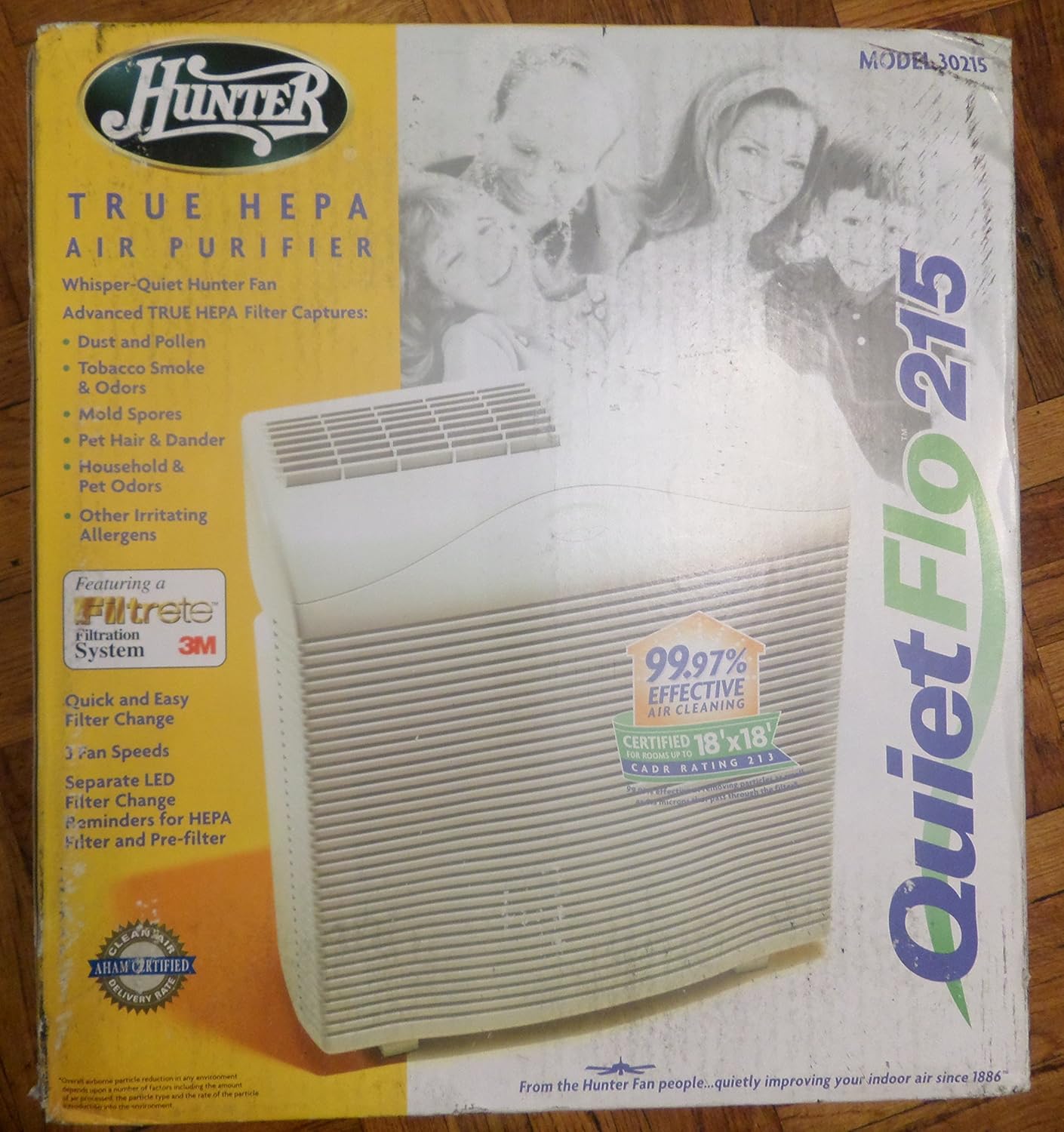
One of the filters we have is a fancy Bionaire model BAP-1175. It works OK - Mark bought it at Linen's N Things about 20 years ago. Lately, they have been getting very bad reviews - arriving broken. The real problem is, it takes special cartridges which cost almost as much as the machine. And you can't wash them - or at least they say not to. I do anyway. It is quiet, though. We have two "Quietflow" models from Hunter, model 30215, which isn't as fancy, but seems to work as well. The nice thing is, it takes a standard 16x14x1 furnace filter, which I can buy online for cheap - and then throw them away on a monthly basis. Maybe they aren't the recommended filter and maybe they aren't as effective, but they seem to catch a lot of particulate!
Do they make a difference? Between the three filters and the furnace filter (with the furnace fan running all the time) the dust level in the house is cut down dramatically. We also sleep better and feel better, during pollen season - until we go outside, that is.
I think also, after a few days or weeks, your body does adjust to the environment. Your immune system figures out that the pollen isn't a threat and basically gives up or at least calms down a bit.
Cheat on your taxes, don't be a fool - What's that you said about a golden rule?
A reader asks whether people cheat on their taxes a lot, and if so, how - and what are "audit bait" types of things that the IRS looks for. I am not sure what the reader is asking for - a roadmap to tax evasion? If so, look elsewhere!
But it is a valid question. One reason people hate our existing tax system is that it can be complicated and leave you with a FOMO situation - where you think other people are cheating and maybe you should be, too. Or that you are trying to be as honest as possible, but will be caught by the IRS for making some stupid math error, and then crucified in the public square as an example to others.
The reality is, of course, that for most of us, cheating on taxes, in any big way, is nearly impossible to do. And under the new tax law, there is even less incentive to do so.
But in order to understand this, you have to understand how it is possible (and nearly impossible) to cheat on your taxes. There are basically two ways - under-report income, or over-report deductions (or tax credits, or dependents). In both cases, the IRS can easily check this, so it makes no sense to attempt it.
For us salary-slaves in the middle-class, our income is reported to the IRS on a form W-2. Income from investments and the like is reported on a form 1099. Even for self-employed people, income gets reported by the people who pay you, on a form 1099-MISC. So, for example, in my law practice, about 3/4ths of my income gets reported by my clients to the IRS by 1099-MISC forms they file. And they file these forms, as they want to claim my fees as a business expense, and they can't do that unless they report these on a 1099! So it is a closed ecosystem - not much income doesn't get reported.
But what about that other 1/4 of my income? Well, I get paid by check or direct deposit or credit card - all of which leave a paper trail. And since I want to track my clients' invoices and make sure I am getting paid, I have my own records of these payments on Quickbooks. So even though this isn't reported to the IRS, there are records which can be easily obtained by the IRS during an audit. So there is little point in trying to "hide" this income - you are just setting yourself up for a fall.
You see, there are two levels of penalty for cheating the government. If you make a mistake on your taxes and forget to carry the three or slip a decimal point, they can assess a penalty for late payment of your taxes - plus interest. That hurts, but it's just money. But if you intentionally try to cheat the government, then you may face criminal charges and go off to jail, like Leona Helmsley did. So it makes no sense to intentionally try to cheat the government - although a lot of people try, every year, and fail.
People with cash businesses - like small corner convenience stores - often keep cash from transactions and fail to report it. These are the folks whose homes get broken into and are held hostage until they open the home safe and give the thieves tens of thousands of dollars. Sort of a Karma thing there - ain't it? But it goes beyond that. Even if you could hoard this money and not report it to the IRS, it would be hard to spend. Any transaction over $10,000 has to be reported to the IRS - and trying to avoid this rule by making deposits for $9,999 is called "structuring" and is also illegal. You can't win at cheating, so why bother?
This is why I say, even if you "found" a million dollars in a sack by the side of the road, it would be damn hard to spend any of it - without declaring it as income and paying the IRS first. And organized crime does this - using retail businesses as money-laundering venues, passing cash into the business and then declaring it as legitimate income. Casinos work the same way - you take cash in, buy some chips, then cash out. They give you a check, and you declare it as "gambling winnings" and pay taxes on it. These are the "whales" the Casinos talk about - not real winners, but likely money launderers. But the government is cracking down on even that.
So not declaring income is really problematic. And in terms of audit-bait, the number one sure way to be audited is to file a return that does not declare income that the IRS has already received a 1099 on. The computer will simply spit it out. If it is a small amount (like $150 you got in interest payments and forgot to claim) they may simply amend your return for you and adjust your refund - as happened to me once. Again, they IRS understands the difference between "honest mistake" and "outright fraud" - but the fear of the IRS is something that is useful to them, so they don't go out of their way to tamp down stories about the big, mean, IRS taking away people's money.
And by the way, most of the stories you read along those lines are about people who intentionally tried to hide income or take bogus deductions and really had it coming to them. When you cheat on your taxes, big time, for ten years in a row, well, why should we feel sorry for you?
But getting back to cheating - deductions are the far more common way of "cheating" and a little harder for the IRS to detect. But the new tax law, which doubles the standard deduction, may make this a moot point. What's the point of claiming bogus charity deductions if your standard deduction is so much higher?
Again, there are "red flags" that can trigger an audit if you make too many of the wrong kind of deductions. For example, if you make donations to charity under a certain limit (I believe $500 - check with your accountant, as tax law is fluid) you are not required to show a receipt to prove this. So a lot of people who itemize will put down $450 in clothing donations or whatnot. And I suspect the IRS knows this is bogus but doesn't care. Because in the greater scheme of things, it means an adjustment to your taxes of maybe a couple hundred bucks, tops. And if you can make the person filing taxes feel nervous that somehow they cheated - even a little bit that helps keep them in line.
But even a lot of deductions are reported to the IRS or are part of your bank records. Your mortgage interest, for example, is reported on a form. Your Obamacare subsidies and payments are reported on a form. So the big deductions are hard to fake. And even smaller ones - you should be able to produce a cancelled check, bank record, or receipt, should you be audited.
Of course, there are really stupid ways of cheating, such as trying to claim your dog as a dependent. This sort of nonsense will land you in a world of woe, as if you are ever audited, it is a pretty simple matter to prove you cheated and moreover did it intentionally. Again, intent is the key. The tax code isn't simple. I've taken several semesters of Calculus and even Number Theory, and still the numbers seem to float off the page if I tried to do taxes myself. In previous years, I used TurboTax. This year, I hired my late Dad's accountant, as she handled the taxes on my Mother's small trust. Her fees were not much more than TurboTax charged - and a lot less hassle. And I felt better having a "second set of eyes" on my taxes.
For people who are self-employed or run small businesses, there are more temptations. Leona Helmsley went to jail in part because she did stupid things like try to claim her girdle as a "uniform" expense. And she said out loud, in front of her maid, that she knew this was wrong. Again, making an honest mistake might result in a penalty and interest, intentionally defrauding the IRS can result in jail time.
I've always been pretty conservative in taking deductions for business expenses. Others are not. My accountant always nags me to find more deductions. The IRS uses certain ratios of expenses to deductions to flag returns for audit (in addition to random returns that are flagged). So if you claim a huge amount of deductions relative to income, you may be audited.
A friend of mine who was a real estate agent was also an auditor for the IRS. And the deductions he took, scared me to death. But he wasn't worried - not because he had an "in" with the agency (indeed, I suspect they are hardest on their own) but because he knew the rules and the trip-wires that would trigger an audit.
So, for example, he leased a brand-new Range Rover and deducted the entire cost as an expense of his Real Estate business - he needed the car to show prospective clients around. And this is a legitimate expense, too. But it does illustrate the fallacy of chasing deductions in the tax code. He still had to pay for that overwrought POS British-made car (whose air suspension never worked right - the car would go down the road tilted sideways). The tax code is not an investment guide and you can't deduct your way to wealth. I suspect he would have been better off buying a more plebian car and putting the difference into an IRA or 401(k) - both of which, by the way, are deductions also.
But it is expected that if you have your own business, you may deduct telephone and internet expenses - which may be personal expenses otherwise. And a home office is no longer "audit bait" in this modern era of people who work from home. Unless, of course, you are not self-employed. If you have a W-2 and a home office deduction, you may be in trouble - consult your accountant!
Similarly, setting up a "hobby business" for the purposes of deducting your life expenses is sure audit-bait, no matter what some click-bait sites claim. My Mother fell into this trap with her bookstore, which lost money nearly every year. After five years or so, the IRS audited her (again, another tripwire - a business that loses money for several years and never shows a profit). She was incensed when the auditor mentioned "hobby business". Mother thought this was a personal attack on her store, not a term of art used in the tax business. Lesson learned - show a profit every few years and avoid an audit. And you can do this by not claiming some deductions you are entitled to.
But even that will not protect you from audit if you have a real "hobby business" - that is to say, taking a personal hobby and trying to use it for the purposes of deductions. For example, Clem likes old cars. He has '57 Chevy in the garage. He claims to have a "business" in old cars, and claims deductions for travel expenses to car shows and auctions, as well the cost of gas, insurance, and parts for his car (which he depreciates as an asset). This offsets his income as a Dentist, so it reduces his taxes. But unless he actually sells something and makes money at this, it really is just a "hobby business" for tax purposes - taking a personal hobby and trying to claim it as a deduction. This is illegal and I would not suggest it!
On the other hand, if he makes replica trim pieces for '57 Chevies and sells them at car shows and online, and occasionally makes a profit at this, he may be able to legitimately claim this as a business. Again, consult your tax adviser - there is a fine line here you can cross between legitimate and hobby business.
Now that I am retired, I don't have to worry much about taxes. With no mortgage interest to pay and a huge standard deduction (Thank you President Trump?) I no longer have to itemize my taxes. And indeed, since I am living largely on after-tax income, I have little income on which to pay taxes. The net result is, there is little incentive for me to "hide" income - and indeed, I cannot realistically hide it, as every investment firm I am with reports everything on 1099 forms. And since I take the standard deduction, I have no incentive to be "creative" in taking deductions.
And maybe that was the point of the new tax law - to make taxes simpler for the masses, and also so they didn't feel they were "cheating" with deductions or that they were "missing out" by not taking some sketchy deduction. If so, it was a clever law. You no longer have to feel guilty about something when you file your tax return!
UPDATE: There are, of course, ways to avoid taxes if you are in the higher brackets. I illustrated before how I bought investment properties, fixed them up and rented them out for a decade, taking a depreciation deduction which offset my income as a lawyer. All perfectly legal - there are even forms for it. When the time came to sell the property, I rolled it over in a Starker deferred exchange to another property. If I converted that property to a personal residence later on, I would avoid paying capital gains taxes - and a personal residence (at least for use middle-class Joes) is not taxable.
There are other "loopholes" of course. If you are Elon Musk rich, you can "borrow" against your stock and live off that, tax-free, as loans are not taxable, and your stock is not taxed until you sell it. It is a tricky business, as if your stock price goes down, your bank may call your "loan" and loans usually have interest payments as well.
Then there are really sketchy things like offshore accounts or offshore licensing. The first is tax evasion and illegal. The latter is, well, it should be illegal. You put all your "Intellectual Property" in a shell company in Ireland and then structure your US company so it makes no money (and pays no taxes) but pays huge licensing fees to the shell company in Ireland which has a 100% profit ratio, but of course, is taxed very little in that tax-haven country. I am told this is legal and Apple and Google and all the other big players do this. But it is not within the scope of this article.
If you make taxes onerous enough, people find ways to cheat - legally or illegally. If you create a "Yacht Tax" in California (which the plebes eat up!) the wealthy simply register their yachts in Mexico, where it is cheaper to dock them and where they go fishing anyway (and labor is cheaper as well!). You enact this populist tax to go after "rich people" and they do a neat end-run on your tax.
Meanwhile, Joe Middle-Class with his 30-foot fishing boat gets a hefty tax bill. California - go figure!