Tuesday, January 26, 2021

The Real Problem Facing Restaurants

People fall into habits - and then fall right back out of them again.

We went into town the other day - a big day for us, leaving the island and all.  Mark has a show in February, and we needed some supplies for that, as well as a few grocery items.   Ordinarily, this would be an opportunity for us to stop at our favorite run-down Mexican taco joint and have a few beers and some tacos carne asada, but we haven't been to the restaurant since the Corona Virus took hold.  Well, we went early on, but this is the most dangerous time right now - right before vaccination kicks in.  The rate of infection is at an all-time high, as is the rate of mind-infection of mask protesters.   Hopefully, in two or three months, most everyone will be vaccinated and this nightmare will end.  I said the same thing 12 months ago and I was wrong, though.

But I wonder if things will go back to "normal" in a real hurry.  We had lunch before we went to town, and we thought about getting a coffee to share on the way back, but thought better of it - after all, we splurged $10.83 on a new coffee maker, why spend half as much to buy one cup at a store?

Not only that, but it just seemed that everything we saw at the stores was.... expensive.  It is not like the gas shocks of the 1970s where gasoline doubled in price nearly overnight.  It is just that everything seems just a little bit more expensive and I don't remember prices being so high.  Funny thing, too, every store on the planet is tearing itself apart and completely reorganizing how the stock is laid out, from grocery stores to home improvement stores, to hobby stores.  What's up with that?  Also, a lot of things seem to be out of stock these days.  It is like a time-warp to the 1970's where peanut butter and coffee were rationed.   What's next?  Ration stamps?

Of course, it could be that prices haven't changed that much (although, they have) but that my perceptions have changed.  In the back of my mind, I am thinking that a recession is coming and that I should marshal my assets and cut back on spending.  That may be the other half of it.

But there is a third thing going on here, and that is how habits change.  When I started this blog back in the dark days of the last recession, businesses were hurting as people cut back on spending.   Folks were trading in their gas-hog SUVs for small sedans.   Restaurants were offering dollar meal deals.  It all lasted about two or three years before the price of gas dropped and people stopped being so nervous, and sales of SUVs and pickup trucks took off again, and the "dollar deals" were quietly dropped.

There is hysteresis in the system, of course.  People keep spending as before, even as they lose their job.  I saw this firsthand the last time around.  A friend of mine lost a six-figure job and it took them three years to realize that they weren't going to get another one.   Oddly enough, they took a job that they thought was "beneath" them and worked their way up and are back in six-figure territory again.  But in the interim, it was interesting to see how they coped.  At first, they did all the same things - the wife stayed at home and didn't work.  They kept the cleaning service and the lawn service.  They ate out in restaurants several nights a week.

But as the weeks of unemployment turned into months, well, they started cutting back.  Why hire a cleaning service when you are both at home all day long?  Why hire a lawn guy when you are sitting in the house watching him mow the lawn?  Why eat out at a restaurant when you have a kitchen at home?  The "too tired to cook" excuse seems kind of slim when you have no jobs.   And the wife went back to work, eventually, which helped tide them over until he found a job.

Once they were both working - and making good money - the old habits slipped back in, slowly over time.  I am sure the lawn service is back, along with the cleaners.  We all do this, too - I am just using them as an example, not criticizing.  It is what it is, human nature, and we have to confront that.

Which brings us to our current situation.   Restaurants are finally throwing in the towel and reorganizing under Chapter 11.  Some are merely closing selected locations.  Others are closing for good.  You can't go for eight months with no customers.  Will this turn around in a hurry once the crises is over?  Maybe.

Maybe in three months, once we are all vaccinated and the infection rate drops off the charts (and the virus hasn't mutated to be vaccine-resistant) people will flock back to Disney World and the cruise lines, and vacation resorts - and return to restaurants and bars.  One thing this epidemic has illustrated is that people basically lose their minds in isolation, something anyone who has been in or worked in, a prison can attest to.  The worst torture devised by mankind is solitary confinement.

But I wonder if this will be the case.  First of all, there will be no "Olly Olly Oxen Free" - with everyone leaving their homes at the same time to rush back to be first in line at the Ole Country Time Buffet.   It will be a very gradual thing, I think, with no one day being marked as "end of virus" day.

The second problem is habits. Just as it took many people months or even years to change their spending habits in response to the last recession, it will take people months or years to increase their spending habits in response to an end of virus.  And as I noted before, we may see a "post-war" recession in response to this virus, as virus spending falls off the charts.

I just know from a personal perspective, that my habits won't be changing radically in the near future.  In response to the last recession, we started shopping for groceries at Walmart and were amazed at how much lower the prices were and how great the selection was.  The other day we went to Publix to get a birthday cake for a friend - something Publix can do that Walmart can't.  We were kind of shocked at how high the prices were compared to Walmart. Sometimes you have to go back to realize how much you use to be spending!   The point is, ten years after the last recession, one habit that hasn't changed at all is shopping at Walmart.   I doubt we will be going "back" to shopping at Wegman's and not looking at prices - those days are gone for good.

There are quite a few people still recovering from the last recession.   According to some sources, as much as 10% of the housing stock was "underwater" as recently as 2018.  I can say that personally, our house is just now worth more than we paid for it, nearly 15 years ago - and that's not counting the improvements and maintenance we have had to do to it.  Thank God it's paid for at least.   The point is, again, hysteresis - effects of economic booms and busts take time to sink in.

Of course, I believe that expanding spending is a lot easier to do than contracting, which is a good reason not to expand in the first place.   And that is an old saw from long before my time - it is a lot easier to expand your lifestyle than contract it, particularly when you have signed for long-term commitments like 30-year mortgages on mini-mansions or worse yet, a time-share.  If you lose that six-figure job right after signing the papers on an expensive house, well, things get ugly really fast.  I saw this happen to my parents, when I was four years old (yes, I do remember everything).  It wasn't pretty.

That is why is pays (literally) to bank any raise in pay into a 401(k) or other savings account, rather than let the money slip into your lifestyle and expand your personal overhead.  It is temping, when you get that raise or new job, to stop by the car dealer on the way home from work.  Yea, I say this from personal experience.  My bosses were always happy when I signed a car loan.

Of course, I could be wrong about this - I typically am.  Maybe there is such a "pent up demand" that people will go nuts this summer and the cruise lines will be booked solid and Disney World will be overflowing with people, including little snot-nosed children sneezing on each other.  Maybe there will be lines around the block at the local chain restaurant, as people rush back in to get their fill of lite beer and stuffed potato skins.

Or, maybe, having learned to live without these things for so long - or having learned how to make them at home in their new air-fryer, they just might not be in such a hurry to go back.  I think personally, something along the lines of the latter, although I don't own an air-fryer and have no desire to.

Monday, January 25, 2021

I Remember Everything


Memory can be a troubling thing, depending on how you look at it.

I was at a friend's house the other day.  They were both retired school teachers, which used to represent the demographic here on the island.  That is changing.  Instead of retirees, we are getting more and more wealthy Georgians who are buying vacation homes here, and then driving six hours from Atlanta to visit - one weekend a month.  We'll see how long that lasts.

Anyway, one of the couple taught second grade, and I told him of my vivid memories of those years.  I could remember the name of the second grade teacher (Mrs. Hornkel) and the "SRA Reading Tests" we took out of on a roll-around open-topped file cabinet.  The laminated cards started with Aqua and then went up on color all the way to gold and platinum.  Me and another boy - also named Robert - raced through the cards, although he was always one card ahead of me.   Some of the other kids never went beyond Aqua.   I remember we planted seeds in little Dixie cups and put them on the window sill and watched in wonderment as they germinated and grew.  We built a diorama for our plastic dinosaurs (something boys still collect in the second grade).  And I had a crush on a girl - I forget her name - with whom I was competing for with another boy.   I remember also we studied subtraction as well as addition.  I didn't like subtraction, so I changed the minus signs to plus signs, which made the problems easier.  Destined to be a lawyer.

So I told my friend not even half of this, and he said, "You remember all that?" which I think scared him, as he assumed that, as a second grade teacher, whatever he imparted to his students, good or bad, was quickly forgotten within a few years.

But memory is like that - maybe more for some than others.  I meet a lot of people who claim to have few or no memories of their childhood.  I meet gay men and ask them when they knew they were gay - and most claim no memory before age 18.  It is like they woke up one day and decided to be homosexual.   But I suspect that was not the case - they just don't remember, or choose to remember what they felt from years before.

Maybe I am abnormal in that I remember so much.  Or maybe I remember a lot less than others.  The weird thing is, I remember things I would rather forget, and then important things - things I should remember - I forget.  I was never able to memorize the multiplication tables, and trig identities were memorized long enough to pass the test, and then quickly forgotten (why memorize something you can look up in a book?  I guess that is my brain's logic in this).

The problem for most of us, is that we remember awkward things we said or did, or bad things that happened, twice as much as good things. My Father, before he succumbed to dementia, said, "remember the good times!" which was also the mantra of Tony Soprano, both of whom created a lot of bad times for themselves and others, which may be why they adopted that motto.

The problem is, the human brain is programmed to remember bad things at a rate twice that of good things.   We remember putting our hands on the hot stove, because remembering that is a survival skill.  Remembering pleasant times or pleasant experiences isn't necessary for the brain, as these experiences reinforce themselves.  You don't have to "remember" that sex is pleasurable or that food tastes good - your brain automatically reinforces this.

So while I remember these fond memories of second grade, I also remember being sent to the principal's office as well as awkward and embarrassing moments as well - as well as strange and bizarre things from my childhood.  Repeating the mantra "remember the good times" doesn't get these out of my head, it only serves to shame me for remembering them.   Gee, Dad, thanks again!

I kid.  He did the best he could, and being a parent is no Swiss picnic.  No doubt, like most parents, he got halfway into the deal and thought, "Is this what I thought it would be?   I was hoping to raise a fine family and here I am stuck with these spastic, ungrateful, spoiled monsters!"   I suppose it happens with every generation.

I like to read comics online, and it surprises me - but doesn't surprise me - that so many of them mention this effect.   People wake up in the middle of the night, antagonized by their own brain remembering some awkward thing they said or did a decade ago.   Why do our brains turn on us this way?  And you would think, as you got older and your brain cells die off, you would remember less and less - and perhaps you do, but the evil brain preserves only the worst of memories.  Perhaps.

I read somewhere that younger people have a better capacity for memorization, and that as you get older, your memory gets worse.  But that may be only with regard to short-term memory.  The point of the article I read was that older people are not necessarily "wiser" by dint of experience, only that since their short-term memory is smaller, they tend to triage facts when considering a problem.   Thus, to a younger person, a problem seems overwhelming as there is a panoply of facts to consider.  The older person sees only two or three relevant facts, and then can more easily make a decision.

Maybe this shrinking of short-term memory is what causes older people to remember more long-term things.  As my Dad got older, he remarked how vivid memories from his childhood became suddenly clear - things he had not "remembered" for decades were like they happened last week.  Perhaps it was a synapse in his brain firing off one last time - "here, look at this before it is long gone!"   But in his old age, he started to almost obsess about things from his childhood - things he never told us about before.  And weirdly enough, in his obituary (which he wrote) nearly half of it encompasses things he did before his 21st birthday.  The whole getting married and having kids and working for 40 years and whatnot were relegated to a paragraph.  How odd.

I am not sure what got me started on this, only that when I mentioned these details from the second grade, the look of fear on my friend's face was kind of funny - as if he just realized that hundreds upon hundreds of children he taught over the decades had similar memories of him, and that some offhand comment or gesture he made back then may have had some profound effect on someone's life - and that scared him to death.  It was kind of funny, actually.  I mean, maybe not for him.

Memory is a funny thing.  And I think our actual memories are often colored and clouded by our own minds.  We remember something and like a DRAM chip cycling itself, re-write that memory, only this time, perhaps slightly different than before. This is one reason why "eyewitness testimony" is so unreliable - people's memories are a fragile thing, and often after-the-fact, we "remember" things that didn't quite happen.

Maybe also that is why my Dad - and Uncle Tone - said "remember the good times" as perhaps when these memories are dredged up and reviewed and the re-stored by the brain, they can be altered to highlight the good parts and attenuate the bad.   Perhaps.

I guess the only thing I take away from this is, it is pretty normal to remember the awkward moments, and to not worry about it too much.  It is just some stupid survival skill your brain has, and probably a sign that you have above-average intelligence.   Like I noted before, you never hear about rednecks worrying about things they did in past.  It is only smart folks who cripple their own brains this way, often fogging brilliant minds with drugs and alcohol, trying to "forget" things that really make no difference in their lives, moving forward.

I remember everything.  It could be a curse, if you let it be one.

Saturday, January 23, 2021

The New Luddites

The rise in bizarre beliefs can be traced, in part, to the rapid rise in technology in recent years.

It seems we are in an age of unreason.  People are not only believing odd things, but stuff that is off-the-charts insane.  Sure, you might argue that the Kennedy assassination has some odd discrepancies about it.  After all, a guy who went to Russia - and was later thrown out - was the assassin.  And then he is gunned down by a guy who ran a bar with supposed mafia connections - and died of cancer not long after.  On the other hand, other people point out there are other, more mundane explanations - he was a hothead who regularly beat the customers in his own bar.  Either way, you are not going to "solve" the Kennedy Assassination, and it really makes little difference in your daily life - wasting your energy being a "conspiracy buff" is just stupid, as I noted before.

But conspiracy theories like that seem almost plausible compared to the whack-shit stuff coming out in recent months and years.  I suppose it started with 9/11 "truthers" - an oxymoron if there ever was one.  Lie through your teeth and call yourself a "truther" - hey, it worked for Hitler, and for Trump.  Project your own deficiencies onto your opponent!   The 9/11 crackpots want us to believe that "fire can't melt steel!" but of course cannot explain why steel truss buildings routinely collapse during fires, as the steel loses its temper and twists into a pretzel-like mass.  They want us to believe a missile hit the Pentagon (and a Congresswoman actually says this!) when thousands of people on I-395 saw the plane fly over head and hundreds saw it hit.  People who never lived in DC or even visited there fail to realize how close the roads are to the Pentagon.

But that's the great thing about conspiracy theories.  If someone points out facts that fly in the face of your theory, you just say (a) that person is part of the conspiracy, or (b) those facts are simply untrue and then just repeat the same old lies. To me, knowing people who actually saw the plane hit the Pentagon, such conspiracy theories are infuriating.  Similarly, the idea that the tens of thousands of people in New York City who saw not one, but two planes hit the World Trade Center all were suffering from "mass hallucinations" is just an insult - and an insult to all the people who died on those planes - whose grieving relatives are called "crises actors".

But in a way, this sort of thinking is understandable, if you understand the human brain. When the 9/11 attack happened, an initial reaction is to say, "this can't be happening!" and thus it is easy to believe that it never did.   It was an inside job - all those people weren't at work that day and no one died as a result. What a comforting thought.

It is like the school shootings.  What a horror - little kids being gunned down by a mentally ill person with an assault rifle, which was given to him by his Mom.   It can't be that our permissive gun laws and gun culture are to blame, right? So the brain is ready to embrace an alternative reality - it never happened, which again, is just a horrible thing to say to people who lost children in these events.

Of course, given how many guns there are in America, it isn't hard to conceive that such events are inevitable, when you have mentally ill people with ready access to large quantities of powerful firearms with high-capacity clips.  It's a funny thing, though, when a Muslim commits such a crime, the same people have no trouble believing it, as it fits their world view.  Muslims are terrorists - not white folks!

So it is easy to live in denial.  But how did we get from there to Flat-Earth and Q-anon?  Same shit, different day.  Technology has advanced rapidly in the last decade or so, and not in terms of landing on the moon or whatever, but in more insular terms that affect our daily lives.  The smart phone has literally changed the way we think - we can be "connected" to the Internet at all hours of the day and night, and many of us fall into that very addictive habit.  It is hard not to look at your phone, first thing in the morning, and last thing before you go to bed at night.  It has replaced the radio, the television, the newspaper, and the daily mail.

As I noted before, whenever a new form of media is created, it disrupts society.  Before Gutenberg printed Bibles, they were copied by hand - and the Word of God was in Latin and limited to a few acolytes of the church.  Others merely had to hear it secondhand.   But once the Bible was printed and moreover printed in English, well, all hell broke loose, and hundreds of years of religious wars ensued. Only 50 years after Gutenberg, we have Martin Luther, which lead to Protestantism, and so forth.

The telegraph, the daily newspaper, and widespread publication of books such as Uncle Tom's Cabin, no doubt helped spread the discontent in the North that lead to the Civil War.  The radio - and broad-casting - lead to the rise of Dictators in the 1930's.  Television, the rise of the protest generation.   And Facebook - gave us Trump and a host of right-wing nationalists worldwide.

But it isn't just the Internet or smart phones.  I noted before how lightbulbs and toilets and decking screws have changed in the last decade.   You go to the store to buy a 99-cent lightbulb and find they all cost several dollars - and have a funny color and no longer work with your dimmer.  The galvanized decking screws you saved in your workshop now corrode in half, in a year, when screwed into this newfangled "yellow wood".  The water-saving pressurized toilet explodes in your bathroom - and it is mystifying how it actually works and how to fix it.   Front-loading washing machines cost more than cars you've owned, and are nearly impossible to service, except by a skilled technician.  It all seems like a con-job, to the average consumer, who sees his world spinning out of control.

Trump seized upon this discontent, which mystified the left-leaning newspapers on the coasts, who saw LED technology as an advance, and not a threat.   Smart phones, wind power, solar power, electric cars - the world is changing, and changing for the better.  But change makes people uneasy.

Part of this change, of course, was "People of Color" asserting their rights and moving up in the world. Not only that, you have gays and lesbians holding hands and getting married, but people changing their gender! (OK, that freaks me out, too).  And political correctness - in general.  It is unsettling when change occurs rapidly - perhaps too rapidly.

Some say that was what caused Brexit.  Many in the working classes were uneasy at the waves of new immigrants, who had different values and spoke different languages.  Worse yet, they all worked hard and made the "native" people on the dole look bad.  We have the same thing here.   The right likes to talk about "illegal immigrants" collecting welfare, but the reality is, they are more likely to be working three jobs, while the red-hatted Trump supporter is on disability.  Projection again rears its ugly head.

So we end up with these bizarre conspiracy theories which are more or less related to technology.  Qanon has its pizza-gate aspects, but it also embraces anti-vaxxers and 5G conspiracies.   Medical science is amazing - and mystifying to lay people.   Why not just allege it doesn't exist and that postings on Facebook are just as valid as decades of medical research?   Cell phones are mysterious to the lay person as to how they actually work, so why not allege they are up to no good?  Elon Musk is going to fly rockets to Mars, and Mars rovers are sending back photos of the surface.  It's a lot easier to believe it was all faked, the moon landing was faked, and the earth is flat.

Accompanying these stupid conspiracy theories is often an expressed desire to return to "simpler times" when a man had his black-powder musket and could "kill him a bar" or two.   No wonder more than one Capitol rioter was wearing frontier furs.   Still others are into "survivalist" chic and "prepping" for the end times by building a rustic cabin in the woods, and loading it up with pallets of "prepper" food.  This urge to be self-reliant in an increasingly technological world is almost understandable.

It is like the old timers and rednecks who blather on about how the oil-burning pieces of shit we used to call automobile engines back in the 1960's are "better" than cars today.  Back then, a 350 cubic-inch engine might make 300 horsepower, or maybe the vaunted "one horsepower per cubic inch".   Today, you can get 300 horsepower from 3 liters or less and you can buy a car off the showroom floor with 400, 500, 600, or even 700 horsepower - absurd numbers that were never dreamed of in "the good old days".

But that's not the point. They understood carburetors.  Hell, you can see the gas flowing right down the throat of one.  They might have sucked in terms of efficiency, longevity, and emissions, but they were a known quantity.  You have to understand computers to work on today's cars - it isn't hard, really, but it requires a different skill set.  You have to learn the new lingo and get new tools, and no one wants to invest in that.  That, and if you make a mistake, well, it gets expensive, really quickly.

People feel they are losing control over their lives.  A farmer can no longer turn a wrench on his John Deere tractor without having the master computer disable it for "unauthorized service" - and today's cars are not much different.

So conspiracy theories are attractive, particularly for people who are - how do I say this nicely? - not all that smart.  It is funny, but you scratch a Q-anon believer and you find an MLM believer selling "essential oils".  Again, the idea of taking back control of your life, in terms of "being your own boss" and also controlling your health through snake-oil holistic medicines.  Never mind that neither idea has any merit - no conspiracy theory does.  It is the feeling of control that is the key.  Their world is spinning out of control, and Qanon suddenly makes it all seem to make sense.

Now, throw in BLM protests - and Antifa riots - as well as a mysterious virus, and you have the perfect storm.   Again, as with 9/11 or school shootings, why confront difficult truths when you can just say they don't exist.  Hey, if you don't know anyone personally who died from Covid, it is easy to say it is all a hoax.  And even if someone you know does die - you can say it is a hoax and they died of other causes and the medical industry is "in on the scam."  Suddenly, a scary and mysterious virus seems not so scary anymore - because you just denied its existence.

With that in mind, the rise of bizarre conspiracy theories doesn't seem so unusual.  It would be weird if they didn't naturally arise in response to the changes in the world.   And I suspect, if we look back through history, the rise of conspiracy theories accompanies rapid change in the world.   After World War II, once the Russians had "the bomb" we lived in fear of nuclear annihilation.  Nuclear energy and radiation - it seemed so unreal.  This invisible ray could kill you, and you'd never see it or feel it.  Perhaps it is not coincidental that UFO sightings date from the same period.   Believing in some greater power, or greater scheme allows our brains to process horrible things that are going on right in front of us - hence religion.

Maybe that explains why religion was so much more popular in more primitive times and cultures, where life was short, brutish, and nasty.   People up and died for no apparent reason. Natural disasters would occur.  It is comforting to think that these are actions of the Gods, who can be appeased in one way or another.  Today, in more prosperous countries, religion seems to have less of an impact - and the more well-off a person is, the less religious they are likely to be.  Maybe religion is the ultimate conspiracy theory.  Indeed, some are arguing that Qanon may morph into a religion of sorts.

OK, so maybe this explains the move toward irrational thinking.  How does this help us to dampen conspiracy theories and stop their spread?   I am not sure I have the answer to that, but if what I have said above has any merit, I think that the wealthier and more secure a person is, the less likely they are to believe in conspiracy theories.  If you are well-off and secure in your life, chances are, you have "bought in" to the system and don't want it to change.   On the other hand, if you lost your job and your job skills are obsolete in this modern age - and these newfangled lightbulbs confuse you - maybe conspiracy theories, with their simplistic world-view, are more comforting.   Comforting, that is, until they eventually collide with reality.

Perhaps one way to fight conspiracy theories is through education.  And by that, I don't mean confronting someone about their Qanon beliefs and then trying to systematically debunk them.  As I noted before, that simply won't work. When you attack someone's belief system, you attack them.  You have to let them figure that out on their own, whether it is religion, a cult, or a conspiracy theory.

On the other hand, perhaps if people didn't feel their life was spinning out of control, they would be less likely to "invest" in a conspiracy theory.   If they become comfortable with LED technology, learn how to read the P-codes on the OBD-II computer on their car (and learn how to fix it when it breaks) and understand how low-flush toilets work - and why these are good things, in the end - maybe they will stop thinking the world is out of control.

It may just take time - to get used to seeing people of different colors and different cultures, on the television and at their place of work. What seems novel one day is passe the next.  When the New York Subway system first opened, New Yorkers marveled at the technological accomplishment.  By that afternoon, they were acting blase - as if they had been strap-hangers their whole lives.  This suggests that perhaps these conspiracy theories could collapse quickly, if left to their own devices.  And there is some evidence that some of the Qanon faithful are leaving that sinking ship, as one prediction after another fails too come true, and Mr. Q himself seems to be AWOL.

Maybe it will just take time.  And yes, there will always be conspiracy theorists with us - that is a given.  People will always succumb to weak thinking - convenient thinking, which is all conspiracy theories are - externalization.  And maybe it will just take time for people from a previous era (such as me) to shuffle off this mortal coil and rightfully leave the world to the next generation, to do as they see fit.

Friday, January 22, 2021

The Indian Wars

If you could run a business tax-free, you would put everyone else out of business in short order.

I noted before that perhaps the only reason drug dealing is so profitable is that it is not taxed.  Street-level dealers don't make a lot of money, but the higher-ups, if you'll pardon the pun, can rake it in, all tax-free.  Of course, getting those mounds of cash into the banking system has its own inefficiencies and costs.

Marijuana is now legal on the State level in a number of States.  But a funny thing, "illegal" sales of marijuana have actually increased.  Since the illegal seller doesn't have to pay taxes, his profit margins are greater and he can undercut the "legal" marijuana store by a considerable amount.  And since the drug is now legal, law enforcement isn't spending too much effort in cracking down (again, pun) on illegal grows and sales.

When we lived in Central New York, the local Indian tribe sold gas and cigarettes at a gas station, tax-free.  They were raking in the dough, and since their prices were cheaper than the competition, they literally bankrupted every gas station within a 15-mile radius.  It was helpful that their station was right along a major commuting route - but not on the reservation.

By the way, there are an astounding number of reservations in America, and new ones formed every year.  Some cover hundreds of square miles, others just a few acres.  It is pretty fascinating.

Their position was that any land the tribe bought was in fact, part of the reservation, and thus they were exempt from Federal, State, and Local taxes, including property taxes. They even ran a little casino next to the gas station - which was closed down as being illegal, but the last time we were there, it was opened up yet again.  And the gas station?  It never closed.

The problem with this argument of theirs is, well, if any piece of land the tribe buys is "reservation" and they can operate a business without any tax overhead, well, eventually it is a mathematical certainty they would acquire more and more land, run more and more businesses, and put other non-Indian businesses out of business.  Eventually, they would take over the country - which some might argue is poetic justice.

There would reach a tipping point, of course.  If left unchecked, as more and more Indian businesses were allowed to operate tax-free, the tax burden on the remaining businesses and landowners would increase, making them even more unprofitable - an avalanche effect would occur.  In some Counties in Central New York this is already happening - due to a different cause.  If enough people in a county are on welfare or some form of assistance, the tax burden on the remainder, skyrockets.  In some Counties, the ratio of non-workers to workers is 2:1. Tax bills of $15,000 a year on fairly modest middle-class homes are not unheard of.

When more and more land is removed from the tax base, the remaining taxpayers are smothered.  If a majority of a County was Indian reservation, the County would have no money left to pave roads or fund other government operations - without doubling or tripling the tax burden on the remaining taxpayers.

Of course, this is not an issue now or even in the very near future. Indian tribes, by and large, are struggling with poverty issues, lack of jobs, drug abuse, as well as the abuse of women.  It has hardly reached the stage where Native Americans have become our overlords, or are, on average, well-off or even middle-class.

But this idea that Indians don't have to pay taxes is a curious one.  And the Bureau of Indian Affairs is still creating new tribal lands.  Maybe Uncus was the "Last of the Mohicans" but they have a Mohican reservation now in Connecticut and a casino - which was the impetus for creating the reservation in the first place.

I noted before that when we lived in Central New York, they had an article in the paper that the treasurer of the local casino was found floating face-down in the canal.  Tony "Knuckles" Russo was drowned, and the head of the casino, Anthony "Kneecap" Romano announced that Frankie "Bada-Bing" Esposito was to be the new treasurer.  I thought at the time, what colorful Indian names!  I suppose they got their nicknames during a sweat-lodge ceremony after going on a vision quest.  Sadly, it seems that the mafia is involved in some of these Indian casinos (drawn to a tax-free law-free haven like files to a pie) and as a result, the rank-and-file tribe members are not really being enriched.  But I digress.  But not by much - money is driving this whole thing, as usual.

In addition, many of the treaties made with tribes - most of which were abrogated by the US in one form or another - are being found invalid. In Central New York, the treaty signed between the State and Indian tribes was found invalid, as only the Federal Government can sign a treaty with a "sovereign nation".  When buying property in some parts of Central New York, you had to purchase "Indian Land Claims Insurance" just in case - the thing still is not settled, decades later. Apparently a similar situation exists in Oklahoma, where a big portion of the State, including the city of Tulsa, was recently deemed tribal land by the Supreme Court.  

The whole "reservation" thing is, of course, a little unseemly as it is a reminder of how the Native Americans were poorly treated historically.  There really is only one other country (besides Canada that I am aware of) that has nations-within-nations, and that is South Africa with its "homelands" which served a similar purpose to reservations - to move a minority population away to make room for white settlers, during the Apartheid era.  Historically, Indian reservations were impoverished areas where there was no water or fertile land.  But when gold or oil is discovered on Indian lands, all bets are off and tribes are forced to move yet again.

Again, some may see these changes as long-delayed justice. Travelling through reservations in the Dakotas or Northern New York State, you realize there is a lot of poverty and privation. But one wonders whether the solution to this, on a personal level, is to leave the reservation and assimilate into the greater society.  While we tend to view "Indians" as primitive native peoples who were "in touch with the land" the reality is - or was - that early on, they adapted to many of the Western habits of their new neighbors, giving up a nomadic lifestyle to settle down in farms and villages, for example, in Central New York.  Sadly, they chose the wrong side to fight on, in the French and Indian wars - and later the Revolutionary War, and were rousted from these settlements, with many fleeing to Canada.

In Aurora New York, on Cayuga Lake, there is a plaque commemorating the village once occupied by Native Americans.  They farmed and had peach orchards.  General Sullivan came through, rousted the Indians and burned their orchards so they would not return.  When I mentioned this to one of the new natives of that town, they said, "Well, he had to burn the orchard, it was infested with bugs!" to which I replied, "No, the problem for Sullivan was it was infested with Indians"  People can rationalize even genocide.

But the point is, by the 1700's the Indians were well-adapted to Western ways - living in villages and farming.  The romantic notion of nomadic Indians living off the land may have had some currency further West, but for the most part, these were just people being forced off their land because they chose the wrong side of a war - a war that really was not their own.

It will be interesting to see how this plays out, though - will more and more lands turn into reservation?  And will Native Americans be allowed to run businesses tax-free with impunity? I suspect it will not come to a head in my lifetime, although I suspect folks in Tusla, Oklahoma are a little chagrined to realize they now live on an Indian Reservation, so maybe this issue will come to a head sooner, rather than later.

It also raises the issue as to whether there is a statute of limitations on injustice.  We are hearing cries again for "slave reparations" to counteract injustices from well over a hundred years ago.   Exactly how far back do we go to right wrongs?  Because if you get down to it, almost everyone has someone in their ancestry who was horribly wronged at one time in history or another.  And does it make things right to hand out money or other benefits to someone who is removed five or more generations from the injustice?

Tough question, because who is an "Indian" is as complex as "Who is a Jew?" or "Who is Black?" as we have seen in recent years.  A fellow claiming Native American status is told by the tribe, in no uncertain terms, that it is up to them as a "sovereign nation" to determine who is and is not a member - it is not determined by genetics alone.  It is funny, but when oil is discovered on a reservation, or they open up a new casino, a lot of people suddenly discover their Native American heritage, and it has lead to some recrimination and controversy as people are "thrown out" of the tribe.  Put a dollar on the table, and people's behavior goes off the rails.  It is human nature.

But getting back to "Who is an Indian?" or "Who is Black?" it seems like a moot question in an era where claiming minority status is to claim a lesser share of the American pie.  But in a future era, where racial or tribal membership conveys benefits - this may become something that people fight over.

Like I said, maybe not in my lifetime. But then again, maybe identity-theft politics are the first step in this direction, as some are finding that claiming to be a minority does indeed convey some benefits in our modern society, particularly in academia.

The Indian wars are coming - it is just a question of when.

Thursday, January 21, 2021

European Standards?


Our European friends like to run us down for using "Imperial" measurements, old-fashioned 12-hour clocks, and an archaic way of writing dates.  But for informal measurements, often people overseas revert to our bad old American ways.

I wrote about the metric system before.  As an Engineer, of course, it makes perfect sense.  One cubic centimetre of water weighs (OK, masses) one gram.  One liter of water weighs one kilo.  It isn't hard to do conversions - everything is a factor of ten, as opposed to quarts, pints, cups, and gallons - which have no relation to cubic feet, which in turn use the "foot" as an arbitrary measurement, as well as the mile, which is 5280 feet for some reason.  Imperial measurements make no freaking sense at all!

But a funny thing.  Whenever we watch television shows or movies made in Europe, particularly the UK, it seems people tend to slip into Imperial measurements when it is convenient for them.  For example, in a car show, they talk about "0-60" times in terms of zero to sixty miles per hour.  Engines are rated in horsepower, and gas "mileage" is often talked about in miles per gallon and not the more trendy(and useful) liters-per-hundred-kilometers.

We watch a show about trains, and they talk about how many feet long a coach is, and how many miles away the next station is, or how many horsepower an old steam locomotive has.  An historic railway has restored ten miles of track - not kilometers!  Why the switch?

Go to the lumber yard in Norway and you'll see the lumber sold as "2x4" or "2x8" or whatever - even though the lumber isn't 2" x 4" over there - or over here for that matter.  Buy a flat-screen television, and it is measured in diagonal inches and not millimetres.  The "English" or "Imperial" system isn't quite dead yet, even in metric countries.

When it comes to colloquial measurements, it seems that people revert to Imperial units when it is convenient.  Temperature in Centigrade or Celsius or Kelvin may be more scientifically accurate and useful, but the spread in temperature in the human comfort zone in Fahrenheit provides a better "feel" for temperature differences, without the need for decimal points.   If it's 100 degrees in the shade, I know it's hot.  The difference between 65 and 70 degrees gives you nice five degree spread.  But the metric equivalent, 18.3 to 21.1 seems just to be confusing.  Either there is only a three degree difference (too little) or 30-step increments (in tenths a degree) which is far too much.

But it goes beyond temperature, volume, and distance.  In terms of time, many of our overseas pals love to use what we call "military time" or the 24 hour clock.  Unless you served in the military, you have to do a little math in your head to figure out whether 17:00 hours is time for dinner or time to go to bed.  Alan Jackson and Jimmy Buffet never sang about "It's 17:00 Hours Somewhere!"   Again, military time may be more efficient and clearer (hence why the military uses it, so battles plans are not off by 12 hours!) but when it comes down to colloquial, human-scale measurement, many revert to the old 12 hour format.   Big Ben isn't a 24-hour clock, now, is it?  Or did they fix that with the recent renovations?

Of course, time itself if non-metric - 24 hours, 60 minutes, 60 seconds!  How archaic!  Some folks propose one version or another of "Metric Time" with 10 hours in a day, or some such nonsense.  Apparently, some idiots have actually done this.  Hey - that's one way to enact the $15-an-hour minimum wage - just make every hour 2.4 hours long!  Happy now, Socialists?

It is like the idea of metrifying the compass.  360 degrees?  That should be 100 degrees, or maybe PI or something!  No more sloppy dividing by sixty!

Dates are also an issue.  I literally get complaints from overseas friends who say our archaic way of writing dates is confusing.  But the Declaration of Independence was written on July 4, 1776, and not "04-07-1776" as some prefer to use.  The stated reasoning behind the latter format is that it increments by relative time size - date, month, year.  Of course, if you are going to go that route, why not have ten months of 36.5 days each?   And why date things from Jesus' birth?   It gets messy, this revisionist stuff.

When I search a Patent or Trademark database, it does get confusing, particularly for overseas databases such as WIPO (World Intellectual Property Organization) where "03-12-1999" could be read as March 12th or December 3rd of 1999, unless you are careful.

At first, it seems the regimented day/month/year makes more sense, as the numbers go from left to right in increasing ordinate.  Of course, with regular numbers, we do the opposite - the highest ordinate comes first.  So ten-thousand is written as 10,000 not 00,001.  Oh, geez, now another thing - the commas.

Yes, we still use commas after every three digits because it is so much freaking easier to read.  My European friends either use a period - which is confusing as fuck, because the period denotes a decimal fraction.  So ten-thousand becomes either 10000 - where you have to count the zeros with a pencil if you are dyslexic like I am, or 10.000 which sounds like ten to three decimal places.  For decimals, they often use a space which also causes confusion, as ten-thousand, five-hundred and sixty-five dollars and 50 cents isn't written as "$10,565.50" but "USD 10.565 50" or something like that.

UPDATE:  This is more of an Asian thing, which I have seen on invoices from overseas attorneys.  Not only is the decimal used as a comma, but many use the comma as a decimal!  So "$10,565.50" might appear as "USD 10.565,50" or "USD 10 565,50" or something like that.  Not hard to figure out, but must be a bitch for people coding banking sites internationally.

But getting back to dates, the reason why our ancestors - on both sides of the Atlantic - used the "old fashioned" method was that when you were looking at a document, the month was probably the most important thing you were interested in - is this a recent document, or from days gone by?  And in an era where communications took weeks or months - particularly to cross oceans and vast empires, the numerical date was more a matter of curiosity than the month and year.

When we sent the Declaration of Independence to King George, he wasn't confused by the date: "What is this?  April 7th, 1776?  I know the mail is slow, but this took over three months to get here!" No, they were on the same page as us.  For some reason, Europe seems more inclined to adopt "metrified" time and date recitations and the US is stuck in its pre-revolutionary ways.

Some say the reason the US is so "backward" is that we had a chance to adopt modern standards back in the day, but that the standard meter and kilo and other measurement tools were lost at sea.  It makes for a good story, but doesn't explain why we didn't switch later on.  I suspect the French adapted early on to the Metric system as a means of renouncing "Imperialism" after the French Revolution.  After all, when the basic measurement of distance is based on the length of the King's...er, foot .... it all depends on who is King, right?

But wait, it gets worse.  The British, had what they called "Imperial" measurements, and back when I was a kid, when you went to Canada, you didn't buy gas by the liter, but by the "Imperial Gallon" which was slightly larger than the US gallon.  Overseas, they now sell gas by the liter, but we still pump oil by the barrel which is an arbitrary measurement standard. The Brits also had a set of tools called "Whitworth" and why is anyone's guess.  Anyone who has owned an old British car has no doubt cussed out Mr. Whitworth, whoever he was.

We also have something called "gauge" which is used for wires and drill bits.  I believe they still use this archaic system in Europe.  The weird thing about gauge is that the larger the number the smaller the diameter.  So 12 gauge wire is smaller than 10 gauge wire and can handle less current.  The obvious problem with this scheme is that you quickly run out of numbers as your wires get bigger and bigger.  Eventually you are down to 1, then zero ("ought" or "aught") and then double-ought, triple-ought, and what-nought.

Speaking of "ought" which is an archaic way of saying "zero" - some folks overseas still use that term, instead of zero.  So while Elvis Costello may sing about "Less Than Zero" his countrymen might be thinking "Less Than Ought."

And by the way, the word "Zero" begins with the letter "Z" which is pronounced "Zee" not "Zed".  Zed is someone's name.

This is not to say that the old "Imperial" measurements are better than Metric.  They aren't.  Airplanes have run out of fuel and satellites have been lost when people made the wrong "conversion" between  "English" and metric units.  Clearly, mission-critical applications should use the metric system, or at the very least, use only one system, and not multiple versions.

In aviation, for example, we still use knots (even weirder than miles per hour), nautical miles, and measured altitude in thousands of feet.  Only Russia and China use the metric system - damn Commies!  Speaking of which, in Russia, the "artificial horizon" is reversed - the horizon stays the same and the little plane indicator moves.  When transitioning to Western aircraft, this can cause confusion, and is suspected as the cause of at least one airplane crash.  A simple thing, really.

In maritime applications, nautical miles and knots are still in use in much of the world.  I suppose both aviation and maritime applications are areas where metrification would make sense - but switching over most of the world overnight to one system or the other would be difficult, to say the least - with the potential for even more disasters.

But as I noted in my earlier posting, that pretty much is becoming the case.  It is hard to find "English" nuts and bolts anymore on an "American" car, although they are available at the hardware store (don't get me started on thread pitch!).   Science and Industry has already made the switch to metric.  Whether or not we need to do this to tell the time of day, how much flour to put in your cake (although one reader recommends doing this by weight rather than volume, which makes sense) or how much gas to put in your car, is another question.  Eventually, I suspect these too, will change, but it will take a lot longer as the compelling need for such change really doesn't exist.

UPDATE:  A reader writes:

I thought you might be interested to know that organ pipes all over the world are classified according to their Imperial length - 8 feet (pitch), 4 ' (octave higher), 2 ' (2 octaves higher), 1 ' (3), 16' (octave lower), 32' (2) and very occasionally 64 ' (3). The measurement is that of the lowest in the range (C is the lowest note). This classification is absolutely irrespective of nationality - German 'acht Fuss', French 'huit pieds' etc. The measure persists because, of course,  it reflects real life - sound waves at C divide in that way.
Don't get me started on Western musical notation - something that as a tone-deaf person, I was never able to figure out.  "That's a middle C!" some musical person would exclaim to me, "Can't you tell?"  I dunno - can you express that in frequency (262 Hz)?   Not all of the human family uses the seven-note "Doe-a-Deer" system that Julie Andrews immortalized.  And let's not even talk about sharps and flats!
And also, BTW, in German markets you can buy loose stuff (cheese, apples, etc.) by the 'Pfund'. 'Ein Pfund' is half a kilo (so actually not exactly an Imperial pound, but just called that).
And oddly enough, in the USA, the liter is now a pretty standard unit of measurement for larger soda bottles, which come in liter and two-liter sizes.  For smaller sizes, though, we still talk about 8, 12, and 16 ounces.  For "fountain" drinks, the ounce rules - often up to 44 ounces for the "super big gulp" - known also as the diabetes special.
The 'English' for 'zero' is actually 'Nought', not 'ought' - in dialect this is 'nowt', a contraction of 'nothing'. So it's not illogical, tho' different. (And 'Zed' may be someone's name in the US - but we DO have different names - I remember the first time I heard someone called 'Randy' with a straight face. This is not something an English person would be happy to be called. The American equivalent is 'horny'!)
Naught, Nought, Ought, and Aught seem to be different spellings for the same or similar concepts, some of which are archaic spellings.  For wiring, I have seen "ought" and "aught" used to describe zero-gauge wire.  It has all come to Naught, but we Ought to do something about it.

My Scottish friends howled with laughter at the idea of "Fanny Farmer Candies" as they told me that "Fanny" was Scottish slang for "Vagina".  Oddly enough, they told me that in their country (leaving the UK soon!)  "Cunt" means a stupid person and has nothing to do with genitalia, whereas in America it is seen as misogynist slur against woman.

Two countries separated by a common language.   I just find it funny when you see a British car show and talk about the "BMW Zed-3" when everyone knows it is the ZEE- THREE which not only rhymes, sounds so much more awesome - which is why so many car makers us the moniker "Z" in car names.  ZED?  It rhymes with "Jed" and Mr. Clampett didn't drive sports cars.
Many 'Imperial' (I think this name was coined when we had an empire and were trying to standardise measures across the globe!) measures are, like the above-mentioned foot, 'natural' ones - a 'foot' is the length of a man's foot, and the origins of the others can be found here.
In addition to driving on the wrong side of the road, you spelled "standardize" wrong (along with "color" and a host of other words).  And a "Controversy" is a CON-TROW-VERSY not a "CON-TRAV-A-SEA" - but I digress.  And don't get me started on Aluminum! The word "Tesco" is correctly pronounced "Wal-mart".   "Cling-film"?  Saran-wrap!

And a Billion is a thousand-million, not a million-million!  This last item causes a lot of confusion sometimes, as some British tabloids have used this discrepancy to make it seem like we have a lot more money than we do.  Still, a billion dollars ain't nothing to sneeze at.  That's the jackpot for the Mega-millions tonight - too much freaking money, in my mind.  My UK friends tell me the jackpots there are smaller and more numerous - which I think makes more sense.  Nice to win a million and retire early. Not so so nice to win a Billion, spend the rest of your life fighting lawsuits and hiring bodyguards to prevent your children from being kidnapped.  There is such a thing as too much money.  You think Jeff Bezos can travel in anything other than an armored limousine?

That is the one nice thing about "English" measurements (as we refer to them here, as "Imperial" has the connotations of older Canadian measurements, such as the Imperial gallon) is that being human-based, you can use body parts to measure things.  Having size 13 feet (and not some Communist metric shoes!) I can pace off a number of feet by going heel-to-toe, pretty accurately.  And since a yard is a pace, I can pace off 100 yards within a few feet - although I suppose the "meter" is about the same, and come to think of it, its name probably originates from the pacing of a person's walk.  An inch?  About the length of the last joint on your pointer finger.  That's how these things developed.  The Centimeter is fine and all, just harder to visualize.

Damn.  Spell check tells me that "Centimeter" should be --Centimetre-- which just sounds too damn French.  Turns out to be yet another spelling discrepancy between "English" speaking nations.

I think metric measurements will slowly infiltrate the US, as evidenced by the use of liters and kilos more and more in packaging.  It is a shame that the last time we tried to convert - in the Carter era - we used dual signage for road signs, which just made things worse.  But with the press of a button, my speedometer switches from MPH to KPH and the navigation system does as well - which is handy, as when you travel to Canada, it can get confusing to try to convert in your head.   You end up missing exits as a result.

But like I said, in industry and technology, the metric system is already predominate - metric fasteners are now the norm in "American" cars and have been so, for many years.  Colloquial measurements will likely be the last to convert, as it really makes no difference, and they are just too damn handy.

UPDATE:  A Canadian reader reminds me that there is a metric compass (Grads) and of course we have Radians (based on PI), the latter having many applications in Electrical Engineering.   I learned that all a long time ago - and then promptly forgot.   In everyday use, we still talk about 90 degree angles.

They also brought up the point of nonsense Metric/English sizes.  Butter is sold by the pound in both America and Canada, but is called "454 grams" up there.   In the States, many metric sizes are ounced.  A 1/3 liter of beer (common in Europe) is sold here as 11.2 ounces.

Nonsense conversions accomplish nothing.  It is like taking a blueprint and then just converting the numbers, not realizing that there is no such thing as a 12.7mm wrench (but there is a 1/2" bolt). 

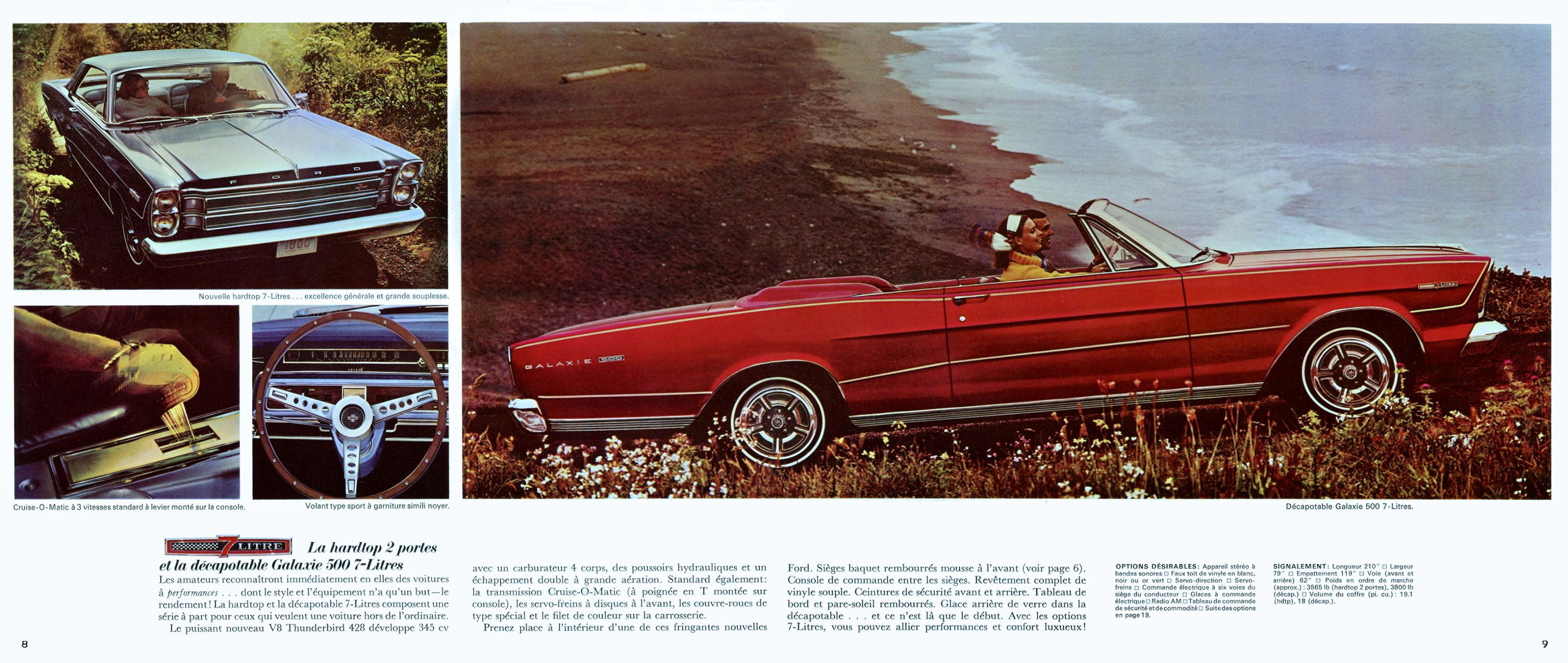
Car engines in the States are all denoted in liters now.  Ford, back in the 1960's, thought they would try to sound European by calling one of their 2,000 kilogram two-door coupes, the "7 Liter" - an engine size that is obscene by European standards of the time (or indeed, even today).  It just confused people and Ford dropped the name (but not the engine) after a year.  Jay Leno had one, and removed the ultra-rare 427 side-oiler for the more reliable 428.  Not sure that was a smart move, Jay!

It is easy to convert engine sizes in your head, if you realize that 5.0 liters is about 300 cubic inches.  Although five liters is today considered a pretty huge displacement engine.

So long as the worlds largest (or second-largest) consumer market remains mired in the "English" system, I think we will have this nonsense of dual size ratings and nonsense conversions.   I suspect that, over time, though, metric will seep into American life.  Liter water and soda bottles seem to have been accepted - for decades now - without any hue and cry from the John Birch Society that a Communist Coup is imminent.