Friday, October 17, 2014

The Problem With Serial Refinancing

Why was serial refinancing a bad idea?  Why were people told it was a good one?


In the last decade, we have experienced a boom and bust in the Real Estate market, and many people have lost their homes or found themselves in "mortgage stress."   What caused this mess?  Part of the problem was the use of "serial refinancing" to allow people to live a lifestyle they really couldn't afford in the first place.   The idea of owning your own home went out the window in favor of perpetual mortgage payments.
  
Let's crank some numbers and see what I am talking about.   Jim and Cindy buy a house for $220,000 and put down $20,000 as a down payment and obtain a 30-year mortgage for $200,000 at 6% APR which at the time was a reasonable rate.  They pay about $3,000 in closing costs and have a monthly mortgage payment of $1,199.10 (P&I).

From the Bankrate Calculator, we know that after five years, they have paid $58,985.32 in interest payments and owe $182,510.78 on the house.

Wow, five years and you've paid over 1/4 of the value of the home in interest payments.  Scary, eh?   But that is how compound interest works - when you are borrowing.

After five years, they've run into some credit card debt issues from remodeling their home.   And since interest rates have dropped, (and home values have gone up) why not "refinance" their home?   The monthly payment would be less, of course, than the total of their old mortgage and credit card debt payments.   And in five years the home has increased in value.

So they refinance $220,000 on a new 30-year morgage at 5% APR which lowers their monthly payment to 1,181.01 and gives them some more breathing room.

The problem is, of course, they still owe the same amount of money, it is just now spread over a longer period and at a lower interest rate.   They have robbed the equity in their house to pay off credit card debt.  They also spent another $3000 in closing costs to the banks.

Freed of the credit card debt (and enjoying all those frequent-flyer miles) they decide to buy a new car.  And letters come from the credit card companies congratulating them on their financial acumen and announcing that their credit limit has been raised yet again.

Five years later, they are in the same pickle.   Lots of debt from lots of spending, and with car payments and credit card payments, it is hard to make the monthly payment on the mortgage.   And since their last refinancing, the house has gone up in value and interest rates have again dropped.

Since their last refinancing, they have paid another $53,725.43 in interest and now owe $201,683.97 on the house.  If you are astute, you already see they are falling behind here.

They get yet another new 30-year mortgage at 4% interest for $250,000, which gives them a monthly payment of $1,193.54.  Closing costs are again $3000.  Five more years go by and they pay another $48,484.81 in interest and now owe $225,678.97 on their house.

And of course, they get into the same pickle again - new cars, credit cards, expensive trips, meals at restaurants - all charged to high-interest rate "miles" or "cash-back" credit cards (of which they have six).  So they think, "no big deal, we'll just refinance again!"

But something has happened to the Real Estate market this time around.  The economy is tanking and home prices are falling.   Lenders are hesitant to loan money on houses, as many are "upside down" or "underwater".   They get an appraisal on their home (the bank requires one, this time around!) and discover that is worth less than the $225,678.97 balance on the loan.

They are insolvent.   Technically, they are bankrupt.   But they decide to bite the bullet, cash in savings from their 401(k) and make payments on all this debt for another five years before they run out of money and end up in bankruptcy court.   Pretty sad.

But what is interesting to me is how the banks make a lot of money out of all of this.   By resetting the 30-year refinancing clock three times, over 15 years they've paid $161,195.56 in interest payments and still owe $225,678.97 on the loan.

If they had kept the original loan, they would have paid $158,646.37 in interest payments and owe $141,609.08 on the house.

Now, some folks might argue, "Well, see, they only paid a little extra in interest as opposed to keeping the original loan!"   But that fails to take into account the remaining interest.   You see, if they kept the original loan, they would own the home free and clear, in 15 years, after paying another $73,030.01 in interest payments.  Their total interest paid would be $231,676.38

But now they owe another 25 years of payments totaling $131,118.96 bringing their total interest to $292,384.52 - a difference of $60,708.14.

Now this scenario is based on each refinance increasing the balance owed - that is a typical scenario that we saw in the 1990's and early 2000's.   And I know this from experience - I've done it myself.   I was lucky in that I sold out before the market went bust and was able to pay off all this debt.   Most other folks weren't so lucky.

The banks love refinancing, as they get lots of fees in the transactions.   Junk fees, points, and other fees can run into the thousands of dollars.   And appraiser's fees, tax deed stamps, recording fees, courier fees, and closing attorney's fees can run the real costs up $3000 to $5000 for the homeowner.   So in addition to this $60,000 in additional interest, add in $6,000 to $10,000 in closing costs for the two refinancings.

Of course, this is not to say that all refinancing is bad.   Suppose Jim and Cindy decided to refinance after 10 years - and did not run up a lot of additional debt?   And suppose Jim and Cindy decide to refinance the new mortgage for 20 years (as opposed to resetting the clock to 30 years again).  After 10 years, they owe $167,009.21 on their home and have paid $112,100.43 in interest charges, on the original loan.

Their new loan, at 4%, over 20 years, will have a monthly payment of $1,012.04 and over the 20 years left in the loan, they will pay $75,881.10 in interest for a total of $187,981.53 - over $100,00 less than in the first scenario and a savings of $43,694.85 over the original loan.   Yes, refinancing can save you money, provided you don't use it as a vehicle to cash out on your home's equity to pay off credit card debt.

The cause of the Real Estate crash of 2009 was the Jim and Cindy's of the world.    They lived beyond their means and borrowed from the future by taking short-term debts and amortizing them over long periods of time (30 years) using their homes as collateral.   They were "cashing out" on phantom equity in their home, which was "created" when housing prices took a ridiculous turn.

In the post 9/11 era, we were all encouraged to consume as much as possible, apparently to show Al Qaeda that we were not cowed.  I am not sure that was a good idea.

There were a few frugal people who used refinancing responsibly - to obtain a lower interest rate and thus lower their interest expenses.   But those folks were few and far between.   Most were like Jim and Cindy, who bought a Lexus and then financed it using their house.   We all did it.

Of course, if you talk to Jim and Cindy, they have another story.   The Community Reinvestment Act was to blame - by allowing "poor people" (code word for N-word) to buy houses "they couldn't afford" and that caused the collapse of the market.   Nice try, but no sale.   The collapse of the market did not occur in low-income homes, but in middle-class and upper-middle class homes.

So why did Jim and Cindy do this?   Well, the banks certainly encouraged it.   They made money off the interest they charged Jim and Cindy on their credit cards - as well as the 2-4% they charged the merchants for each credit card transaction.   They made money on the interest Jim and Cindy paid on each mortgage.  And they made money on the refinancing fees and points charged on each mortgage.   In other words, they made a lot of money - perhaps twice as much - compared to our second scenario where Jim and Cindy refinance once - and don't "cash out" equity to pay off debt.

From Jim and Cindy's viewpoint - aided by normative cues on the television (talk shows touting refinancing, advertisements, etc.) it "makes sense".  They lower their monthly payments (which is all that matters, right?) and they get a tax deduction for that mortgage interest, right? (actually no, not for debt beyond the original purchase price).  And they are "cashing out" on the boom in the real estate market, right? (actually no, they are just borrowing on phantom equity).

The mortgage broker tells them it is a swell idea.  The credit card company tells them it is a swell idea.   The bank tells them it is a swell idea.   In fact, few people at the time said otherwise.   So it was not hard to get caught up in the maelstrom.

Today, perhaps we see things differently.   Borrowing money is not cashing out on equity.  And by cashing out on phantom equity, you are robbing Peter to pay Paul - in particular, you are impoverishing the future you so the present you can spend more and live more lavishly.

And much, if not most, of this spending was for unnecessary things.   Luxury cars (when a good used regular car would do), restaurant meals (when you could eat more cheaply and more healthy at home), and tchotchkes that clutter up your home (which you end up selling in a garage sale for pennies on the dollar).

No, debt is not a good idea.  And no, we are not preordained to be debtors from birth.  The idea that "everyone has debt, right?" as set forth in a Bank of America cartoon, is just plain wrong.   It is possible to own yourself and not be a debt slave all of your life

It does require two things, though:
1.  You have to sacrifice and learn to live on less (less than you make); and 

2.  It requires you unplug from the media that provides the poor normative cues that encourage you to go into debt.
It really is that simple!  Not easy, of course.   But simple.

Thursday, October 16, 2014

Is the Stock Market Crashing? Hardly.

Is the stock market "crashing"?   The media seems to think so.  The chart above shows a different story.


In the news recently, a lot of panic and fear.  As I noted in a previous posting, fear sells.   CNN says the Fed is "out of ideas" and illustrates the "Wall Street Crash" with this image:

Wow!  I never realized things were so bad!  Oh, wait, this is just an effect of scale change.

You see, when you zoom the scale up by 10,000% and then CUT OFF anything below 15,000, and then limit the time scale to two days, well, you can make the market look "volatile" to anyone.  Well, anyone who doesn't understand math and graphs.   Oh, wait, that's about 99% of the United States.  I wonder who the 1%'er are.  Oh, right, the Billionaires who didn't sleep through math class.

Look at the two images above carefully.   If you look at the top image, you see a correction, albeit a minor one, taking place, after nearly five years of continued economic growth.   If you look at the bottom graph, you see the world falling apart and your portfolio being cut in half - that is, until you realize the bottom graph has been snookered to make it look worse than it is.

Is the market down a bit?  Sure, and you would expect this.  A lot of "dot com" businesses are starting to show their real side - speculative earnings, wild-eyed promises, and no real business plans.   And that brings down the market.   The Fed is easing its "quantitative easing" and interest rates may rise.   That's part of it, too.   Ebola and ISIS (or ISIL?  Make up your mind what your name is, terrorists!) - I doubt it.   Ebola is no big threat to national health and ISIS or whoever they are are only a big threat to Iraq and Syria - countries that are both already fucked beyond recognition as it is.

So why is the second graph so different than the top one?   Well, duh, bad news sells.  And if they can get you to think that the world is coming to an end, they can get you to "keep viewing".

Plebes.  So easy to lead by the nose.  I only wished I figured this out long ago, I'd be a Billionaire by now, too.

Wednesday, October 15, 2014

Mods, revisited

Sometimes it is just best to leave well enough alone.


In a recent article in Sport Aviation, maintenance guru Mike Busch discusses problems he had with a client who had a highly modified Cessna Skyhawk.   The airplane belonged to a flying club, and apparently, the club had the "need for speed" and added one engine mod on top of another, trying to get the plane to go faster.   The end result was, as Busch concluded, not legal and likely not safe to fly.

The article reminded me of my last article about car "mods" and beggared the same question:  If you want to go that much faster, why not simply sell the Skyhawk and buy a faster airplane?

People who think in terms of monthly payments and not overall costs would say, "Well, it's cheaper to 'mod' the Skyhawk to go faster than it is to buy a faster airplane!"

Wrong - on all counts.

This situation reminds me of the plethora of young men who take low-level automobiles and try to make them "go faster" with mods.    They spend more money that they would have buying a faster car, and moreover the overall cost is far higher.

For example, Joe has an old BMW E36 from 1992.   It has a four-cylinder 318 motor and while it handles OK, it is by no means a high-performance car.   Joe decides to "modify" his BMW by installing a turbocharger kit, along with a number of "mods" to the suspension, body, and drivetrain.   He spends thousands of dollars on this process and the end result is a car that has twitchy and unsafe handling, and an engine that is a hand-grenade waiting to go off.

While the companies selling all these add-on parts tell you they are more reliable and safe to use, the reality is, small parts companies don't have the R&D budget to really research this stuff.  Their handling and horsepower gains are guesstimates as best - which is why their literature is somewhat vague when it comes to actual claims.

Within a few years, the turbo blows up the motor (running too lean) and the car is pretty well trashed.  Joe sells it for little more than junk value.  No one wants to buy an old BMW 4-banger that was ridden hard by a kid and "modded" with questionable "improvements".

Like I said, if you add up the cost of all Joe spent on the car plus the "mods", he spent more than he would have buying a six-cylinder 325i.

But wait, it gets worse.

Joe could have decided instead to polish up and sell the old BMW 4-banger as a used car, and used that money to make a substantial down payment on a much faster (and more collectible) BMW M3 of the same vintage.    By then, such cars were coming down in price, and since they were factory "motorsport" cars - and not modded boy-racers - they would hold their value much more.

At the end of the day, the resale value on a well-maintained used M3 is far higher than the scrap value on a ratted-out "modded" 318i.  The overall cost of owning the M3 ends up being less than the cost of trying to "mod your way up" from a 318i to M territory.

And yet Joe fails to see that.   Each "mod" cost a small amount of money on his credit card (except the turbo, which cost a LOT).   So he doesn't see the costs of all this bolt-on junk as being excessive - and he doesn't see the cumulative costs.   Moreover, he fails to appreciate that each mod ends up devaluing the resale value of his BMW, not increasing it.   By the time he is done "modding" a pedestrian BMW, it has little or no resale value at all - no one wants someone's used boy-racer.

They make faster cars.  They make faster airplanes.   If you want a faster car, just go out and buy one.   It is a lot cheaper and more cost-effective than trying to "make" a faster car out of a slower one.

And with this flying club, the same would be true.  Rather than trying to "hop up" an old Skyhawk, they would have been better off just selling the plane (worth more in "plain jane" form than modded) and then using that money to buy a faster airplane.

And it would have been a heck of a lot safer, too!

Sadly, it is all too easy to fall into this game.   You buy a car or a plane or a boat and think, "Gee, this is a swell car/plane/boat but if only it had...." and you start shelling out money at the car store, the boat store, or the plane store, on some add-on doo-dad which will make your pedestrian ride "just like" the big boys.   But of course, it doesn't, so you go back to the well, hoping that "this time for sure" some add-on will "upgrade" your vehicle to the next level.   It doesn't, of course.

It is cheaper just to upgrade to the next level.

But it is even cheaper to just appreciate your vehicle for what it is.   The old 318i is a nice handling car and a reliable mode of transport.   Not fast, but precise.   The Skyhawk is no speed demon, nor was it meant to be.   But it is a nice plane to build time on and see the sights flying "low and slow".  It is one of the most popular airplanes made - the "general" in "General Aviation" - a flying Toyota Camry, if you will.  Trying to make it into a rocketship is just a waste of time and money.

Sometimes, leaving well enough alone is the best idea!

Tuesday, October 14, 2014

Your Condensate Drain

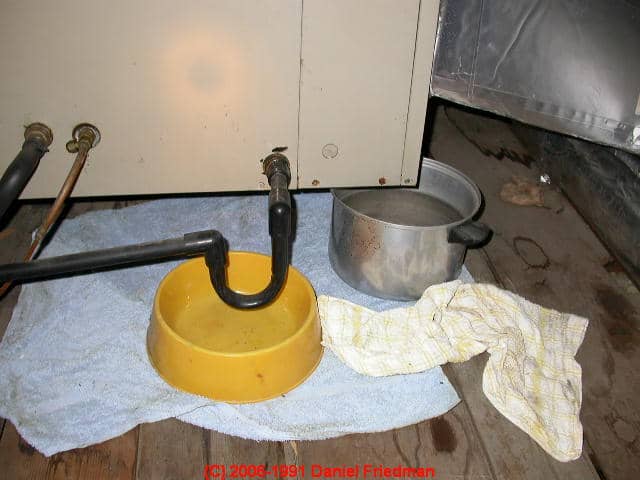
Uh, oh, someone's condensate drain is clogged!

It never ceases to amaze me how people are willfully ignorant about things.   If you live in America, you will own, in your lifetime, maybe a half-dozen each of refrigerators, stoves, microwaves, dishwashers, and the like.   You will probably have a few toilets.   You may own a dozen cars or more.   And you likely will own at least one air conditioner - mostly likely three or four.

Yet most folks have little or no idea how to even operate these appliances, much less how they work.   And in order to do the former, you have to know something about the latter.   It is like trying to drive a 5-speed without understanding what a clutch does.   You'll never get it right, no matter how much you try.

We've been gone a few months and when we came back, I found the condensate drain on our A/C system clogged.   A few pitchers of hot water (and some simple green) later, it is unclogged.   The outside portion got buried with lawn debris, and it backed up and formed a gelatinous goo inside.  It was disgusting.

What is a condensate drain and how does it work?

Well, to understand this, you need to understand something about how A/C systems work.  I'm not asking you to take Thermodynamics and understand Entropy and Enthalpy.  Thermo is a hard course - I took it three times.   Rather, you should understand the basics of how A/C systems work.

Basically, refrigerant (what people call "freon" sometimes) is compressed by a compressor into a liquid.   This liquid is hot because it has been compressed.   An outside coil and fan cool the liquid, which is then passed to an expansion valve.  The expansion valve works like the nozzle of a spray can, and turns the liquid refrigerant into a gas.   This phase change is what causes the cooling effect (just as ice changing phase from solid to liquid is what cools beer in your cooler).    The gas cools when it expands, and this cold gas is passed through another coil inside your house, and a fan blows air over it, which then cools your house.  The gas then goes back to the compressor for another ride around the loop.

OK, so that's A/C for morons.  Not hard stuff.   So where does the condensate line come in?  Well  you have to understand how air works, as well as refrigerant.  And few people do, based on the number of fogged-in cars I see driving around.

Air can hold water basically dissolved in it.  We call this humidity.   Just as you can dissolve sugar in water, you can dissolve water in air.  How much water you can dissolve in air depends on its temperature and pressure.   The colder the air, the less water it can hold - which is why it gets drier in the winter.  When warm, moist air passes over the cold A/C coils in your air conditioner, the water falls out of solution and condenses on the coil surface.  This drips down into a pan and then is drained outside (usually) by a condensate drain.

In a car, the same thing happens.  Problem is, in a car, you can choose "recirculate" or "outside air".  When you do the latter, you are basically trying to air condition planet earth, with predictable results.

You see, any air conditioning system is basically also a de-humidifier.   A de-humidifer is just an A/C unit with both sides in the house.   If you want to "dry out" a house, (or a car) run the A/C.   Funny thing, but people don't get that.  They think if you turn on the heat, it will dry out the house (or a car) but usually all that does is create a hothouse effect.   (Turning on the heat AND the A/C, however, works best.  By heating the air, more water will dissolve (evaporate) in it.  By running the A/C, this water condenses out and drains out the condensate drain.  Just running the heat does nothing, as the water has no place to go!).


Few people understand the science of defrosting.

Getting back to the condensate drain, this tiny pipe can easily clog over time, as mold, mildew and even bacteria colonies grow in it.  Insects may clog it.  Dirt may accumulate.   When this happens, the drip pan in the A/C unit will overflow, usually into your house, possibly ruining your floors or just making a puddle in the basement.

Keeping this line clean and clear is a good idea.   Make sure you know where it exits the house and make sure the yard man does not cover it with lawn clippings (as happened to me).  Run some water through it on occasion (it should be plumbed with an access point to pour water in).   Make sure the outlet of the drain pan does not become clogged.

If all this seems too hard to do (and it is for many folks) then hire an A/C company and sign a service contract.  They will come by your house 2-4 times a year and clean the condensate line, check charge levels, change filters, and clean coils.   It is worth the money, as it avoids problems in advance.

In some installations, a small "condensate pump" may be used to pump the condensate outside or to a drain.   If this pump clogs or fails, it may overflow and leak water all over the place.  Sadly, most installations with condensate pumps are places where a water leak would mean disaster.   So when the pump fails (or the line clogs) you end up having to repair floors or sheetrock or whatever.   If you have a condensate pump, you could check it regularly or get a service contract.

If you don't know whether you have a condensate pump or not, maybe you need to get a service contract.

UPDATE:  Some condensate pumps have a float valve which will shut off the air conditioner if the pump sump overfills.  This prevents the spillage of water and ruining your floors.  But it does mean, to many, that their air conditioner has "mysteriously" stopped working.  Again, keep those condensate lines clear and avoid these problems!  If you can't do this yourself, get a service contract.  I do both.

Death of PayPal? Maybe.

PayPal has made a lot of money on Internet transactions - some say too much.   Banks have taken notice of this and are offering cheaper and easier ways to transfer money online.

I have written about PayPal before.  It is an OK service, but it has its issues.  First of all, they charge a LOT of money just to transfer money - about as much as the Credit Card people do, perhaps more.   And that's a lot.  The guy who founded PayPal had enough cash in his pocket when he sold it to start his own electric car company - and a spaceship company.  That's how much money they make.

PayPal has other problems besides "charging too much" for its services.  A lot of its add-on services have been clunky and hard to use (and also expensive).   PayPal virtual terminal, for example, is overpriced and hard to use.  I checked it out and decided to use LawPay instead.

Their "Buy It Now" button, designed for e-commerce, was also clunky and hard to use.  It was hard to integrate into websites (such as google sites, for example - as they wanted you to use googlepay) and it limited the number of transactions any one customer could make on your site.   Clunky and stupid.

And every time you log onto PayPal, there is some odious offer screen you have to click through.  They want you to get a PayPal debit card, credit card, phone "app", or "pay later" option, none of which are good bargains.   And they make it hard to get around these "offers" by putting the "no thanks, I'm not that stupid" link in tiny lettering at the bottom.   They have all the charm of the folks at Motley Fool.

And like the Obama re-election team, PayPal loves to send you lots and lots of e-mails with "exciting offers" giving you "$20 to spend!" at some online retailer you've never heard of.   Of course, no one is giving away free money this week - some restrictions apply.

And then there are the scams.  PayPal isn't complicit in these scams, of course, but they seem to be always one step behind the scammers.   Next to Western Union, it seems that PayPal is the scammers second-best-friend.

But all that aside, does PayPal have what it takes for the long run?   Sure they have a big Internet presence and a big name recognition.   So did IBM, at one time.  And in terms of name recognition, PayPal has the same problem as Hillary Clinton - the "high negatives" issue.   People use PayPal not because they love the service, but only because it often is the only way to consummate a transaction online.  No one has warm and fuzzy feelings about PayPal - and much of this goes back to the early days of the service, when they sort of ran rogue, as I noted in an earlier post.  Today, these bad vibes are fueled further by the high fees PayPal charges.   It is about as popular as a Cable company.

So, customers will jump to the "next big thing" that comes along that can supplant PayPal.  And the banks are cooking up the "next big thing" as we speak.   One of my suppliers overseas used to use PayPal.   They got tired of handing over a big chunk of each paycheck to PayPal and now use Chase QuickPay.   Most banks are offering a similar service, where you can pay anyone, anywhere, just by using an e-mail address.   No account or routing numbers needed.  And the fees are low or non-existent.

As with online bill payment, one wonders how the banks make money at this.   At least they don't have to print checks and then put stamps on envelopes.   The answer, like online bill payment, is that by offering this service, you attract customers - and deposits.   Moving forward, it will be harder and harder for smaller banks to compete, if they cannot offer online bill payment, online transfers, and other electronic banking services.

I use a small bank here on our island, as it is handy to make deposits without having to go to the mainland.   However, you can now deposit a check from anywhere in the world, using your smart phone (by taking a picture of the check) so that advantage is evaporating.    I can make electronic transfers online between than mom-and-pop bank and Bank of America, so I can deposit a check in one bank and then move the money over with a click of a mouse.   It is pretty neat and handy - and more than a little frightening.

The point is, the banks aren't asleep while PayPal is raking in the dough.  They are offering more convenient and easier ways to pay online or by app.   PayPal, in contrast, remains a clunky service that really is limited to eBay and a few other outlets.   Using PayPal is akin to having an AOL account these days - it marks you as an internet dork.

eBay alone remains a huge market for PayPal.   But ask yourself this - when was the last time you used e-Bay for anything?  While once the source of great bargains in a peer-to-peer transaction, eBay has repositioned itself as a "powerseller" marketplace - trying to compete with Amazon.   And Amazon will clean eBay's clock.    I find myself using eBay less and less, as there are fewer bargains to be had there.  And many sellers are shying away from it as well - due to the high fees charged by eBay, which are nearly doubled by the high fees charged by PayPal.   You sell something on eBay these days and you're lucky if you make any money at all.

So, going forward, I see trouble for PayPal.   They can't seem to expand beyond the eBay marketplace, and there are so many other better (free) ways to send money online these days.

And I doubt PayPal can beat "free" in terms of pricing.