Saturday, March 26, 2016

Eskimos

The freezer section at your local supermarket.   The folks who shop here exclusively are called "Eskimos" in grocery store slang.


You see all kinds at the grocery store.  Some folks come to the register in their electric scooters with sixteen bottles of orange soda and huge bags of cheese-flavored popcorn.   How they live as long as they do is beyond me.

Still others shop exclusively in the frozen food aisle - buying prepared meals to be thawed and microwaved at home.  Some folks fill their carts with nothing but prepared frozen entrees.   Grocery insiders call them "Eskimos" as they spend all their time in the freezer section.

Are there bargains in the freezer section?   Perhaps, but not as great a bargain as making food by yourself.  However, for single people and those who can't cook, the temptation is pretty strong.   Making an entire meal for yourself is not only time-consuming, but creates a lot of work in terms of dishes to wash and the like - as one reader noted.

As I noted in an earlier posting, the cost of making a basic egg sandwich meal, with coffee and hash browns, is about 92 cents at home.  This does require you own some coffee-making device, dirty a pan or two, and spend about 10-20 minutes in the kitchen every morning.

We recently saw, in the frozen section, new products by Morningstar Farms, which is a division of Kelloggs.  We have used their "vegetarian" sausage patties in the past only because they were a lot less hassle (and mess) that frying real sausage patties in a pan, particularly in the camper.  While in the Eskimo aisle to get them, we saw that Morningstar Farms also sold pre-made breakfast sandwiches for about $5.98 for four, or about $1.50 apiece.

This begs the question - are prepared meals a good deal?   To begin with, I will not address the whole "vegetarian" thing involving a sandwich which includes a real egg.  Some vegetarians claim that eggs are "dairy" but I hold that they are simply mono-cellular chicken or aborted chicken fetuses.   But getting political about the food you eat is idiotic anyway.  We are omnivores, get over it.

But at $1.50 apiece, is this a bargain?   Well, no, not really.   As I noted in my earlier posting, for about 92 cents you can make a breakfast sandwich, hash browns and coffee.  If you just want the sandwich, it is about 50 cents, or about 1/3 the cost of buying the pre-made frozen variety.

And of course, there is the quality factor.  Something you microwave for a few minutes, right out of the freezer, isn't going to taste very good and will have an odd texture.  Microwaves and eggs don't mix well.

To be sure, there are cheaper varieties.  The Jimmy Dean sausage croissant sells for $8.98 for 8 (the "family pack"), which comes down to about $1.12 per sandwich, or still more than double the made-at-home variety.   For a single person the savings may be only $227 a year (really?  That much?) but for two or three people, the costs add up.  For a family of four, you are talking about nearly $1000 a year - and all for the sake of convenience.

This is not to say that frozen entrees are something to be avoided.   They can be a handy way of having something on hand when you are working late and don't have time to cook.  They are still about half the cost (or less) than eating at a restaurant.

But to go full Eskimo?   Probably not a value proposition, nor a healthy one.

PhD Impaired

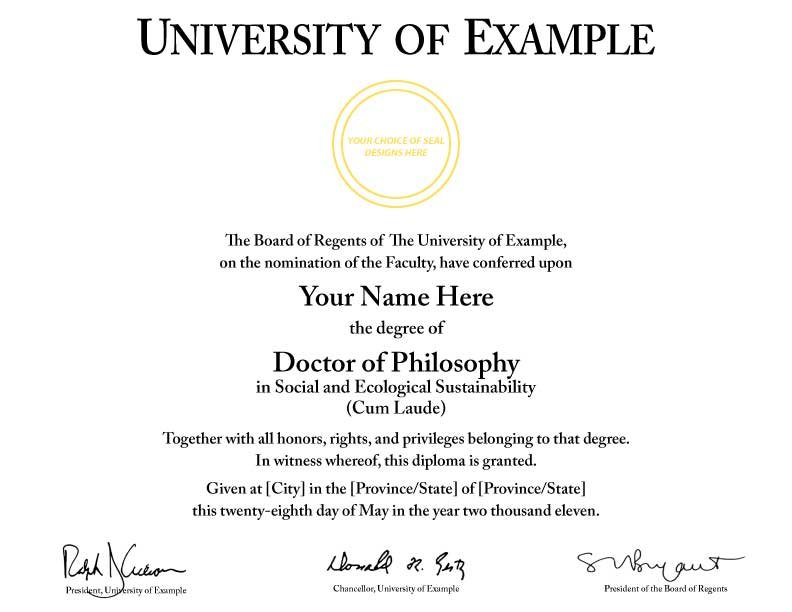
My Alma Mater: University of Example.


As I wrote in The Problem with College is College a post-graduate degree in Engineering can be crippling.   To get a job in the field, you only need a B.S. degree and some experience.   If you can co-op with a company while in school or land a summer job or internship, you will do far better than someone with a Masters or PhD in the field.

Why is this?

Well, to begin with, in Engineering school they taught us to "Think like Engineers" - in other words, how to solve problems with available resources.   Sure, we took courses like Statics and Dynamics that would teach us how to calculate the stress on a bridge beam and whatnot.  But what was being taught was not specific solutions to equations, but how to apply these equations to unknown situations - how to solve problems that hadn't existed in the past.  Because as Engineers, no one was going to pay us to solve problems that were already solved in the textbooks.

Graduate level courses are an interesting animal.   In terms of jobs, they don't necessarily qualify you for a better one, or better pay.  And in fact, they can backfire.   If you spend too much time in Academia, you will have the reputation (and thinking skills) of an academic.   And the longer you spend in college, ironically, the less useful your education might be in the real world.

Let me give you a real-world example.   When I went to work at the Patent Office, nearly 30 years ago (July 22, 1987 was the date I was to "report for duty" at Patent Academy), I started out as a lowly GS-7-1225 (Engineering Scale).  The pay was low, but my performance expectations were low as well.  I had time to learn the system and ramp-up to a higher level of productivity and pay, eventually reaching GS-11 in two years.

A friend of mine, who had a PhD, started out at GS-9 and was quickly advanced to GS-11.  He made more money, but his production quota was much, much higher.   So it was harder for him to learn the ropes and do the same things I was doing, and do them in less time.

But it was worse than that.  He was over-educated for the job.   Why he took the job is a good question.   I think in part it was because no one was hiring PhD Engineers except in research labs, and to get those jobs, you had to be at the top of your field.

The problem for him was, he couldn't make a decision on any case he was assigned to.   I talked with him in-depth about this and he explained his frustration.  He was amazed that I was doing so well, even though I had less education - while he struggled with the job.

He asked me, "How can I allow this Patent when I only have 20 hours to search the Prior Art and draft a rejection?  There could be references out there that I never found!  How can I make a final decision in this matter in such little time?"

And I explained to him that as a "dumb" old BSEE, I looked at it from a different angle.   The applicant paid for 20 hours of examination, for which they paid a $265 filing fee (back then).    They paid $265 and they get $265 worth of examination.   If, in 20 hours on average, I can't find a "Prior Art" reference to deny their application with, it gets allowed.   End of story.

Of course, I was coming from industry, where everything has a price tag attached to it.   We allocate so much for research, and when that money runs out, whatever we came up with is our new product.  We can't just indefinitely improve the product - eventually something has to be made, so we can sell it and make money to keep the lights on.

And the same is true in the Patent field.   Patent Examination is not the "final answer" on the Patent-ability of an item, particularly today, when the "presumption of validity" isn't as strong as it once was.   We litigate Patents for precisely that reason.   There is no point in spending tens of thousands of dollars examining a Patent Application for a product that may never sell or never be profitable.  Let the courts decide the more important cases - the Examination process is a coarse seive to screen out the more egregious cases.

It is a pretty good system, too, for the most part.   But my friend couldn't see it that way.  He had to be absolutely right the first time, which was what was taught to him in academia.   He was literally crippled by a PhD degree.

Since he couldn't make his production quota numbers, he eventually had to quit.   And where he went, I am not sure.  He said he wanted to get back into "real Engineering" but I am not sure that after so many years in academia and then at the Patent Office, that any Engineering firm would want to hire him.

Of course, his life path sounds a lot like that of another PhD and former Patent Examiner - Albert Einstein.   So maybe he found some nice professorship at Princeton or somewhere.

This is not to say all graduate degrees are useless, of course.  If you squandered your undergraduate days majoring in "Sensitivity Studies" or whatever, a graduate degree - at least a Masters - may be necessary to get you a job at all.

And of course some professions, such as Doctor, Lawyer, or the like, may require such advanced degrees.  But beyond that, is getting more degrees going to be helpful to you?  Unless you are a New York State schoolteacher - and paid based on the number of degrees you get, perhaps not.

Beyond that, PhDs are rare, and perhaps for a very good reason.    Most are academics - professors, researchers, and so forth.  And these should be rare, exalted positions for a very few deep thinkers.

The rest of us, breathing the less-rarified air, we can make do with a lot less, and in fact, be better off because of it.

Bob Gets A Smart Phone

You don't have to spend $600 on a smart phone.


I have resisted getting a smart phone for years, for a number of reasons.  First, I felt like I was being forced to buy something - and something not very cheap, either - and also paying a monthly plan for something I didn't want.   Despite what smart phone users claim, they are not cheap to buy, own, or use.   A new iPhone or Galaxy is going to run you $600 or more, and you will pay for this as part of your "plan" - it is not "free" as you may like to think. 

And smart phone bills can be pricey.  If you have a contract plan, you may have unlimited text, data, and talk, but you pay for this in monthly service fees (and maybe use very little of it) which are amplified by taxes, universal access fees, and the like.   People like to say their plan is "only $39 a month!" but most plans end up costing more than that - far more.  But folks don't like to admit to that.

Men lie - a lot - about gas mileage, penis size, and their smartphone bill.

The second thing was the way smart phone affect people's behavior.   They are highly addictive, constantly making little noises and vibrating and promising - if you would just pick them up - something interesting and fascinating.   So people become obnoxious smart phone users - texting friends while you are talking to them, which is the ultimate rudeness if you think about it.   The smart phone becomes a virtual second world where they live most of the time - in tweets and texts.  I don't want to be that guy.

Oddly enough, the very most useful features of the smart phone are often least used by their owners.   You have, in your hand, a pocket access to the largest database in the history of mankind.  Yet so few use it.   A friend blathers on about the latest internet rumor he heard on Facebook or from a friend.   I grab his iPhone and "ask Siri" to find the answer (you can do this in Google voice as well) and in seconds, you can verify or debunk things.   But most smart phone users prefer to live in the dark than to illuminate themselves through use of this wonderful instrument of learning.

Or take maps.   I was traveling in The Villages with some friends, who were attending open houses.   We were in a golf cart, of course (the preferred mode of travel there) and they could not find the address of the open house.   I hit the "google voice" button and read the address, and it flashes back a map of where we are and how to get there.   They thought this was magic, although both of them owned state-of-the-art smart phones.

So they can be useful devices, if you take advantage of the great database that is the Internet, the online services like banking and whatnot, and of course GPS, streaming music, or whatever.  They can be evil as all hell, if you use them like Pavlov's dog - jumping every time it makes a ding, chirp, or vibrate.

And increasingly, they are becoming necessary devices.   Employers and retailers expect that you text and increasingly, trying to communicate via (audio) phone is next to impossible.   Everyone screens calls and doesn't pick up - if they answer at all.   And if they respond, it is by text.

Banking by phone is a good thing.  You can take a photo of a check and deposit it.   You can pay for things with Android Pay or Apple Pay - or whatever.   The "credit card" may go by the wayside within a year or two.   And if you don't have a smart phone by then, it will be like being un-banked

I suppose it is like the PC era, when everyone started buying computers and going online.   I was an early adopter as I used computers for work and as a hobby.   But I am sure others felt that it was just a fad and hoped it would blow over - because they didn't want to shell out $2000 for a personal computer and try to figure out how to work it.   Why should they?  If they want to send a letter, the postman comes twice a day.   If you want to "instant message" someone, just call them.   And if you want to balance your checkbook, you wait for your monthly statement.   And why shop online when we have the Sears catalog?

Same old shit, different day.  And today, it is smart phones.   The good news is, you can buy used ones for cheap.  And there are even brand-new "stripped" no-name models that can be bought for cheap as well.   So I set out to get a used smart phone and figure out a data plan for it.  But which one to get?

First, we want something cheap, with a removable battery and SIM card and memory card.   Apple products are probably out of the running, but this website has a neat smart phone selector.   The only thing about the site that is archaic is pricing.  It uses Amazon pricing, which is kind of high.   The site shows the Samsung Galaxy S4 as selling for $300 on Amazon, but you can find it for about $100 on eBay.  You can expand the memory to 64 GB with SDRAM and it will accept a GoPhone SIM.

I received the unit, which was set up for T-Mobile, but was "unlocked" so it could run on any GSM carrier, such as AT&T.   It would also work with our existing GoPhone service.

(By the way, buying a used cell phone is a good way to avoid paying cell phone insurance.  If you drop your cell phone in the toilet, you can probably replace it, if it is a few years old, with one in similar condition,  for about a hundred bucks, from eBay.  I suspect a lot of these used sales on eBay are to people replacing damaged or lost phones).

But first, I played with it in WiFi mode, which was not hard to do.  Power it up and link it to your router via the WiFi link.   You can download and run apps, load music onto in, sync it via bluetooth to your car or landline or a set of external speakers and whatnot.   It would even run the Bank of America App, and allow deposits by cell phone (by taking a photo of a check - that saves me a 10 mile drive right there).

Our GoPhone sim was mini, not micro, so we went to the AT&T corporate store to get a new micro SIM, which was free of charge.  We used Mark's SIM, and for now (and the foreseeable future) I will continue to use my cheap $14 slightly-retarded phone, instead of a smart phone.   There are GoPhone plans which include data and texting - unlimited texting and calling, and a fixed number of GigaBytes of data per 30 day billing period.  For example, for $40, you get 2 GB, which is enough to send and receive e-mail, but not enough to stream longer videos (shorter YouTube videos seem to work OK, and  of course using WiFi is unlimited). 

There are, of course, other plans out there, some cheaper, some more expensive, which have more data or less data or pay by the minute, or whatever.   The nice thing about a monthly plan is that you are not limited to one carrier for a contract term.   We stuck with GoPhone not because it was the cheapest, but because the service and range of AT&T has been good, and it was pretty painless to make the switch.  The clerk at the AT&T store spent about an hour with us going over  plans and switching the phone and showing us how to work it.

Since it is a month-to-month plan, I can go to the GoPhone website and change plans at will.  While traveling, I can up the plan to a higher level (e.g., unlimited data for $60 a month), and when staying at home, I can downgrade to a lower level of service.  You can also buy additional data blocks if you "run out" before the end of the month.  So far, this doesn't seem likely at all, as we hardly use half the 2GB of data.   It is kind of handy, though, if you plan on using it intermittently, to upgrade and downgrade service accordingly.

You can use the phone as a WiFi hotspot - there is no additional charge for this with GoPhone.  Some carriers charge an extra hotspot fee, and many folks don't even realize they are paying it - and never use it!  However, it will only "tether" to one device at a time.  So when traveling, we can use the phone as a hot spot for less money than other companies (T-Mobile, Verizon, AT&T) charge for a "wireless hotspot" device (usually $50 for the device and $30-$40 a month).

The car will even sync with it, in three ways - by Wifi, Bluetooth, and via USB cable.   With the car tethered to the phone, the car can then run apps and even perform diagnostics and download error messages to the phone.   It will also remember where you parked (via GPS) and download that data to your phone so you can find your way back (I am not sure this is really a necessary feature, but there you have it).   It will also call 911 if you set off the airbags.   Sort of a poor man's Onstar.

With mirroring, you can mirror the display to a smart television, which we also had to buy recently, as our old flat-screen finally died (about 1/3 the screen was brown lines).  The new television - $50 cheaper than the old one - is 4" larger and has a built-in Netflix, Vudu, YouTube, and Internet interface.  It also works with our wireless keyboad and mouse.   So this has been a month for electronic upgrades.

You can use Bluetooth to play onto a bluetooth speaker and thus replace your iPod.  You can even buy bluetooth adapters (I found one at a truck stop) that will play bluetooth through non-bluetooth devices.  So the stereo in our camper will play music from the phone.

And yes, sometimes this tech shit actually works.   I write Patents on this stuff all the time, and it always shocks me when it actually works as described.

It also sends and receives e-mail from both our hotmail and gmail accounts, and even automatically synced our online calendars with the device (combining them, no less).   Of course, all you can do, really, is read one-line e-mails and make one-line responses.  This kind of thing that infuriates me when I am sending an e-mail with three attachments (which require signatures) and five questions - the smart-phone user replies, "looks good, thanks!" which is not an answer.

What is nice about these devices is how little you have to fuss with them, compared to a traditional computer.   A lot of things are done automatically without your intervention.  There are downsides to this, of course.

The downsides?   Well, first, the battery life sucks - it runs for about a day between charges, and that is with the screen-saver set at 30 seconds.   Second, the device dings and chirps whenever it does anything at all - sync with Bluetooth, receive e-mail (from either account), or text message.   And it is hard not to pick up the device and see what is going on when it dings and chirps.  This is the Pavlovian aspect of smart phones and it is annoying.  I will learn how to turn these chips off.

But of course, one way to avoid this problem is the off button.   Just turn it off, or don't carry it with you all the time.   What I find odd is how some folks have to carry their smart phone with them, like it was an artificial kidney.  Some are strapped to the belt in holsters like guns.  Others put them in their back pockets, which can be disastrous if you sit down.  Still others hold them by the edges as if carrying a piece glass - arms out, as if dowsing for water.   I am not sure why folks do this, but it is like walking around looking at a computer screen.

The Samsung has some downsides - it comes with a lot of spamware which took me a while to figure out how to delete from the home pages.  They have some sort of Facebook-like thing they want you to use, or some kind of "travel" log they want you to fill out.  Delete, delete, delete.

And there are a lot of features.   The owner's manual is a staggering 288 pages (in large font, however) that fills an entire ring binder (downloaded from the Samsung site).  I also ordered the Samsung Galaxy 4 for Dummies for Mark.

We also went to Wal-Mart for a body-glove case and a screen-saver (the clear plastic piece that goes over the screen).  Combined, these cost nearly as much as the phone.  Oddly enough, Dollar Tree only had cases for Galaxy 6s and iPhone 6.  I guess those who shop at Dollar Tree only want the best!

The funny thing is, though, that while people pay big dollars for the "latest and greatest" smart phone to show off (and your iPhone case HAS to have a hole in it to show the Apple logo out the back, right?) they all pretty much look the same from the outside, other than small changes in dimensions.  The Galaxy 4, 5, and 6 are all about the same in size and format.   How in God's name can you rub someone's nose in your status if you can't tell the phones apart?

Of course, there are some differences which will be important in the future.  Fingerprint ID, for example, might be necessary for mobile banking.  And if your phone doesn't have near-field communications capability, using GooglePay (Android Pay) or ApplePay isn't in the cards.   Samsung's innovative "SamsungPay" which can work with any swipe terminal out there, only works if you have a Galaxy 6 or newer.

But in my view, by the time these payment systems become the norm as opposed to a novelty, it will be a few years from now.

And by then, a mint Galaxy 6S will be on eBay for $99.

What the Hell Happened to the Law Business?

This lady sued her law school for fraud, claiming that they promised her a cushy job that never materialized.   She lost the suit - after hiring another lawyer to represent her.   I hope they were working on contingency!

In the 1980's and 1990's it seemed that getting a law degree was the ticket to the big time - a way of stepping up from the middle class to the upper classes - perhaps even striking it rich.   And this has been a narrative in our country for some time, although it is a flawed narrative.

Abraham Lincoln became a lawyer, and while his law career went better than his career as a retail merchant, Lincoln never became more than comfortably middle-class from his practice.  Even back then, few lawyers became rich.

My Grandfather went to law school after his Father committed suicide.  The family was nearly broke, although his Mother - a formidable woman, apparently - managed to keep the family together by buying and selling second mortgages.   He became fairly upper-middle-class, moving to Larchmont, New York and becoming Mayor of that village. While he drove Cadillacs, his house was fairly pedestrian by Westchester County standards.  He was well-off, but hardly "rich".

Even during the go-go years of the 1980's and 1990's, most lawyers ended up with a good job, not a fortune of money.   Becoming a Lawyer was a way of hanging onto a middle-class lifestyle not a means of moving up a notch in the social ladder.  While I made "a good living" in the Patent Law field, I ended up making more money in Real Estate.  However, having a law degree and the requisite credit rating (and income) was what made my Real Estate investments possible.

Today the law business seems to be in shambles.  While there are still big mega-firms out there billing hundreds of dollars an hour, the norm for most lawyers, particularly recent grads, has been to scramble to make a living.  The "lost generation" of 2000's grads may never make much money in the field, as they entered the market when the business was in the toilet (in 2008) and they are past their "sell-by" date today.

Yes, Lawyers are like fresh fruit - they are only good while ripe.  Look in the classified ads in any law journal or online.  Everyone wants a young associate with "2-5 years experience" in the field.  Someone whose brain is bright and fresh and is up on the latest case law.  Young and smart, but dumb enough to work long hours for fairly low pay - on the implied promise they might make partner some day.

No one wants a 10-year associate.  And certainly no one wants someone like me, with nearly 30 years in the field.  So the poor sods who graduated in 2008 will find it hard to get work - ever.  The jobs becoming available today will be taken by graduates from 2014 onward.

(Even in our courts, this is true.  Much fuss has been made about replacing Antonin Scalia, but the reality is, all of his opinions were drafted by an army of law clerks - young graduates who go to work for the Supreme Court and create new law for all of us.  The old white-hairs on the bench are merely their supervisors.  It is kind of scandalous, if you think about it - the highest court in the land staffed largely by the youngest and least-experienced lawyers.)

Now, of course, this could all turn around perhaps, as law school enrollments decline.  But that could take years, and if you are like the young lady shown above - still struggling to pay off law school debt and not finding "real work" in the field, a future lawyer shortage will be too little, too late to solve her personal problems.

So what caused the meltdown in the law business?   In part, it is a number of obvious things, but also in part, some things that are subtle social and legal trends.   And I think some of these trends may be non-reversible.

1.   Supply and Demand.  This is, perhaps, the biggie.  When I was in law school, demand was high.  People would pay you to go to law school.  So I did.   Today, people are borrowing huge sums of money to go to law school.  It is an entirely different paradigm.   Hiring was up in the 1980's and 1990's, so a lot of people went to law school.   But since it is a pipeline of about 3-4 years time, the supply/demand curves can be entirely different by the time you graduate.

As we shall discuss below, there are factors on the demand side that are bringing down wages.   People are litigating less, courts are making lawsuits less attractive, and more and more litigation tasks (and other legal tasks) are being handled by paralegals - just as nurse practitioners are handling more and more "doctor" jobs today.

But the biggest problem, I think, was supply.  Too many people thinking they were going to strike it rich as lawyers and deciding to go to law school.  And why they thought this was the media, as we will see below.

2.   Women in the Workforce.  No, seriously.  It appears that since women are valued less than men in our society, any field in which they go to work in, not only do they earn less money, but the money made in the field drops overall.  Now, this could be merely an expansion of the Law of Supply and Demand as in #1 above.   Since the 1960's, the dual-income household has become more of the norm than the exception, nearly doubling the size of the workforce by itself - in an era where automation has taken over more and more jobs.

When I was in law school in the early 1990's, women were, for the first time, outnumbering men in school.   Law School seemed like a good choice for women, as the field was more egalitarian (not entirely so, but more so) than other traditionally male-dominated fields like Engineering or Investment Banking.   Law and Medicine are two fields where women are rapidly filling up the ranks, and this is not a bad thing, of course.

But whether wages in both fields are stagnant because women are in the field (and are perceived as less valued) or whether supply in both fields has gone up, is a good question.   But it is an unusual and unexpected factor.

Of course, the irony is, to women, that once again they are getting a raw deal.  Just as they start to take their rightful place in a field of endevaor, wages go into the dumpster.

3.  The Rise of the Paralegal:   In a recent article in the Journal of the Patent & Trademark Office Society (sorry, I have no online link, articles are not available online) an author opines that there will be a shortage of Patent Attorneys in the next five to ten years, as the number of people taking the Patent Bar has declined.   But his charts and graphs show something astounding - the number of people taking The Patent Agent's Exam has skyrocketed.   Patent Agents are registered to practice before the USPTO and have an Engineering Degree, but no Law Degree.  They are sort of like super-paralegals who can practice a very narrow area of law.   So, the decline in Patent Attorneys is accompanied by an increase in Patent Agents.   It may be that no "shortage" of Attorneys occurs.

In other fields, the same is true.   For law firms, a larger and larger amount of work is being done by paralegals.   In the old days, law clerks or first-year associates would be tagged to do the drudgery of legal research or preparing routine legal documents.   Today, full-time paralegals do this work, accompanied by computers which store most of these documents as forms that can be readily customized for each client. 

Very little legal work is innovative or unusual.   If you are making novel arguments in a legal venue, that is often a sign you are in trouble - or very, very smart.  But in most cases, a Will, Trust, or Personal Injury case is pretty routine, in terms of pleadings and documents.  And these routine documents can be prepared by Paralegals.

And increasingly, as we shall see below, people are realizing that such cases are best settled from the get-go, as litigation means only enriching the attorney and your own expense.

A final word on paralegals:  This is one area where outsourcing has taken its toll.   Not a day goes by that I don't get an e-mail plea - or even a phone call - from an Indian Patent Firm who wants me to "farm out" my legal work to them.   Initially this started out with the drudge work of Patent searching or drawing preparation.  But increasingly, these firms are making pitches for amendment and even application preparation.   I am not sure how many firms - if any - are farming out this work overseas or what the quality of work is.  However it is an indication that any job can be outsourced if you are creative enough. 

4.   The Law Firm as Ponzi Scheme.  I have talked about this before and alluded to it above.  In any large firm, there are a few Senior Partners who make a lot of money, some Junior Partners who hope to make a lot of money, and a lot of Associates who work long hours and think they are making a lot of money.  Stick around at the firm for a few years and you realize that a lot of these Associates end up going down the elevator with a photocopy box of desk ornaments and personal effects.

Simply stated, the odds of making even Junior partner are about 1 in 10, and making senior partner, maybe 1 in 100.  Yes, there are a few lawyers out there who make millions a year.  Most of us make thousands.   Some of us are on food stamps.

And it has always been thus.  The television (see below) likes to romanticize the practice of law and make it out that we all are making tons of money.  But the reality is, more than half the graduates, perhaps 90% or more, don't get those high-paying jobs you see on television 

5.   America Wakes Up to Lawyer Antics?   During the 1980's and 1990's, the law field was all go-go-go with stories about young law clerks being wooed by big-city law firms with things like luxury apartments, limousine rides, and free tickets to the firm's box seat at the ball game.   Work?  That was secondary.   During that era, lawyers could charge what the market would bear, and the market would bear a lot.

But since then, America - particularly Corporate America - has wised-up to the antics and billing practices of attorneys. As one in-house attorney explained it to me, their medium-sized electronics firm was bringing in $5 Million a year in profits on $100 million in sales.  Their legal bills were about $2 Million a year.  If they could cut their legal expenses in half, they could show a 20% increase in profits - which would drive the stock price through the roof.

In another case, two electronics firms were suing each other and we were enjoying billing one of them about $100,000 a month in legal fees. I am sure the opposing side's firm was doing the same thing. The CEO's of both companies did the unthinkable - they went out to play golf together, and by the 18th hole, and worked out a settlement agreement that would put an end to the endless (and unprofitable) litigation and allow them both to confront their real nemesis - the threat of cheap foreign-made products.

It is said that no one wins lawsuits but the lawyers, and that is indeed true. We get paid, generally, win or lose.  And even "the little guy" is wising up to this.  If you google "unhappy with personal injury settlement" you will see pages of postings.  People are realizing that hiring a lawyer to "litigate" (and I use that term loosely) their case resulted only in endless delay of the settlement and a smaller payout in many cases - as opposed to what they could have negotiated with the insurance company.

6.  The Myth of the Law Business.   Television shows loved to depict life at a law firm as romantic - literally.  Shows like L.A. Law or Alley McBeal depicted law firm life as one fabulous lunch date after another, followed by a little sack-time with your law partner. Once in a while, you'd go to court and say outrageous things to a Judge, who, impressed by your wit and wisdom, would acquit your client.

Of course, this is not reality, just television.  Today, more realistic portrayals of the life of lawyers - as low-paid drudges or folks living marginally- are becoming the norm.  Shows such as "Better Call Saul" depict lawyers as losers and quasi-criminals. And perhaps this is a bit of an exaggeration in the other direction, but at least a less glamorous portrayal.

When I was in law school, you could tell the types who went there because of television.  They clearly  thought that working in a law firm was going to be like on TeeVee.  And they thought that law school itself would be like television as well.  They were disappointed in both.  It turns out that both are just a lot of work, and the pay isn't all that great.

If your idea of what it is to be a lawyer is based upon some television show - even if you won't admit to this - you might want to re-think a law career.

7.  The Death of Litigation.  The courts have put a damper on the good-old-days of lawsuits.  Things like punitive damages have been curtailed severely.   The idea that you can win "litigation lottery" and win millions of dollars at trial is basically hooey.

Oh, sure, you'll still hear of jury verdicts with outrageous damage awards.  But these are usually reduced severely on appeal - and you never hear about that.  In the famous "McDonald's Hot Cup of Coffee" case, the lady won $3.8 million at trial (not $5M as often reported) but it was reduced to a little more than $600,000 on appeal. McDonald's probably spent more on legal fees.  It was hardly a lottery-like payout as people like to claim.

This doesn't stop lawyers from advertising that they will win big settlements for your car crash or whatever.   But the reality is, if you get into a fender-bender, you are not going to receive a life-changing amount of money. You may not even receive enough to buy a new car.  You may not even get enough to repair your old car and pay your hospital bills - after paying legal fees.  And you do pay them, with contingency-fee attorneys.

In other fields, similar curtailment of abuse has occurred.  Class-action suits were once huge money-makers for law firms.  You have probably been a member of such a suit and never realized it.  A clever law firm finds some billing discrepancy or some disclosure issue or some other situation were a big company has arguably cheated a lot of people out of a little money each.  They file the case in Illinois (one town there claiming about half of all such suits filed in the country - until recently) and then almost immediately offer to settle for a token amount (for the plaintiffs) while the law firm rakes in millions.

So you get a coupon for a free car wash, which supposedly "makes you whole" for having a car with a dangerous fire defect.  The Law Firm gets $5.6 Million.  That's how the game is played.  A bit of corporate shakedown, and no one comes out ahead - except the lawyers.  But that was the good old days.  You can still file such a suit today, but it is harder to certify the class and thus you have to have a more substantial claim than in the past.  The days of the drive-by class-action suit are largely over.

Even in the Patent field, the glory days of Kodak v. Polaroid may be over.   The courts have reined in interpretation of Patents, and new rules and laws have made it harder to get broad Patents allowed.  While Patent "Trolls" continue to annoy many large and small companies, there are signs that these changes to the laws are having effects.   And no longer is it possible to put your competitor out of business with a Patent suit, if indeed it was ever possible.

And bear in mind that in each of these cases, not only does this mean less work for Plaintiff's lawyers, but less work for defendant's lawyers as well.   Like I said, we make money from both sides of the transaction.

So what does this mean for the practice of law?   Well, it could be a sign we are heading toward a less litigious society - or that the law and litigation, like so many other fields, has been quantified and normalized as part of the cost of doing business and that individual cases become routine transactions and not some grandiose show-trials.  As such, the idea of the "white shoe law firm" becomes less and less of a reality.  No one can afford to pay the outrageous rates of such firms - and indeed, the company that hires the expensive law firm ends up losing, as they hemorrhage cash at a faster rate.

But I think as a long-term trend, pay in the law field will remain stagnant.  We are heading toward a "McLaw" type of environment, where legal documents and legal briefs are served up with a side order of fries.

Something to think about before you borrow a hundred grand to go to law school!

Friday, March 18, 2016

1960's Work Ethic

The office of the 1960's was one giant human computer.

In a previous posting, I mentioned how things were so different back in the 1960's and 1970's that you can't really compare them to today and say whether they were better or worse.   Yes, some folks had the "three- martini lunch" but those were few and far between.

Most folks had to toe the line at work, swear loyalty to the company, and live in fear of being fired at any moment.   Watch old episodes of The Flintstones or The Jetsons or The Honeymooners.   In each episode, it seems, you hear, "Jetson, You're Fired!" or "Flintsone,  You're Fired!" or the boys are working up some cockamamie scheme to make it big.   

Everyone back then lived in fear of the F-word.   You went to work for IBM, did your 30 years, got a gold watch and a pension, and never rocked the boat.   The idea of golden parachutes or dot-com startups was alien to us back then. 

And if you kept your head down, did your job, you got paid.  Not a lot, but something. Enough to buy a 2-bedroom house in the suburbs (the kids could share a bedroom, naturally, and the four of you could share one bath - yes, this is how it was done).   And your wife could drive you to the train station every morning.  If you scrimped and saved, maybe you could buy a "second car" for the wife - such an extravagance.


Women were limited to mindless clerical jobs - until they got married, at which point they'd be fired.

As a reader noted:
Drives me crazy when Millennials I know (or even some entitled X'ers, for that matter) who've watched way too many episodes of "Mad Men," start pining on about how better professional office jobs used to be.  Really?  Showed up late 15 minutes 'cause there was a line at the coffee shop?  Fired--and you're not allowed that coffee at your desk anyway.  Felt like showing up in jeans and running shoes?  Fired.  Sick days?  Fuggedaboutit.  Found out you cheated on your spouse?  Fired.  Tattoos and a nose ring?!  Yeah, right--yer ass is grass and we'll probably call the cops to boot!

I usually send them the attached pics and ask which office job they'd prefer.  It was before my time, but I'm well aware it was anything but a barrel of laughs.  Even when I started in the 90s, EVERY guy had to wear a tie at the office EVERY day.  The Doc Martins had to stay at home.

And as for the "cost of stuff and inflation" tears?  You're dead on.  A casual glance through a Sears catalog from the 60s-80s will not only tell you things were more expensive, but (adjusted for today's dollars) completely unfathomable.  It's a wonder that middle-class was able to stash anything at all for retirement.  ...But I guess they didn't spend all their money on crap and restaurants.
And that is all pretty much true.  In his biography On a Clear Day, You Can See General Motors, John Delorean recounts how much he was hassled - as Vice-President in charge of Chevrolet - for having long hair and wearing contemporary clothing.   Back in the day, at IBM, you would be sent home, like a naughty school child, if you had the gumption to show up for work in a brown suit.  It simply wasn't done.   And in a lot of places, taking off your suit jacket was not even allowed during working hours.

And if you were fired, well good luck getting another job.  Not only would being fired (or even quitting) be a black-ball to hiring, if you applied for a job, they would call your former employer, who would then trash your character without fear of legal recourse.

Losing your job back then could be a devastating life-altering experience.   People were paranoid about being fired or let go.   And as a result, people would often do odious things when ordered to, as they lived in fear of losing their jobs.  This, in short, is how "corporate malfeasance" occurs - when people are so worried about making their car payments or house payments that that go along with really bad ideas, like dumping toxic waste in the third world.

Ahhh... the 1960's!  Such a great time to be working.   And that's just for men.   For women, in addition to the discrimination were the outright sexual assaults.   Sleep with your boss, or get fired.  And if he gets you pregnant, well, you're fired anyway.  But no problem, he'll slip you 50 bucks for a back-alley abortion that will cause you to hemorrhage to death.  And everyone will shake their heads and wonder why you became such a slut.  That was the standard back then.

Gay?  Don't even mention the word.  Because not only would you be fired and blackballed from employment, you'd be chucked in a mental hospital and given electro-shock treatments, whether you wanted them or not.  Or, like my great uncle, you'd do "the honorable thing" to help erase the shame brought on the family and put a bullet through your head.   Sort of like self-inflicted honor killings.

Still want to go back in time?  Be my guest.  We didn't even talk about what it was like for black folks back then (The same newspaper from my previous article also advertises a "room for rent in a colored home" - in Connecticut in 1957!).

Now, compare this to my work experience at a semiconductor firm in Austin during the SXSW festival - a music and technology festival, if you can believe such a thing.   I showed up for three days of work, wearing blue jeans and cowboy shirts (and cowboy boots).  They gave me a conference room to work in - a glass cube that was cantilevered over the bar the company owned, right above the stage.  Three rock bands played each day, at 10:00, 1:00 and 4:00.   And no only was I not "sent home" but everyone else was largely dressed the same way.

Our generation won.   The way we work today is so dramatically different than in the past.   No longer are we tied to one employer by financial loyalty - in both directions.   Since we have portable 401(k) and IRA plans, we can jump ship and not lose tenure or "vesting" in some complicated (and underfunded) pension plan.   Want to quit?  Go ahead.   Start your own company.  Go work somewhere else.  I did.  You have options today - if you have talent and an education.   If you have neither, well, you have few options today - just as you had few options back then.

Perhaps that is why for someone of my generation, the present and future seem pretty decent.   While people protest "Black Lives Matter" and talk about trans-gender restrooms, it seems to me that we have indeed come a long way and opportunity today is greater than ever before.  The American Dream - of achieving a lot based on your talents and personal abilities is far more achievable today than it was in the past, even the recent past.   Not to say there isn't room for improvement, of course.

But this does mean, however, that achievement is still based on talent and ability.  That, and hard work.  We do not live in a world where everyone is paid the same regardless of their talents (or lack thereof) and how hard they work.   That has been tried before, and it simply doesn't work.   When everyone is paid as much as the laziest employee, everyone quickly tries to become the laziest employee.  It becomes a race to the bottom in short order.

This also means that people who are willing to sacrifice a lot of comforts in the short-term, will end up with a lot more in the long-term.   If you are willing to live without the latest smart phone today, you'll have more money in your 401(k) later on.  If you are willing to skip the keg party at the frat this weekend and study Calculus instead, you likely will land a better job later on.   Rewards should go to those who work, not those who slack off.

A friend of mine is in law school right now, and he said he was appalled by how people are spending their student loan money.   Since they get a lump sum of money from the loan company to cover "living expenses" many go out and buy new cars, new cell phones, clothing, and other luxuries, and fail to budget for the entire semester.   Worse yet, they borrow more than they really need, and of course it all has to be paid back later on.

This is a condition today that we did not have in the past.   It is entirely possible to live a very nice middle-class or upper-middle-class lifestyle while still in school.   Investors are building "luxury" apartments near campuses, hoping to cash-in on this trend.   And kids raised in a middle-class environment naturally think they are entitled to the same standard of living in college as they had in high school.

In this regard, one thing my parents did that was helpful to me was that they were incredibly cheap and didn't let us have new cars (or even a car, unless we bought it ourselves) in high school.  Today, the typical suburban kid gets a car from Mom or Dad (or weekend Dad) as a graduation gift - or even before graduation.   Again, this is a social value entirely removed from the 1960's when often the family had one car.   My elder siblings received rusted-out "hand me down" cars to go off to college (sometimes not until their Junior year).  Starving us for cash maybe was a good thing, because I know when I was in college, I felt the part of the "starving student".  The idea of a "luxury apartment" never even occurred to me.

The world today is a different place.   Better in most ways, maybe worse in a few others.   Despite the problem of global warming, pollution problems have been severely reduced.  No longer do rivers catch fire from toxic chemicals.  Roadsides no longer look like unsanitary landfills (I kid you not - the roadside next to any Interstate in the 1960's was a solid wall of garbage back then.  Throwing shit out the window was just what you did).  We no longer smoke like chimneys - and live longer as a result.

Yes, people really did just throw shit out their car windows back then.

Yes, it is true that you can't go down to the Union hall and get a job on the assembly line because you Dad worked at DuMont Motors for 20 years.   And no, you can't blackmail the company into paying you three times the prevailing wage rates by threatening a strike.   But on the other hand, you are far less likely to be kneecapped by the Union rep.

There are still a few places today where you can make a lot of money - more than your qualifications entitle you to.   And these are largely in the government sector.  It is kind of ironic, but back in the 1960's and 1970's, everyone looked down on government jobs or teaching jobs, as they were low-paying jobs, albeit with good benefits and an assured modest pension.   Over the years, the benefits got better, people lived longer, and the pensions got - well, pretty cush.   And wages shot up like mad.   It has gotten to the point where a local high school guidance counselor can make more than a doctor or a lawyer.   And I am sure there a good guidance counselors out there who are worth six-figure salaries, I just haven't met one yet.

Of course, this may all change, and change very soon.   As one generation retires, the workforce may find itself in a shortage situation.   Already unemployment is very low, and in the recent past (1990's) there was actually a labor shortage.  It could happen again, and soon.   And as demand rises, wages may rise, too, which in turn will fuel inflation, which will decrease the wealth of the retired generation, resulting in a wealth-transfer from the old to the young.

But all that being said, if you have a worthless degree from Joke University and can't pass a urine test, life will be no better for you than for a high-school dropout in 1965 who was fired from his last job.   Life will always suck for the ne'er-do-wells.

One alternative is to not be a ne'er do well.   Radical concept, I know.  But life is less circumstance than choice.