Monday, November 6, 2017

Why I Replaced the Ice Maker


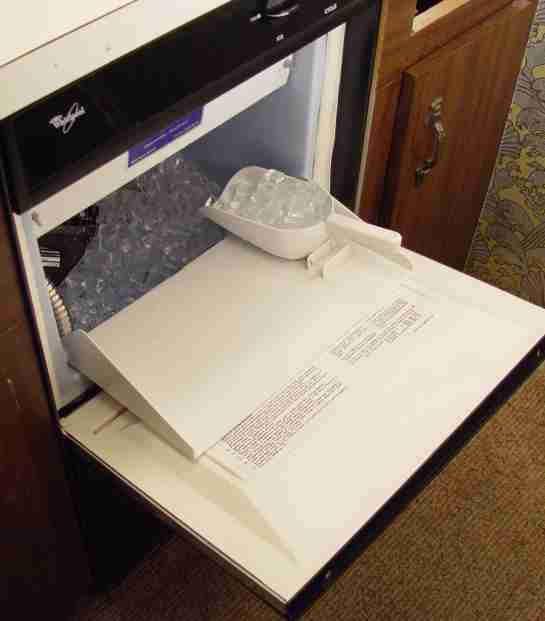
If I was building a house or remodeling from scratch, I doubt I would install an expensive ice maker - or indeed even an inexpensive one.   But if you buy a house that has one, what do you do when it breaks?

A reader gave me a hard time about replacing the ice maker in our house.   It broke and broke bad, and I would have to replace it or decide to do something else.   I figured there were a limited number of options I had:
1.  Leave it broken.   I could just leave it where it was, unplug is and disconnect it from the water line (or even not do that) and have a non-functioning appliance in the house.   Some folks take this route.  The power window in their car breaks, and they decide to live with a window that doesn't go up and down anymore.  Real fun to be behind them at a toll booth.

This is the cheapest option, but when you sell the house (or the car with the broken window) it says volumes about how the previous owner treated the place (or car).   If this is broken, what else is?  And no, saying "you can fix that" doesn't make it right (run away from people selling stuff and saying this).

Plus, it just lends a general air of crappiness to your house (or car, boat or whatever) when stuff is broken.  And over time, you'll have more and more broken stuff, and pretty soon you are living in (or driving) a shit hole.   So this is not an option for me.  I don't "live with" broken things.

2.  Install a cabinet.   I could just take out the ice maker and install a cabinet in its place.  But since the cabinets are custom, this means I can't just buy a matching cabinet at Lowe's and install it myself, but would have to hire a cabinet maker to build and install one, and even then, it would not match and look awkward. 

Again, you can patch something together, but this is a house we are talking about, not some trailer hovel.   The other alternative is to rip out the whole bar and install all new cabinets, and start over.  Of course, this means removing the countertop, back splash, cabinets, etc. and staring over, and then re-painting and sheetrock repair and a bit of construction mess.   Lots of labor and probably just as expensive as replacing the ice maker.   And for what?  To get rid of something.

Some folks do this.  The generator fails in their boat, so they tear it out and say, "Pre-wired for a generator" when they sell it, instead of "generator broke, so I threw it overboard".   I guess it is one approach, but again, sort of adds to the crappiness factor, and also isn't saving much money.  In fact, you are spending as much to have less.

3.  Go to a cheaper ice maker.   Again, most "cheaper" ice makers are 15" wide, leaving me with a 3" gap to fill.  Either I have to try my hand at finish carpentry or find someone to fill the gap (a finish carpenter) and pay him to do it.   The price "savings" over the stock unit evaporates quickly, and if the gap-filler isn't done right, it looks like crap.   This also means more effort and work as well.

Cheaper is what you pay for, and reading the reviews of these off-brand ice makers, I realize that many of them might not last even the 12 years the Kitchenaid did.  So am I being penny-wise and pound-foolish?   Also, all of our kitchen appliances match (white, Kitchenaid) and again, this is a house we are talking about and again, the crappiness factor.  Mismatched appliances in different colors of different brands can detract from the perceived value when selling the house.

With the added cost of putting in a patch panel, I am not sure this option is cheaper, either.

4.  Repair the old one.   Sadly, the refrigeration circuit is shot on this one (corrosion ate through one of the copper lines) so it is not feasible, or at least cost-effective to repair.   I found a used one online that "needed work" but it was sold before I could snatch it up.  I could have used the parts from mine to fix that.  But again, appliances last about 10-15 years, and used appliances, like used tires, don't last very long, so while it would have cost less, it wouldn't have given much service.  If I was selling the house next week, maybe.   But we plan on staying here another decade at least (God willing).


5. Buy the exact same damn thing and be done with it.   While this initially seems "more expensive" than the other options, it ends up being on a par with nearly all of them in terms of cost, and in terms of labor and hassle, far less.   Make one phone call, order the damn thing, and they show up and put in back in, and the bar looks like new and we have another 12 years of ice.   No patch panels, no construction zone, no off-brand item for 2/3 the cost (but half the service life) - no worries!

If you look at the decision matrix here, the best option is to try to find a used one to install, which I was almost able to do.   Failing that, the second best option is to just replace it.  Re-doing cabinetry is opening up a whole new can of worms and starting a major construction project.  Leaving dead appliances in the house is not an option for me.   I don't play that way.

Now one reader, who sometimes seems to be trolling me, said, "why not buy bags of ice?  They are only a couple of bucks a bag! and they last a week!"   I am not sure how to parse this.   I would use more than a bag a week, to be sure, and at couple of bucks a bag, we are talking $104 a year, or well over $1200 after 12 years, without the convenience of having ice at hand (buying ice and bringing it home before it melts is problematic).  Like I said, I think he was trolling me.   Lot of that going around these days.

The standard ice maker in the refrigerator, which makes u-shaped pieces of ice is acceptable for most uses, but the ice is cloudy with air bubbles.  By the way, it isn't hard to add one of these ice makers to most standard refrigerators, and they are not very expensive.  We installed one in our condo and it worked well.   As I recall, it was about $50 plus the installation kit (tubing and water tap).   This is obviously the "stingy" option for making ice.   But it isn't clear ice.

It is hard to explain, but "clear ice" works much better for beverages, particularly the shaken  variety.  This is the kind of ice you get at a restaurant.  And yes, ice makers in restaurants are very expensive and break down pretty often.   Again, all that water spraying around leaves deposits.  Having a clear ice machine is a luxury, yes, and again, I would probably not have installed the machine if I was doing the initial remodeling.   But since it's there, well, might as well use it.  And living at the beach, we tend to go through a lot of ice.  Trying to get rid of it is almost as expensive as replacing it.

So I made the decision to replace it.  Of all the alternatives, it was the least hassle and is a "plug and play" solution.   It is like when a part breaks on your car.  You can buy the standard replacement part and know it will fit and give good years of service, or try to use some fancy aftermarket part that will cost you more, have fitment problems, and perhaps not even last as long.   Just stick with stock, we know it fits, and we know it works.


UPDATE:  A reader writes that I should have just left the dead ice maker in place or "just put in some shelves or something" which I might have done in a lesser home.   But this is a half-million-dollar vacation home on a resort island, not a college dorm room.   Also, although we plan on moving from here eventually, you never know when you may have to move.  So leaving a gaping hole in the cabinet isn't really "saving money" as we'd have to either replace the icemaker or put a new cabinet in before selling the house.   A house with a lot of broken crap in it is not going to command a very good price.

Sunday, November 5, 2017

Overwatering Your Lawn (The Lazy Man's Lawn)

Overwatering or a sprinkler leak can turn a manicured lawn into a waterbed.

It has been a number of years now since we fired our lawn service and decided to take a less aggressive approach to lawn care.   And oddly enough, the lawn looks better than it ever did.  The lawn care guy was killing our lawn with over-mowing.

Of course, some folks said we should just spray the lawn with poison, kill all the grass, and then pay thousands of dollars to have sod put down, along with thousands more for a sprinkler system and a shallow water well and pump system.   We would have a golf-course like lawn, but it would be totally fake like the one shown above.

The video above shows what is known as a "lawn bubble."  What causes these "lawn bubbles"?   If you search YouTube you will see a lot of videos of them.  People put down sod, usually on top of "landscape fabric" and then install a sprinkler.  They douse the whole thing with herbicides, pesticides, and fertilizer - it is more of a laboratory experiment than a lawn.   When a pipe bursts or leaks - or you just overwater - the lawn bubbles up like a carpet, which really, is all it is.   It is not part of the landscape, just resting on top of it.

My neighbors have elaborate sprinkler systems and shallow-water wells and their lawns look good.  They hire "GreenLawn" or some such company (one neighbor hires two of them!) and they spray, spray, spray for bugs and weeds, and of course they fertilize too.   My neighbors also water - all day long.  Often they have each circuit or sprayer go for an hour or more until the lawn is saturated.   Of course, since we live on a spit of sand, the water simply soaks into the ground, taking all that expensive fertilizer, pesticides, and herbicides with it (and poisoning the environment).

There has to be a better way.   And I think I found it.

First, I researched our grass.  We have centipede grass, known as the "lazy man's grass" as it doesn't like to be cut too much.   It also doesn't like traffic, and our lawn guy had a zero-radius mower the size of a Geo Metro.   Driving on this kind of grass kills it (it kills most grasses, actually) and when he made zero-radius turns mowing the lawn, he left "divots" about the size of a dinner plate.  He was slowly turning our lawn into a sand pit.

And since they used leafblowers to blow all the clippings, leaves, and pine needles to a huge pile by the road, they blew sand all over the place, including into our screen rooms.   He created more work for us, not less.   And that enormous pile of "clippings" represented nutrients lost from the soil.   We fired him, or more precisely, he fired us, when I told him that mowing sand was kind of pointless.

I bought a Honda lawnmower for about $250, or the cost of five mowings.  Almost right away, the lawn looked better.   Since I wasn't doing the equivalent of driving a car on it, the grass started to grow back, the centipede grass sending its trademark tendrils across the sandy wasteland.   And since we could mow only when we needed it, we could let the grass grow longer (and set the mower at the highest setting) both of which are things most grasses prefer, particularly centipede.

We did end up buying a cheap electric string trimmer, but we use it only three or four times a year, as opposed to every other week as the lawn guys did.   They tended to over-trim, particularly around trees and plants, and girdled more than one ornamental tree or shrub in the process.   Having control over the process and actually doing a good job made a difference.

Rather than bagging the clippings and dragging them to the road (an onerous task) we just let the mulching mower do its thing - mulch.   The lawn doesn't get "thatched" or anything, but rather looks fuller and richer that ever before.   The soil, after several years, is now a rich black color, whereas before it was basically grey sand (if you dig down a few inches, however, you still get sand).

The pine needles we raked up and I ran over with the lawn mower, making a nice mulch for the shrubs and trees.   I later bought a shredder and if I put the shredded pine needles from the lawn mower through that, the combined shredding action reduces the volume by about 3/4 and makes a nice fine mulch which looks attractive.   Some of my neighbors spend hundreds of dollars each year on pallets of bark mulch, which tends to attract ants and termites.  Pine needles are free (some folks actually pay for them in huge bales, though!) and they tend to repel bugs and also the acidity chokes off weeds.

Oh, yes, the centipede grass loves acidity.   So it's all good.

I tried initially using "Southern Weed 'n Feed" on the lawn, using a spreader bought at a garage sale.  What a mistake that was.   It turns out, the "Weed" in the Weed 'n Feed thought that centipede grass was a weed.   So I was basically killing off my lawn every year, for three years in a row.   Less is more and we found that fertilizing maybe once a year was sufficient.   In fact, centipede grass doesn't like to be over-fertilized, as it will start to grow on top of itself if you do.   As for bugs, the only thing we use, occasionally, is some red ant granules.  If you've ever been bitten by even one red ant, you know why.  And if you have pets on your lawn....

For the most part, we don't need to water.   Although centipede grass is not very drought-tolerant, it doesn't seem to need to be soaked with water, either.  Someone lazier than I must have planted it.  We do have a dry spells now and then, so I bought a simple battery-operated timer and used some old garden hose and some sprinkler heads (on sale for $2 each!) to cover most of the lawn.   I have it set to water for five minutes a day, twice a day, but sometimes I shut even that down, in the rainy season.  In the summer, when we are away, we turn the water off entirely.  The timer has a rain sensor, so it doesn't water if the ground is already wet.

If you do water, it can jack up your water bill a lot, mostly because you have to pay sewer for each gallon of water you use.   That's why my neighbors dug shallow-water wells - to avoid higher water bills.   But the shallow-water wells are very brackish, and thus tend to leave stains on your driveway, house, sidewalk, car, garage door, and anywhere else they overspray.   In addition, the brackish water tends to clog the sprinklers over time, so it creates a maintenance nightmare.

I find the sprinkler heads thaat I use tend to clog even with tap water, but if you soak them in a bucket of Dollar-Tree rust and scale remover (and water) for an hour or so, the scale goes away.

We've added some shrubs and plants over the years.  The house came with some hastily planted "curb appeal" plants that all died within a year or so.   We left it blank for a while, and it started to look like an abandoned house.  So we added some shrubs along the front and mulched with the shredded pine bark. 

During the summer months, we do have a local guy mow the lawn if we aren't here.  He had a ton of "Elephant Ear" plants he had ripped up from another client's house, and asked if we wanted them.  He planted them under the magnolia tree, and they have taken off.  Deer don't eat them, either.   We've added some more plants - usually old houseplants that will also grow here outside, or plants that some restaurants and hotels were throwing away while remodeling.   You did read the name of this blog, right?

I bought a cheap drip irrigation system ($15) on eBay and put it on one circuit of the timer.   The plants are doing well and we have a nice verdant green-garden in the front near the new screen room.   The birds seem to really like it, and during the winter, it can be quite a bird-fest out there with several feeders, and yes, sometimes a twirl-a-squirrel.

After several years, the centipede grass has grown almost all the way across the lawn. There are still some stubborn spots that seem to defy growing anything.  But in the winter months, we overseed with rye grass, and the entire thing looks like a green carpet.   This is not very expensive, and otherwise, the centipede would turn brown over the winter (like Zyosia grass) which is the time when we are here the most.

It's funny, but one day, someone stopped by and said, "Gee, your house really looks great!  Your lawn is fantastic!"  And I never thought about it, but it was looking a lot better.  Not the "abandoned house in the sand lot" that it was when we bought it. 

The house was a rental before we bought it, and the back yard was quite a jungle.  It took several years to pull down all the ivy vines (poison and otherwise) from the trees, some as thick as your wrist.  But today, it looks neat and tidy.  Not manicured, by any extent, just nice.

Again, we could have taken other approaches.  We talked to a "landscaper" who stopped by and said we had to rip up the lawn, tear out the trees (and cut down our magnolia!) and start over with a fake lawn, sprinkler system, and specimen plantings - all for a modest cost of $25,000 or so.   Apparently he was used to working on rich people's island, not ours.  This simply was not in the cards.  Not just because of the cost, but because we didn't want a high-maintenance "fake" yard that would require a small army of people to mow it, spray it, and fertilize it - as well as maintain the sprinklers.   It was also a look we really didn't like either - making a house look like a golf course or country club.

Of course, a lot of people like that look.  Drive through any godforsaken suburb in the country, with the mini-mansions lined up one after the other, each having its own Mexican lawn care company with a ratty landscaper trailer, and they are mowing, blowing, and raking up.   (I wonder what happens to suburban America when all these folks get sent back by Trump?  Will people still believe in "Trumpism" when it costs $200 to get your lawn mowed?   Wait and see...).

It is a look a lot of people like - antiseptic, sterile, cold, professional, expert, upscale.   It isn't real, though, any more than the "gourmet eat-in kitchens" are used for anything other than re-heating restaurant meals in the microwave.

I think we have found a happy medium between the manicured look and the vacant lot - for a lot less money that paying a yard service to mow the lawn.   But it does require some effort, which is a good source of exercise.

Saturday, November 4, 2017

Novelty Acts


We seek novelty in our lives to distract us from our routine mundane existence, where nothing seems to change much.  But it is this mundane existence that actually accomplishes things over time.  Successful people eschew novelty in favor of the continued slog.

Further to my previous posting about logical versus emotional thinking, it occured to me that one distinction between people who are proactive and successful in life and those who are depressed and merely consumers who fritter away their money, is the pursuit of novelty.

Getting ahead in life and becoming successful often takes years, if not decades of hard work and sheer boredom.  Oftentimes it is said that people who are very successful  perhaps have mild autism or Asperger's Syndrome or some other mental affliction which allows them to concentrate on one thing for long periods of time. They are not so easily distracted by the frivolous or by novelties, as so many of us are prone to.

Most of us get bored and depressed after doing the same thing over and over again, like working at a job, paying off a mortgage, and trying to save up money.  So we seek out novelty.  We seek out the latest fashions, the latest music, the latest television shows, the newest movies, the new releases, the new novels, the new celebrities, the drugs, the alcohol, the parties, the in-group, the new tattoo, the new piercing, the new trend - whatever.  We seek out distractors.

We do this to anesthetize ourselves against boredom and depression.  We want to keep up with what's going on in life, so we stayed glued to the television, plugged into our smartphones, the internet, or whatever, to see what the latest trends are.  And before there were smartphones, the internet, or cable television, we watched regular television, or listened to the radio, or read the newspaper, or interacted in some other way to see what the latest trends and fads were.  So much of the "news" for example, really isn't useful information to you personally.  Yet we all feel a need to "keep up" with "what's going on" in life - or what we think of as life.

This struck me the other day as I was mulching our planting beds around the house.  About  once a year, I rake up all the pine needles that blanket our property and shred them with a lawnmower and then shred them again with a leaf shredder to produce a fine mulch.  Having raked up these areas, I carefully reapply that mulch so that it looks nice and keeps down the weeds and insects, and also maintains moisture in the soil.  It is a tedious process and after 3 or 4 days of it, one gets bored and just wishes it was over.

And for many people, such projects end there.  Half-hearted attempts at projects that are started but never completed.  We get bored and distracted, and decide to finish things "later" but we never return to them.  The person who sees it through and keeps going, day after day, week after week, year after year, is the one who is successful.  For most of us, we abandon projects when we see only incremental advancement over time.  We lose interest and move on to other things.

I alluded to this before, noting that many young people put $500 into an IRA or 401k account, and by the end of the week if they're not billionaires, they get discouraged and decide to do other things with their money.  I say this half-jokingly, but I recall vividly when I was in my twenties feeling that very same way.   I had a very tiny amount of money saved in my retirement account and it wasn't growing in leaps and bounds overnight, so I got very discouraged.  I bought a motorcycle instead.  That $2000 would be about $29,948.92 today, if invested - or about a year earlier I could have retired.

(And as an aside, I could have bought a used motorcycle for cheap and fixed it up - after all, fixing things is something I can do.   But I had to have a brand-new one, right?).

But of course, if you keep putting money into savings, day after day, month after month, year after year, decade after decade, eventually it adds up to a nice pile of change.  But this requires a long attention span and the ability to endure boredom and what appears to be stasis for long periods of time.

I didn't become a fairly successful patent attorney overnight.  Rather, I spent over 30 years in the business, writing and prosecuting literally hundreds and hundreds of patent applications during that time period.  I probably wrote or prosecuted over a thousand applications in my lifetime or at least it seems that amount.  I know that for one customer alone, I wrote over 300 patent applications.  So 1,000 cases isn't too far off.

This didn't happen instantaneously or overnight.  It took a long time to build up the expertise and get the training to learn how to do these things.   And it took a long time to earn a significant amount of money, as each year the amount of money I earned was often spent on overhead and expenses as well as living expenses.

Many of us - and I'm including myself, particularly I was younger - don't have the patience for this.  We invest a little money and don't see it growing into a billion dollars overnight.  So instead of saving up money and trying to build real wealth, we instead fritter away our money to buy the appearance of wealth, so we can kid ourselves that we are becoming wealthy, when in fact we are just spending money.  So we go out and buy the latest fashions, the latest cars, the trendy house in the trendy neighborhood, the latest tattoos and piercings, attend the latest shows and concerts, and do all the "in" things, that are seen at the in clubs and bars.  It is instant gratification and the appearance of wealth but not actual wealth.

If you read the biographies of famous men and women throughout history the one thing that seems to be consistent across the board is not that they became really wealthy overnight, but that they spent long hours, days, weeks, months, and years working at projects, before they were finally recognized for their achievements.

Ernest Hemingway didn't win the Nobel Prize for literature after writing his first short story, but rather toward the end of his career.  And the same is true for Bob Dylan if you think about it.  Achievement takes time and effort and doing the same thing over and over again for years on end.  And perhaps today, more than ever, we are less and less prepared to go through this.

Some of my readers - and I use that term loosely as they apparently don't read anything I have to say - write to me wanting to know how to get rich quick.  That Zuckerberg fellow became a billionaire overnight, right,?  That's how it works in this new "dot.com" internet smartphone era, where people become billionaires before the age of 25 - or so it seems, anyway.

You just need to invest in the right thing or invent the next gizmo.  Buy a few Bitcoins and become a millionaire in a matter of minutes.  The idea of slogging through life, working hard, setting aside trivial amounts of money, and hoping they accumulate, is just old-school nonsense which is irrelevant in this modern day and age.

Or is it?

Granted there will always be one or two people who get struck by lightning and become fabulously wealthy overnight, such as lottery winners.  But these are the exception, not the rule, despite what people tell you about the internet, or smartphones, or apps, or social media being the "new paradigm."  Most companies and people who are successful become so after slogging long and hard through the years, to develop products ideas and services - and working hard to make them successful.  Yes, even a lot of these "overnight billionaires" actually worked for years, if not decades, to get to where they are today.   Nothing landed in their laps.

And that's basically the long and the short of it.  You can go out and spend a lot of your money trying to appear to be successful, young, trendy and "with it" and have all the latest trappings of our modern society.  Or you can put away a little bit every month and work hard toward a goal which may take years or even decades to achieve, but in the long run will result in the acquisition of real wealth.

Friday, November 3, 2017

What is All This Noise About Pass-Through?

"Our government needs to adopt a pro-market agenda that doesn't pick winners and losers, but it invites competition and it levels the playing field for everyone." Sarah Palin
Is the new tax plan a simplification or just a give-away to certain groups?

The new GOP tax bill is turning into a nightmare.  The idea was to simplify the tax code, which in the abstract is a good idea.  However, there are so many special interests who have a hand in the pie here, each is carving out exceptions to this simplification.   So the new tax bill is just the same old tax code with some tweaking and further complications - doing the opposite of simplification, really.

One issue is tax rates for "pass-through" entities.   A "pass-through" entity is basically a subchapter-S corporation, sole proprietorship, or partnership, where profits are not taxed at the entity level, but instead passed to the individuals, who report them as ordinary income.

I wrote about this before, and how my brother-in-law sort of got into trouble over this.   His accountant argued that he should be able to declare the profits from his subchapter-S home appraisal business as 100% "dividends" or capital gains, and thus avoid paying the 18% self-employment tax.

You see, when you work for a company, you pay Social Security and Medicare taxes on top of your income taxes and your employer matches the Social Security and Medicare taxes.   Back in the day, this was about 9%, so the total came to 18%, half of which you didn't have to pay - directly.   For those of us who are self-employed, well, we have to pay the whole deal.

Table 1. Single Taxable Income Tax Brackets and Rates, 2017
Rate Taxable Income Bracket Tax Owed
10%
$0 to $9,325 10% of Taxable Income
15%
$9,325 to $37,950 $932.50 plus 15% of the excess over $9325
25%
$37,950 to $91,900 $5,226.25 plus 25% of the excess over $37,950
28%
$91,900 to $191,650 $18,713.75 plus 28% of the excess over $91,900
33%
$191,650 to $416,700 $46,643.75 plus 33% of the excess over $191,650
35%
$416,700 to $418,400 $120,910.25 plus 35% of the excess over $416,700
39.60%
$418,400+ $121,505.25 plus 39.6% of the excess over $418,400


Now if you throw in your income tax rates plus your State income tax rates, well, you could be paying 50% or more in taxes - that is, unless you find ways around it.  For me, it was investment real estate and the depreciation deduction, which lowered my taxes and also provided me with a nice investment.   I also had the home mortgage deduction as well as State and local property tax deductions, charitable deductions and all the other "gimmies" for the middle-class that not only give us breaks on our taxes, but direct our behavior.

As you can see from the table above, the self-employed guy making $200,000 a year or so at a high-paying job and living in an apartment - he gets screwed on his taxes - paying close to 50% of his income to the government.   And now you know why houses in the bay area are so expensive - all those Google and Apple employees with six-figure incomes need deductions to offset their taxes.

Getting back to my brother-in-law, his tax advisor ended up going to jail.   You see, while the tax code is all in black-and-white, there are grey areas when interpreting any text - even the Bible.   So different accountants have different theories and different ideas.   And the IRS doesn't have the time or money to audit everyone.  So as long as your theory looks reasonable, chances are, it will fly.  Well, at least for a while, anyway.

My brother-in-law didn't go to jail, but he discovered later on in life that the lies told to him by Republicans since 1960 were just that - lies.   "Social Security won't be around when you're ready to retire!  We might as well abolish it!"   They still try to sell this story today.   Well into his 50's, he figured out that Social Security will be around and since he was not paying Social Security taxes, he would not get any of it.   So late in life, he struggled to report 40 quarters of income and now he gets at least the minimum amount.

For most wealthier people, this aspect of pass-through is not really very relevant.  You only pay social security and medicare taxes on the first $110,000 or so of income (a regressive tax) and when you are in the $500,000 level of income, well, maybe that is less of a concern.   Still, it does save you quite a few bucks, even though it means you don't get Social Security later on when you retire.   But maybe that is part and parcel of this plan - to "starve" Social Security of cash to "prove" it is broken.   Sort of like pulling the legs out from under Obamacare to "prove" it won't work.  But I digress again.

So what is this obsession with "Pass-through" accounting?   Kansas passed a law basically exempting state income tax for people with pass-through entities.  The result was, of course, that everyone created a subchapter-S corporation and no one paid any state income taxes, which has bankrupted the State.  The only people who paid state income taxes there were the poor middle-class bastards who had salary jobs and could not posit themselves as "contractors".   Yes, the very rich got a huge tax break, and the middle-class got screwed.   Expect more of this in the current tax bill.

In a recent article in Bloomberg, is this interesting quote:

House Republican leaders cite the example of a lawn care business owned by a married couple that brings in $500,000 in profits a year. The pass-through provision, along with the elimination of the alternative minimum tax, should allow this couple to cut its current tax bill of $128,000 by about $25,000, according to a statement issued by the House Ways and Means Committee.

Now, if my lawn care guy is pulling in $500,000 a year, then I am paying way too much for lawn service (He charges $45 to mow the lawn when we are away, I do it myself the rest of the time!).  I suspect their hypothetical is someone who runs a huge company that hires dozens of illegal Mexicans to run those leaf-blowers.  If so, well, they will need this tax break when all of their employees are deported, as they will be.  But I digress. 

The problem is twofold.   First, there is no logical reason why someone who has a business and is self-employed should get a huge tax break just for being self-employed.   This whole thing plays into the false narrative that the GOP uses that employers will hire more people if their personal income taxes are cut.   This flies in the face of logic.  You hire people to make money, and their salaries are business expenses which you don't pay taxes on.   If you can make money by hiring someone, you do it, regardless of your personal income tax burden.

The GOP argument would be akin to saying that people would work less if their taxes go up, and they will work more if their taxes are lowered.   Actually,  the opposite may be true.  If you need more money to pay your taxes, you might think about taking that second job.

But the second part of the problem is that this pass-through is selectively applied based on what kind of job you do and thus creates a whole new layer of bureaucracy, where people will have to sit down and come up with lists of activities that qualify for pass-through and how much pass-through they get.  And that's why a lot of Republicans and business people don't think this tax plan is a good idea, or indeed any form of simplification or reform, but rather just a "gimmie" to very wealthy folks.  From the same Bloomberg article cited above:
That’s why the National Federation of Independent Business, a small-business lobbying group, says it opposes the House bill. “We think the benefits [of the new pass-through rate] should extend to all small businesses,” said spokesman Jack Mozloom. In addition to offering lower preferential rates for smaller businesses, Mozloom said, the bill shouldn’t make distinctions between professional service providers and other pass-through businesses.
“We think that’s bad policy, picking winners and losers based on what they do,” he said. “We certainly want manufacturers to get a tax break, but we want their accountants to try to get a tax break too.”
Picking Winners - a phrase the GOP has used to damn Obama and the Democrats in the past, as exemplified by the Sara Palin quote above.  Actually, if you Google the phrase "government picking winners" you get a plethora of quotes from various GOP notables and wanna-bes who barf-up this line - and then go out and pick winners, usually from the coal and oil businesses - or whoever else donated to their campaigns.   Act shocked - but don't think the Democrats do things any differently.

True tax reform or simplification would provide the same tax schedule for everybody and eliminate as many behavior-directing deductions as possible.   Your tax rates shouldn't be determined by how clever an accountant you can hire, whether you have a subchapter-S corp, or whether you can afford to litigate with the IRS.   And your taxes shouldn't be offset by inducing you to perform certain behaviors, like buying rental properties or even your own house or saving for the future - things the middle-class gets juicy deductions for, but the poor can't take advantage of.

That would be the Libertarian view, anyway - a value-neutral, simplified tax code that applies equally to everyone.   And it is a fantasy, because the folks with the money are the ones who sway elections (that and the Russians).   And that is who is going to write this new tax code - if it has any hope of passing at all.   Given how many disparate factions are demanding their own little set-asides, though, perhaps it will go as far as abolishing Obamacare, the Wall, and the Muslim ban.

Dramatic changes based on pet economic theories are hard to get through Congress.  And maybe that is a good thing.

Wednesday, November 1, 2017

Obamcare is Badly Done - But the Alternative is Worse!


Poor HTML, crashed sites, poorly worded letters and documents - the Obamacare system has its flaws.

I recently received notice from Blue Cross of Georgia that my premiums for health care would go from $18 a month to $675 a month (!!) for a total unsubsidized premium of about $2000 a month. 

Ouch.  I nearly had a heart attack.   But as it turns out, it appears the letter was wrong.

I went on the healthcare.gov website to check for alternatives, and it turns out the Blue Cross people were applying last year's subsidy to the new premiums.   Turns out this year, we may qualify (MAY - we won't know until we file our taxes in April 2019!) for a subsidy of up to $2000 a month.   So the total cost per month is about two bucks.

Of course the site crashed twice and when I clicked on "return to Blue Cross" it bombed out.  I finally re-selected my existing plan in the "marketplace" and it renewed it - I guess.  I have to make that $2 payment before December 15th for the plan to kick in, and Blue Cross is suppose to "contact me in a few days" to arrange payment.  It is all badly done, and if you are not astute and can read pages after pages of documents, you may end up not getting coverage even when you think you have.

But $2 a month sounds great, doesn't it?   Well, it is, so long as you, the taxpayer are paying for other people's health insurance - like mine.   And it is great so long as I keep my income very, very low, like under $40K a year, which isn't hard to do if you aren't working.

But although it appears I am getting a freebie here (and again, I won't know how much of one until I file my taxes in 2019!) I am cognizant that this is very, very expensive health care, and something is wrong with this system.

We ran up about $7000 in claims this year, due to two hospital visits.  This cost us $5000 out-of-pocket.   As it turns out, both visits were probably unnecessary.  I passed my caterization test with flying colors - well, adequate colors anyway.  The net result was I was in typical shape for a middle-aged man who spent the last 30 years behind a keyboard.  And no, we don't have a band.

The second was for a CAT scan, because the emergency room nurse practitioner was concerned that maybe my diverticulitis attack was appendicitis (it wasn't) and the old standby of antibiotics and predesone fixed me right up in a day or two.  These were things my late doctor could do for one $75 office visit.

Others, of course, have even greater medical needs.   Besides people who are really, really sick (cancer patients, motorcycle accidents, whatever) there are people who are just uncomfortable.   A neighbor complains they can't sleep at night, so they go to a "sleep lab" to sleep in front of technicians overnight (I am sure that wasn't cheap) and are prescribed a CPAP machine which they use on and off until they get bored with it.

Others are merely depressed and imagine illnesses.  They drink to relieve stress, get depressed, and are put on anti-depressants and Ambien.   One neighbor binge-eats ice cream at night, while in an Ambien stupor - finding the evidence the next morning, but no recollection of having eaten it.   Bizarre.

And then there is the opiate crises.   People show up in the emergency room and demand pain killers - as happened while I was in the fisherman's hospital in the thousand islands.   The fellow next to me complained about back pain, but didn't want any sort of actual treatment, just a script for pills, Doc, I have to get back to work.

The weird thing about the opiate epidemic is that unlike other drug problems in the past (cocaine, crack, heroin, etc.) the drugs are being sold legally through doctors, and then the cost is charged to Obamacare.   We've taken the illegal drug-abuse market and taken it mainstream.    People aren't getting their "fix" from the local drug dealer in a "shooting gallery" but rather at the pharmacy at Wal-Mart in tidy little pills.   Well, at least initially.  It seems most progress to shooting up, over time.

The problem with Obamacare was that the plan basically says, "send us the bill" and so doctors and hospitals do just that.  There is no incentive to cost-cut or ration medicine, and indeed to even suggest doing so is to be considered a heartless cruel bastard.

My cardiologist/GP wanted this catheterization deal because he "didn't care about costs" and "never looked at bills".   I certainly did when I wrote that check to him for five grand.   I hope he buys another carbon-fiber bicycle with it.   The deal is, of course, that since I failed the stress test, he had to run the other test, or be accused of malpractice.   If I keeled over dead in the next 1-6 months, my heirs could come after him for not running the catheterization.

The same is true of the emergency room nurse practitioner.   A patient comes in complaining about intestinal pains, well, you'd better be sure you know what is going on.   If my appendix burst and I died, the hospital could be sued.   So it is a "better safe than sorry" kind of deal, but these tests aren't cheap, of course.

And since Obamacare pays - and pays a lot - there is little incentive to cut costs.   In the long-term, these subsidies will probably go away - perhaps sooner rather than later.   And when that happens, well, most Americans can't afford $2000 a month for health insurance, and will allow their plans to lapse.

For those covered under employer health plans, well, now you understand why wages have been stagnant for a decade or more.   They are paying a lot more to employ you these days - you are just not seeing that in terms of your paycheck.  Rather, your benefits, which appear to you to be staying the same (or getting worse) are costing more and more.

Eventually, something has to give.   The health industry is already a huge chunk of our GDP.   If it starts to dominate our economy, well, we will stop actually making things and end up just treating each other for illnesses, real or imaginary.