Thursday, March 10, 2022

The Contest Mentality

You have won a contest you never entered! Click here to WIN!

Like anyone else I get SPAM messages.  Gmail is remarkably effective in filtering them out, though.  However, after a week or so, the SPAM box is filled with dozens of messages.  You can either let them accumulate - they self-delete in 30 days - or periodically dump the SPAM.  It is interesting to see what angles they use to try to trick people into handing over credit card numbers and other personal information - a process known today as "Phishing".

Online Casinos that don't exist tell me I "won" $9456.17 (a very exact amount!) and I just need to "Click Here!" to claim my winnings.  All they need is my bank account number to credit my account!  Of course, they can debit it the same way.

But an alarming number of other messages are related to contests, drawings, or prizes associated with surveys.  These messages tell me I "won!" a contest I never entered and once again I just need to "click here!" to claim my prizes.

It is an interesting gambit and illustrates how the poor obsess about contests and prizes.  40 years ago, I rented a room in a bad part of Flint, Michigan (which is to say, Flint Michigan - there are no "good parts").  One of the fellows there was obsessed with the McDonald's "Monopoly" give-away.  He would go there every day and order a small fries or a coke to get a game piece or even dig them out of the trash.  He collected them over time and was always just missing one piece to get the prize.  "If only I got Boardwark, I would win a million dollars!" he said.  But of course, the gag was, they gave out a ton of Park Place coupons, but only one Boardwalk piece for the entire United States.  He wasn't a very bright lad, I'm afraid.  He thought he was this close but was in fact, a thousand miles away.

Of course, marketers use our fascination with contests and surveys to induce us to spend more.  If I am nice to a Walmart cashier, they hand me the receipt and say, "There is a survey link on the back of the receipt! Complete the survey and enter for a chance to win $1000!"  If I am surly they don't mention this - their performance appraisal is based on the survey results.

What they want is a perfect "10" on the net promoter score and nothing less than that counts - or counts against you. It is sad, but not only managers, but individual employees are victimized by these surveys, which are baited by contests.  I mean, it is hard enough doing a retail job as it is, but you have to dragoon customers into answering surveys to get your next raise?  It isn't fair.  What's worse is guilting the customers into answering surveys - the old, "buy this magazine or we shoot this dog" routine.

That's bad enough.  But these register receipt "surveys" make it all that much easier for scammers to convince the plebes that they "won" the WalMart or Home Depot or Lowes survey contest, and then get them to click on some dreaded link.

Yet other contests - like those entry forms you used to see in the lobby of a restaurant - just sell your name to a timeshare company or a scam cruise line or worse yet, authorize them to "slam" a service on your telephone.

Contests are for losers, and I say this having entered a number of contests over the years.  At best, I wasted a few hours of my life filling out forms. At worst, I spend a few dollars on a drawing.  Only once did I ever "win" a drawing, and that was at a campground (I did win $500 though!).  You can see how the contest mentality appeals to the gambler in all of us - we remember those sweet wins, but forget about all the losses.

Just say "NO" to contests!

Wednesday, March 9, 2022

If I Had a Rocket Launcher....

This Bruce Cockburn song seems quite relevant today.

One lesson Russia is learning from this war - and a lesson we should have learned from the last three or four wars we fought - is that all this high-tech weaponry is fine and all, but airplanes, helicopters, and even tanks can be taken down by one insurgent with a rocket launcher, shoulder-mounted SAM, or a rocket-propelled grenade.

And of course, this is nothing new.  In the waning days of World War II, the Germans armed civilians and even children with the Panzerfaust, which was an anti-tank weapon.  Get close enough to the tank, fire the thing, and if you are lucky, the tank stops in its tracks (quite literally) or catches fire.  It turns out a lot of low-tech weapons can destroy high-tech weapons fairly easily.

We learned in Iraq that our mighty Abrams tank was excellent in taking out the outdated Iraqi tanks in a tank-to-tank warfare in the desert.  However on the streets of Baghdad, well, it fell prey to IEDs and other ambush techniques.

Of course, it helps if outside forces are providing these rocket launchers and other easily transportable, easily hidden, relatively inexpensive and easy-to-use weaponry.  During the Soviet occupation of Afghanistan, we supplied the Mujaheddin with various weapons - through third parties of course - to antagonize and eventually throw out the Soviets.  Stupidly, we failed to learn from this and spend two decades fighting two wars and occupations in Iraq and Afghanistan, killing countless people and squandering trillions of dollars in the process.

Apparently the Russians didn't learn from our examples (Vietnam, Iraq, Afghanistan, among others) or from their own experience in Afghanistan.  You can't occupy a foreign country that easily - the locals will always snipe at you, quite literally.  And that is one reason we handed over control of West Germany to the Germans - even some former Nazis, and Japan to the Japanese.  We realized that an extended occupation would result in a war of attrition, with each assassination resulting in ever-greater reprisals. It just wasn't workable.  And yes, after World War II, there were former Nazis assassinating local mayors and officials deemed to be "cooperating" with the Allies.

If Russia tries to occupy the Ukraine, well, the same thing could happen - and a steady flow of weapons from the West - as is occurring today - would keep a simmering war going for decades.

We spend trillions on the latest fighter jet or the latest new armored personnel carrier or whatever.  But inexpensive handheld weapons or drones end up being far more effective and less risky than expensive mega-weapons.  Many an armored personnel carrier or tank has turned into a fiery coffin for Russian soldiers - and more will do so in the future.  Expensive weapons cost money and can drain the coffers of the invading country - and they are hard to replace on a moment's notice.

The reason why we "retired" the "Stealth Fighter" was that it got shot down.  Yes, some folks in Bosnia figured out how to track un-trackable aircraft.  Funny thing, we like to run down the technology of any non-Western country, but people are amazingly astute at figuring out these things, particularly when survival is at stake. (I got in trouble mentioning how this was actually done, as some consider it "top secret" although there are Patents on it. Let's just say there is a reason invaders attack television towers - and not because they want to take reruns of I Love Lucy off the air).

Sure, you can shoot down a drone.  But drones can be made cheaply enough that you could literally swarm over an enemy and overwhelm them.  Sadly, it seems the trend in drones these days is not toward more and cheaper, but toward bigger, heavier, and more complex and expensive.  This means, in turn, that people are less likely to engage with them, for fear of losing an expensive asset.

By the time this entry is posted (tomorrow) the war could be over, one way or another.  Or it could drag on for months on end.  The reason for the war isn't hard to figure out.   Just as Hitler nibbled away at Europe, taking the Sudetenland, Czechoslovakia, and Austria, Putin has tried to nibble away at Eastern Europe - taking Georgia, Chechnya, and the Crimea.  when Hitler (and the Russians) invaded Poland, people finally said, "enough!" and the world was drawn into war.  I think a similar thing is happening here.  Putin thought he could nibble some more on Ukraine, and if he limited himself to two breakaway territories, he might have succeeded.  But he played his hand badly, and now he has galvanized the West against Russia for some time to come - unless Putin fades away, one way or another.

In the meantime, we'll see more rocket launchers at work.  Let's hope, anyway.

Tuesday, March 8, 2022

Meme Stocks - Monetizing the Qanon Effect


Convincing people of crazy shit online was just for funsies at first.  Then some folks realized you could create political movements and get people elected doing this.  But then the really smart folks realized you could make a shitload of money this way.  This will not end well.

Note:  This is a posting I worked on in December 2021 and for some reason never posted it.  I have hundreds of such ghost posts!  Maybe more later...

The Internet had such great promise. In the early days, it allowed us computer geeks to find information online and buy things for cheap.  It allowed me to work from home - 20 years before the pandemic made people "discover" this.  But then came Facebook, and suddenly everyone was online, usually on a smart phone (an inaptly named device if there ever was - if you weren't dumb before you started using one, the longer you use it, the dumber you will get!).

Facebook and Twitter gave us conspiracy theories.  At first it was stupid stuff like the pedophile pizza shop.  No one got hurt, right?  Well, except the poor owners of that shop and the duped idiot who ended up in jail after shooting up the place.  Thank God no one was hurt or killed - yet.  But then we had Qanon and Donald Trump, whose presidency could be traced to social media, particularly his Twitter escapades and the hyping of his candidacy on r/the-donald and elsewhere. And let's not forget the Russian bot and troll farms that put him in the White House!

The Democrats didn't see it coming.  They still ran their attack ads on television, which no one watches anymore, or if they do, they skip over the depressing ads using a TiVo-type device.   It was like Hillary's first campaign against Obama - she didn't "get" the Internet and thought you could control what people said online - it drove me to the Obama camp very quickly. Sadly, eight years later, she still didn't understand that one posting on Twitter was more powerful than a million dollars of campaign ads.  Sadly still, Democrats still don't get this.  They need their own troll army.  The far-left, however, is doing a good job of this - just check out r/antiwork - they are tearing Biden apart.

But politics are one thing, real money is another.  And someone figured out that if you can influence people online, you can get them to divert money your way.  The Elio fellow promoted his non-existent car this way, and got 20-somethings and even teenagers to send in "deposits" on cars that were never made.  A decade later and he's still taking "reservations" if you can believe that.  But that's small potatoes.

Suppose  you could manipulate stock prices this way - and make real money?  Well, someone figured out a way to do this.  They noticed that short-sellers, who placed options on stocks, gambling that they would go down in value, had "shorted" a lot of brick-and-mortar kinds of businesses that were either dying slowly or were affected by the pandemic. GameStop is a brick-and-mortar company selling video games, consoles, and accessories. They are losing money and closing stores because "the kids these days" can download games online or order them online, often for far less than at a physical store.  It was the Blockbuster Video of computer gaming, or perhaps the Sears (or Photomat?)  It will linger on for a long while, but the writing is on the wall.  So shorting that stock was a no-brainer.

But suppose you could affect the price of the stock so that these short-sellers get screwed?  If the price goes up, then the short-sellers would have to buy the stock at the higher price (which would in turn drive the price up even further) and thus incur huge losses.  Again, when you buy an option, you put down a small amount as a "bet" unless it is a "naked" option.  If the price goes where you think it will, you cash in an amount that could be ten times your "bet" - but you could also lose ten times as much as you bet as well, if you bet wrong.  That's why options are basically worse than gambling and why they are a bad idea for the small investor.  You go to the track, you can't lose more than you bet.  With options you can lose everything you own!

So... how do you manipulate a share price?  Well, in today's retail investor market, there are a lot of small-time players who will throw $100 or $1000 at a stock.   Many think they will get rich this way, or it satisfies their need to gamble.  The folks running this scheme started hyping GameStop stock on Reddit's r/wallstreetbets (aptly named) and got a few hundred or a few thousand or who knows how many clueless people to buy a little GameStop stock, a few shares at a time.

Now, as I noted before, the share price of a stock is the price the last chump paid in, and not an indication of the real value of the company or the shares.  When a lot of people buy a stock, the price goes up - supply and demand.  Sears, Canada stock, for example, went from $0.01  a share to $0.02 a share recently.  That does not mean the value of Sears Canada doubled overnight, only that some chump decided to buy some shares.  Share prices are volatile and do not reflect the real value of a company.  And this is how some folks make a lot of money on Stocks - if they have the real data and are willing to gamble.

At first, the readers of r/wallstreetbets (called "apes" by their handlers) were encouraged to use the "Robinhood" trading platform, which offered free trading.  Robinhood itself was subject to some controversy - how do they offer free trades and stay in business?  As one reader noted, it was because they sold  the trading data to the big firms, who can trade electronically in nanoseconds.  So you put an order in to buy a stock and it is executed in a matter of minutes or hours.  Meanwhile, the big trading firm has that data and in less than a second, bought shares before you did - and maybe even sold them to you!

But the Robinhood honeymoon died quickly. A number of the "apes" decided to sell their shares at once, and the Robinhood model broke down. They froze sales of "meme" stocks and people were understandably pissed.  A class-action suit ensued and people were given a pittance as a settlement.

Undeterred, the puppet-masters at r/wallstreetbets encouraged the "apes" to buy using systems like Computershare, which is nominally a dividend re-investment platform (which for GameStop, which doesn't pay a dividend, makes no sense).   And once again they primed the pump, this time around for AMC (the movie theater company) stock which was also a target of short-sellers.  Wash. Rinse. Repeat.

Of course, there were ulterior motives in encouraging their followers to use Computershare.  First, as a dividend investment platform, it is not really suited to real-time buying and selling of stocks.  So while the people running this scheme can program computers to buy and sell stock (or options) in nanoseconds, the "apes" with their Computershare registered stocks, can only sell in terms of minutes or hours.

Another aspect is that with Computershare, your shares are in your name, and thus cannot be "lent" out to short-sellers (short sellers have to borrow shares to sell, hence the cost of the short, and then later re-buy them before the end of the option period).  In theory, this would prevent short-sellers from "borrowing" those shares, as they are not on the books of a trading house, which in turn would drive up the price of shorting.  But many retail trading houses have noted that they don't lend shares unless the owner borrowed money to buy them.  And others have noted that the short-sellers usually "borrow" shares from the big trading houses, not the small retail outlets.  Yet others claim that if more shares are taken off the options "lending" sheet, the price of the stock may become more volatile - and volatile stock prices make a lot of money - for other people, not you and me.  Myself, I think the reason they are promoting Computershare is to keep people from readily selling their shares and getting a "free ride" on the pump-n-dump.  The puppet-masters want to make sure the "apes" lose it all.

And of course, they promote holding the stock at these inflated prices.  One fellow, who is either a bot or a useful idiot, posted breathlessly, "I'm keeping my [AMC, GAMESTOP, TESLA, WHATEVER] shares forever!"  Which is a good idea as with a P/E ratio that is negative or over 200, you basically have to wait forever to make your money back.  Pump-n-dump schemes, as the name implies are not about buy-and-hold, but rather the buy and dump, once the price goes up.  Again, if you can convince a few idiots that holding their shares is a good idea, so much the better for you, the scheme operator.

The people running these scams made a lot of money - and continue to make lots of money. They bought options that the price of these shares would go up.  And these options were cheap to buy as no one expected the share prices of failing companies to go up.  AMC theaters were closed for months during the pandemic and the company was hemorrhaging cash. The price went up only because all these small investors - a stock-brigading army - bought shares.

When the options came due, the big trading companies were screwed - they bet the price would go down, and now they were on the hook to buy these shares at a much higher price.  The folks rigging this whole deal were sitting in the catbird seat - they made millions, maybe tens of millions of dollars, maybe more.

But what about the "apes" sucked into this mess?  Maybe a few of the more astute ones made a few dollars. But buying one share of AMC and then selling it for double the price isn't going to make you rich.  Buying an option for a million shares on the other hand.... can make others billionaires (but not you, silly!)..

But for the apes?  Consider this sad story - a fellow lost his shirt on stock options.  You can lose more than you bet - which makes it worse that a casino:

For every gains porn post someone out there is on the other end with a loss. I can still remember when the GME runup began. I was so sure it would blow over in a day, and I picked up 10k in 3 month out puts just as GME crested 40 dollars. I remember as it skyrocketed I even found myself up on my position as the I/V grew. But I wanted more and I was so sure it would be back to 4 dollars in a month or two. Lesson one, don't get too smart, and don't fight the market.

Well, a few months rolled by and the expiration on my options was getting close, they had slashed in value down to a third and even though GME had fallen, they weren't worth what I paid for them. I could have cut my losses and been out about 5k. But this is where I made my second mistake. Trading options on emotion. I couldn't believe my puts were priced correctly so I rolled them out a few more months, and aggressively. My position was now 50k instead of 10k. I couldn't let go of my ego and take the loss.

Well, as fate would have it, a few days later GME would rip back up into the 200s. My freshly rolled position, started collapsing, and fast. I remember sitting at work every day, constantly pulling out my phone and staring at the GME ticker, waiting for any drop, hoping to be saved. But, my salvation never came, and my position got worse and worse. Enter my third mistake, doubling down. At this point I was desperate. I wanted, needed, to make my money back, so I averaged down, and averaged down again. My position was now worth just over 100k.

With each passing day, my position ticked down in value. I remember one day so vividly as I saw my losses pile up into the 80k range I noticed sharp pain in my chest. It had been getting harder and harder every day, and the extreme stress was taking a toll on my body. I held on for a few more days, but the pain was getting worse, and I was literally shaking (tm), from the stress. Finally I called it. I closed my position down a total of just over 100k. It was one of the hardest things I've ever done.

As pathetic as this sounds, I remember actually crying several times thinking about what an idiot I was. When you lose that kind of money, and for me this wasn't play money, it takes you to a dark place. I remember ringing in my head over and over, what was I thinking, how could I make such a mistake. It was one of my lowest points ever, and it felt like I would never feel normal again, anyone who has been in my shoes knows what I'm talking about.
So how do these chumps get sucked in?  Simple - these schemes are promoted the same way Bitcoin is (and that is essentially the same scam - a very few people own most of the Bitcoin, and they hype it on the Internet or get Musk or other "influencers" to hype it, and then cash in when the price goes nuts).  Yong people aren't very astute (although some oldsters get sucked into this - the something-for-nothing mentality is hard to shake!).  The puppet-masters put up bizarre posts with lots of confusing numbers and technical-sounding mumbo-jumbo.  If you question any of it, you are shouted down - and voted down - so your "emperor has no clothes" posting disappears from social media, and the rest of the chumps live in an echo chamber.  Everyone seems to agree this is a swell idea!

Sort of like how everyone on r/the_donald thought Trump was great, too. .Echo chambers are dangerous places - for your soul, your psyche, and your pocketbook.

And of course, our two emotional nemesis, FUD and FOMO come into play.  Everyone is making money at this, I need to get into it before it is too late!  Hate to say it, but it is too late, and never was not too late.  And FUD?  Again, anyone who questions the deal is deemed "too dumb to understand how it works!"  But no one asks the question as to how you can make wealth out of nothing, or if this was such a good deal, why are the people behind this telling us about it?  And the answer to the last question is, they need the chumps to drive up the stock price so they can cash in.  A few thousand chumps, each buying a share or two, can move a stock price considerably!

But I suspect a change is in the air and not a good change.  It is inevitable that these schemes eventually collapse under their own weight.  The puppet-masters are trying to move onto new stocks and new "investments" but people are starting to figure out they are just getting burned.

Just as before the collapse of the housing market in 2008, I am seeing more and more skepticism online about "stonks" and "crypto" and a number of other things - including again, the scary-stupid price of housing these days.  Eventually, something has to give.  In 2007 or so, it started with one person deciding that no, a house that sold for $150,000 five years ago isn't worth $500,000 today.  They walked away.  And then someone else did and so on and so forth.  It is an avalanche effect and I've seen it play out several times in my lifetime.

Leading up to the real estate bubble of 1989, commercial investors discovered that you could put up an office building in Washington DC (and other cities) and have it rented out before you even broke ground.  And rents were high - government was expanding under Reagan and Bush, despite claims to the contrary.  So another building went up, this time half-rented before ground was broke but rented entirely before it was finished.  Then another building, this time half-rented by the time of completion.  Finally, buildings went up with no tenants and no prospect of tenants - "see-through" buildings like we saw in Fr. Lauderdale in 2007 and we are seeing in China today.

A cascade or avalanche effect took place.  The tenants were on five year leases for this office space.  The "see-though" building goes bankrupt and is bought for pennies on the dollar.  The new owner rents it out for cheap.  And those tenants who paid a premium five years ago to be in a "new" building, now realize they can move to another new building and cut their rent in half.  Like giant dominoes, these office buildings went bankrupt, one by one, each one triggering the bankruptcy of the next, as falling rents made these buildings unprofitable, until they went through bankruptcy and came out with their liens stripped.

That's the way these things work - like an orgasm, building, building, building, until BAM! - it's suddenly over.  1929, 1958, 1989, 2008, and maybe 2022 (we'll see - timing is hard to predict).  But one sure sign of imminent collapse is when folks start questioning the premise of the whole deal, whether is tulip bulbs or the South Sea corporation.

And I think - really think - we are due for another one.  And this time around, it will be the usual suspects - dot-com companies and real estate.  Again, we have hyped share prices to the point where they make no sense - companies that are losing money have sky-high valuations.  Other companies that are making some money, have P/E ratios in the hundreds and no clear path to increasing their profitability by a factor of ten or more.  And real estate?  Builders are rushing to put up luxury, high-end housing, because those houses are more profitable.  But there aren't enough people to buy all those houses. Meanwhile, demand for lower-cost housing goes unfulfilled.  We may see an echo of the 1989 residential housing meltdown, where min-mansion ghettos were created in outlying places like Woodbridge, Virginia, when no one in their right mind wanted to pay so much for such a poorly put-together stucco "look at me!" house, two hours from work.

Maybe!


Monday, March 7, 2022

Farmers Home Adminstration Home Mortgages (FmHA)

My first house I bought in 1982, using an FmHA loan - not to be confused with an FHA loan!

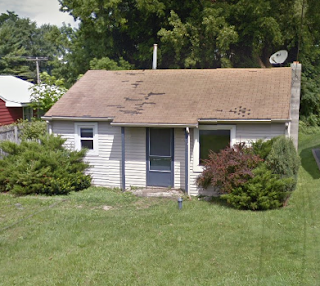
People say they pulled themselves up by their bootstraps, and to some extent this is true - you have to at least make an effort.  But we all receive help along the way in life, from other people and from financial institutions and the government.  And one of the hands-up I received was a Farmers Home Administration mortgage loan on my first house, pictured above (from Google Maps) which doesn't appear to have been maintained since I sold it in 1987.

I was working at Carrier at the time, making $17,000 a year as a laboratory technician and probably underpaid. I was renting at the time and it was difficult to find a place that was reasonably priced, in a safe neighborhood, and a reasonable distance from work.  My boss at work told me about a house for sale in Chittenango for $22,000 which was a lot of money at the time.  Bear in mind that interest rates in that era were double-digit so the corresponding payment was pretty high.

The Real Estate agent I talked to told me about this program through the Farmer's Home Administration - you could get a mortgage and the interest rate would be subsidized based on your income.  If you made a lot of money, there was no subsidy.  If you made nothing, well, you paid no interest at all.  There were caveats, though.  If you sold the property for a profit, you had to pay back the mortgage subsidy out of the proceeds, up to your level of profit.  You could not rent out the property, but had to occupy it as a personal residence.  Every year, you had to fill out a form listing your expenses and income so they could calculate your subsidy.

As I noted before, the government form asked me to itemize my expenses.   One line on the form was for "Entertainment" with a notation in parentheses,  "Bowling,  Cigarettes, etc."  I got a chuckle out of this, as I guess that is how the government thought we lived.  I just put down how much I spent on beer and pot.

As I recall, the monthly payment was like $250 or so, and when I went on leave-of-absence at Carrier to finish my Engineering degree, the payments dropped to $80 a month (!!) which was cheap even then (my car payment was $166 a month, I remember that!).  Of course, when I sold the house a few years later, they "recaptured" the subsidized interest to the tune of $6000 or more and I netted only $5000 from the sale (which I stupidly didn't save!).   Oddly enough, if I had paid off the mortgage, the recapture would not have applied.

There were a lot of things I did wrong there, of course.  I didn't get a roommate and cut my living expenses.  I didn't keep the place up (and apparently neither did the subsequent owners!).  When I bought it, the previous owners were a young couple. He was a woodworker and made custom "knotty pine" cabinets in the kitchen and installed a new stove and refrigerator.  He put in a new furnace, too - with ductwork (it had a floor furnace, which was poplar back in the 1950's).   FmHA insisted I put new siding on the house, new doors, and a new roof, as well as new wall-to-wall carpeting.  The cost of these repairs was folded into the mortgage.  Apparently that was last maintenance done on the house - from what I can see on Google Maps.

The house had been a "party house".  When I told some po-thead friends I bought a house, they said, "Cool!  The house with the tiger mural!"  Apparently before the previous owners lived there, there were some Deadheads occupying the joint, and they painted a huge mural of a tiger walking out of the jungle.  I never saw it, as the previous owners to me had paneled the living room.  But come to think of it, maybe in my younger days I had visited there to buy pot.

But it was a cheap place to live, and it wasn't far from work.  And when I decided to go back to school, well, it provided me with an even cheaper place to live.   The FmHA program gave me a "hand up" not a "hand-out" and because of that, in part, I am where I am today.

Is the program still in existence?  I guess so.  It only applies to rural areas, though, so you can't buy a loft in SoHo using the program.  Also, the program made a lot of sense in an era of 14% mortgage rates.  But today, even with rates going up to a whopping 4%, it makes less sense - rates today are scandalously low- but that is about to change.

But such programs exist - you just have to go looking for them or keep your wits about you.  And maybe in the future, if interest rates climb, well an FmHA loan might make sense!

Sunday, March 6, 2022

The Godfather, Part IV

The real reason Part IV was never made...

I found an old copy of The Godfather at the local book exchange, and it was interesting to re-read this so many years later.  Mario Puzo is quite a storyteller and the book is a real page-turner.  But like with Melville, he doesn't just tell a story, he interjects some philosophy into the narrative.  Consider this paragraph which succinctly describes the paradox of police work:
Hagen understood that the policeman believes in law and order in a curiously innocent way. He believes in it more than does the public he serves. Law and order is, after all, the magic from which he derives his power, individual power which he cherishes as nearly all men cherish individual power. And yet there is always the smoldering resentment against the public he serves. They are at the same time his ward and his prey. As wards they are ungrateful, abusive and demanding. As prey they are slippery and dangerous, full of guile. As soon as one is in the policeman’s clutches the mechanism of the society the policeman defends marshals all its resources to cheat him of his prize. The fix is put in by politicians. Judges give lenient suspended sentences to the worst hoodlums. Governors of the States and the President of the United States himself give full pardons, assuming that respected lawyers have not already won his acquittal. After a time the cop learns. Why should he not collect the fees these hoodlums are paying? He needs it more. His children, why should they not go to college? Why shouldn’t his wife shop in more expensive places? Why shouldn’t he himself get the sun with a winter vacation in Florida? After all, he risks his life and that is no joke.”― Mario Puzo, The Godfather (emphasis added)
You see this all the time in ordinary people - they bitch and complain about cops giving them a speeding ticket for... speeding.  We want the Police to police the other guy, not us.  But when we break the law, we whine and complain about the unfairness of it all, and want a special exception made in our case, because we are middle-class, white, and wealthy.  And in many cases, such exceptions are made - which in turn, feeds the feeling that the whole system is "unfair."  People get the government they deserve.

This quote illustrates how The Godfather is more than just some Mafia story with people getting kneecaps broken or "swimming with the fishes."  Sadly, most Mafia movies are like that - catering to the unnecessary violence that the audience craves and pays to watch.

Of course, The Godfather is a work of fiction, and shouldn't be taken as a serious documentary of Mafia life.  But one aspect of it I found interesting - Don Corleone achieved power not through ruthlessness and murder, but by reasonableness.  His "offer you can't refuse" wasn't an implication that you would be murdered if you did not accept (although that was always in the background) but that his offer was something in your own best interest to the point where refusing would make no sense.  It was better to build up friendships than to accumulate enemies:
“Friendship is everything. Friendship is more than talent. It is more than government. It is almost the equal of family. Never forget that. If you had built up a wall of friendships you wouldn’t have to ask me to help.”
― Mario Puzo, The Godfather
As a result, he built up a lot of friendships.  He had politicians in his pocket because he could get out the Italian vote for them, not because he threatened them with extortion or paid them bribes. And he could get out the Italian vote not because he threatened people in the neighborhood, but because they all owed something to him and felt an obligation of friendship to vote for the candidate he endorsed.  It also meant they would not rat him out if the Police came asking questions.

Now whether any of this is true or not, I don't know.  But it makes a lot of sense - people are motivated more by greed than fear.  You go to someone and make them an offer that will make you rich and them wealthy, they are inclined to accept it.  You make someone an offer that makes them destitute and you obscenely rich, they may fight you to the death (figuratively or literally) as you gave them nothing left to lose.

And perhaps this is where "Don Trump" failed. No doubt he had dealings with the Mafia families in New York, in terms of labor unions, garbage collection, and whatnot. And maybe he fancied himself a "made man" of sorts.  Or perhaps he spent too much time with Russian Mobsters in their Adidas track suits, whose idea of finesse was a broken kneecap.  Whatever the reason, Trump accumulated enemies all along the way, and few friends.  And the few friends he had were friends only out of fear - and willing to sell him out at a moment's notice, particularly as he was so willing to sell them out if it was convenient to him.

The Puzo method perhaps has applications in matters outside of the underworld.   You can only squeeze people so much before they figure they have nothing left to lose, and fight back.  In fact, that is what motivated Vito Corleone to become Don Corleone.  The local "Don" was squeezing him too tightly and he figured out that, like Trump, the Don was all bluster and no real power.  So he took him out - he had nothing to lose in the process.  And in doing so, he earned the gratitude of the people in his neighborhood and accumulated power - not through threats and intimidation, but through favors and friendship.

I noted before that many financial institutions have switched gears over the years.  In the old days, they tried to build up a customer relationship so as to have customers for life and build up a brand loyalty.  But today, particularly with bankruptcy reform, it is more profitable to loan someone so much money they can never pay it back and then utterly ruin them for life.   Why bother grooming a customer for return business when you can just take everything they have right away?  The problem with this model is that it chases short-term gains over long-term profits.  You ruin a customer through predatory lending and you make a lot of money right now.  But if you help a customer, you make money from them over a lifetime - and society benefits as well.  In this era of quarterly profit reports, the latter simply isn't an option, though.

People want to see you succeed in life - smart people do, anyway.  There is not much to be gained by ruining someone completely, as they are no longer a good customer and become a burden to society, not an asset.   And perhaps this is where some folks in the 1% should take note - if everyone in the country becomes destitute because you are too greedy, who will buy your $1500 smart phones, your $100,000 pickup trucks, and million-dollar  mini-mansions?  Who will stay in your luxury hotels or vacation resorts or visit your high-end restaurants?  A solid middle-class is really necessary for any civilization to survive.  And revolutions are not started by the very poor, but by the educated middle-class.

And now you know why the GOP wants to destroy education - as well as the middle-class!