Thursday, July 3, 2014

Smart Phones and Skinner Boxes

The smart phone is the ultimate Skinner box.

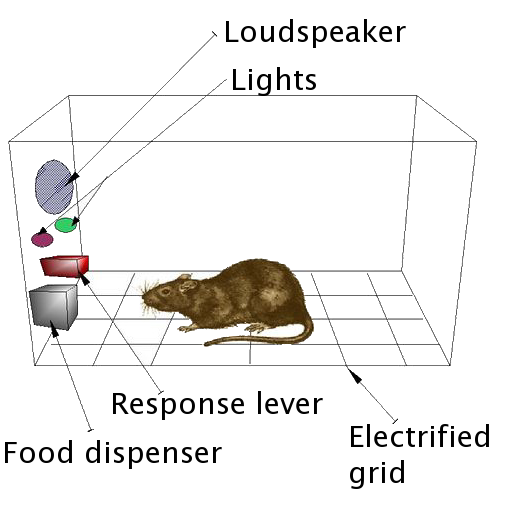
B.F. Skinner experimented with rats in boxes and discovered some interesting things about behavior.   In his experiments, a rat or mouse would be given a reward for pressing a response lever.  Funny thing was, the less often the reward was given, the more likely the rat was to press the lever.   One would think that if you got a reward when you pressed the lever, you'd press it a lot, and if rewards were given rarely by the lever, you'd give up on it.   But the opposite is true.   Skinner's rats would be jerking that lever like maniacs, trying to get that elusive reward.

And if you've ever been to a Casino and seen the ladies in their housecoats jerking the levers on the slot machines (today they push buttons, less effort) you'll see the same effect.   The rewards are few and far between, but they jerk that lever all day long.

Some friends of mine got smart phones recently, and their behavior would make B.F. Skinner proud.   The main use, apparently, for a smart phone, is to locate other people to have sex with.   There are "apps" galore that allow you to hook up with people of the opposite or same sex.   You can even track people in your vicinity, who are interested in sex.   It is an electronic version of the singles bar, and it is quite frightening.

What is interesting is that the rewards are few and far between.   Most people contacted this way, they tell me, spend endless amounts of time sending and receiving texts and making appointments that never amount to anything.  There is a lot of noise and very little signal.   So they spend even more time online trying to find sex, and finding it very rarely.   But occasionally lightning does strike.

And since the reward is there, but very infrequent, they keep texting and scanning and whatever, on their phones, almost 24 hours a day, convinced that if they don't monitor these things 100% of the time, the good ones will get away and all that effort would be wasted, doing dumb things like hanging out with friends or, well, work.

Even for those who are not sex addicts, the smart phone acts as a Skinner box.   I see people obsessively checking their phones all the time.   Someone might be texting them, and if they don't respond right away, the other person will get mad at them!   The person sitting in the room in front of them apparently doesn't matter.   That's just some asshole who doesn't have a smart phone - not even worth talking to, if you can't text them.

And I am serious about this latter point.   If you want to communicate with someone who is smart phone addicted, even if you are in the same room, the best way to go about doing it is to text them.   Otherwise they will just pretend to pay attention, while furtively glancing at their electronic bar of soap.

It is sad, and it is scary, that our entire society is going OCD all at once and not only is no one noticing, everyone thinks it is a fine and wonderful thing.

But perhaps this is just part of a trendline that started years ago.   With mass media, people started listening to records and radio, and by the 1950's radios were in every car, and usually on all the time.  By the late 50's television invaded the home, and watching every night, with a TV-dinner served on your TV-snak-tray, was a new norm.   By the 1960's we had color television to watch, and the family sat around the "tube" every night and watched the same fare as millions of other Americans.

By the 1970's and 80's, we had cable and lots of channels to chose from.   And since every member of the household had their own television, everyone could crawl off to their own cubby and snuggle up with their own shows.   Average tube watching time skyrocketed - with most Americans watching about 4-5 hours a day or more.   That's basically every waking, non-working, non-driving hour.

But apparently that wasn't enough.   The Internet promised to liberate us from the tyranny of television.   But for most folks, the most interesting thing they could think of to do with the largest database in the history of mankind, was to post pictures of their cats on Facebook.

And with the smart phone, the television level of banality can be carried on your hips at all times.   Televisions in public spaces now compete with smart phones for the hearts and minds and eyeballs of America.

And in 10 years, a television in a bar, airport, or restaurant, will seem as quaint and antiquated as a public payphone - and perhaps broken like one, as well.   Because everyone will have their own television, right in their hands - and most do, already.

Obsessive-Compulsive Disorders are detrimental to your well-being and your personal wealth.   Hoarders do not live very long, nor are they very happy, healthy, or wealthy, as they squander their estates on the idea that broken lawnmowers and other junk are valuable.

People who obsessively clean their homes are never very happy people, no matter how well combed the fringes on their rugs are.

And similarly, people who obsessively smart phone - which is about half the population, from what I can see (including drivers!) are not very happy people - or very happy for very long.  They live in a virtual world, where great things are always one text or tweet away, and if they don't stay online 24 hours a day, they might miss that great experience that the smart phone promises - but rarely delivers.

Businesses make money on your obsessions and compulsions, period.   Casinos cater to the compulsive gambler.   Tobacco companies cater to your addiction to nicotine.   Carmakers cater to your obsession with your personal image (as do branded clothing makers, along with a host of others).   Everyone sells status, in one form of another - catering to your obsession to be "special" and "unique", as if your choice of consumer goods could make you so.

The smart phone industry is no exception.   The genius of Apple in developing the iPhone was not in the technology or packaging or even the status-selling of the product.   The genius was in developing a product that had a crack-like effect on its users - that once they use it, they cannot stop touching it, playing with it, and constantly looking at it.  Sort of like an adolescent boy who has just discovered his penis.

Obsessions are not healthy.  They are not good for you.  They are not profitable, except to the people who cater to those obsessions.  When you give in to obsession, you surrender all control in your life to others - and hand them your wallet as well.   You are giving into weakness and making yourself weak and vulnerable.

Suddenly, something that you never needed or wanted before is now a necessity.  And many people view these things as necessities in their lives.  Many people tell me, with a straight face, that having cable television is necessary to daily living - and they cannot imagine living without it.   Once they get a smart phone, they believe that too, is part of daily living and the fabric of life would be rent asunder if they cannot get five bars of 4G service.

The reality is, these vendors are not selling oxygen.   You do not need it to breathe, or to live.   You can do without.   If you cannot, then you are merely choosing to do so.

REMEMBER:  $100 a month, invested at 5% interest, over a 45 year working life, comes to $201,222.20 in your IRA or 401(k) account.   Your savings ARE like oxygen, in that you need them.   Funny thing, though.  Most Americans have nothing in savings, but have 500 channels of cable television and the latest smart phone.

Choices, choices, choices!   Choose not to be obsessive, and you come out ahead.  Act rationally in an irrational world.


A Visit to the AT&T Store

A visit to the AT&T store was a real eye-opener!

I recently got a weird message on my AT&T GoPhone.  We love the GoPhone, as it costs us $200 a year for two phones, which is a lot less than the $150 a month I was spending before.  In cased you missed it, that amounts to about $125,000 in your 401(k) over 30 years - or more!  Smart phones are very expensive to own.

Anyway, the message from AT&T was along the lines of, "Please stop using your antiquated Motorola Flip-Phone, as it is so old, it is slowing down our network!  We'll give you a free phone if you'll just stop using that POS!"

No, really, it said something like that.

But the catch was, we had to go to a physical store, and not get the new phone online.  What a waste of time and money for AT&T.  I could have gone online and just clicked on the phone, ordered it, and swapped the SIM myself.

The free phone (Alcatel) retails for $14.99 so it is about as valuable as a Styrofoam cup.

The offer was timely as my old flip-phone was starting to go south (sometimes going blank when you opened it or made a call) and I had already replaced the batteries on both of them more than once.  Flip phones have one weakness, and that is the flexible connector that connects the two halves.  Over time, it gets flaky.  So a new phone was on the horizon anyway.

We go to the AT&T store and have to wait nearly an hour to get waited on.   But the floor show was fabulous.  It was like the seventh circle of hell, with so many weeping and unhappy people coming in, with all their smart phone problems and complaints.

Very few people were actually buying new phones.  Most were coming in to complain that the service was spotty and that they could not get reception in the Squirrel Hollow Trailer Park.  I kid you not, a knot of rednecks came in, all wearing "duck commander" gear (what ever happened to "duck dynasty"?  Must be some trademark issue, I assume).   They were not really complaining about the service, but were having classic buyer's remorse, having signed a two-year contract for $150 a month (or more) for a smart phone and then realizing they had bought a $650 phone and were obligated to make payments on it forever.

Others simply were baffled by how these things worked and had to come to the store for instructions.   Average waiting time was 45 minutes or more.  Ouch.  Few people know most of the features smart phones have, or what features they are paying for.

For example, many people pay $30 a month or more for a service that allows their smart phone to act as a WiFi hotspot.   They never use this service or even know how to use it.   I was traveling with some smart phone friends and using my T-Mobile (how's that for old school) WiFi hotspot, which costs me $35 for two months, when I am on vacation (and nothing, the rest of the year).   They were piggybacking off my hotspot and I complained that they had their own internet access.  But they feigned ignorance about that as they did not know how to use that feature.  But they were paying for it!  I could see their hot-spots listed on my laptop!

But that was the typical sort of thing we saw there and it was kind of sad how unhappy most of the people in the store were.  They paid a lot of money for smart phones and were now unhappy that they were not getting their money's worth.

On the other hand, as I explained to the clerk (after the duck monkey people screamed at him for a half-hour and then left), we felt happy with our service, even if it was crappy, as we didn't pay much for it.   If a call gets dropped, we figure, "Oh well, whaddya want for a hundred bucks a year?"

Expectations are lower, so satisfaction is higher.   And since we were the only ones getting free phones in there, (and really free, not folded into the cost of a "plan") we were the only ones laughing and carrying on.

Actually, they had only one free phone left, but offered $14.99 off on the next model up, which cost us $4.99.

AT&T had to work pretty hard for that five-dollar sale!

But the interesting thing I took away from this was that the folks who spent more seemed less and less happy.   And this reflects my experience over the last 30 years with technology.   When I spend a lot of a piece of techno-crap, whether it is a computer or a BMW, I am disappointed when it doesn't work exactly as advertised.   Buyer's remorse is common.

But when I get a good deal, well, I am willing to tolerate some slack.   My cheap Japanese pickup truck isn't all that hot.  But I didn't pay a lot for it, either.   My NetTalk phone device crapped out after a month.  They sent me a new one for free.   No big deal - I only pay $30 a year for the service.

Sometimes less is more.   Actually, less is more all the time.   When your expectations are low and you don't pay a lot for something, you are always getting pleasant surprises and ignoring difficulties.   When you pay top dollar, well, you are always disappointed, and even when it works perfectly, well, you are merely satisfied, not pleased.   After all, expensive things should always work as advertised, all the time, right?

They rarely do!

I hope I never have to go back to the AT&T store.  The level of angst and frustration was alarming.  People were shooting off pheromones of aggression and worry.  It is not a happy place.  Bad Feng Shui!

UPDATE:  I have since learned that there are two types of AT&T stores - the "real" stores run by AT&T and "franchise" stores where everyone is on commission selling "plans".  You may also see this at the wholesale club where some fresh-faced young man approaches you, claiming to save you money on a new plan.  These are just salesmen on commission.

During my last trip to the "franchise" AT&T store to get my poverty internet hotspot, the store look sad - not many phones on display and the sales people were clueless - telling me point blank that the Affordable Communications Act didn't exist and that the e-mails I got from AT&T were just a scam.

Don't bother going to a "franchise" store - go to a real store.   But it can be hard to tell the difference!

Laid Off, Part II


Getting Laid Off when you are 55 is a pretty predictable event, as I have noted before.

In a post from long ago, I noted that many middle-managers get the pink-slip when they hit about 55 or so.  It happened to my Dad back in 1981.  It happened to a lot of people in the last five years.

This topic bears revisiting for two reasons.  First, it just happened to a friend of mine, and his situation is an exact playout of the scenario I set forth in my previous posting.   Second, it pays to keep this scenario in mind, as it can throw a wrench into the most carefully crafted retirement plans.

Actually, that second comment bears special mention:  Most retirement plans are not very carefully crafted.  Many middle-managers and middle-class people "struggle to pay the bills" for 20-30 years and then realize, after age 50, that they have nothing saved for retirement.  So they buckle down and try to save for the last 10-15 years of their working life (which is too little, too late) only to get laid off in the midst of this sprint-to-the-finish-line, and end up royally screwed.

If your retirement plans are "I'll get to that when I get older" you are not really making plans.   You may think you "can't afford" to save for retirement now, as the cell phone and cable bills are too much, plus the lease on your new SUV is a real budget-buster.   But you can and should cut back NOW on that sort of nonsense and save when you are young, as it is far harder to do when you are older.

Fortunately, my friend who was laid off is not in that boat, or at least I don't think he is.   Most folks don't like to talk about how much they have saved for retirement for two reasons.  First, if you have under-saved, people will think you are an idiot and then shy away from you, lest you start asking them for money.   If you have a lot saved, no one wants to hear about it either, as they will think you are "rich" and start asking you for money.   So I think my friend is going to be OK, but I can never be sure.   He is also hoping for an inheritance, but we know how those things can work out - particularly when parents with mental health problems are involved.

But getting back to my friend, I kind of saw this coming down the road.  But how do you tell someone who is an "executive" with his name on his own parking space, drawing down a six-figure salary, that it could all come to an end, quite rapidly?   They would simply refuse to believe it.   But he was prime layoff meat, not because he was a slacker or unvalued by the company.   Rather, he was just older, with higher health care costs, a higher salary, and could be replaced by younger, less-expensive employees.   He did not have the "must have" credentials that would force the company to keep him on.   Few people do, even superstar CEOs - who are dumped quite frequently these days, if the stock price so much as blips.

Now laid off, he is going through those five stages of grief or whatever.  You know, denial, anger, bargaining, depression, and acceptance, and so on.  I think he is in the bargaining stage right now.  It has been four months since he was laid off.  That might not seem like a lot to some folks, but it is four months longer than I've been unemployed since age 13.

The problem is, when you are 55, your skill sets are often less in demand, and your costs are higher.   You are still of value to companies out there, but at a far lower price than before.   This is the hard part for the laid-off person to accept - and that's why acceptance is the last stage.   A manger with a liberal arts degree is a very hard sell.   Experience is what you are selling at this point, but many companies are looking for younger blood, for a number of reasons.   Younger people are cheaper - that is the main thing.  They might also stay longer.  A 30-year-old manager has a lot of room to grow.  A 55-year-old is counting down the clock to retirement.   It is nothing personal, just a realistic view of the world, and you can't expect companies to live in a fantasy-land.

So what can you do if you are laid off?   Well, you end up doing the things you should have been doing all along, but are now forced to.   The lawn service goes away, along with the maid service.  The 500 sports channels on Cable TV are still there - they just don't get that $100 a month in cable service is robbing your 401(k) of $125,000 over 30 years.  But maybe eventually they will see that as well.   Like I said, it takes a long while for people to reach the acceptance stage.

They are considering the downsizing factor - selling the now expensive home and moving to something cheaper.  With one kid off to college, who needs five bedrooms and 1/3 acre of lawn to mow?   It would free up some capital (enough to pay for a smaller house) and also reduce monthly expenses.   That would be a good move as well.

But these are all things they should have done years ago, but didn't.   A stay-at-home wife does not need a maid service.   And anyone can mow their own lawn and save $150 a month or more.   In fact, when I get done writing this, I am going to go do just that.   Yea, it took me a while to see the light as well.

It is all-too-easy to think, when you are making six figures, that you can "afford" a $240-a-month cell plan, $150 a month for cable, a maid service, a lawn service, and a stay-at-home-wife who doesn't need to work anymore.   But you are just suffocating yourself, slowly, and it will come back to haunt you.

If you haven't been laid off or downsized or fired, you may think none of this applies to you.   Au Contraire.   If you can make these cuts to your expenses now and put the cost-savings into real savings, you can end up with quite a nest-egg and not have to worry about losing a job.  And if you do lose your job, well, your personal expenses are so low that you can afford to be unemployed for months at a time - without worry or stress.

What will happen to my friend?  Well, he likely will find a job, one way or another.  Perhaps at his old salary, or perhaps at something less.   But the experience will be a wake-up call for him - or should be.

But then again, a lot of people, when they get laid off, panic and think about changing their lifestyles, but then go back to the same old bad practices, once they get hired on again.

And the cycle repeats indefinitely!


Sunday, June 29, 2014

Why Belief is Evil

What is the difference between knowledge, reasoning, and belief?

There are three forms of intellect, as I see it.  First, there is knowledge.  Knowledge is raw data, the sort of thing they teach in school - the arithmetic tables and dates and names of famous people.  "In 1492, Columbus sailed the ocean blue" - that sort of shit.  Knowing a lot of stuff doesn't make you smart.  Or it least it doesn't make you any smarter than an encyclopedia or a memory stick.

Wisdom, or reasoning, is something that can be derived from knowledge, when combined with experience.   If you can apply reason to raw facts, then you can derive real truths about the world.  Wisdom or reasoning is rarely taught in school these days.  In fact, legislators are pushing for more "basic education" such as the "Three R's" (which means they cannot spell "Arithmetic" right off the bat).

Teaching knowledge-only education means emphasis on testing as a means of measuring education, and today's educators live in fear of the standardized test.   We want our students to be little robots who barf up memorized answers, without thought, analysis, reasoning, or wisdom.

And this is sad, as facts alone cannot teach you anything.  Reasoning and analysis can.  In both Engineering and Law Schools, I was told that we were being taught not facts and statistics, but "how to think like an Engineer" or "How to think like a Lawyer".   In other words, your reasoning skills were what was important, not your ability to memorize case citations.

Sadly, we live in an age of unreason - where logic and analysis is shunned in favor of something else.

What else?

Belief.

Belief is what is being sold today, and the reason why our legislators are so keen on standardized testing and knowledge-based learning.  They do not want people to learn how to reason or how to analyze anything.  Because if they did, they would see through the smoke-screen of our daily lives and the lies routinely fed to us by the media.

What they want us to do, instead, is believe.   They want us to believe in God, or more specifically the God of certain prescribed religions (not those bad Gods of other religions).  They want us to believe in slogans and sayings.   They want us to give up reasoning and analysis in favor of sound bites and talking points.

What got me started on this was a recent post based on a piece of viewer mail.   A reader could not believe that a friend of his who was an Engineer was trying to sell him into an MLM marketing scheme.   How could reasonable people fall for such a scam?

Belief.  She believed that she could make money without work, and create wealth without labor.  So long as she was willing to believe, and not engage reasoning, she was destined to fail.   And it is an easy belief to sell these days.

Belief is what sells payday loans, title pawn loans, rent-to-own furniture, and all sorts of bad bargains to the poor.  So long as they do not reason and rely instead on belief they will fall for these sort of cons.

And again, this is why the powers-that-be want us to believe, but not reason.

Look around the world - all of it - and see where belief has gotten us.   Every major religion has promoted wars and intolerance, all in the name of belief.  Even Buddhists have gone on killing sprees in the name of religion.  No one is spared.  So long as people rely on belief instead of reason, we are doomed.

And it hardly ends with religion.  Nationalism, Socialism, Communism - just about any "ism" relies upon Belief as its foundation - and not reason.  Once you can sell someone on a "belief system" you can sell them just about anything - from Scientology to a used car.   It makes no difference, of course.  Money is usually the common denominator.

Reasoning seems to be a dying art these days.  Few people seem willing to engage in it, as it is "hard" to do, and the answers it provides are often disappointing.   When you reason, you realize there are no free ponies.  When you believe, well, anything is possible (although not very likely).

So people engage in belief instead, as belief gives us all sorts of fun answers, even if they are the wrong ones.  We believe that we will go to heaven, as that is comforting.  Reasoning provides a less attractive answer.

We want to believe that if our party is elected to office, everything will be wonderful.  Reasoning tells us that not much really changes for the better, no matter who is elected, and that the extreme views of either party, if allowed to predominate, are not the best solution.

Belief tells us that leasing a car is fun and cool.  Reasoning tells us it is a bad bargain.  Reasoning is no fun at all!  In fact, he is a real kill-joy and a downer at parties.

But if you want to get ahead in this world, it is reasoning that is your friend, not belief.   Belief will lie to you, again and again.  And most people will continue to "believe" even when burned by belief their whole lives.

At the same time, they reject reason as unsound, even when he is proven right, again and again.

The choice is yours.  Live in a fantasy world and be burned by harsh reality over and over again, or try reasoning, which might not sound like as much fun at first, but in the long run pays off big-time.

Why Your Parents Aren't Rich

Mom and Dad aren't as wealthy as you think they are.

A friend of ours was hoping to inherit from her "wealthy" relatives and was surprised to find out, when the Will was read, that the wealthy relatives weren't all that wealthy.  This is a common occurrence.

Why is this?  Well, Mom and Dad or Auntie and Uncle have a lot of nice shit, to be sure.  They have a nice home worth a half million dollars and a vacation home worth a quarter million.  So the kids think that Mom and Dad (or Auntie and Uncle) are filthy with it, when in fact, they are quite middle class.

What's that you say?  They have to be rich to afford a three-quarter-million-dollars in "paid for" real estate?

Wrong.

You see, they bought their house for $70,000 a long time ago.  And the vacation home cost them $30,000.  While that was a lot of money back then, it was, in terms of today's dollar, a lot less.   They could not have afforded to buy the houses they now live in (or lived in), on their accumulated wealth or income.

That is the conundrum of getting old.  Oftentimes oldsters find they cannot afford to buy the house they lived in.   I know I can't, and I'm only 54 years old.  The house we sold in Alexandria, Virginia, went for nearly $700,000.   We paid $189,000 for it, which was the highest price paid in that neighborhood at the time.   We could not have afforded to buy it at $700,000, no matter what, which is why we sold.  And today, there are two homes on that lot, selling for over a million each.   Let's just say that I could afford neither, much less both.

So heirs think their parents are "rich" as they have all this real estate that is paid for.  But in terms of actual non-real estate assets, they might be quite poor, or at least middle class.  And as our older generation is the recipient of something called a "pension" (ask your Grandpa what those were) they might, in fact, have very little in the way of cash assets.

So when the estate is settled, other than the home, there are not a lot of assets to be had.  Yes, the house is worth a lot of money, but when you divide it by nine (children, nephews, grandchildren, etc.) it ends up being a lot less money than you'd think.

What got me started on this was a relative who was convinced that her Auntie was "rich" as she lived in an expensive home.   After all, if you live in a half-million-dollar home you must have millions in the bank, right?

Wrong.  She had some money, but when divided by nine, not a lot for each heir.  And the relative who was counting on this inheritance is now pissing in their pants, as they thought than Auntie would fund their retirement.   As it is, Auntie left them enough to buy a nice car.

So she goes berserk.  Where did all the money go?  Someone must have "took it" - right?

Wrong.  There never was a lot of money.  Middle-class people can end up owning homes that are worth far more than their net worth or their income would ordinarily support, over time.  Inflation and rising home values means that some folks end up with a real estate asset that is huge compared to the rest of their assets.

And it means they live in a home that they could otherwise not afford.

If you think you are going to inherit "a lot of money" from Mom and Dad because they live in a fancy house, think again.   Even though they have a nice house, their actual income and assets may be slim.  Once a house is paid-for and you have Senior tax relief, the cost of living in it is minimal.  Mom and Dad might be getting by on less money than you make - in fact, far less.,

But then again, relying on an inheritance to fund your retirement is a really, really bad idea.