Friday, May 12, 2017

Are Food, Clothing, Shelter, and Healthcare Basic Human Rights? Um, No.


Putting up a meme or making a conclusory statement that you are entitled to certain things doesn't make it true.  Sorry!


People on the Left elected Donald Trump.  How?  By being radical leftists and scaring the crap out of the rest of America.  Every time some "anarchist" leaves his parents' basement, puts on a balaclava and tosses a Molotov cocktail at a McDonald's (but never a Taco Bell!) to protest something or another, the far-Right gains three new supporters.   America doesn't want to go commie, and the Democratic party has sadly been hijacked by a far-left agenda.

(Of course, conspiracy theorists would wonder whether these masked terrorists were not, in fact, College Republicans, bent on a false-flag operation.   But we don't truck in conspiracy theories here!).

Some of these folks on the far-Left post messages and memes that claim that that food, clothing, shelter and even health care are "basic human rights" that should be available to anyone, regardless of whether they work or make a "profit" for "big business."   This would come as a sharp surprise to our founding fathers, to be sure - and to a whole lot of other people.

The revolution that started this country was started by the middle-class and landed gentry.  Their beef with England wasn't free food, free houses, free healthcare, but merely the right to keep the fruits of their labors, and if taxed, have a say in how those taxes are collected and spent.   And yes, they were first-class hypocrites, too, owning slaves (who toiled but never gained).  They also kept those who didn't own land or have wealth out of the political system.

When our Constitution was written and adopted, it was quickly amended to include a "bill of rights" and while those first ten amendments set forth a lot of "rights" for individuals, free food, free houses, and free healthcare are not among them.   Indeed, "free stuff" isn't anywhere in our Constitution.

Indeed, the thinking of that era was that people should have the right to lead their lives in as unfettered a manner as possible.   In The Rights of Man, Thomas Paine argued that government's sole purpose is safeguarding the individual and his/her inherent, inalienable rights.  Nothing in there about "free shit for everyone!"

Somewhere along the line, a younger generation decided that "basic human rights" included the right to not have to work for a living and to have all your needs handed to you by the government.   This is, to say the least, a perversion of our heritage and what are commonly believed to be "human rights."

Our founding fathers envisioned clearly a society where you had the right to starve to death or die of exposure if you didn't take care of yourself.  And indeed, in the early part of our republic, it was quite possible to do both of these things, through poor luck, circumstance, or lack of effort.   Laws were passed to try to help those who fell down the economic ladder, and over time, these have evolved into a number of government agencies and programs that provide a host of services and "entitlements" to people.   But basic rights?   Um, no, these are laws, enshrined in the United States Code, not in the U.S. Constitution.   Congress, if it desires, could cancel these entitlements or adjust them at whim.

And in fact, it has done so, changing traditional open-ended "welfare" to something called "TANF" where the "T" stands for "Temporary" - you can only collect modern "Assistance" (the "A") for five years in your lifetime.  After that, you are on your own.  Hardly a "right" is it?

The "NF" stands for "Needy Families" and thus there is a "needs test" on welfare these days - you have to show you are looking for work or unable to work.  You can't just show up and say, "gimmie money" under the present system.   And perhaps this is why the far-Left is proposing asinine things like "guaranteed minimum income" in order to subvert existing need-based welfare schemes.  Even food stamps - one program receiving a lot of criticism these days, has a work requirement.

While some folks have argued that access to health care is a human right, not everyone agrees that all healthcare should be free.    Some countries have tried making it free, but the problem with free health care is that eventually, someone has to decide how much you get for free, as there is only so much to go around.  And perhaps this is a fairer system than determining who gets the best health care based on income, but even in countries with "nationalized" health care, the very rich can still go to private doctors or indeed, fly to other countries (often the United States!) for better care.

I am not sure how this "we all get free shit" thing started, but it seems to have taken hold in the minds of many people, mostly folks who smoke a lot of pot and would rather not work for a living, methinks.  While no one wants to see people starve to death or live on the streets, even the most simple-minded person can see that an "everything is free" model of society simply would break down rather quickly, as people decide that working really isn't all its cracked up to be, if you can just stay home and get free stuff.

There has to be some incentive - both carrot and stick - to get people out of bed in the morning and off to work.  No one likes having the wolves at the door, but the threat of poverty and job loss seems to be one instinctive thing that programs our brains to work.  Idleness often leads to depression, which is another reason why "free stuff" is a bad social model.   People will find things to do, often anti-social things, if you tell them they don't have to work for a living.

This is where the Leftists chime in with "Well, surveys show that people work for reasons other than money!" which is wrong on two counts.   First, we don't rule our country based on surveys, except one, called voting - something else the Left forgot about in the last election, what with their hissy-fit protest votes for Jill Stein.  Second, such surveys are suspect - yes, people will say this, but they really work for a paycheck - we all do!  While most people who work do get non-monetary satisfaction from it, it is the paycheck that keeps them coming back.  You can't eat "job satisfaction" nor should the few who enjoy working have to subsidize the many who'd rather not.

And yes, we do have homeless people in this country, but not because we are a heartless society with no safety net.  There are huge safety nets out there, but there are people with severe mental health and drug problems who chose a life of begging (and extensive public assistance) over that of working.  As the shoeless beggar story illustrated, you can get a good gig going out of being the "shoeless beggar" while commuting to "work" from your apartment and receiving food stamps and other forms of government assistance.   Think about this before you hand over cash to some guy with a cardboard sign.

What with food stamps and cheap food, we have the fattest poor people in the world.   Funny how that works, ain't it?  Meanwhile in Socialist and Communist countries where people have a right to government-priced food (which they still have to pay for), they literally are starving.   Breadlines are common in Communist countries (and Comrade Sanders says this is a good thing!) but in the land of opportunity, we throw away bread after a number of days as it has "expired."   Do we want to go to the Venezuela model of economics, when it has been shown to be a miserable failure?  Sure, you can prop up individual countries on oil revenues - for a while at least.  Once the oil money goes away, well, what then?

When you tell people they will get stuff for free without working, they tend not to work.  On the other hand, when you tell people they can make as much as they want to - and that they have to if they want to get ahead, they tend to work their asses off.    So in America we have abundance not in spite of capitalism, but because of it.   In Communist countries, they have shortages not because of capitalism but because of a lack of it.   Every Communist country that reverts to a capitalist system ends up booming economically - and China is the prime example.

Is our Capitalistic system fair?  Of course not - no system is perfect.  And that is one reason why we are not a true capitalist system - we have a quasi-socialist society with a plethora of government programs and safety nets in place, as well as a progressive tax system.   In fact, the largest single payout the government makes is to fellow citizens already.

So we already have a safety net - and in fact most Western countries do as well.  So why all this agitation on the Left for more free shit?   Compared to the rest of the world, Western countries have the most generous social services around.   Try going on welfare in Russia, China, or Africa - see what they get there - bubkis!   Why then, are people on the Left making arguments that Western countries are the most horrible places to live, ever, ever, ever?

Well, maybe it is not so much people on the Left as it is Russian troll farms.   We know now what we've always suspected (but actually knew, really) that all governments try to affect public opinion in foreign countries or even foment revolution.   We did it, though the CIA.  The Russians did it, through the KGB.   Today, the Russians have entire operations online posting messages on everything from Facebook, to Twitter, to Reddit, to YouTube.

Some of these posts are toxic troll-postings that start wild conspiracy theories.   Others are more subtle - encouraging far-out political views among naive college students.   Where did you think the idea that the college cafeteria serving tacos was practicing "cultural appropriation" came from?   The idea is insane on its face.  Under that view, the only thing a cafeteria could serve is white bread, lest they offend some  "culture" by making anything else.

In short, this is an attempt, I believe, to divide us from within and also weaken us.   If they can get a substantial portion (or even a vocal minority) of people to squander a decade or so of their lives believing in "free shit" they can create chaos and division.   And I say a decade or so of their lives, as most young people fall for this nonsense in their youth and then sober up and realize the ridiculousness of it all, not too much later in life.   It happened to the hippies, it will happen to this latest generation of "anarchists" or whatever they call themselves.

No, a society cannot survive based on handing out free stuff to everyone.   And maybe that isn't fair, but it is the only workable solution.   We do hand out a lot of free stuff already, based on need, not based on your ability to breath and have a pulse.   We have foodstamps for free food.  We have public housing and section-8 housing for free places to live.  We have Obamacare and Medicare for free health care.   But the freeness of these things is based on a demonstrated need - your lack of income, lack of job, and/or lack of ability to work.

Young people in the prime of their lives, with the ability to work, don't need free shit.  Sorry, but that's the long and short of it, and generations of people had to deal with this, put down the bong, and find a job.

And you know, it wasn't all that bad, either!

Thursday, May 11, 2017

Countering Click-Bait and Fake News

Both the Left and the Right use click-bait and fake news to advance their agendas.  How can we counteract this?  Answer:  By thinking!

A friend comes over today and announces that it is an "outrage!" that Harvard is having a separate commencement for black students.  He read the headline on his smart phone but didn't bother to read the article.  If he did, he'd realize that no, Harvard is not having a "separate commencement" for black students, but rather some student group is holding a fake black commencement as some sort of publicity stunt.

But that requires thought, and at least some reading.

Similarly, another headline on the smart phone today touted that a $65 parking ticket morphed into a $132,000 "nightmare" which again is "outrageous!" if you read just the headline on MSN Money on your smart phone.   If you read the full story, though, you realize it is not just one ticket but $25,000 worth of parking tickets (!!!) and that he hired "some guy" to try to get rid of the tickets, apparently by altering the dates and times on the tickets illegally.  So now he has to pay $132,000 in fines for basically trying to defraud the City of New York.

Not nearly as "outrageous!" as the headline suggests, is it?  No, a single ticket didn't morph into over a hundred grand in fines. And only some news sites even used the plural word "tickets" in their headlines.

In both cases, however, when I read these headlines, I immediately thought, "This smells like click-bait to me!" and in the case of the Harvard story, I had read the real deal on Snopes before I read it in "the media" so I knew I was being bamboozled before they could even try to get to me.

You can smell click-bait a mile away.  The easiest way to tell is by the nature of the headline.  Is the story so outrageous that you want to read more about it?  If it really was as outrageous as the headline suggests, wouldn't there be more in the news about it?

For example, the Harvard story is a case in point.  If Harvard put on a "black only" commencement ceremony, there would be an outcry and lawsuits filed.  It would be illegal for the college to segregate students in this manner.   So right off the bat, I am skeptical about the story.   And as I guessed from the headline, it wasn't an official event, but a private one - and private groups can discriminate if they want to (not recommended, but you can do it).

Similarly, the smell-test on the parking ticket thing also tipped me off.  Come on, if you could rack up $132,000 in fines from one $65 parking ticket, the world would be in revolt.  What is "outrageous!" to me, if anything, is how this guy could rack up $25,000 in parking tickets (nearly 400 violations) and not have to pay them sooner and not get towed or booted.   Yea, fuck him - tow his car and then crush it and make him pay for the towing and crushing.   I know what would happen to my car if I parked illegally in New York City!  Why does he get a free ride?

The easiest way to deal with these click-bait stories is to just re-read them with the word "NOT" in the title, as in "Harvard is NOT having a separate black commencement" or "Man does NOT have $65 ticket morph into $132,000 in fines" - because that is the basic truth of the matter.

The problem is, of course, that we click anyway on these stories, just to confirm what we thought all along - that they were bogus.  Curiosity killed the cat.  The news sites know exactly how many minutes we spend on them, and what stories "engage" us and what click-bait titles work and what ones don't. We are the problem, to a large extent.   This is the news media we created, not the one they wanted to create. They are in business to make money, and you make money these days with clicks - and if your news organization doesn't do it, the others will.

And no one is above the fray - some of the worst offenders are the Washington Post and the New York Times - which want us to believe that "protests" and shouting at people are going to bring down the Trump administration any day now.  I don't bother clicking on those stories anymore, they just really aren't reporting much in the way of real news.  Some guy stands up and screams at a town-hall meeting - did that really change anything at all, or just make the Left look even more stupid?

A reader sent me a link to an article about how news has gone downhill, and how much of it is speculation news, which I wrote about before.  Sadly, the author of the article was Michael Crichton, who writes the same novel ever few years, where some computer goes "haywire" and mankind is saved by a hero who manages to disable it and prevent "the bad guys" from winning.  The most ridiculous of these novels was Congo! where for some reason they had a computer in the jungle and the bad guys were mysterious white apes.  It made no freaking sense at all.  It was his Cujo, I think.   Most of these are harmless enough books, until he wrote one claiming that global warming scientists were the bad guys.  We can only hope the hero disabled the computer in time!

But speculation news is the same deal - you have to think about these things and then turn them off when it appears that the "news" media isn't reporting anything but instead merely speculating.   Wait a day, a week, or a month, and the real truth becomes clear, once the speculation and click-bait titles die down.

Sadly, of course, most people don't think anymore, but rather read and react - the Facebook effect.  And we all do it to some extent, yes even me.  We react to an "outrageous!" headline and then post it to our wall without thinking things through.   We jump on the bandwagon of a guy who refuses to get off a plane - without thinking of whether it is right that someone can refuse the instructions of a flight crew on an airplane.  What kind of can of worms are we opening up here?  Is the pitchfork mentality really the way we want to live?

Apparently, for most Americans, it is.

Wednesday, May 10, 2017

What Ever Happened to Angie's List? (Making Money on the Internets Isn't Easy!)


Angie's List is finally sort of going away and re-emerging as something else.  Maybe something else that makes money this time around?

I wrote before about Angie's List and what a waste of time it was.   Angie's list is one of a number of "review" websites out there that some are saying border on reputation blackmail.   Some contractors claim that Angie's list offered them premium memberships or suggested they have friends sign up, in order to counteract negative reviews and up their "score".

Whatever the truth was, we'll never know.   A new CEO decided that the "subscription" model of Angie's list wasn't working, because as I noted in my previous posting on the subject, there are so many "free" sites out there you can access with similar reviews, which are about as worthwhile (read: worthless).

Again, to sum up, word-of-mouth is not common currency.  Who is making the review is more important than the content of the review - which is why we used to have professional reviewers in our society.   As an example, a local Mexican taco place makes real Mexican "street tacos" al pastore, which is barbecued beef, cilantro, and raw onions on a small soft corn tortilla.  This is the real deal - what you get in Mexico - not some American aberration with lettuce and cheese on it, served on a dried Dorito.

 But like clockwork, some yahoo reviews the restaurant and says, "the durn tacos don't have no cheese on 'em!  We ended up going to Taco Bell down the street!"    Again, who is making the review counts, and some trailer-dwelling redneck isn't really qualified to review anything, much less a restaurant.  But these "review sites" dutifully count his review and add it to a "score".   Fortunately, the owners of the restaurant simply don't care as the place is packed every day and they are not relying on Yelp! or TripAdvisor to fill tables.   In fact, the kind of restaurants who cater to that crowd generally suck, as they have to lower their standards to the lowest common denominator.

The other problem with review sites is that the people motivated to review things are either really pissed off, or friends of the owner.   If the food is "OK" and you had a good time, you have better things to do that spend a half-hour writing a review on some site.   So these reviews are suspect, from the get-go, on all these social media review sites, period.

Anyway, this "Freemium" model of Angie's list didn't make any money either.   Angie's list reported that it made a profit in 2016  for the first time.  But apparently that wasn't enough to keep the place going, and they agreed to merge with Home Advisor, which is a site that sort of like Uber or AirBnb, puts homeowners in touch with contractors.    Decades after the death of the Yellow Pages, we are still struggling to figure out a replacement for it, it seems.

So the new Angie's List (no word on whether they are keeping the name or not) is morphing into something else - less of a review site and more of a clearing house for contractors for home services, much as Home Advisor was.

But the bottom line is, of course, did Angie's list make any money for its investors?  At a buyout price of about $8.75 a share (although for some reason, the share price today is over $11) the folks who bought in at the beginning in 2011 when it went public, will find they get most of their money back and not much else when this sale goes through by the end of the year.    The company made profits only one year and never paid any dividends.    You'd be better off and at far less risk leaving the money in your checking account.

But of course, most of the shareholders in Angie's list are not IPO stock buyers.  They sold over eight million shares of Angie's list at the IPO, but there were over 50 million shares outstanding at that time, and close to 60 million today.  So like any good IPO, the goal was to create a market for the shares owned by the insiders who started the company - who also hold a bulk of the shares of the company.

As a result, the little people who bought stock on the exchanges ended up breaking even - or if they bought at the height of the hysteria at nearly $30 a share, lost their shirts.   But the founders who have huge blocks of shares, they clean up and cash out.   That is how an IPO works, to take money from you and give it to other people.   And yes, these are hyped on television - I've explained to you how television works, right?   Just bad bargains!

So what is the point of all of this?   A number of things.   First, stop trying to "get rich quick" by purchasing "tech" stocks or IPO stocks.   These are stocks that make other people rich and those other people never bought their shares on the NASDAQ or NYSE - they were paid in stock for their contributions to starting and running the company.   You are just the chump they sell to, in order to get cash for a Ferrari.   Just stop handing rich people all your money and then whining about income inequality, OK?
 
Second, this whole "online review" nonsense is just that.   Yes, I've been on a number of the sites and written a few reviews myself.   It really means nothing.  No one reads the reviews and no one cares.  Many of the sites are jiggered up so that the restaurant or company ends up being shaken down by the review site (where the site makes its real money) in exchange for cancelling your negative reviews.   These sites are little more than advertisements, and your contributions really aren't changing the world, they are lining someone else's pockets.

Third, word-of-mouth isn't a common currency.   If you want a good recommendation of a restaurant, ask people you know and trust.   And be prepared to take that big scary risk of having a bad meal and go to some place you've never heard of and try it.

Is Angie's List a success story or another example of the long string of failures on the Internet?   Well, I guess that would depend on whether you were an insider shareholder, an IPO stock buyer, a contractor whose reputation was ruined by an online review, or one of the hapless fools who actually paid money to get onto the site (and is still trying to get them to stop charging your credit card).

For an elite few, it was a chance to make a life-changing amount of money.   For the rest of us, it was really a nothing.   And I think that perhaps sites like this - and there are so many of them now - are another reason why there may be a tech crash in the near future.   People eventually fatigue of these things, over time.   Taking pictures of your food and posting them on Facebook gets old, really fast.   Eventually, the fascination factor of these online sites wears out.   And Angie's list may be a victim of this trend. 

If I want to hire a contractor, I will ask my neighbors who they used to have the work done on their house.  I am not sure I want to go through some site where people paid to be listed and to be referred to someone who cannot get work based on his reputation in the community, but rather in the online community.

There's the fly in the soup right there.


UPDATE:  Yelp! seems not to be doing so well these days, either.   In a few years, we'll say, "hey, remember online review sites?  Sort of like AOL or MySpace...."
"It was all hands on deck obviously at that point, and we put a team in place to focus on that particular cohort and that particular profile,” said Jed Nachman, Yelp’s chief operating officer. “And we’re able to really course-correct in a pretty short period of time and saw progressively better results as we got into March and particularly in April.”
Translation from CEO-speak:  "We're fucked!"

Millennial Cardinals


Kind of geeky and awkward looking, juvenile male cardinals resemble their 20-something human counterparts.

We have a number of bird feeders and a bird house in the magnolia tree in front of the porch, and in the morning it is interesting to watch their behaviors.  Breeding season is about over and many of the birds are proud to have new families to show off.   The Carolina Chickadees raised a clutch of eggs in the bird house in about two weeks, weaned them in another two, and then tossed them out of the bird house and told them to get a life.

Cardinals are another story.

A juvenile cardinal may take a year or so to "grow up" and live on his own.   Given their longer lifespan, this is not surprising.   And it is interesting to watch Dad Cardinal, in all his resplendent red glory, trying to show junior the fine points of flying, landing on feeders, and feeding himself.  The juvenile cardinal chirps incessantly, saying, "Daddy!  Feed Me!" while wiggling his wings in a pathetic display.  The Dad Cardinal gets some seeds and then feeds the juvenile, putting the shucked seeds into his son's mouth.

We can tell it is a male as it is grey and has a black beak.   What is interesting is that the juvenile is nearly as large as Dad, and is clearly capable of flying and even landing on the feeder.   But when he lands on the large platform feeder, he absentmindedly pecks at the seeds and then chirps and flutters and waits for Dad to feed him.

It is an interesting pattern of animal behavior, one that is likely present in a number of species, as we are all cut from the same cloth of complex chemicals.   Baby birds as well as baby anything else (even crocodiles) look "cute" to us, with their odd proportions, large eyes, big heads and whatnot.  It is instinct, bred into us since before we were humans, to want to protect and cuddle and feed the young.  The species that ate its young or did not take care of its young does not survive to reproduce.

Of course, it is a delicate dance, this raising of young birds.   The Chickadees had several babies, so I guess they gave them the basics on flying and feeding and said, "good luck" - figuring that a number would probably be eaten by predators or fail to figure it out within the first week or so.  The Chickadees rely on safety in numbers as an approach to survival.   The Cardinals, on the other hand, seem to have fewer kids, and in fact, Dad appears to be rearing only one that we can see.   So maybe they have more invested in that one kid.

Interesting thought.   When you have 12 children (which was not unusual in the Catholic town I grew up in) you expect that maybe you will lose one or two to accidents or illness.   In the not-too-distant past, nearly every family lost a child or two to childhood illnesses - that was the norm in the 1800's and early 1900's before antibiotics and immunizations.   Oh, right, they cause autism.  Silly me.

I grew up in a family of four children, and my older siblings, when they were the only two kids, received the hot spotlight of parental attention and suffered in the glare of its intensity.   Their every move was questioned and counseled.   They were told what to do, what to wear, what to study, what sports to play.   It wasn't that my parents were dictators, but that they had a tenuous grasp on the middle-class as it was (not much has changed in 70 years!) and wanted to make sure their kids succeeded in life.

By the time my brother and I came along, they were less concerned about our future success and spent less time trying to micro-manage our lives.   As I recounted before, my eldest brother, who was something of a sensitive artist type with a physique better suited to ballet than football, was forced by my Dad to go out for the sport, even as he warmed the bench most of the time.   My next eldest brother was coerced into playing "Pop" Warner football, which he didn't like, so he quit - and my Dad berated him for weeks over that.   When I was of that age (and I am built like a linebacker), my Dad merely suggested I try out for it, and I soundly told him, "no way, Dad!" and he quickly backed down.  The urge to "parent" had been pretty well beaten out of him by his repeated failures at the game.

But perhaps this pattern illustrates why today we hear stories (and they are anecdotal stories, which are often suspect) about "helicopter parents" who "hover" over their children, convinced that even the slightest mistake in their lives will lead to a bleak future.   If the kids are not accepted at the right pre-school some of these modern parents have a meltdown.  After all, how can you get into Harvard if you didn't go to the right Montessori school?   Like I said, these are anecdotal stories, but maybe there is a nugget of truth to them.

And maybe the reason for this is that folks are having smaller families or at least folks in the middle and upper classes are.   Your typical middle-class family today is only two kids, maybe three, and as a result, like my older siblings, the parents spend more time "grooming" their kids for life, just as the Dad Cardinal spends an inordinate amount of time invested in his one spastic son (who frankly, I think is autistic).  He has a lot riding on this one outcome - the survival of his genome.

Other families, with larger numbers of children, just don't have the time and energy to spend on grooming all of the kids in the same manner.   And with four, six, eight, or more children, you can pretty much expect that some will do well, some will do OK, and maybe one or two will end up dead or in jail - you play the odds, like our Chickadee friends do.

I am sure there is more to it than that, of course.  If you have five or six kids, you can't afford the time, money, and space to have a "bounce-back" kid living in the basement until he is 35 - flapping his wings and chirping for Dad to vomit some pizza down his gullet.  You have other things to do - like raise a whole flock of other children.   So, you boot them out of the nest and let them figure it out.  If they fly, great, if not, well, the possum and raccoons will have a midnight snack.

There does eventually reach a point, however, where even Dad Cardinal has had enough.   Mom has a new clutch of eggs to incubate and Junior isn't helping matters any.  It may seem cruel, but eventually he dive-bombs his own son and chases him away from the nest - forcing him to live in the cold, cruel world and figure things out on his own.   But hey, there is a girl Cardinal in the tree next door.... maybe they can build a nest of their own!

Tuesday, May 9, 2017

Did the 401K Create Wealth Inequality?

NOTE:  I started writing this entry a couple of weeks ago, before my posting on Tax Reform and the Middle Class - which addresses the New York Times' claim in a recent article that home mortgage interest deductions created wealth disparity.  Perhaps it is not the home mortgage interest deduction - which has been around since after the war, but the 401(k) which is a more recent invention.   Perhaps.


 Did the 401(k) create wealth inequality?

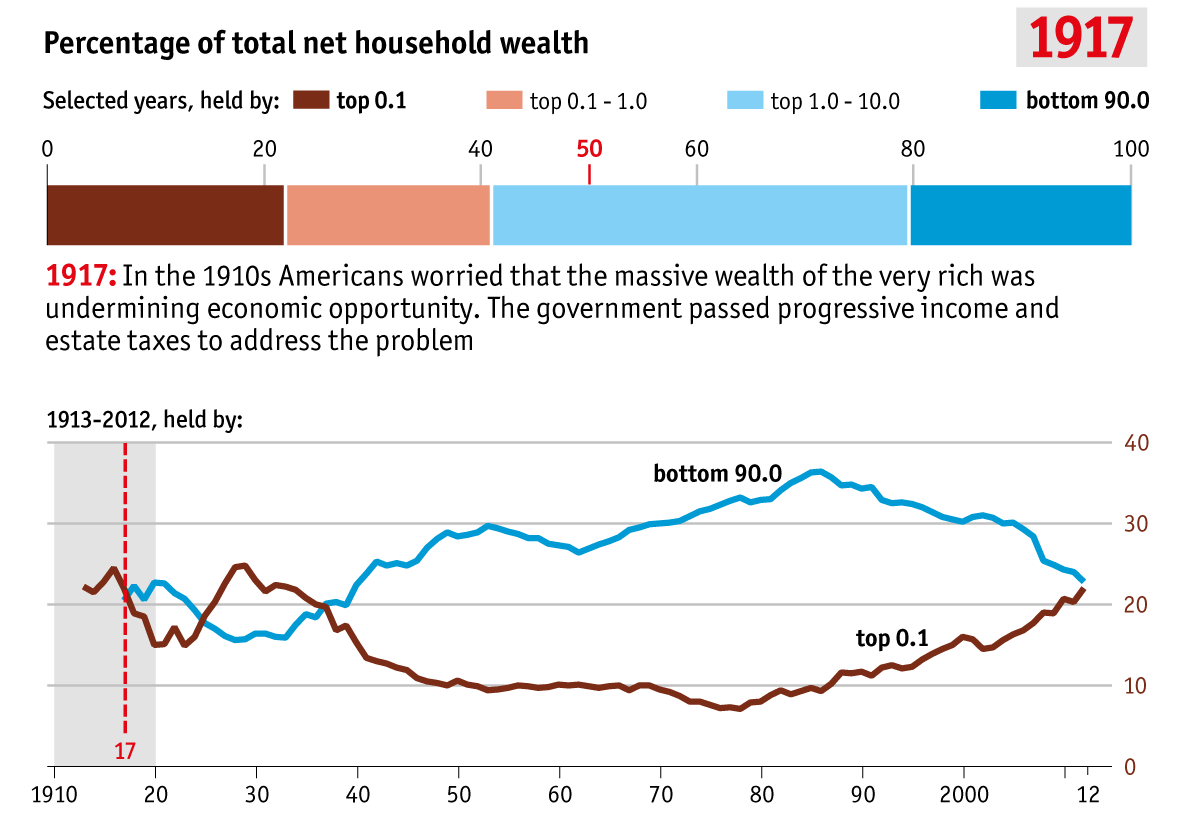
Income inequality and or wealth inequality (which are two separate things) have been in the news a lot lately.  People on the Left have harped upon an increase in the disparity between the wages and wealth of the very rich and the very poor as a sign of a breakdown of our society.

Many on the Left posit that the cause of this disparity was the Bush tax cuts of the 2000s, which reduce the tax rates on the very rich.  However this answer is too facile and easy and doesn't stand up to scrutiny.

While marginal rates were slightly reduced during the Bush era, the slight decrease of a few percentage points really isn't enough to account for huge increases in wealth by the very rich.  What's more, marginal rates are rarely paid by the very wealthy as Mitt Romney aptly illustrated.  The very rich can afford to incorporate and pay themselves and capital gains and pay only 15% capital gains tax. And that is a pretty old law which hasn't changed in recent years.  Thus, the tax explanation isn't quite the right answer.

What has changed in the last two or three decades is we've become more of an investor nation, and not by choice.  With the demise of the defined benefit pension and the rise of the IRA and 401(k), ordinary citizens are forced to invest for their future rather than rely on fixed benefit defined-benefit pensions.

The result of this is a lot of small investors such as myself are getting into the stock market and buying stocks without really knowing what we're doing.  As I've mentioned before, the outrageous stock prices for many of these tech companies are not based on what the people who founded the company paid for the stocks, but what the last investor in paid.  In other words the last chump who buys a share of LinkedIn or Facebook is the one driving the price through the roof, and technically this is a small investor paying the top dollar.

And as investors, we want to see the maximum return and our 401(k) because we all want to be rich and have a healthy retirement.  So we demand high rates of return on a quarter-by-quarter basis, sometimes on even a monthly or daily basis without regard to long-term profitability or stability of the company in question.

To achieve these spikes in share price, we have incentivized company managers and fund managers with arrangements which pay them in stock options or based on share price increases.  This motivates these managers to jack up the stock price is high as possible in order to maximize their own personal profit.  As a result this can result in a payday in the millions or even tens of millions for some lucky managers, and smart managers figure out ways to make the stock price of their company soar.

And one way to achieve these results is to cut the pensions and benefits of the poorest workers for that company.   The poor can't afford to invest in a 401(k) and they are now even less likely to receive even a modest pension from a company after 30 years of hard work.   The middle-class profits from their 401(k) investments, and the investor and manager class profits hugely from stock options and other deals that yield staggering incomes.

Draw the chart - does wealth inequality start after World War II when the home mortgage interest deduction was created?  Or does it begin shortly after 1978 when the 401(k) was created - and accelerate throughout the 1980's and 1990's as more and more companies dump pension plans (even the Federal Government!) and adopt 401(k) type plans.  It is an interesting thought.

Of course, it was not always this way, even for small investors. My mother used to buy stocks when I was a kid, and the cost of buying a stock was rather steep, as you had to go through a stockbroker who charged a pretty hefty fee. I remember selling some stock my grandfather left me back in the 1980s and paying $30 to $50 just for the privilege of selling the stock, and I believe he was doing me a favor at the time by charging me so little (It was Republic Bank of Texas stock, and a good thing I sold it as it went belly-up).

Today, we have low-cost trades and even zero-cost trades which allow small investors to buy even one share of stock with no little or no transaction costs.  In the old days, my Mother would hold physical stock certificates in her safe deposit box and have the dividends reinvested or mailed to her and a check once a quarter.  You bought and held stocks for the long-term, rather than buying and selling based on where you thought the market was heading.

And, as you might imagine, share prices were more stable back in that era.  It is only in recent years since the introduction of the IRA and 401(k) that we were seeing wild swings and share prices.  I believe this can be directly traced to the increased number of little people playing the market and moreover people feeling they need to make it big in a hurry in order to fund their retirement.

My mother's time was also the before the Internet.  So the idea of swapping stock tips online or going to websites which discuss strategies for buying and selling stocks was just alien.  Today, there any number of sites you can visit where people cheer-lead the idea that you should churn your investment account in order to "cash in" on great bargains and deals, most of which are spurious.  The idea you can beat the market has always been a dream, but in general it's been a false dream.

The other half of the wealth disparity and income disparity equation is the decline of wages for the middle class.  The reasons behind this are also less interesting than those proposed by the Left.  The big problem is that high paying union jobs have largely going away in America.  Companies hire fewer people as efficiency has improved thanks in part to improve machinery and robotics.  It takes half the number of people to build a car today and that in the past. Part of this also is that car makers farm out the production of parts to independent companies many of which are non-union and/or located overseas.  When I worked at General Motors, we made every single part of the car except for the tires the paint and the gasoline we put in the tanks.  Today, General Motors merely assembles parts into cars, and most of these parts are made and independent factories or even overseas.

And again, the reason why companies pursue this cost-savings is the expectations of investors - the middle-class who wants high rates of returns on their 401(k) and damn the consequences!  So companies have to cut costs to the bone to appease Wall Street, and by extension, the middle-class 401(k) investor.   We have met the enemy and he is us.

One could argue also that is the supply of labor has increased, and the demand for labor decreased, the value of labor has decreased as well.  Whether we can go back to the union era of high wages -  often four to five times the prevailing rate - is questionable.  It would be propping up an economic system that would not be sustainable and eventually collapse - as our economy did in the late 1970's.

But I think another aspect of this trend, at least with regard to wealth disparity is that many in the middle class today have dissipated their wealth by purchasing toys and services rather than saving and investing.  Defined benefit pensions were a means of forced saving for the middle and lower classes - which kept them from sinking into poverty in old age.  While the new investor class may have driven stock prices crazy, it represents only a portion of the middle class and very little of the lower classes.  The alarming fact is that very few people have saved much for retirement or saved anything at all.  Many people complaining of living "paycheck-to-paycheck" have several vehicles parked in their yard as well as a deluxe cell phone plan and every channel of satellite or cable television.

When I grew up - I came from a upper-middle-class home - we didn't have cable television largely because it didn't exist.  And cell phone plans were also nonexistent - we had one phone in the house and we were always nagged not to stay on too long because the phone bill would be too high.  Most families only had two cars, compared to the five or six you see populating the driveways of many suburban households today.  If young people wanted to drive they borrowed dad's car.  And when you went off to college, your parents give you a ride there - you didn't have a car on campus.

Our apparent wealth has increased since then, as our generation has decided to spend more and save less.  And with the plethora of inexpensive consumer goods available to us it is easy to spend a lot more.

While this does not account for income disparity, it does show how wealth disparity can be altered not by external forces but by internal ones - our choices on how to spend our money.  The irony is to me, that even back in the day of fully funded defined benefit pension plans, my parents still saved money and invested in stocks, rather than rely only on the promises of a pension plan. They also make regular payments on their mortgage and paid it down rather than continually adding to their debt load through refinancing, which was almost unheard of back in the sixties and early seventies.

Thus, when retirement came, my parents had a house that was nearly paid for, some money in the bank from investments, and a small pension and Social Security.  My parents never had the fancy cars, jet skis go fast boats.  My parents never had a deluxe diesel pusher motorhome, even though my father was a vice-president of his company.

Today, I see a lot of people of fairly modest means with all of these sorts of toys, usually financed on time.  And as I illustrated in a number of earlier postings, it is very easy to upside down on these things end up paying for the rest of your life for what was a transitory pleasure.

This is not to say that the Bush-era tax cuts had no effect on wealth or income disparity, only that the effect was fairly trivial.  Cutting or increasing marginal rates really only affects the upper middle classes, such as doctors and dentists and other professionals who make in the mere hundreds of thousands of dollars.  They don't have quite enough money to figure out ways to avoid paying income taxes and pay themselves and capital gains instead.  Although lately, more and more are figuring out how to do this which is why your Dentist is now an LLC and not a solo practitioner.

In other words if you view the tax code as a wealth transfer scheme, which it is to some extent, particularly with graduated marginal rates, it has not been a very effective means of transferring wealth from one group to another.  On the other hand, the proposals by the Trump Administration will basically cut what little wealth transfer feature our present tax laws have.

Sadly, I believe that even those Draconian tax changes will not be the cause of the next wave of wealth transfer, at least not directly.  By cutting taxes to the very wealthy by such huge margins, without having corresponding spending cuts, we will increase our deficit spending even further. Over time, this could lead to rapidly accelerating inflation which would have two interesting and opposite effects.

For the middle class which is saved nothing and borrowed everything, hyperinflation will be a blessing, as they will pay it back old debts with new dollars which are worth far less. Of course, when they try to borrow more money they will find the interest rates in the double digits.

The second effect will be even more devastating, is it will basically wipe out the savings of those who did choose to save, as their retirement plans become worth less and less as the new dollars purchase less over time.

But it is an interesting thought, though.  Did the 401(k) create wealth disparity?  By making the middle-class and upper-middle-class into investors, we've pushed the market for greater and greater returns, lining our own pockets and really rewarding those who run such companies or run investment houses.  Meanwhile the lower classes have their wages and benefits and most important, their defined benefit pensions cut.   And the middle-class people who didn't bother to save under this new plan find themselves part of the new poor.

UPDATE:  I am not sure whether this is true or not, it is just a thought that struck me.  And it makes more sense than the New York Times' argument that home ownership caused wealth disparity!