Tuesday, March 15, 2022

Political Fundraising Scam?

What the ever-loving fuck is this about?

I've been receiving a lot of SPAM messages from people claiming to be political fundraisers or candidates in elections - some halfway across the country.  You contribute to one campaign, and even though they say they won't sell your name to a mailing list, they do - or people get ahold of it from public record, I guess.

Anyway, I get all these messages saying "Deadline TONIGHT!   We have to raise $1M by midnight tonight or Donald Trump becomes the next President!"  I am not sure what these artificial deadlines are all about, other than to instill a sense of urgency in the recipient.

In a way, I hope these missives are fraudulent, because if they are real, well, my faith (what little there is) in the Democratic Party is shot.  And no, this doesn't mean I'm turning Republican - they lost me a long time ago - long before they became the party of Q or the "GQP" as some are now calling it.  I guess today it is all about raising money so the political consultants can buy a new Audi A8.

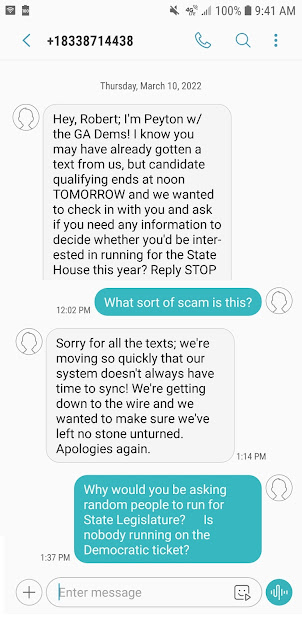
The latest plea was comical - I get a message saying the deadline for candidates to register to run for State legislature is tomorrow and would I like to run?    Sure.  I am certain I can get the requisite number of people to sign the petition, come up with the filing fees, fill out the forms and do this all in less than 12 hours.  What the ever-loving fuck is this all about?

I am not sure, other than it is another plea for money.  And frankly, I think these money pleas are getting out of hand.  The real issue in the 2022 midterm election and the 2024 Presidential election is not paying for yet more attack ads, but in getting out the vote.  It seems Democrats have been laying down and just letting Republican legislatures run right over them, in terms of passing new restrictive voting laws that reject absentee ballots for arbitrary reasons, or closing polling places in minority neighborhoods, and of course, redistricting.

Yes, they have fought some of these things in court - here's a clue, the mid-terms are months away.  Sadly, even if a court overturns some of these new laws, odds are, it won't be until after November.  Already we saw 27,000 absentee votes tossed out in Texas, and I am sure that is just the tip of the iceberg.

I read something online from a voter who was turned away from the voting booth because his registration was out of date - his address was listed for another district.  He was offered a provisional ballot (which would have counted, once he updated his voter registration) but he turned it down, with the "logic" that, "they probably wouldn't have counted it anyway!"

That is the issue in the 2022 election - getting voter turnout and getting people to vote in spite of these obstacles.   There should be a concerted door-to-door "get out the vote" effort, with volunteers going from door to door (or calling or texting or whatever) encouraging people to get their voter registration updated.  I went down to the Office of Voter Registration the other day when I realized they had my old P.O. box number (and old phone number) on my voter registration.  I could update some of this information online, but not all.  Oddly, when I asked for a new voter registration card, they could not provide one - and the one I ordered online never arrived.

But I am fairly certain that my registration is correct, and I will test this out in May with the upcoming primaries.

Sadly, a lot of people don't take their voter registration very seriously.  Hell, a lot of people don't take their car registration seriously.  These are the same people who get pulled over for expired tags and have a driver's license with an address they left three years ago.  Yea, it is a "hassle" to update these things.  It is a bigger hassle to get a ticket or worse - tossed into jail when they used an expired tag as an excuse for a Terry-type stop and find drugs in your car.   Sadly again, it is the same people who blow off their basic responsibilities that tend to have drugs in their car.

Which is why, in a nutshell, marijuana is still illegal in many States (and at the Federal level) despite legalization being overwhelmingly popular.  The GQP gets re-elected because they get out the vote, while Democrats just complain about how unfair the system is.

I noted before how the Democrats made a poster-child out of this 78-year-old woman from upper Michigan, who didn't have a birth certificate or driver's license and thus could not vote.  They funded a million-dollar ad campaign to try to overturn the new voting laws in the State.   Seems to me, for a lot less money, they could have gotten that lady a copy of her birth certificate and then driven her down to the DMV for an identity card - and motor-voter registration.  In fact, the money spent on ad campaigns complaining about the unfairness of it all could have been better spent on just registering people to vote.

It takes effort to vote.  You have to register, which means you have to have your personal documentation in order.  Slackers and ne'er-do-wells obviously aren't going to do this - and maybe that is a good thing?   Our forefathers limited voting to white males who owned property.  Yes, that was unfair to women and people of color, but on the other hand, the property-ownership thing was a way of weeding out the slackers and do-nothings from electing representatives who would just vote to give away money (or whose votes could be bought with a glass of whiskey).   The latter isn't a joke - when we lived in Alexandria, the local museum had an exhibit of the expenses George Washington spent on whiskey, beer, and other intoxicating liquors, which were given out for free at campaign rallies.  The Father of our Country wasn't above bribing voters with booze.

Sadly, this will not change anytime soon.   The political consultants are resigned to losing the mid-terms and would consider it a victory if they didn't lose too many seats.  And with a major recession and spiraling gas prices on the horizon (if not already here) many a "low information" voter will vote for change - any change - as they think the President has a dial on the wall of the Oval Office that sets gas prices.  Why doesn't Biden turn the dial back down?  He must be dense.  But of course by 2024, oil from Iran and Venezuela will be flowing and the world price will drop (as it did recently when UAE dumped a load on the market) and the new President will take credit for it and the low information voters will believe it.

Um, maybe that is why the Democrats like to complain about voter suppression, but do nothing about it.  After all, low-information voters come in all shapes and sizes, and if you help that 78-year-old lady from Michigan get her voter registration, odds are she'll vote for Trump.  Hell, she was dumb enough not to be able to figure out how to get a copy of her birth certificate, right?

But getting back to these scam texts and e-mails, the best way to avoid handing money to the wrong people is to go to the site of the candidate you support (and make sure it is indeed their site) and donate directly.  Otherwise, you may be handing money to a PAC or some other organization with a sound-alike name whose agenda is unknown.

For example, "GA Dems" - who the hell is that?   If it was the Democratic Party, why not say so?  And who goes around asking random people - via text - to run for office?

Scam.  Scam.  Scam!

Monday, March 14, 2022

Harvest Hosts - Circling the Drain?

Negative option renewal techniques are a sign that a company is struggling, or greedy - or both.

I have written before about negative option.  It is a technique that loser companies use to make money, not from selling goods or services at a fair price and a fair value to valued customers, but to instead charge annual fess and hoping most customers won't notice or not think it is "worth the hassle" to challenge them.

Believe it or not, there are people who still get their credit card bills in the mail (or even online) and don't bother to look at them in detail.  They just pay the minimum payment or have it auto-drafted and then move on with life.  I know this as I used to be one of those people.   You get the credit card bill and it is pages long and you can't remember what is charged for what and you start to challenge the charges and realize, yes, indeed, you did order Chinese take-out six times last month.  So you give up and pay the bill.

Today, I check my credit card balance every day and pay at least a portion of it daily - if not all of it.  I can keep track of charges this way and thanks to online push notifications, I get texts and e-mails whenever a charge is made.

So it was a surprise when my phone buzzed and said Harvest Hosts had charged my credit card $45.

What is (or was) Harvest Hosts, anyway?  Well, it was a cool way to camp for free while visiting a winery, brewery, distillery, organic farm, museum, or other type of retail venture (generally involving something related to agriculture or culture).  The idea was, you would sign up for this service for $40 a year and they would give you a list of places you could stay.  So you visit a winery, for example, and taste their wines and maybe buy a bottle or two (or a case) and then park out next to the vineyard and enjoy a bottle of their wine (that you just purchased) and some snacks, as you watch the sun set along the vines.

That was the theory, anyway.  and when it was run by the founders in the early days, it kind of worked that way.   We joined and stayed at some wineries, a brewery, and a museum.  Unfortunately, the company was sold to a "tech entrepreneur" (you know that that means!) who saw the potential for "exponential growth" and wanted to make the site more "user-friendly."   I guess negative-option renewal, pages of four-point type ToS, and an impossible-to-navigate website is "more user friendly".

If you want to opt-out of auto-renewal (which I never recall signing up for, but the owners point to a tiny-print part of the ToS, claiming I agreed to this) you have to hit "CANCEL MEMBERSHIP" which seems odd.  What it means is, auto-renew is turned off, but your membership is still active. Intuitive, no?  Just finding the user login screen required a separate Google search - the "main page" of their site just scrolls forever with hype about how great it is and how you should sign up.  I mean, it just comes across as desperate.

But they also have user page on how to request a refund if you didn't want it to auto-renew, which is interesting and tells me volumes about how many people besides me are pissed off about this.

The reason I didn't want to renew the membership can be boiled down to two words:  Covid Campers.  In the early days of Harvest Hosts, you could go to a farm and maybe there would be one other camper there with you. But with CoVid and the explosion of new RVers, well, that all changed.   You would get to a farm or winery and find that all the spots were taken (and typically, most places only accomodated a half-dozen campers at best).

Worse yet, even though the system was supposed to be "first come, first served" people started making reservations, so if you called a winery or showed up, they would tell you that there were no spots available and that people had reserved them weeks in advance.   This of course, placed an additional burden on the winery owner, as they now have to take and keep track of reservations - essentially running a campground - with no real profit in it.

Yes, that.  A lot of "newbies" started complaining online that the farmer or winery owner or brewery owner "acted like they expected me to buy something!" - as if these entrepreneurs were letting people camp for free just for fun.   As a result, more than one winery we visited said they had opted-out of the program as it was too much hassle.

Worse yet, were people who left reviews savaging the winery owner for not providing 50A service or water and sewage connections (the whole point of Harvest Hosts was that you were dry camping).   People not only wanted a place to stay for free, they wanted free water, electric, and sewer!  And of course, if a farmer started providing these services for campers, well, the authorities would start to ask pointed questions as to why they were running an unlicensed campground.

And yes, in a few incidents, some campers left trash, grey water, or worst of all, black water, on the ground when they left.  "Thanks for the free place to stay!  We have no intention of buying anything! Oh, here's some garbage strewn across your lawn and some fecal matter to boot!  Enjoy!"

People suck.

But overall, we found ourselves not using the service. Why?  Well, it just wasn't practical.   You stop by a brewery for example, as we did in Indiana once, and have a beer and a pizza and buy a t-shirt and a six-pack and a growler to go.   You have to get there when they are open, which usually means in the afternoon for many wineries.  But even if the place is open late, you want to get there before they are busy.  So you've parked your rig in the parking lot, had your dinner and patronized the host business.  Now what?   It is hours before bedtime.  Do you sit in your chair in the parking lot and watch the sunset over the parked cars?  Or do you sit inside your $500,000 motorcoach and watch Fox News on your Satellite Tee-Vee and get angry at "Brandon"?    And if the latter, why leave home to do this?

Now, granted, some places had a nice view and you could sit outside and watch the sunset over the corn field of whatever.  Others were more like parking lots and in some instances, could be creepy, particularly if there were homeless or young people (or homeless young people) loitering around your camper.

As a result of all of this, we didn't use Harvest Hosts at all last year - wherever we were going, there was not a Harvest Host nearby or en route that made sense to us in terms of timing.  Others that we wanted to stay at were "booked up" weeks in advance.  It was $45 spent for nothing and bear in mind you can stay two nights in a State park for $45 in some places.

The year before that, maybe we stayed at one or two places - and spent quite a bit patronizing those businesses.  It is a neat concept, but I think the new owners of Harvest Hosts are more interested in making money than in the overall concept.  And sadly, the newbies who are signing up are more interested in a free place to stay than in visiting.  And in that regard, there is another site - also bought by this "tech entrepreneur" which is even more bizarre, and that is boondockers.

The idea behind boondockers is similar to Harvest Hosts, minus the winery or distillery or alpaca farm.  It is a listing of people who, for whatever reason, are willing to let you camp for free on their land.  Sounds like a good deal - for the campers.  But what does the landowner get out of it, other than potential liability?  I mean, if your insurance company found out you were letting strangers camp on your land, they might have second thoughts about insuring you.  After all, all it takes is one idiot to trip and fall and sue you, to bring the whole thing crashing down.

The land owners don't expect payment or anything, although the site sort of suggests giving the landowner a small gift (like maple syrup!).  I am not sure that is enough compensation for what is, in effect, opened-ended liability.  And if someone leaves trash or sewage on your lawn, I am sure you would nope out of that in short order.

I wonder about the future of these services.  Yes, in Canada, you can just park your camper on "Queen' Land" and hang out.  But in many cases, that's all you can do, as there are not a lot of things to do out in the middle of a vacant lot.  And in places like the Yukon Territory, the scenery is divine - but you do you really want to camp out, all alone, miles from civilization, in Bear country?  Worse that the bears are your fellow humans.  Yes, camping off the beaten path has its risks as well as rewards.

I wonder about the future plans for Harvest Hosts.  If this "tech entrepreneur" is going by the Silicon Valley playbook, he'll jack the numbers for a few quarters, show exponential user growth, insert annoying ads in everything, and then go public with an IPO or better yet, a SPAC - and cash out millions.  I mean, that's how the game is played, right?

The Harvest Hosts people did refund my money after I went through the refund process.  There have been too many class-action suits over this sort of nonsense for them to do otherwise.  In addition, I could just dispute the charge with my credit card company which, cumulatively, would ding them with the credit card people.  It is funny, but I don't mind doing business with a company which allows me to sign up and sign off from a service without having to go through three layers of menus or to search online on Google for a "how to" video.  Disney+ and Netflix, for example, make it easy for you to sign up for one month and then cancel - and will welcome you back when you are ready.

My suggestion to Harvest Hosts is to make auto-renew an option - that you have to check off on a box when you sign up.  Relying on buried ToS language is a cheater's way out - sure, it makes you money, but at an overall cost to your business reputation.  And if you are going to do auto-renew, send a reminder e-mail before running the charge.  Again, this results in less profits, so they won't do it - companies like this (e.g., AOL) rely on "ghost subscriptions" to stay in business.

To me, though, it says volumes about a business if they use negative option - that they don't really believe in the business model and are trying to milk the system for everything it is worth before it all comes crashing down.  The other thing is my mantra of "If you get into a business relationship predicated on a lie, no matter how trivial the lie is, it will only go downhill from there!"  And in this case, the trivial lie is putting auto-renew language into small point type in a ToS that no one in the history of mankind ever reads and then relying on that as your legal leg to stand on when you charge people again and again.

You can spot a bad deal from 100 paces, as I noted before.  And Harvest Hosts, by auto-renewing me, left a bad taste in my mouth.  I realized that I should have bailed on them a year ago, when it basically became unusable.   Actually, I should have hit the ripcord when the young "tech entrepreneur" took over the site.  I guess he still thinks "tech entrepreneur" is an accolade and not admonition.

Sunday, March 13, 2022

The West Won't Lose Much to Putin

Putin threatens to confiscate airplanes and factories and businesses.  Turns out, he won't end up with much and the West won't lose much.

When I worked for GM, the union workers would justify their obscene pay raises with the mantra, "They'll never close this factory!  They have too much invested in it!"  But the reality is, any business that is losing money eventually goes bankrupt, and GM closed that factory long before it went bankrupt.  In fact, closing those money-losing plants was the last gasp of the old GM to save itself - and the union blocked GM at every turn - insisting that laid-off employees be paid not to work.

The reality is, most of these companies have little to lose in simply walking away from these "investments" in Russia - and Russia has little to gain by confiscating them.  As illustrated in recent articles, unless Russia can get certified parts for the Boeing and Airbus aircraft and have all maintenance done by certified mechanics (and have a complete paper-trail for everything) the aircraft would not be considered airworthy or insurable to fly to Western destinations, even if sanctions were lifted.   Once the aircraft is repaired using unauthorized or undocumented parts or the work is done by non-certified mechanics, well, it becomes a major hassle to meet Western airworthiness standards.  So Putin can confiscate "$10 Billion" worth of leased aircraft, but it would be like trying to shovel water - he ends up with little or nothing, other than some unsafe aircraft to fly domestically, for a few months or years until the parts run out.  He should talk to Iran about this - they went through the same nightmare.

As for the leasing companies, they likely will file an insurance claim and be made whole, although the insurance companies will take a hit.  Of course, they will be less likely to insure aircraft leased to Russia or any other nation that may "go rogue" (Hello, China?) or at the very least raise rates to correspond to risk.  So even if sanctions are lifted, Putin shoots himself and his country in the foot, as Aeroflot will have a tough time leasing new planes once the dust settles.

But bear in mind that these leasing companies have already been paid billions for these planes and may have already covered much of their costs.  So it is not clear that the leasing companies are really losing out all that much - the $10 Billion number is batted around, but everyone also says, "but the planes may be worth much less than that."   $10 Billion may represent the remaining lease payments or the retail prices of the planes.  Hard to parse.

As for factories and stores and whatnot, the losses may be even less.  You may lose your inventory of your fashion store in Moscow, but likely the store was leased and the worst you have to contemplate is being sued by the Russian landlord (good luck with that!) for terminating the lease early.  A few weeks or months of inventory isn't hard to write-off and the store fixtures, while costing a lot new, are worth nothing in resale.   Most retail stores recoup their startup and operating costs with a few years and thus most have likely made profits for their corporate owners - and they can afford to walk away at this point and still come out ahead.  Sure, they would like to have continued to make money, but they aren't losing much by walking away from the Russian market at this point.  With the crash of the Ruble, who is going to buy your products, anyway?

Even factories are not that big a deal.  A big car factory may seem like a huge investment, but the reality is, most are built on a concrete slab with a truss roof and the sides made of corrugated steel.  Pretty cheap stuff - the assembly equipment inside is worth more than the building.  And according to some sources, you can recoup the cost of tooling in as little as two years of production (otherwise, how could you maintain a 3-5 year product cycle?).  The various Western automakers already made back their investments in the Russian market.  They'll miss making more money, of course, but with Putin doing his anti-Western drumbeat, do you want to be seen driving an American or German car in Russia?  By the way, this same effect will take place, I think, in China, and buying a Buick will be seen as an act of disloyalty to the State.  GM may lose half its profit sources, but they still came out ahead in their China venture (the same could not be said for Ford).

And what does Putin gain?  Putin has said he will void international intellectual property agreements (Patents, Trademarks, Copyrights) but that isn't enough to keep the factories running. Castro nationalized the Coca-Cola factory in Havana after the revolution.  The resulting product - Castro-Cola, if you will, was described as dreck.  Communists make lousy capitalists - seems kind of obvious in retrospect.   Kleptocrats aren't much better - as the Venezuelan example illustrates.  Once the major oil companies left Venezuela, production plummeted.  You can't just ordain that production continue or increase - you have to know what you are doing.

Nevertheless, people mistakenly believe that factories or stores are major investments by companies, when in fact, they are about as durable and valuable as a disposable paper cup.  In fact, in many cases, not too many years go by until they realize it is cheaper to simply bulldoze the whole works and start over again.

When I worked at New Departure div. of GM, we had recently moved to a brand-new factory.  The old factory buildings which were designed by famous architects (which is what you did, back in the day) were three stories tall (or more) and spread out over blocks of downtown real estate.  This meant that an army of employees spent all day moving parts up and down elevators or between buildings, on city streets.  As you might imagine, this was not only inefficient, it was an invitation to theft, fraud and waste. One broken elevator could tie up production in an entire department for a day.

So the new factory - a concrete slab with a flat roof, one story, with cheap corrugated metal walls, was built.   And since the company had invested in this "new" factory, the workers felt they had the company by the balls - after all, who could afford to walk away from such an investment?  As it turns out, they couldn't afford not to and not long after I left, the factory was closed, the machinery sold off (which was happening while I was working there!) and 8,500 employees given the pink slip.  It was cheaper - far cheaper - to simply buy our bearings from outside suppliers.

It is funny, but it is human nature to think of things like buildings and structures as "permanent" when in fact, they exist for a relatively brief time on this planet.  A building may have a lifespan of 50 years or so - often less - before it is cheaper to tear it down and start over than to try to retrofit it for new uses.  In many cases, the original use of the building no longer makes sense - and the building was designed for that specific obsolete use and cannot be readily adapted to other uses.  Such is the fate of shopping malls, for example.

Putin seems to be falling into this trap, and maybe it is because he isn't astute at business.  I guess he thinks that a McDonald's building is worth a lot of money - but it really isn't.  Look how many of them are torn down and rebuilt on a regular basis (the one near our grocery store has gone through two such rebuilds in the 15 years we've lived here).  It isn't the building, or the employees, or even the burger patties.  It is taking all these things and putting them together along with an advertising campaign and brand awareness that produces the real profits.   McPutin won't have the same appeal - any more than Castro-Cola did.  But McDonald's and McPutin will both have a clown as a mascot, I guess.

Sure, McDonald's says it may lose 50 million dollars a month by closing stores in Russia. But that's in terms of lost revenue not lost profits, it doesn't take into account the profits they've already made. It's like me saying I would lose 50 billion dollars by not winning the lottery.  They are only losing potential income, not actual cash losses. Besides, how long would have been before McDonald's would have to leave Russia eventually? I mean, how many countries would Russia have to invade before McDonald's would finally call it quits or Russia would throw them out?

Of course, it may not be too late for Russia.  If the Oligarchs take over and push Putin aside (the Russian way - defenestration) and do a major mea culpa, then maybe business will go back to normal - and actually improve, as it was before the Crimea invasion.  But otherwise, it seems Putin has brought down the iron curtain once again.  Russia has devolved into an exporter of raw materials (Canada, please take note!) which is not a sustainable prosperous economy in the long run.  With a lack of foreign investment and technology, Russia will once again be reduced to primitivism.

And the recent war in Ukraine has illustrated how well home-grown Russian technology actually works.  I mean, these are the people who bought you the Lada - a half-assed remake of an obsolete Fiat.  And that's not saying much.

But Russia aside, there is much we can learn from this example.  The idea that buildings or shopping malls or restaurant chains are an inviolable part of the landscape is flawed.  These things can evaporate in a heartbeat, as they have in the past.  Yes, even major brands like Walmart or Facebook or McDonald's can end up gone, in a matter of months or years.  After all, look what happened to Kmart and Sears - they were the Walmart before there was a Walmart.

Sadly, most people don't get this.  In addition to the Union members wanting to milk our factory for all it was worth, the local officials in Connecticut wanted to tax the place to death as well.  Everyone wanted a "taste" from this perceived cash cow, even if it wasn't generating any cash.  They'll never leave, they have too much invested!  And yet, they left - and other industries followed suit.  And then the insurance industry started moving out as well.   Connecticut today is now a nightmare high-tax State with little incentive for anyone to want to start or build a business there.  The thing I can't figure out is where all the money goes - because taxes in "Red" States are often half or less that in "Blue" States.  I guess it all goes to snow removal.

On a personal level, it pays to consider this before throwing money at your own home.  We tried to fix up our house in Alexandria and had a lot of fun along the way.  But the reality was, the land was more valuable than the 60-year-old house with a bad foundation ever was.   We sold out to a developer.  Our neighbors took the plunge and threw hundreds of thousands into a remodel.  We doubled our money, they merely broke even.  And quite frankly, I suspect something similar will happen where we live now - with ordinary houses fetching close to $800,000 it may be cheaper to flatten an older home and start over than to try to fix up a plain-looking ranch house into a million-dollar mini-mansion. But we'll see.  If a developer knocks on our door again, we'll listen to what he has to say, for sure.

Saturday, March 12, 2022

Chromebook - the Future?

The Chromebook has evolved from a toy to a serious machine.

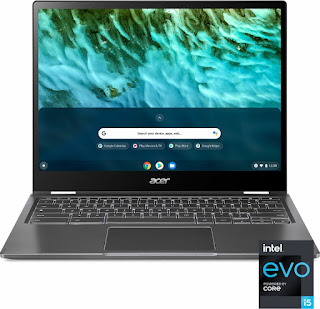
The Acer Spin 712 arrived on Friday and it worked without any hassles.  Funny thing, I was at Sam's Club and they had an HP Chromebook with a larger screen, same features, for a little under $600.  And yes, it had an HDMI output.

There were no instructions with the Chromebook, and as it was a "reman" there was not even any packaging.  But it powered right up and walked me through the "setup" steps.  It is as easy-to-use as falling off a log - provided you are already in the Google universe and have an android phone.  It imported all my bookmarks from Google and it was pretty seamless.

It was pretty easy to download all the "apps" I needed, but oddly enough it came pre-loaded with YouTube, not as an app, but as a website.  I hooked up the HDMI output to our old 42" television and worked pretty seamlessly.  You can adjust picture size (font sizes) and resolution, along with orientation, using the setup menu - not very dissimilar to the display setup in Windows, actually.  I set the television to be "on top of" the laptop display (as an extension, not a mirror) as this allowed me to move the mouse from one display to the other and also allowed me to go "full screen" on the television.  There is also a feature to allow you to adjust the edges of the display, which was handy, as it was going off the edge of the television screen.

Speaking of mouse, I plugged in a mouse/keyboard (logitech) dongle into the one standard USB port and it worked right away - no "loading device drivers" nonsense.  Also, when the thing powers up (which I am still not sure how to do this - it just seems to turn on when you open the book up - whoops there is a power button on the side!) it starts up right away.  No welcoming screens or cutesy Microsoft theme songs.  That's kind of handy.

I streamed some videos from Disney and it was flawless - no jitter or other problems, although I used the audio output from the television into a surround sound system.  I tried the bluetooth to a bluetooth speaker and there was a time-delay issue with that.  The picture was really sharp and we were enjoying it until it suddendly stopped and Mark's phone announced it was out of data.  I realized, in horror, that Disney reset itself to HD streaming at a staggering 2GB per hour.  Doesn't take long to chew up your data plan, at that rate.  Maybe that 100GB data plan is in order.

This Chromebook doesn't have the provision for a SIM card, but you can either connect using your phone's hotspot or using the "instant tethering" connection, which looks just like hotspot to me, but is somehow different.  While the Acer Spin 713 doesn't have a traditional SIM card slot, it apparently supports eSIM, which eliminates the physical presence of a chip.  We'll look into that.

As for playing DVDs, that was a no-go and even if it did work, it would be clunky. The site I referenced even mentioned that if you could get it to work, the VLC player would only play individual files - you'd have to watch a movie one file at a time, which would be tedious.

I uninstalled the VLC player as it wasn't working.  I plugged in my Seagate 1TB expansion drive and lo and behold, it plays MP4  video files perfectly.  I guess DVDs are not in the mix, although I have a stand-alone DVD player for the television and if it was really an issue, I could buy a small flat-screen television (probably even a 12V one) for a hundred bucks, for the camper.

Of course, it would not play Windows .wma audio files, which is the format I have over 11,000 songs stored in.  Oddly enough, my phone will play those (!!) but the Chromebook will not.  It will play more conventional MP3 files, however.  I re-loaded the VLC player and tried that, and it pays some video files, but none of my audio files and doesn't recognize any image files.  I uninstalled VLC.  I am not sure why people say it is so great in the first place.

I noticed they had a Quickbooks "app" for the Chromebook, and I downloaded it and quickly un-installed it as well.  The "app" is very simplified and looks nothing like traditional Quickbooks.  And as you might imagine, there is no path to importing my previous data (even back in the day, Quickbooks played that game, requiring you to buy each version of Quickbooks to migrate data.  If you skipped a revision, well, too bad for you!   The "app" requires that you subscribe and they way they pitch this set off my spidey senses. "Subscribe now for 50% off!" it says, giving you two choices - to pay now before you even try the program or click on "No thanks, I'd rather pay full price!"  Once in the app, it offers you a 50% discount for only three months with a timer indicating how long the offer is good for.  In the corner, it says "Quickbooks Beta".   Uh, no thanks paying for a "Beta" version !

You can spot a raw deal from 100 paces by the way it is presented.  And Quickbooks has all the charm of a carnival barker here - pressuring me to subscribe or we shoot this dog.  Since I can't import my data anyway, I guess I'll stick with the old program on my laptop, or migrate to another app which isn't so grating.  Having your own financial records, independent from the bank, is important.  For example, my bank shows a balance of $2500 which is keen.  But since I wrote checks outstanding of $1500, it means my available balance is only $1000.  If you go by the bank's records, you end up bouncing checks.  It pays to understand where your money is going as well, as those idiotic "pie charts" that banks and credit card companies present are worse than worthless as most of your expenses are listed as "other".

But I digress.

At this point in my life, the only two Windows programs I use regularly are Quickbooks and Microsoft Word - the latter I use less and less as I am not working anymore.  Besides, there are plenty of word-processors online (indeed, Blogger is basically one of these, creating HTML from your typing and formatting).  It makes more sense to learn HTML than how to format things in WORD, anyway.  Of course, I am using WORD 2000 - 22 years old!  Maybe newer versions of WORD are HTML-based.  That would make more sense.

So maybe I will migrate to another financial program down the road, but I am not sure which one yet, although readers have suggested several.  Oddly enough, the Quickbooks website presents some pros and cons of using a Chromebook for running Quickbooks.

But for doing anything else - particularly on the Internet, it seems like a very good machine.  I find that I spend most of my time on the laptop on Chrome anyway.  Phones are nice and all, but if you are doing something like ordering online, it is handy to have a large display and keyboard, as trying to find things on the phone, with the tiny keypad and tiny display, is frustrating.  So I think for online usage, it will be a good thing.

Note that like the article about playing DVDs on Chromebook, there are a host of what I think are fraudulent articles about running Windows software on a Chromebook.  This article, claims you can, but what you are doing in reality is running the programs on a Windows machine and "remotely accessing" them from a Chromebook.  You need to leave your Windows computer up and running at all times (with power-saver disabled) and the remote access enabled.  Hardly a practical solution.

There are other limitations as well.  The Chromebook comes with 100GB of Google "Cloud" storage, but of course, as one wag noted, "Cloud" means "someone else's hard drive" and is not exactly a promise of security.  In addition, most "apps" require an internet connection to work, so it isn't very helpful if you like to work "offline" or are forced to (in a remote area, for example).  But again, with 100GB of hotspot (or built-in cellular) data, maybe this won't be an issue.  I need to look into this eSIM nonsense.

The only frustration I have so far is that every time I turn the darn thing on, I have to log into Google, and my password is very, very long.  No, the Acer Spin 713 doesn't have a fingerprint reader, either!

But so fat, it seems like a worthwhile device.  The neat thing about these Chromebooks is that they have no hard drive to break - as you really don't store data in them, but online.  Hard drives are fine and all, but they chew up battery life and since they have moving parts, can be very fragile if, for example, you drop or jar your laptop (most hard drives today have sensors that "park" the read/write heads if they detect jarring, so as to not crash the heads - but even then, hard drives crash over time, eventually).

So far, so good.  But my Toshiba is as comfortable as an old shoe.  And I like having physical control over my own data.  It will be hard to give it up!

Friday, March 11, 2022

Spoiled Rotten? (Who Spoiled Them?)

When you grow up living a certain lifestyle, the reality of living on your own can be very disappointing.

Note:  This is an older post which I just finished today.

A lot of young people today, or at least a few very loud voices among young people, are complaining that they somehow got a raw deal in life. Their parents have a certain lifestyle that they aspire to, and the younger generation wonders why they are not living that lifestyle already. It appears they fail to realize that the lifestyle of their parents' generation was only achieved after 30 years of hard work. You don't get the corner office in the six-figure salary your first year out of college.

But that raises the question as to why people expect this. And I think it's because we are such a wealthy country today. No one wants to hear this, but we are far wealthier country than when I was a child. When I was growing up, most families had one maybe two cars at most. The house had one television set and one dial telephone. Maybe if you were wealthy you might have a second television in the parents' bedroom as well as an extension phone. But that was about it.

Yes, college is a lot less expensive back then, but then again not everyone went. It was only for people who came from a certain social class, or people who were very smart and got good grades and worked their way through school, climbing the social ladder. People such as my grandfather whose mother was flat broke after her husband killed himself. He worked his way through City College and became a lawyer. It wasn't easy.

Even when I was in school, it was not necessarily a luxurious lifestyle. We lived in student housing, which comprised either ratty dormitories or off-campus housing which was roach-infested apartment buildings which were converted from old houses. The idea of luxury student housing, which is so prevalent today, was not even imagined.

Even the concept of spring break was something fairly scarce. I never went on a spring break vacation, as I felt that since I wasn't working, I didn't deserve a vacation. Besides, college students had the entire summer off, so what did you need a spring vacation for?  Because of all that hard work in college? Back in the day, some of my classmates felt entitled to these things. To my parents' generation, though, the idea of a vacation while you're in college was completely alien. My mother and father never drove down to Fort Lauderdale to party on the beach. This is not to say they didn't have a good time at fraternity parties and whatnot, only that perhaps their life was a little more austere and serious.  There was a World War going on.

Today, we have a lot more money as a country and as individuals. Middle-class kids get a new car when they turn 16 or their parents buy one when they send them off to college. When I was school-age, you weren't even allowed to have a car the first year or two of college. as they felt it would distract from your education.  My brother wasn't allowed to bring his car to campus until his Junior year.  Fortunately for me, this wasn't the case, but then again, I went to school at General Motors Institute.  The more cars you bought, the better!

Last year, I drove by my old alma mater, Syracuse University, and they had a huge billboard advertising new luxury student apartments. Such things didn't exist when I was there back in the 1980s. Today it's pretty much the norm.

The kids today are spoiled, and it's not their fault, it's the fault of their parents. Their parents' generation is far wealthier than previous generations and they can afford to lavish their children with every possible luxury. From brand new cars to cell phones to computers to gaming consoles and designer clothes, to everything else that a middle-class kid has today in the suburbs.  And those houses in the suburbs - huge!  Everyone has their own bedroom and bathroom.  None of this sharing bathrooms and sleeping in bunk beds nonsense!

This is not a bad thing in and of itself, but it sets up a set of expectations that are bound to cause trouble in the future. When one graduates from college, the harsh realities of the real world suddenly are thrust upon you. No longer can you afford that luxury student housing unless your parents are willing to subsidize your rent. And that brand-new car the parents bought you when you graduated from high school is now five years old and needing work.

Suddenly, you have to pay for everything in life and the prices seem pretty high.  Oh, and those student loans come due - didn't see that coming, eh?  What's more, not many people are going to pay you very much money, even if you have a degree in a highly desirable field. You're just starting out without much in the way of experience, and people want to have at least three or four years experience before they pay you serious money.

(This is why, during my 14 years of night school, I always got the job first and the education second, and made my employer pay the tuition.  You can still do this today - co-op programs do exist, but not for agitation studies majors).

Others are less fortunate. They major in silly things such as Communications and then get crummy grades and wonder why they haven't been made the next Tom Brokaw.  They struggle and they flail and they try to find a job which they find is impossible to do. Many end up moving back home with their parents. Many struggle for years before they finally settle down to some other job which doesn't pay nearly as well as what they thought they should receive. They become bitter and angry as their lives appear to have gone downhill.

And if they have student loan debt, the problem is even worse. Not only does their life suck compared to their life in college and in high school, but now they owe all this money and they're not earning any. Moreover, they weren't properly trained and how to handle money. So they accumulate more debt through credit cards and whatnot and fall into all the same stupid traps that we all did at that age.

The difference between today's generation and my generation is that when I went to college we didn't have very high expectations of our lifestyle. We drove rusted beat up cars and even then only in our junior and senior years. We lived in roach-infested rundown houses and thought that's what we deserved. When we finally graduated and got a job, we might have struggled a bit, but the struggle was no worse than what we had in college. In fact, our lifestyle seem to improve.

From my perspective graduating from college was a step forward in life, not a regression. And I think that's the problem for today's generation. They had a great time in college, funded by their parents and student loan money, and now the bills are coming due and the reality of the harsh working conditions in the world are thrust upon them.

I saw a posting on the internet the other day from a young fellow who just graduated and got a job. He's one of the lucky ones in that he has a job. But he complained that he didn't like going to work for 8 hours a day, 40 hours a week, and didn't want to do this for the rest of his life. It seemed so unfair. Only a few months earlier, he was goofing off in the dorm and playing video games and enjoying himself and doing the absolute minimum to pass his courses. Now he has to do this horrible work thing that his parents had to go through. Why can't you just cut to the chase and be the wealthy retirees at this point?

And I sympathize with his plight because I felt sort of the same way when I was his age. It seemed like I was never going to get ahead in the world and that all this work was just pointless. But then I hit age 25 and realized the complaining about it wasn't going to change anything. I went back to school, got an advanced degree, and got serious about my career and buckled down.  As I've noted time and time again in this blog, within a decade things changed radically. I went from flat broke (negative net worth actually) to millionaire.  Ten years after graduation from law school, I had my own law practice, I owned my own office building, and we owned several investment properties as well as our own home.

That did not come without some effort, as well as luck.  Being broke at age 25, though, seems to be a norm, not an outlier.  At least it was for me - until age 35, at least!

It's amazing what you can accomplish in life when you put your mind to it. And although many of the kids today probably will never achieve that level of success, many more will.

There's a great quote from Alexander Graham Bell (no relation) that when God closes a door he often opens another one. The rest of the quote is more interesting though, in that it says we spend so much time looking at that closed door we fail to see the new opportunities available to us.

And that perhaps is a problem for our young graduate. He's mourning the loss of his collegiate lifestyle and fails to see the opportunities provided to him - a world where he controls his own destiny and doesn't have to rely on student loans or the largess of his parents, which must often be paid for by acquiescence to their demands.

Maybe that's the greatest gift my parents gave me - being the annoying pains in the ass that they were. I wanted to get out from underneath their proverbia thumb as quickly as possible and definitely had no intention of ever moving back home with them.

For me, freedom from their tyrannical rule, such as it was, was more valuable than all the fancy gimcracks and toys in the world. I would rather have live in a hovel with nothing but what I could earn on my own, then to be showered with largess but having to dance to their tune.

Others seem to have less trouble with the concept. I know of many bounce-back children who live with their parents.  I know many parents who keep them as adult pets. You never achieve their own success in life, but do their parents bidding and sort of live in a constant stasis, waiting for their parents to die so they can inherit a modest sum of money and us live out the rest of their own lives.

I suppose it's a way of surviving, but it's not a way of living.

The problem is, of course, not entirely the fault of the children.  Parents who coddle and spoil their kids set them up for failure.  When you give a teenager a lifestyle that a 30-year-old wouldn't have - with cars, electronic toys, nice clothes and everything they ask for - you set this expectation that life will always be like that.  Adulthood comes as a shock as everything now has a price tag attached to it.

In addition to being annoying pains-in-the-ass, my parents didn't buy me cars or high-end stereo systems or other stuff.  I asked for an AM/FM clock radio one year for Christmas, and they gave me an AM radio - because FM was too high-falutin' for a teenager!

As a result, when I went to live on my own, my expectations were lower.  I didn't have shit when I was a kid - a succession of $50 and $100 junker cars that were mounds of rust.  Having a decent reliable car, even if it had no frills, was a big deal for me.  It took a long time for me to realize I was able to afford more.  I was 30 before I had a car with air conditioning!

Again, this is not to blame "kids today" for their plight, only to understand it better.  And I get where they are coming from - spoiled by a middle-class suburban lifestyle, they freak out when they realize that post-college life can be at or near the poverty line.  What's worse, even if you make "good money" you still have to go to work, kow tow to a boss, and all the nice toys you want have a price tag attached to them.  It is a shock to the system.

On the other hand, not many people feel sorry for entitled rich kids (and they are rich, by world standards) discovering what real life is all about.

I mean, boo-fucking-hoo.