Friday, March 25, 2022

Trump Steps in the Dogshit (Again)

The old Trump strategy of "I'm rubber you're glue, bounces off me, sticks to you!" is backfiring.

Donald Trump learned at the knee of Roy Cohn, who was advisor to Joe McCarthy.  When the bad guys are closing in, you go on the offensive.  If they accuse you of fake news, you say, "No, you're the fake news!"  If they accuse you of corruption, you say, "No, you're the corrupt one!  Lock her up!" and so on and so forth.  He takes accusations against him and flips them around - or at least tries to.  I suppose next, he'll claim that it was leftists who stormed the Capitol on January 6th.  Oh, wait, he already went there.

The Russian Collusion thing was sort of put to bed.  While there was a litany of smoking guns, it seemed that no one was willing to do anything about it, as courts were reluctant to get involved in what they deemed to be political squabbles and Congress didn't have the votes to convict on two impeachment trials.

So, that's all water under the dam, right?  Well, no.  Seems the shit is about to get real, and perhaps with the imminent fall of the Putin government, documents might come out that impugn Trump.  Manafort has already been pulled off a plane trying to leave the country.  Others may follow suit.  Investigations are still ongoing into Trump's business affairs and taxes.

So, what to do?  The classic Trump playbook is to hit the ball back to "their" court.  But this time, it may be a fatal error.

Trump has filed a civil suit against Hillary Clinton, among others, claiming that the Russian Collusion investigation amounted to a tort against him and a RICO violation.  Big Mistake.  You see, by filing suit, this means the opponents can depose Trump (and he can't weasel out of that or claim executive privilege) and also he has to hand over documents and other materials, including, presumably, his tax returns and financial records.  In other words, he has opened up a door he has tried to nail shut for over five years now.

What's more, this gives the media a chance to air Trump's dirty laundry once again, including whether or not he starred in the "Pee-Pee Tape" and if so, what was in it.   Rather than let sleeping dogs lie, he has sicked a nest of hornets on them.  This will not end well - for Trump.

It is highly doubtful that even under the standard of preponderance of the evidence that he would succeed in his lawsuit. And even if he did, it would be a Pyrrhic victory - the entire Russian Collusion thing would be once again brought front and center for everyone to discuss and think about.  It would give voters on the fence another reason to move away from Trumpism and back to a more traditional view of Republicanism.

Worse case scenario could occur if Putin is ousted and a new, more Western-friendly government is installed, and documents from the Kremlin come to light.  Russia has nothing to lose at that point by admitting to interfering in the election - and much to gain in terms of lifted sanctions.

This case reminds me of the Oscar Wilde prosecution.  Wilde filed a libel suit against the Marquis of Queensbury, whose son he was banging.  The Marquis had called him a poofter (which he was) and Wilde lost the suit.  Sadly, by bringing attention to the matter, Wilde ended up prosecuted for sodomy and spent a few years in a hard labor prison, which essentially broke him.

They say the best defense is a good offense, and maybe that is true - sometimes.  Other times, if you can just slink away and get away with what you did, that might be a better option.

Who the heck is advising Trump these days - Giuliani?

Thursday, March 24, 2022

Putin Isn't Hitler, He's Mussolini!

Hitler was able to invade and conquer most of Europe, at least for a time.  Mussolini was only able to bomb a defenseless African country into submission.  One was strong, the other weak.  Both were misguided and evil.  Putin isn't Hitler - He's Mussolini!  By the way, both of these guys are about as "buff" as William Shatner was on Star Trek, which is to say, "keep your shirt on, please!"

The war drags on and the first casualty in any war, is the truth.  It is hard to understand what is going on right now.  The Russians say losses are minimal and the war is almost won.  The Ukrainians claim over 10,000 Russian dead and the offensive bogging down (quite literally, in bogs).  US Intelligence is somewhere between the two, leaning more toward the Ukrainian version.

In the modern era, wars of conquest haven't gone well.  Putin has made a lot of noise about how the US is "just as bad" as he is (he admits to being bad?) by invading Iraq and Afghanistan.  Point well taken Vlad.  Say, what happened to those invasions?  Oh, right, we spent two decades, trillions of dollars, killed an awful lot of people, and accomplished nothing.  In fact, it was worse than nothing, as our enemies are now emboldened and in fact, in power.  The Iranians hold sway in Iraq and the Taliban has taken over Afghanistan.

And Putin should know this, as his country invaded Afghanistan before us and suffered the same fate.  So when he says "Well you did the same thing!" well, duh.  And how did that work out and how will it work out for you?  Why will it be different this time?   Answer:  It won't.  Even if Putin "wins" in Ukraine, there will be an insurgency going on for years until the Russians get tired and call it quits.  Sanctions against Russian will continue indefinitely until their economy collapses - as it did after they lost in Afghanistan.

This will not end well for anyone.

But it goes beyond regional oil wars.  Japan attacked the United States and it did not end well.  Hitler invaded Poland and France (and the USSR) and it did not end well.  The US invaded (if you will) Vietnam and it did not end well.  North Korea invaded the South and it did not end well.  Even when we "won" a war, we realized that going after someone on their home turf would be deadly.  We dropped the A-bomb on Japan in part because we perceived that the Japanese would fight to the death to protect their homes - and kill millions of American troops in the process.  Similarly, the only way we "won" Germany proper was by annihilating it.  In both cases, we quickly ceded control back to the Japanese and Germans, rather than trying to install puppet governments or remain as occupiers.  In both cases, we faced insurgencies while we did stay.

Short of killing every single person in a country there is really no way to "take over" another land militarily.  Even if you "win" the results are fleeting - the 1000-year Reich lasted a decade or so.  The Soviet Union, barely a century (the postwar version, 50 years) - these are blips on the radar in terms of human history.

But in terms of world warmongers, Putin is more akin to Mussolini than Hitler and I'm not the first person to make this connection.  Hitler had a well-tuned war machine and a legion of rabid followers.  He had the best generals, the best weapons, and the best strategies - at least early on.  Mussolini, on the other hand, did not have nearly as big an army, not nearly as many planes, tanks, and other weapons, and didn't really have much in the way of military success other than bombing Ethiopia to smithereens, which was easy to do as the country was largely undefended.   Mussolini's military machine, such as it was, quickly fell apart under stress.  He was the first of the axis powers to surrender, or actually run away.

Mussolini fostered a cult of personality but also one of machismo. He liked to appear shirtless and bragged of his fitness. Hitler, on the other hand, was small, frail, and hardly an Übermensch. He never appeared in public with his shirt off or bragged of his physical prowess.  He didn't have to.  While all dictators are compensating for something, either with vanity-fanning rallies or grand architecture or big military parades (like Trump desperately wanted), not all tie in their need for power with their physical abilities.  To me, it is more a sign of weakness than strength.

But there are other parallels.  Putin reminds me of Saddam Hussein, particularly his statements (and that of his proxies) leading up to the Gulf war.  You may recall at the time, we used the pretext of "yellow cake uranium" and "weapons of mass destruction" to start the war (much as Putin used "denazification" as his justification for the Ukraine war - both blatantly false).   Saddam Hussein, rather than argue this and profess his innocence, made bold pronouncements about how Americans would be wiped out in droves if they attacked Iraq.   It was sort of like Khrushchev's promise "We will bury you!" at the UN.  That never happened.  We buried Khrushchev, though.  Each statement by Hussein pushed him further and further into a corner.  He sounded like a scared child trying to talk big to intimidate an opponent.  But it wasn't convincing.

By all accounts, Russia has thrown everything they have against Ukraine, other than biological or nuclear weapons - which is everyone's concern.  By the way, people rightfully ask why the Ukraine invasion gets so much attention while military actions in Somalia and Yemen and Myanmar go unnoticed.  It is not that those wars are unimportant or that they only involve "people of color" - it is just that the threat of nuclear annihilation isn't on the table there.  The Ukraine invasion is right on Europe's doorstep, and it would be all-too-easy for this conflict to devolve into a World War.   And yea, it is also because we don't care about brown people killing each other - as much.  Not nearly as much.

I am writing this a few days before publishing it.  So when it is published, the war could be over, either way, or entering a new phase.  I think no matter what happens, it is obvious we can't go back to "business as usual" with Russia, as they would be emboldened to either try again, or if they "won" over Ukraine, set their sights on the next former Communist bloc country to invade.  It would never end, which is why the West went after Hitler after he invaded Poland - the writing was on the wall.

But I don't think the analogy to Hitler goes further than that.  Putin is trying to rally the Russian people through propaganda, but is starting too late.  There are a hard core of Putin followers, but I suspect they will become disillusioned with him as economic conditions in Russia deteriorate.  In his biography, Inside the Third Reich, Albert Speer, Hitler's architect and later minister of war production, noted he was shocked to see that up until late in the war, Hitler was diverting resources away from armament production in order to satisfy the needs of German consumers.  Chemicals needed for making weapons were being used to make cosmetics.  Hitler realized his support among the German people wasn't deep, and if they were deprived of everyday luxuries and necessities, their support for the war would wane.  It was only when the war was lost and Germany was being bombed that Hitler relented and went to a full-time war economy - which prolonged the war by another year, by some accounts.

Putin doesn't have that luxury - the average Russian was struggling before the war (compared to Western standards) and now is even worse off.  It is not clear whether they will see the West as the villain in this struggle, or Putin himself.

Of course, the ultimate parallel to Mussolini is that eventually he ran away and was found and hanged by his heels - liberating the Italian people, at least for a moment.  Supposedly, Putin has removed his immediate family to an underground bunker and may be planning on fleeing Moscow in the near future for a flying doomsday plane.  But those are just rumors at this point.

If Putin was removed from power, however, it would solve a lot of problems.  It would end the war and end the sanctions and re-establish a working relationship with the West.  That can't happen so long as Putin is around.  So Oligarchs, you know what to do - and you have the money to do it with, right?

Who knows, maybe by Thursday, everything will change.

Wednesday, March 23, 2022

Study The Test!

You will be tested a lot in life. It pays to study the test!

I recently read online that Tucker Carlson, he of perpetual surprised Pikachu face, argues that the latest Supreme Court nominee should be disqualified because "Biden" refuses to disclose her LSAT scores!  Yes, Joe Biden control access to LSAT scores from decades ago.  He also controls the price of gasoline!

And I guess to a lay person, this seems important.  But it is about as important as what grade you got for your science project in the 6th grade.  Does that disqualify you from working for NASA?

You see, the LSAT is a test you take to get into law school, just as the SAT is a test you take to get into college.  No one gives a shit what you got on your SAT test - what matters is if you graduated from college and what your grade average was.  Even then, five or ten years down the road, no one gives a shit about where you went to college or what your grade average was - indeed, some of the most successful people in the world are college dropouts - I'm one, too.

But I did ace the LSAT - does that mean anything?  No, of course not.  I scored in the top 1% for the country, and mostly that was because I was an Engineer and also I do well on standardized tests.  When I took the review course - and you should take the review course - the teacher told us about the various portions of the test and one of them was on mathematical relationships.  "Don't worry about that part!" he said, "No one does well on that.  So if you don't finish it, don't worry, no one finishes the math part!"

I finished the math part with a half-hour to spare.  So I did it twice.  To anyone who studied calculus and differential equations and maybe a little number theory, it wasn't all that hard.  To someone with an undergraduate degree in "Political Science" or some other "soft" major, it seem insurmountable.

Of course, acing the LSAT is meaningless.  It doesn't mean I am a top-shelf lawyer as indeed, it is an entrance exam to law school, not a qualification test like the bar exam (the latter of which is pass/fail). There are not even any "law" questions on the LSAT (what would be the point - you are not even in law school yet!).   I aced the LSAT, but that doesn't make me some sort of genius - if you read my blog you understand that.  And conversely, if you don't ace it, it doesn't make you an idiot or a bad lawyer, either.  So Tucker Carlson obsessing about this, is just nonsense to get Fox News viewers all riled up over nothing, which is what Fox News is best at.

But the main reason I did so well on the LSAT was that I took an LSAT review course.  I did well on the SAT because I took an SAT review course.  I did well on the bar exam (well, I passed on the first try, anyway) because.... wait for it..... I took a Bar review court (BAR/BRI).  These courses are taught by people who look over the questions and answers for the last decade - and they know that about 30% of any standardized test comprises recycled questions.  So if you look over old exams and take them by yourself, you get used to certain questions and answers and this allows you to breeze by those questions, leaving more time for the newer, harder questions.  And in any exam, they throw in a few "unanswerable" questions that are there to stymie you - the best thing you can do is move on from there and come back to it later, time permitting.

Someone wrote me once saying they wanted to go to law school.  I tried to talk them out of it, but suggested they take an LSAT review course if they wanted to go.  They said they would just "wing it" and that probably wasn't a good idea.  Study the test, learn the test, pass the test.

Now, is this unfair?  Perhaps.  I wrote before about the annoying girl in college who thought you could "wing it" through Engineering school by studying old tests.  And in many instances, you can pass a course and even ace it by doing this.  But you don't learn much about Engineering.  And thanks to the alumni newsletter, I found out her Engineering career was short-lived.  But that is about getting an education, not getting into college.   You don't "learn" from the SAT or LSAT exam, it just tries to measure your skill level.  The Bar Exam?  Actually, studying for this coalesced a number of legal principles in my mind and made me realize that much of law school is just professors playing hide the main idea.  It all came together with BAR/BRI.

And sadly, I wasted the first two years of law school trying to study what the professor taught in class, which I learned only later on, wasn't what was on the Exam.  Law school requires that you learn one thing in class and another on the exam.  It makes no sense, but it is why second year law students skip classes - a lot.   It wasn't until my final year that I figured this out and in addition to going to class, studied old exams.

I didn't go to Harvard, or graduate in the top 10% of my class.  I graduated and got a job.  No one cared or even asked about my LSAT scores, much less my law school grades.  And five years into the business, no one really cared where I went to law school.  That's the nature of careers in general - eventually you are judged on performance, not academics.

But more than that, no one cares about (a) your SAT score, (b) your LSAT score, (c) where you went to high school or your grade average there or the fact you were in band.  So this idea that this lady's LSAT score is somehow important and being "suppressed" is nonsense.  She graduated Magna Cum Laude  from Harvard - that counts more than an admissions test.  And quite frankly, what she did since graduating is far more important than even that.

I couldn't provide you with the paper results of my LSAT score and I doubt the LSAT people even have it on file anymore - that was 30 years ago.  I tossed that crap decades ago.  Anyone who brags about their LSAT or SAT scores is a sad, sad person.  It is like these MENSA people or folks who take online "IQ" tests.  It really means nothing in the greater scheme of things.  I don't even have a copy of my high school diploma anymore - who gives a flying fuck about that?  I'm 62 years old for chrissake.  None of that crap from 40 years ago is important in the least.

But at the time, of course, it was important - for a brief moment.  You need that diploma to get into college - and a decent SAT score.  You need the LSAT if you want to go to law school.  You need to pass the bar if you want to practice law.  Once you pass - well that's something that rapidly vanishes in your rear-view mirror, not some sort of accomplishment you can crow about for years on end.

And once you retire, no one cares that you used to be a lawyer, I can tell you that!

Since these tests, at the time, are so important to your future life, it pays to study for them, and a review course is the way to go.  Study and take old exams, and sit in a room like the exam room and time yourself as a proctor would.  You get used to the procedure - comfortable with it - and when the time comes, you feel right at home.

Some people don't do well with standardized tests.  They freak out and stress themselves out - and a review course would really help them the most.  When I took the LSAT they put half of us in a classroom and half in an auditorium with these tiny fold-out classroom tables about a foot square.  It sucked, but I dealt with it.  Another guy, who no doubt thought his entire life hinged on how well he did on this test, freaked out and started screaming that "this was unfair!" and delayed the whole thing for a half-hour until the proctors - after calling the main office - said, "you can take exam another day and leave, or take it now - those are your two options!"  The guy literally melted down.  No doubt some Political Science major who thought he was going to be the next Steve Bannon.  Probably was Steve Bannon, now that I think of it.  Did he go to law school?

In college, "cheating" by looking at old exams isn't necessarily a bad idea, provided you are actually learning the material.  If you only learn the exam, in college, you don't learn. Most professors will publish their old exams online or allow you to copy them or even hand them out.  I had a professor for organic chemistry who, realizing he wasn't the greatest teacher, handed out old copies of the exam and told us to study it carefully.  The actual exam was a photocopy of questions from the older exams, cut-out and pasted together (you could see the lines in the photocopy!) and had I studied the old exams I would have passed.  Since I decided I would "study the material" instead, I flunked - which is hard to do with organic chem.  Years later, I re-took the course and wondered why I thought it was so hard.  Oh, right, I was high the first time.

Entrance exams, on the other hand, are not a way of learning, but a way of evaluating.  So "cheat" all you want by studying old exams - this is your future we are talking about here.

Standardized tests have come under fire in recent years as being racist or prejudiced against students from impoverished areas.  It is said they favor white, middle-class thinking.  And maybe that is true - but all the more reason to take a review course to understand the questions and what they are getting at.  The standardized test is a way of evaluating applicants, but not the only way of evaluating them.  And that is why college admissions offices consider other things like your grade average, your application essay, and even in-person interviews.  And... one other thing.

Money.

Yes, every school wants to fill the seats with warm bodies, preferably paying warm bodies who aren't asking for tuition discounts and scholarships and whatnot.   Students who pay the full-price for tuition are highly valued.  Better yet, a student whose parents will donate money to the school - that's the hot ticket.  Act shocked, Pikachu face!  Two of the schools I went to - Syracuse and George Washington - were definitely "pay as you go" schools.  Syracuse was the quasi-ivy for kids from downstate who were dumb as a rock but whose parents had money.  As one Dean explained to me (after I won a small scholarship) "we need students like you getting good grades to keep the average up" - so they let me in.

GW was the law school for the kids not ambitious enough to go to Georgetown - but were willing to pay.  Here's all my money, where's my law degree, Goddammit!

That was the problem with the "Admissions scandal" recently - the parents bribed coaches to get their kids in college, when they should have been bribing Deans.   If you are going to throw $100,000 at a college to get your kid in, do it with a sponsored scholarship (in addition to your disappointing offspring's tuition) and you won't be breaking any laws.  "Legacy admissions" works the same way - they let your stupid kid in, not because you are a "Legacy" but because you've be donating to the alumni fund.  Duh.

But of course, most of us don't have parents with that kind of cash, so we have to do well on these standardized tests.  And if you need to do well, study the test, not the subject matter.  Take a review course, go over old questions (they will hand you a book with hundreds of them in it during the review course) and take the test again and again by yourself.  Come test day, you will be used to looking at and answering these questions - some will seem like old friends by then.

And you will do well on the SAT or LSAT and get into school.  And no one else will give a shit thereafter, other than Tucker Carlson 30 years later.... because he's a moron who never went to law school.

From his Wikipedia page:

Carlson was briefly enrolled at Collège du Léman, a boarding school in Switzerland, but said he was "kicked out".[53] He attained his secondary education at St. George's School, a boarding school in Middletown, Rhode Island, where he started dating his future wife, Susan Andrews, the headmaster's daughter.[54] He then went to Trinity College in Hartford, Connecticut, graduating in 1991 with a BA in history.[33] Carlson's Trinity yearbook describes him as a member of the "Dan White Society", an apparent reference to the American political assassin who murdered San Francisco Mayor George Moscone and Supervisor Harvey Milk.[55][56][57] After college, Carlson tried to join the Central Intelligence Agency, but his application was denied, after which he decided to pursue a career in journalism with the encouragement of his father, who advised him that "they'll take anybody".[33][58]

The "Dan White" society?  What a sick, sick fuck!

Tuesday, March 22, 2022

Why Rage-Quitting is a Bad Idea

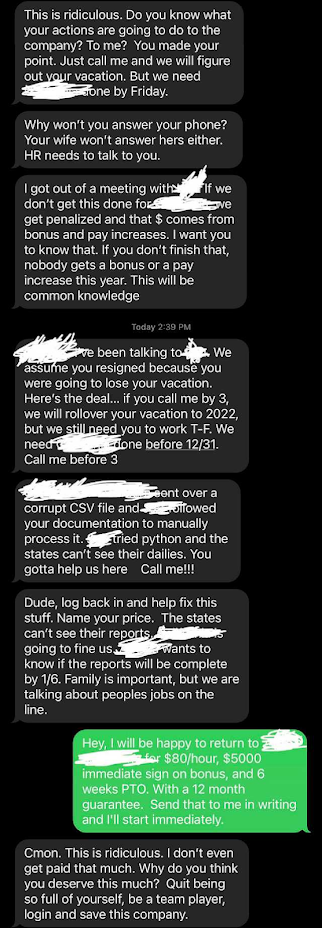
NOTE: This text thread below has been making the rounds on the internet.   Like everything else on the internet you have to wonder whether it's true or not. But even assuming it is, there are legal issues with quitting this way.  Here is a portion of it:

Rage-quitting is not always a very good idea.  And in fact, it could get you into legal trouble.

This supposed thread is making the rounds of the Internet as it encompasses everyone's rage-quit fantasy - you tell your boss to piss-off and they come crawling back begging your forgiveness and asking how much money you want to come back to work.  Nice fantasy - in reality it doesn't work out that well.

One of the married couples I learned from (as in how not to) fell into this trap.  Less than a year away from vesting his pension, the husband quit his job during a recession when the boss asked everyone to take an across-the-board 10% pay cut.  Yea, that sucks, but stick it out for that year and get vested.  Maybe then they'll give your raise back, or you can start looking for a job elsewhere.

Instead, he quit in a huff (a four-door Huff, with vinyl roof and whitewall tires) and said, "They'll call me back in a day or two - they can't run the place without me!"  Well, apparently they could.  Or more precisely, when you have an "essential employee" who tries to blackmail you this way, you are better off taking your lumps, figuring things out and moving on, than to cave in to their demands.  It's cheaper in the long run.

If the company had called him back, it would have been just long enough to get whatever project was done and to have him train his replacement and then fire him.  No respectable manager would keep someone like that around - someone with a gun pointed at your head.

In the thread above, the employee, who is some sort of computer guy preparing reports for clients to submit to regulatory agencies (sounds financial, given the fines mentioned) quits on the day after Christmas, because the company denied his previously approved Christmas vacation and told him that since he didn't "use" his vacation that year, it was "use it or lose it" and he had to come to work and lose his vacation.  Pretty shitty deal if true.  I've never heard of a company with a "use it or lose it" paid vacation policy, and I wonder whether that is even legal (It isn't in some instances in some States).  I know folks who retired from GM, Carrier, and the USPTO who had months and months of unused vacation that they took in one lump paycheck, at their highest salary.  Some folks had nearly a year of vacation saved up!  So I am skeptical of the story from the get-go.  Who would be that cruel to make someone work over Christmas and also rob them of their vacation pay?  Even Ebeneezer Scrooge gave Bob Cratchit the day off!

What is weird is that the employee saw this all going down, weeks in advance and instead of notifying his employer, waits until the last minute, and then resigns by e-mail which he sends on the day after Christmas, "so not to spoil my boss' holiday" or some such.  Pandemonium ensues as they realize that all those reports won't get done and they will face tens of thousands of dollars in fines and no one else knows how to do the reports.  The employee claims (in comments accompanying this thread online) that he previously offered to train others to do these reports but was turned down by management because "he wasn't going anywhere."  Again, I challenge the veracity of this whole thread - it sounds awfully convenient.

The problem is, I suspect this employee might be in some legal trouble, in that he is likely to get sued by his former employer.  The two big mistakes he makes are asking for ludicrous amounts of money to come back to work and agreeing to work for a client (again, this is in his comments accompanying the thread above) for a double his salary.  This starts to look like tortious interference with business practices.  Once could make the argument that the employee intentionally set out to damage his employer financially and knew such damage would occur.  Worse yet, his actions make it look like he is blackmailing his employer.  Icing on the cake is the apparent poaching of a client.

Now, the raging true-believers might argue, "He did nothing wrong!  His bosses were jerks!" and maybe they are right about that.  But the bosses will want to save face and throw the former employee under the bus and blame him for the fiasco - claiming that he knew this would happen all along (which he did) and he was merely blackmailing the company and trying to steal their clients to start his own competing business (which may be a violation of a non-compete clause).   Yes, all these things could be untrue, but you have to go to court to prove it, and the company can afford to hire lawyers and he can't.  And yea, maybe that is an injustice.  Here's news:  The world is full of injustices.

In fact, the company might be forced to sue.  If they try to file some sort of claim on their business insurance, the insurance company may insist they go after the employee first (hope he has an umbrella liability policy!).  A friend of mine went on an around-the-world cruise and her neighbor agreed to look after the house and drain the rainwater off the pool cover.  She put the pump on and left it - and the pool floated out of the ground, tearing out all the pipes and cracking the concrete.  It cost $50,000 to remove, and her insurance company wouldn't pay out until she agreed to sue the neighbor, or more precisely the neighbor's insurance company.

Whatever the motivation, the company has every incentive to sue the employee and frankly, they have a pretty good case, particularly given the paper trail the employee left behind - documented asking for staggering amounts of money as a condition of fixing the train wreck.  Maybe he would win - after spending tens of thousands of dollars in attorney's fees.  Maybe he would lose - a "jury of his peers" (retirees and unemployed people) might just think he was being greedy ("he was making how much?  I never made that much in my life!").

The client poaching thing is a real problem.  Non-compete agreements are pretty odious to be sure, and some employers try to use them to keep employees from quitting.  For example, they will say you cannot work in the same industry or a related industry within 500 miles of the office or whatever.  Such agreements are routinely seen as over-reaching by judges.  There has to be some nexus between the non-compete agreement and the scope of employment.  You can't just use them to keep people as slaves.

On the other hand, it is perfectly acceptable to have a non-compete agreement to keep an employee from going to work for you, learning all there is to learn about your business, and then quitting and opening up shop across the street and stealing away all your clients.  No Judge would find any problem with a non-compete agreement that prevented you from doing that.  And whether or not the employee in this case did so, it looks awfully bad that he talks about taking a position with the client for double-pay.

Was there a better way of doing this?  Perhaps.  He saw this train wreck coming weeks in advance - actually years, according to his comments.  He missed Christmas with his kids (he claims) for six years.  Well, not Christmas, but the week between Christmas and New Year's.  He put in his vacation request in July.  He saw the data coming in late.  He knew there would be a "crunch" to get reports out by the 31st and no one else to do it.  He could have given two weeks' notice and alerted management that he would not be around - and make arrangements ahead of time.  He could have worked that week and then quit.  There were a lot of options.

The best option, of course, is that if you have such simmering resentment for your employer - justified or not - to be searching for a job while you still have a job and then quitting.  The problem the employee has here is that even if the company hired him back, they would keep him around only long enough to train his replacement and then fire him.  The "client" who claimed they would hire him for double-pay clearly wants to avoid paying the fines to the regulatory agency and thus will swallow his salary for a few weeks (which they claim they will back-charge to his former employer).  But would you keep a guy around who rage-quits and leaves you in a bind?  I suspect they would not.

And word gets around.  Yea, I know, most companies have policies of only giving "references" that amount to the dates of employment, as they don't want to be sued for slander or libel.  But there are other channels in many industries - background chatter and cocktail talk.  I am sure that even though he redacted the names of the people and the company in the thread (again, assuming this is real and not a rage-quit fantasy) there are folks in his industry who know exactly which company and clients are involved and the name of the employee.  In fact, I am sure his former employer is keen to make everyone aware of this.

So good luck finding a job in the same industry.  Or any industry for that matter.  Who wants to hire someone who finds glee in costing your company tens if not hundreds of thousands of dollars in contract breach fees and regulatory fines?

But again, I suspect the whole thing is made-up.  The whole "Christmas Carol" theme to the thing is just too obvious ("I suppose you'll want Christmas day off again, eh Cratchit?").  Also the revenge theme is just a little too over-the-top.

Nevertheless, it is a learning tool - don't burn your bridges if you can.  Rage-quitting may be emotionally satisfying, but it could come around to bite you on the ass later on in life.  Sure, employers can be abusive.  But the best revenge is to say to your boss, "I have a job offer for more money at a better company" rather than, "from hell's heart, I stab at thee!"

UPDATE:  The original poster of the "boss rant" ("twas the night before my resignation") deleted the thread, but it was re-posted.  Either he got called out as a fake, or realized he is in hot water.  The Internet is forever, as we all learn to our dismay!

Monday, March 21, 2022

(Weak) Management by Sign or Memo

People who manage by sign are weak managers.

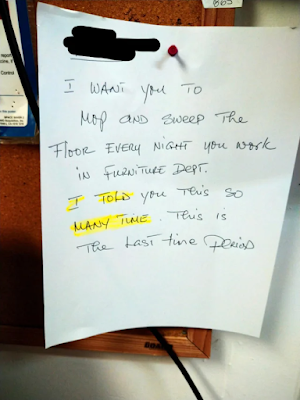
I wrote before about the popcorn memo war and how managing-by-memo is a bad idea.  If, as a manger, you have a problem with one or more employees, you look them in the eye and talk about it.  Leaving notes or memos is just passive-aggressive and no one respects that.

It also leaves a paper trail and odds are, someone will take a photo of your memo or note and post it on the Internet, where you will be mocked.

Such notes and memos are ineffective on a number of levels.  Particularly if you put "this is the last time I remind you!" or some other ultimatum and then not follow through - they've called your bluff and you are toast.  Nothing  you say will have much impact anymore.

Not only that, it creates a bad vibe among employees - and customers, if they see the signs.  I was at a restaurant the other day and there was a sign in the restroom, "No smoking or vaping in the restroom!  If you work here and I catch you vaping I WILL confiscate your vaping device!"  What was worse, was the sign was posted by the bar as well.  Now bear in mind that this restaurant has like maybe six employees total - you can't go talk to them individually or before each shift starts?  It just reeks of shitty, ineffective management.  I bet he shouts a lot, too.

Memos are no better and perhaps worse.  When you manage-by-memo you are admitting to everyone who receives the memo that you are a weak and ineffective manager who tries to avoid confrontation.  You are, in effect, hiding behind the keyboard.  It is like trolling the Internet.  Again, it leaves a bad vibe with the other employees (who feel, rightfully so, that they are being castigated for something they didn't do).  Got a problem with an employee?  Talk to them about it.  Don't broadcast your issue to the world.

In that regard, memos and signs can cause a lot of grief.  There have been reports of people writing memos, or putting up signs, or publishing in the employment agreement - or even sending a text or e-mail - saying "It is against company rules to discuss your pay with others!  You will be terminated if caught discussing pay!"

Problem is, that is illegal as hell.  So now you just handed your "problem employee" a written confirmation that you have violated the law.   It is so much better to just talk to people face-to-face, and not only that, more effective as well.  Oh, and you don't leave a paper trail.

Written communication can be misunderstood.  We've all had the situation where we responded to a text or e-mail or Facebook posting or Tweet or whatever with what we thought were witty comments or something friendly - only to be perceived the wrong way.  The recipient of the message is insulted!  How dare you make light of my grandma dying!  And then a flame war erupts.

If you work at a place where they manage-by-memo or taped-up sign, think about moving on.  Odds are, they will eventually make a sign or memo directed at you, and it won't be pleasant.  In the meantime, you will labor under this litany of post-it notes and written warnings, and it will just suck. So cut to the chase and find a place to work where the boss will at least look you in the eye and say, "You were late for work.... again!" instead of posting some half-assed sign by the time clock.