Friday, October 26, 2012

Colonizers or Colonized?


In the history of the world, countries have either been colonizers or colonized.  The United States has been both, which is why we are sometimes schizophrenic.

I was ordering some things from China the other day.  You can buy directly from China, with no middleman, through sites like eBay.   They ship by China Post, which surprisingly, gets here in about a week or so.   I bought a wireless card for $5 including shipping.  I bought a pair of biking gloves for about $7 including shipping.  They are pretty good deals.

In this election year, there is a lot of China-bashing going on.    Just as we demonized the Japanese in the 1980's, today the whipping-boy is China.

Just a recap, in case you were asleep during the 1980's or were not born yet:

Back then, the Japanese economy was strong.   Japanese car sales were starting to take off (but were nowhere near the levels they are today).  A Japanese car actually cost less than a US-made car, and people complained that their labor rates were too low and that they manipulated their currency to make their exports more competitive. (Stop me if any of this sounds familiar in terms of today's dialog).

They were also accused of "dumping" products here for below cost, to gain market share and put U.S.-makers out of business.   For example, U.S. Marine (the makers of Bayliner, Sea Ray, Mercury and Mercruiser - the GM of boats) filed an anti-dumping complaint at the ITC against Yamaha.   The complaint was dismissed after the ITC discovered that the largest customer for Yamaha power heads was, in fact, Mercury Marine, who painted them black and sold them as Mercuries.

The Japanese went on a buying binge, buying land and hotels, and golf courses, on the West Coast and in Hawaii.   They also held a lot of our national debt (and still do).   The alarms were sounded!  The
"Japs" were taking over!   Time to do something about it!

So at the GM factory where I worked, they brought in some tired old Datsun or Toyota and everyone took turns smashing it with a sledgehammer.   That will show those "Japs!" won't it?   Of course, the hundreds of man-hours lost doing this stupid stunt put us even further behind.  Today, that plant is closed, 8,000 people were laid off, and the 22-acre building is now a warehouse for Chinese-made goods.

What happened to Japan?   Well, as they became more wealthy, the Japanese worker demanded more money.   Suddenly their cost advantage evaporated.   And the Yen became strong, making exports difficult.    They alleviated this problem, somewhat, by building factories in this country.   But today, Japan is recovering from the "Lost Decade" of the 1990's, when their economy was in the shitter, while ours was roaring back to life.   Nature abhors a vacuum, and in a free-market, eventually equilibrium sets in.

Today it is the Chinese that are the bad guys.  But they really aren't "bad" so much as they want to get ahead.  And you can't blame them for that.   And there are signs that what happened to the Japanese is happening to the Chinese - and India as well.   Wages are rising, the cost of producing goods is increasing.  The vaunted advantages of manufacturing in China are eroding, slowly at first.

And of course, the bad press surrounding the working conditions and lack of pollution controls, is starting to affect U.S companies.  How long can Apple keep its image as the "good guy" in the computer business, when story after story comes out of China about the horrific working conditions in the iPhone factories?  Eventually, Apple will be shamed into doing something, and that "something" will increase labor costs.

But it struck me that we have more in common with the Chinese than we think.   Our country was founded as a colony - or series of colonies - of European nations.   The Americas were colonized by the English, French, Spanish, and Portuguese.    And Europe, for the next Century, went on a colonizing binge - subjugating and subdividing Africa, the middle-East, India, and of course China and Indonesia.

We threw off the yoke of colonialism early on, and likely this was because as descendents of Europeans ourselves, we bristled at the restrictions of being a "colony" and not self-governing.   And over time, this revolution spread - even to Europe, and of course, eventually to nearly every colony across the globe, including China.

But in the interim, of course, we ourselves got into the game - laying claim to a manifest destiny and declaring war on Spain, Mexico, the Philippines, and a number of other countries, in order to gain territories, new States, and control and influence.   We even tried to get into the China game, although the British seemed to have the Opium-Tea-Gold triangle sewn up.

There are two points of view, I think, in the United States - those who think we should be colonizers like our European Ancestors of old, and those who think, as a former Colony, we should know better.

The former are the folks who are always shouting to invade this or that country, lest the Communists get there first, or today, Al Qaeda.  And perhaps there is some merit to this philosophy.  But, like playing whack-a-mole, it is a game that never seems to end.   Today, the latest threat is a small impoverished country called Mali, where the Taliban is taking hold, and terrorizing the populace.  Tomorrow, it will likely be somewhere else.

How do our allies and enemies handle this?   In the old days, the Soviets tried to snatch up as many countries as they could, into their "sphere of influence".  The cold war was a real war.  They finally had their comeuppance in Afghanistan (a cautionary tale there) and in trying to match us, dollar for dollar, in military spending.

Today, our military spends as much money as the next ten largest militaries, combined.   And there is talk of spending even more although the Pentagon really isn't keen on the idea.

Right-wingers like to spread e-mails with fictitious pictures of "the next generation of Chinese Aircraft Carriers!"   But the reality is that China has one (1) aircraft carrier, launched in 2011, which was actually a refurbished Soviet aircraft carrier.  Some threat!

So how does China spread influence in the world?   Well, economically, not militarily.  For example, they are building highways and infrastructure in Kenya.  Unlike an invasion, the locals actually appreciate this, as it creates jobs and provides an infrastructure that allows them to advance as a people.   China is giving them a hand-up into the modern world.   We send drones with Hellfire missiles.   Which is is a better long-term strategy to win the "hearts and minds" of the people?

The real threat from China is not fictitious mega-aircraft carriers that exist only in the minds of right-wing cranks.  They don't exist, and thus are not a threat.  China is not trying to project military power very far outside its own sphere, or indeed, far from its shoreline.   The real threat from China is not the low-cost goods and low-cost labor.  Rising labor costs and a slowing economy there will even things out, over time.

No, the real threat is that while we are trucking around the world, kicking ass and taking names, the Chinese are going around making friends and helping people out.  Rather than try to colonize, they are taking the point of view of the colonized.   Who will win out in the end?   And who will go bankrupt first?

We have to decide which side we are on.  Do we want to extend the excesses of the European Colonial Era into this Century?  Or is there another way?

Thursday, October 25, 2012

Refrigerator Pie

Nothing to eat in the house?  Try refrigerator pie!


You may think this is some sweet treat - a kind of sugary pudding pie that is loaded with calories.   But it is anything but.  If you are stumped as to what to eat, consider making a refrigerator pie.

A few years ago, we belonged to a "farm share" program, which is a bunch of dirty stinking hippies growing things like Kale and Collards, which basically have no caloric value whatsoever, even if they are chock full of "viti-mens" (so is Guinness) and will make you regular as a clock.

Anyway, we ended up with a refrigerator full of this stuff - oddball vegetables and enormous root-things that looked rather scary.

Most Liberals would quietly throw it all away and claim to have eaten it.  But of course, we would have none of that.

What to do with a refrigerator full of veggies, as well as a dozen eggs from the farmer down the road (no two the same size or color?).

Hmmmm.....   Well, there's a PIE CRUST in the freezer.

And "Refrigerator Pie" was born.

Chop it all up.  Grate it.  Slice it.  Pureee it.  Toss it all in a frozen pie crust and BAKE IT.  The results will amaze you!   What looked like a bunch of junk in your refrigerator can be made into a mouth-watering meal (provided the junk in your refrigerator isn't a six-pack of diet Pepsi and a half-eaten pizza).

Dinner: Refrigerator Pie

We came up with this last year while on the farm-share program. We had so much kale and swiss chard that we didn't know what to do with it.

Take a pre-made pie crust, and bake according to instructions, then line with a small amount of shredded cheese.

Then, put whatever you have in the refrigerator in it. Rice, leftovers, vegetables chopped up, tofu, whatever you have. Add a eggs to bind it together (it will cut easier and not fall apart).

You can add a top crust to the pie, or leave it open like a quiche. It freezes easily. It is simple to prepare and provides food for multiple meals, or for company (our friends wolf it down)

Ingredients (for this pie, yours may vary):
Pie Crust (open) 1040 for shell.
Tofu: 200 calories
3 cups collards, shredded 147
chopped tomatoes and green chiles (canned) 50
pepper
chipolte pepper
four eggs 312 calories
Total calories per pie: 1749 per pie

Serving size, 1/8 pie 219 calories each. 1/4 pie, 438 calories.

Total calories for dinner: 438 (kind of low!)
(there was probably some leftover rice in there, that I forgot to count).

It was good.  Of course, we washed it down with some local Finger Lakes wine, and maybe that made it seem better.  But the smell, while it was cooking, was sublime.

To us, "refrigerator pie" means taking whatever is in the refrigerator, chopping it up, and putting it in a frozen pie crust and cooking it.   What can you use?  Any kind of vegetable, from carrots, to brocolli, to carrots, to potatoes, to onions, to kale, to collard, to whatever.  The more the merrier.  Boil some rice and throw that in, if you need some "filler".

Some leftovers from last night?  Toss 'em in.   Some hot dogs?  Slice them up!  Have some cheese?  Grate it up!  Whatever you got - throw it in.  And don't skimp on the fresh garlic, hot sauce and peppers.

And the pie will be enough to serve four people - or two people for two meals.

Our ancestors used to make pies like this.  Folks in the North of England called them "Pasties" and filled them with meat and whatever was left over from last night.  Wrapped up in a towel, they would still be warm when lunchtime came around in the fields (and if you are ever in the U.P., you will see a lot of shops selling these).  Making pies, out of "whatever" is a old and honored tradition.

It is worthwhile to keep an extra frozen pie crust in your freezer, just for this....

Compulsive Liars - And the People Who Believe Them

Some folks have the need to lie compulsively.  Just walk away from these nightmares.

Truth is beauty, and beauty truth, so says John Keats.   Why is this important in your daily life and your financial life?  Because the secret to success in this world is really no secret, nor is it very difficult.   You merely need to be able to perceive the world as it is, not as you would like it to appear to be.

So, if you see the housing market shooting up 20-30% a year, you might think one of two things.    People who want to believe sweet lies will say to themselves, "Gee, the price of homes is shooting up!  This must be a great investment!  Let's buy a home and flip it and make money!"

But if you really examine reality - on a granular level - and are not afraid of mean old reality (who is really actually value-neutral) you might come to the rational conclusion that housing was overpriced.  And if you are willing to use logic rather than emotions to analyze something as simple as housing prices, you might readily come to the conclusion that rapid increases in the price of houses is just not sustainable, for the long haul - as eventually no one can afford to live in them.

But a lot of people thought the former.  They were willing to believe bizarre stuff that had no basis in reality.  And this happens a lot in our Country - and in our world.  Human beings, it seems, are willing to suspend disbelief for periods of time.   Go to any timeshare sales seminar, and you will see what I mean.   Go to a car dealer and see some 20-something sign the lease papers on a new Scion.   People will believe anything - at least for a time.

And throughout history, entire countries - or at least large populations - have been snookered in by people willing to say anything or do anything, to get into power.  These are people who are compulisive liars - willing to spin any kind of yarn that people will listen to.  And folks believe these lies, without thinking much about them.

And we look back in retrospect and think, "Gee, those people were idiots!  They were so primitive back then!  I'm so glad we are so much more sophisticated and modern today!  We would never fall for that malarkey!  We have iPhones!"

And we say this to comfort ourselves and delude ourselves that we would "never again" fall for such obvious lies.   I mean, yea, our founding Fathers had slaves and all.  But let's face it, they also shat in a bucket and never bathed, right?   Stupid founding Fathers!  We would never do that!  We have iPhones!

And those stupid Germans!  Following a charismatic leader and believing in a governmental system than a two-year-old could see was fatally flawed!  And scapegoating the Jews - as if all their problems were caused by this one small minority group!   How could they be so dumb as to believe such lies?   Thank God, the world has learned its lesson!  Thank God we are smarter than that!   That could never happen here, of course.   We have iPhones!

Alas, the sad reality is, people believe a bundle of lies all the time - particularly when those lies tell them what they want to hear.   How do you know if someone is lying to you?   It ain't really hard to tell.  You just need to look for these few simple signs:
1.  They tell you that your problems are not your fault, but rather the fault of others.  They want you to externalize your problems onto unseen bogeymen.

2.  They tell you that you can have riches without work, that you have expensive things for free, or leisure without end.  They tell you what you want to hear - that you can get something-for-nothing.

3.  They usually want something from you.  Usually money.

Let's take a look at some classic whopper lies, and see how these Rules can be applied to alert you to the liar.

1.  The Perpetual Motion Machine:  Every so often, someone comes along with a free-energy machine, or a 100-mpg carburetor, or a compressed-air car.  And they get a lot of people to believe in these things, and usually rip off a few of them for lots of money - or rip off a lot of them for a little money.  Either way, they make money.

And if you apply the three rules above, you can easily spot the lies.   First, they tell you that the big oil companies are suppressing the invention - or the government.   Either way, the high cost of gas isn't your fault.  You could drive that Hummer to work every day for pennies, if only the free-energy machine wasn't "suppressed".

And that leads right to indicia number two:   All this free energy (and wealth) could be yours, "but for" someone getting in the way.   With your new free energy machine, you'll never pay a utility bill again!  You'll just go out the garage and feed the "Mr. Fusion" a rotted banana peel or two, and watch it hum and click and just make electricity all day long!   What a sweet life!

But that morphs right into indicia number three:  They need you to believe in the invention, buy the book, or send them money, so they can "get the word out" and stop the "government suppression" of this great idea!  So, buy shares in the company, or buy our book on Amazon!

And people buy into this, because people are idiots, look around you.


2.  Car Leasing Deals:  This scheme falls along the same lines as all other lies.   You want a shiny new car, but can't afford one.  Those mean old banks won't loan you the money - and they make the payments so high!   Never fear!   You can have that nice car after all!   Just sign these papers, and within a few hours, you will be driving that fine ride - all for a low, low price.   It is the classic something-for-nothing deal, and that right there should tip you off that it is a raw deal.

And of course, they want something from you.  They want your existing car as a "trade-in" to cover the "initial fees" and then they want your money for 36 months, at which point they take your car away and tell you that you owe them $3000 in "excess wear" charges.

But hey, that can all be folded into a new lease of course!   And yes, a lot of people were willing to suspend disbelief about car leases - and still do so today.


3. The Housing Meltdown:   We are told (by the far right wing) that the reason the housing market tanked was that all those poor people (code word for Blacks) were buying houses they could not afford through something called the "Community Reinvestment Act" which was passed in the 1990's.   How this affected the mini-mansion market is anyone's guess.    Blaming minorities, as we have seen, is always a good move for liars.

But of course, they tell us, we could have mini-mansions of our own - and not even have to pay for them!  Just sign this funny-money mortgage, which has an "optional payment" provision.   You can buy and "flip" the house in a few years, because the Real Estate Market always goes up, up, up! and there is no way you can ever lose money in Real Estate!  You will be rich without work, a Millionaire without labor - just sign these loan docs, please!

And yea, that is what they wanted all along - for you to spend your money and for them to make a commission, or to make money selling or building a house, or to make money "originating" a loan, closing on the house, doing the inspection, the appraisal, or whatever.   A whole industry of people were willing to persuade you and get you to say "Yes" to granite counter-tops.

And even today, people are unwilling to give up on this dream of Free Ponies.  They are convinced that "but for" all those Black folks buying houses under the CRA, their mini-mansion would be worth millions.

They think that nothing they do is their fault.  How could it be?  After all, they are clean-living Christian folks, and they are not culpable for any of the bad things that happen in their lives.


4. Credit Card Offers:   Those mean old banks have turned you down!   Well, never fear, the Credit Card company has a great offer!   Not only will you have a huge line of credit, but you will get free frequent flyer miles to boot!

Yes, something-for-nothing!  A free trip to Spain!  For the whole family!  All you need to do is just sign this Credit Card application.   Never mind about the 25% interest - you pay off the balance every month, right?  And those late fees, you don't have to worry about them, either.  And a $79 a year service charge is nothing compared to those free airline tickets, right?

Of course, what they want from you is your money - and they will get it, often a LOT of it.   You run up a credit card bill, can't pay it off, and that huge interest charge kicks in.   Miss one payment and penalties apply, as well as the "punishment" interest rate.

Before long, you end up paying TWICE for everything you charged on that credit card.   That $5 Big Mac costs $10 and takes a decade to pay off.


5. Cutting Taxes for the Wealthy:   This is another whopper that about half the country believes in, at the present time.   The proponents of this scheme tell you what you want to hear.   They tell you that all of your problems are not your fault, but rather the fault of "those other people" who are sucking the treasury dry and taking all of "your" tax money, and spending it all on crack.   It's not your fault you have $10,000 in credit card debt!   It is the fault of those welfare queens!

And of course, they promise they can cut your taxes, and it won't affect government spending on the programs than benefit you and it won't create any deficits or add to the national debt.   You can take one minus two and make it equal three.   We can change how basic math works, when it comes to the budget!

So people think, "Gee, this sounds swell!  All my problems will be fixed if we cut the taxes of wealthy people a few percentage points, and it won't cost me a thing!"   But of course, the people selling you this idea want something.  They want to get elected, and yea, they want your money.


You see, as a middle-class American, a lot of that money that the government spends is spent on you in the form of Social Security, Medicare, and other programs, as well as for various government programs, from the National Weather Service, to the Highway Administration.  So when we cut these programs, they cut services to you.

And the other thing is, they really aren't promising to cut your taxes much, if at all.  If you are in the 15% bracket ($70,700 a year or less, combined income) you ain't getting bubkis.   But guess who are the greatest believers in this "tax cut" stuff?  Yup.  The very poor.


* * * 

The list goes on and on, of course.    Periodically, we all fall victim to some sort of mass hysteria, where we all believe things that, just a few years later, seem ridiculous.    And in most cases, rather than learn from our mistakes we basically put them out of our minds.

For example, in 1989, there was a housing bubble.  Funny-money mortgages were proffered by unregulated "Savings and Loans" and the price of houses, in some markets, skyrockets - and then crashed.  The S&L's went bankrupt, and wiped out the savings of a lot of people (including my Sister).   We all wondered what we were thinking.  Just a few years earlier, we were all saying "gee, housing prices will keep going up! Up! UP!"

20 years later, almost to the day, the exact same thing happens, and people act all shocked.   "Who could have seen this coming?"   Well, anyone with a memory.

In the late 1990's and early 2000's, a lot of people made a lot of money (including Bain Capital) by taking companies public.  The initials "IPO" were bandied about by ordinary folks.   Some of these were the "dot com" startup companies with a few wild ideas, no assets, and huge drains of capital.   Others were old rust-belt industries, taken private and then re-bundled for resale as an IPO (the latter being Bain Capital's trademark).

The stock market was going up! Up! UP! and everyone was making money, it seemed.  But of course, it all became unraveled when people realized that a lot of these IPOs and hyped stocks were not making any money and never would.    People - little people - lost their shirts.

20 years later - again - the "dot com" people are offering IPOs in Facebook, Zynega, ZipCar, Groupon, and a host of others.   Some are profitable, some not.  But the IPO prices are easily 5-10 times their real market value.   And some folks bought in - with everything.

People never learn, it seems.   Why is this?   Because LIES SOUND SO DAMN GOOD!  They tell us what we want to hear.

Did you lose weight?  Damn, you're looking good!  Sexy! Is that a new hairstyle?   I like it!    Chances are, you just believed half the statements I just made, even though I cannot possibly "see" you through the computer and they are flat-out lies as a result.

Walk away from the compulsive liars.   Believing what you want to hear is a sure recipe for disaster.

Wednesday, October 24, 2012

United States of Mexico

You probably didn't realize this, but the real name of the country we call "Mexico" is actually "The United States of Mexico" (Estados Unidos Mexicanos).   Suppose the USA ended up like Mexico?   Or perhaps worse yet - like Brazil?  Who would be the winners and who the losers?   And are some folks gunning for this to happen - at your expense?

I had a dream the other night - more of  a nightmare, actually - that our Country had devolved into a country like Mexico.  There were a few wealthy multi-Billionaires  - less than 1% of the population - controlling most of the nation's wealth, and the rest of us were scrambling to get by on a day-to-day basis.

The GOP won the Whitehouse, and got a super-majority in both Senate and House, and pushed through a radical agenda of "reform".   Government programs were slashed to the bone - that is to say, any government program that did not send funds to Lockheed-Martin, Boeing Aerospace, United Technologies, or any one of a number of huge government defense contractors.   And of course, restrictions on lobbying were eliminated (along with the tattered remnants of campaign finance reform).

What few government agencies were left were basically handed over to the industries they were supposed to regulate.  The FCC was run by Rupert Murdoch.  The FAA by USAir.  And of course, all banking regulations and Wall Street regulations were abolished as "impeding the invisible hand of the marketplace!"

Unions were weakened to the point of extinction.  And since any form of entitlement from Medicare, to Medicaid, to Social Security, to Welfare, was either cut down drastically - or completely eliminated - people became desperate for money, and would do anything for a job.   The minimum wage was dropped back down to $4 an hour - then abolished entirely.

Of course, the new Right-Wing Supreme Court lost no time in striking down any law or regulation that would interfere in the economic marketplace.   Bosses were now free to sexually harass their secretaries, discriminate on the basis of gender or race, and do pretty much whatever they wanted to.

New voting regulations, of course, made it harder to even go to the polls.   You needed three forms of ID to vote, and two of them are only available from government agencies open on Wednesdays from 9-11AM and 2-4PM.  Bring a magazine, I hear the line is two hours long.   But of course, since you can't afford to lose your $3.50 an hour job a Wal-Mart, you aren't about to ask your boss for time off, are you?

Of course, it is a good time to be rich - fabulously rich.   If you are born into wealth, you have it made.   You will go to the best schools and get good grades of course (your Dad donated the new History building).  And you'll have your own helicopter - a graduation gift from your parents.   That is to say, a High School graduation gift.

And you'll be used to having servants, of course - and abusing them in any way imaginable.  Since you are spoiled rotten from day one, you think nothing of ruining the lives of a gardener or butler or raping the upstairs maid.   What are they going to do about it, complain?    You'll have them out on the streets and living in one of those cardboard-box ghettos you fly over in your helicopter on the way to the country club!   "How do people live like that?" you think, as you fly over.  Why don't they try to improve themselves!  If only they would pull themselves up by their bootstraps like you did!

Yes, life is sweet, if you are rich, and the rest of the world is desperate.   You can do what you want, manipulate people, and get away with murder - quite literally, if you are inclined that way.

It is not like those bad old days your Dad and Granddad told you about - back when accumulating dynastic wealth was harder to do.  They actually taxed your income, if you can believe that!   And poor people were given a "safety net" of benefits, so that if they could not find a job, they could live in some dignity.   It was a horrible system, your Dad told you - after all, if the poor can make money without working, why on earth would they put up with being abused at work!   According to Grandpa, back then, you had to be nice to your employees.   Strange but true!

You are glad you are born in the era you are in.   You have the world by the string - endless dynastic wealth that will never dissipate over time, even if you do nothing but spend it all day.   And legions of desperate humans who will do your bidding - as if they were slaves.   They will scramble just to get sufficient caloric intake for the day.  Life is sweet!

But of course, for the upstairs maid you just fired (for having the audacity for complaining about that rape thing - sheesh!) life is a different story.  She now can't get a job -anywhere - thanks to your "black-balling" her.  She lives in one of those cardboard-box ghettos, and watches your helicopter fly overhead every day.   She searches the dump for scraps of food.  Sometimes she finds bits of leftovers from your banquets, that your servants and the other scavengers missed.  She can only hope to get enough calories in the day to stay alive, before the inevitable illness and lack of medical care kill her.

* * *

OK, sounds like a pretty fantastic dream, right?  I mean, that is a pure exaggeration - that could never happen anywhere in the world today, right?    Well, not exactly.   It does describe life for a lot of people in places like Haiti, Brazil, and other third-world countries, where a very, very few live ultra-rich lives, and the great masses live like desperate animals.  Um, Africa, parts of Asia.  Well, all of China.  Indonesia, much of the Balkans.  Many Arab countries too.   Come to think of it, most of the world lives in abject poverty, compared to how we have it.   For about half the planet, scrambling to just survive another day is their main goal in life.

I've been to such places - where the well-to-do live in walled compounds (like in Mexico) and often obtain their riches through financial machinations, bribery, corruption, or various criminal enterprises.   But of course, they are just "free market capitalists" - and bribery is the end result of an utterly free market, right?

Well, OK, you say, maybe that sort of thing happens in South America or impoverished island nations - or perhaps in Africa.  Or Indonesia.  Or, well, actually in about half the world, right?  But it will never happen here - this is the United States of America!

All I can say is, I hope you're right.   But if you look at countries that were run like that - such as a the Philippines, they relied on a scrambling middle class, that they could play off against the underclass, to stay in power.  They dangled out the carrot of promised riches which never quite materialized, except for the very few, on the premise that they step on the face of the person below them in the economic chain, to get ahead.  They told the middle class, "Your problems are not with us, the very rich - we are like you!  No, your problems are the very poor, who are dragging you down!  Turn on them, and be like us!"  And people believe it.

If you are wealthy, it pays for poor people to be desperate.  They will do your bidding that much more easily.   And one has to wonder, with all this talk about cutting Social Security, Medicare, and other programs that help the poor and the middle-class, if there isn't some sort of overall design to this.   After all, if we can keep people desperate and hungry, they are far easier to manipulate and abuse.

And that would be a swell world to live in, if you were very, very rich.   But for most folks, it would be (and is) a nightmare.

How Big is the Deficit? How Big the National Debt?

What is the deficit and the national debt?  Are they as huge as people say?  Is this really another "crises"?  Or like most government "crises" is it just politicians trying to get everyone alarmed, in order to get elected?

There is a lot of talk this election year - and rightfully so - about the deficit and national debt.   A lot of people don't understand the difference between the two, even as they have strong opinions about the matter.

(In fact, some people don't even know what a Billion is (a thousand million) or a Trillion (a thousand Billion) and come up with all sorts of cooked numbers when discussing this issue.   A common trick is to count a Billion as a million million which of course throws everything off by a factor of 1,000).

The deficit, of course, is how much more the government is spending than it is taking in, in revenues.   The national debt is the accumulated debt as a result of this deficit spending.

Why do we have budget deficits and a national debt?   The first is a result of both increased spending and decreased income.   In good times, people make more money and the government collects more taxes.  During the Clinton years, we had budget surpluses (but did not pay off the national debt, of course) because the economy was doing well - so the IRS collected more money.  Tax rates, on the very wealthy, were higher then as well.

During the Bush administration, these surpluses evaporated.  Part of this was due to the two wars we were fighting, as well as the massive amounts of money thrown at "homeland security".   And part of this was just spending on all sorts of projects, which Congress just couldn't control, and the White House did not make a priority.   And also part of this was due to the Bush Era Tax Cuts which cut revenues at a time when spending was higher.

In the last four years, things have gone from bad to worse, in terms of budget deficits and the overall national debt.   Income is down, because of the recession.  People make less money, so they pay less to the IRS.  The Bush Era Tax Cuts have not helped any - and some say that eliminating these would eliminate or reduce the defict.   Increased spending, in the form of unemployment benefits as well as other benefits to the poor (of which there are more, because we are in recession) haven't helped, of course.

And stimulus spending adds to the balance as well - although some economists would argue that such stimulus results in a faster economic recovery, and thus will lead to improved revenues down the road.  Think of this in business terms.  If you want to make money running a business, sometimes you have to borrow money from the bank to invest in new machinery and technology.   When you borrow this money, it often means your business balance sheet doesn't look as good the next day.   But down the road, once you start making more money from this investment, you can pay back the loan and then some.

That's the theory, anyway.

But what are the actual amounts of the deficit and the national debt, and should we be concerned about them?   What have these deficits been like, historically?  Let's take a look.

How much is the deficit?
The Congressional Budget Office predicts the deficit for the full year, which ends on Sept. 30, will total $1.17 trillion. That would be a slight improvement from the $1.3 trillion deficit recorded in 2011, but still greater than any deficit before Obama took office.
One positive sign this year is the deficit is growing more slowly than last year.
That data, of course, is outdated.   This spreadsheet from the Office of Management and Budget, shows more up-to-date numbers.   During the Bush years, the deficit went from surplus to a high of about a half-trillion a year.   Since the recession, this has ballooned into about 1.2 trillion.

The GOP is right that the deficit has ballooned over the last four years.   But with reduced revenues, extension of the Bush tax cuts for the wealthy, and a crappy economy, could this really have been avoided entirely?   I think not.  Even with deficit hawks in the White House and Congress (good luck with that, the GOP is as pork-barrel as the Democrats are) they might have been able to reduce to this to say, maybe 1 trillion even.  And then, only at the expense of a slower and more agonizing recovery.

So, much is the national debt?
At the end of September 2012, debt held by the public was approximately $11.311 trillion or about 72% of GDP. Intra-governmental holdings stood at $4.848 trillion, giving a combined total public debt of $16.159 trillion.  As of July 2012, $5.3 trillion or approximately 48% of the debt held by the public was owned by foreign investors, the largest of which were China and Japan at just over $1.1 trillion each.
Are these numbers to be concerned about?

This chart illustrates the national debt, over time, as a percentage of Gross Domestic Product:


As you can see, as a percentage of GDP, our national debt is not really as scary as $16 Trillion sounds.  In fact, it is really right in line with what you would expect during a recession, and compared to the last few decades.

The GOP, of course, prefers to look at the debt in terms of actual dollar amounts, as opposed to percentage of GDP, as it makes for scarier charts, and it is, after all, nearly Halloween.   But of course, a dollar today is worth far less than a dollar in 1945, and that is one reason why the comparison to GDP is often more illuminating.

And of course, the ratio to GDP will drop dramatically once the GDP increases - as we recover from recession.

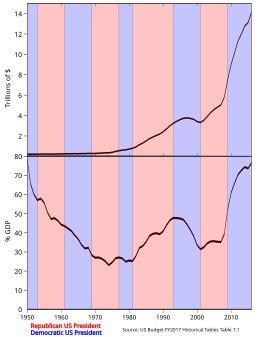
This chart illustrates the amount of the National Debt, both in % of GDP and in dollar amounts.  For some reason, the chart is overlaid by who is President (like that makes a difference, Congress passes budgets, not Presidents!):

As you can see the upper chart, in dollars, is far more alarming than the lower one.   Democrats use the lower chart, Republicans the upper one, to make their points.   As for the national debt growing or receding based on who is in the White House, I see no pattern here, nor a causal relationship.   Congress passes budgets, not the President.

Another way to look at the debt is by dividing it up by the number of people in our country.   We are a nation of about 330 million people (about 1/3 Billion) depending on whose numbers you use.   And that right there is one thing to take into account when looking at these numbers.   We are a huge country, in terms of size, population size, wealth, and economic power.  We are the largest economy in the world.

So you have to take that into consideration when looking at numbers like this.   An annual budget deficit of 1.3 Trillion dollars sounds like a lot of money, but it works out to about $3900 per citizen in this country.  Yes, that is a lot of money we have to somehow make up, over time.

The national debt, at $16 trillion, comes to about $53,000 per citizen, or a hefty mortgage on each of us.   But like any mortgage, it doesn't have to be paid off all at once, but over time.  And like with the GDP ratio, one way to reduce the amount of debt per citizen is to increase the number of citizens.   As the population increases, these amounts per person could go down.  Growth is ultimately the best way out of recession, not cutting back.
 
As I look at our debt, from the charts above, I come to some interesting conclusions:
1.  Our nation has been in debt pretty much since its inception.

2.  We very rarely have "paid down" the debt by very much, since WW II, except briefly in the Clinton years.
3.  Decreasing the deficit, in the past, was accomplished by increasing revenues, not by cutting spending.  Spending, historically, has always gone upSee the OMB Spreadsheet.   The idea that we can "cut spending" is nonsense - at best, we can arrest its growth rate, somewhat.
4.  Our National Debt, while large, is financed at some of the lowest interest rates in history.
5.   Over time, our country outgrows its debt, as our economy grows and as inflation eats into it.
Thus, the idea of us "paying back" the entire national debt is probably a fantasy and will never happen in our lifetimes.  What will happen, of course, is that as our economy recovers, the size of the debt, as compared to GDP, will shrink, and people will worry less about it.

A note about interest rates:   The last time the "national debt" was a huge political issue (as opposed to a general, every-four-years issue) was in 1980.  Back then, our debt was a lot less, but thanks to high interest rates, the amount we spend servicing the debt had ballooned.   A lot of our debt today is financed on long-term treasury notes that have fairly low interest rates extending out over 10, 20, or even 30 years.  We are in better shape than in 1980, in this regard.

A note about "Debt Clocks":  In researching this article, I found a lot of sites, mostly right-wing, with various "debt clocks".  One site has about 50 of these various clocks, which are all spinning in an alarming manner, which induces a kind of panic in the viewer.  These are less than illuminating, as spinning numbers are just dramatic, and not really useful for mathematical analysis.   And often these "debt clock sites" take things like "all unfunded liabilities" (which I guess would include all medicare and Social Security, potentially paid out from now until 2065) and then make the argument that our "total liabilities" are well over $100 Trillion Dollars !!!! (with lots of exclamation points!!!)  But these sort of specious calculations and spinning numbers prove little or nothing.   But they do make an emotional hook into the viewer, as they induce a sense of anxiety and panic in the viewer.  No wonder the "debt clock" was the centerpiece of the GOP convention.   Again, when someone tries to sell you fear they are selling you a wagon-load of horseshit, whether it is "buy a house now, before you get priced out of the market!" or "The debt will explode if you don't elect me!"

But what about all those foreigners who are holding our debt notes?   Romney and the GOP make a big issue of this - that the Chinese are "holding a trillion dollars of our debt" - as if they are going to foreclose on us, and repossess Air Force One.   But of course, it isn't quite like that.   Anyone can buy U.S. Government debt instruments.  You can go online right now and buy T-bills or bonds, as I have written about before.   They are a pretty crappy investment, right now.

So is this something to worry about?  All those Chinese holding our low-interest-rate notes?  I think not, and for several reasons:
First, we can't limit who buys our debt.  It isn't practical to do that.
Second, allowing overseas investors to buy our debt brings down the interest rates on our debt.  
Third, holding our debt instruments doesn't mean the Chinese (or anyone else) can "foreclose" on the USA or repossess it, or that they have some sort of hold over us.   I own a t-bill, it gives me no special rights, believe me.
Fourth - and most importantly - the reason so many foreigners are holding our debt notes is that it is considered to be one of the safest investments on the globe, even if it pays bubkis in interest.   And that should tell you a lot, right there.   While the GOP doesn't have confidence in our country, the rest of the world does.
So why does the GOP make a big deal about "China holding $1 Trillion of our debt?"    Well, it sounds scary to the plebes.  Selling fear, yet again!    They talk as though we are  enriching them with a 2% rate of return or something.   It is a bullshit argument, and when someone makes a bullshit argument, well, you know where things are headed.  They are lying to you - for a reason.

So, does this mean we should not be concerned about the deficit or the national debt?   Of course not.  It is an important issue - but you have to separate fact from fiction and scare stories from actual truth.   And this being an election year, it is easy to spread scare stories about the debt - every party does it, every four years.

Believe it or not, Obama ran on this issue as well, pointing out how Bush increased the deficit and the national debt.  And of course, Republicans, at the time, said, "Well, we had two wars going on!  A war on terror!  We had to spend the money!"   But some would argue that $1.9 Trillion of that money went to the wrong war - invading Iraq, instead of Afghanistan.   And now there is talk of attacking Iran.   Who knows?   Maybe it was worth it - maybe the "Arab Spring" uprisings would not have taken place, if not for the Iraq war.   Or maybe they would have, and Saddam would have been overthrown anyway.   You can't unbark the dog.

I think the fantasy the GOP is selling is that we can actually decrease the budget over time, and thus spend less (except on defense of course!  We need to increase that!) while lowering taxes and decreasing the deficit and actually paying down the national debt.   That last item is a real whopper, if you look at the charts above.   Only during the Clinton years did we ever do that, and even then, by a trivial amount.

I think a better goal is to continue to reduce deficits over time, as the economy recovers, by keeping spending increases in check, and by increasing revenues by allowing the Bush Tax Cuts for his Wealthy Buddies to expire.  We got along just fine in the Clinton years, with the old tax rates - we can do it again.  It just means that Muffy can't have a new helicopter for her Sweet-16 party.

As for the National Debt, the best we can do (and should do) in the next decade, is to arrest its rate of growth.   Paying it down is an infantile fantasy - and a basic LIE, used to get the plebes all riled up for the election.

And that is the whole point, really - to get elected.   We will recover from this recession, come hell or high water.   The USA is not having a "going out of business sale" anytime soon.   And as the economy recovers and the government's income increases, we will see these deficits shrink and the ratio of the national debt to GDP decrease.   And whoever is in the White House when this happens, will claim credit for it and say it was their idea.

So, now you understand why Romney isn't more specific about his plans.   He needn't be.  Why box yourself in by promising anything more specific than cutting funding for PBS?    If you say you will do X, then your opponent will call you out on it, in four years, if you don't - just as Romney is going through everything Obama said and criticizing him for not following through (why Obama decided not to lower unemployment rates is beyond me!  If I were President, I would select a lower rate - as well as lower gas prices.  I mean, it is a no-brainer, right?  Sheesh!).

So the real race here is the race for who gets credit for the inevitable recovery.   And if Obama does it, he will be lauded as a visionary.  And if Romney does it, he will get credit for his "financial acumen".   But in either case, there are greater forces at work than the actions of an individual President, whose powers are really limited, in terms of what they can accomplish, with a balky Congress to deal with.